Showing posts with label Mark Ruffalo. Show all posts

Wednesday, February 11, 2026

A tasty heist movie set in LA


Chris Hemsworth sheds Thor's hammer, and Halle Berry gives one of her best performances in the new heist thriller, Crime 101. In adapting a 2021 novella by Don Winslow, director Bart Layton delivers a throwback caper movie that knows its business and pretty much sticks to it.
   Set in present-day Los Angeles, Crime 101 centers on Mike Davis (Hemsworth), an accomplished diamond thief who targets jewelry stores positioned along the 101. The freeway provides a convenient escape route for Mike's meticulously planned robberies.
   Like many thieves, Mike is looking for the final heist that will allow him to start a new life -- albeit with a fortune at his disposal.
    Of course, someone stands in Mike's way.  Mark Ruffalo plays Lou, the rumpled but good-humored detective who's more interested in catching the man he dubs "The 101 Thief" than in keeping his bosses happy.
     Layton weaves others into his LA tapestry. Berry's Sharon sells insurance to high rollers who fear the loss of their big-ticket belongings, not all of them legally acquired. Barry Keoghan arrives as Ormon, a scary loose cannon motorcyclist who becomes a threat to Davis. 
     In a small role, Nick Nolte adds flavor as Money, the gravel-voiced guy who finances Mike's efforts and ushered him into the crime.
      Layton seasons the screenplay with a few side issues. At 53, Berry's Sharon is supposedly losing the eye-candy glow that helped her sell insurance. That's probably why her male-dominated firm has been dragging its feet on a long-promised partnership.
     Sexism makes for a trendy issue that Layton allows Berry to forcefully denounce, but the movie doesn't climb on a soapbox, and Layton efficiently introduces the elements necessary to keep the plot flowing. He also  includes shots of LA's homeless to remind us that the city's glamor isn't all-inclusive.
     Mike's strictly business approach is challenged when he meets an attractive young woman (Monica Barbaro). He begins to feel an attachment, not a good thing in the thieves' trade. 
    Hemsworth has a steady hold on the role of a criminal who can't totally bury his humanity. Mike carries a gun but never uses it. He has never hurt anyone during his work. He's a thief who tries to be decent about it.
     A complicated screenplay slowly pulls the various characters into the same story, which includes several well-designed, stomach-tightening car chases and a cameo appearance by Jennifer Jason Leigh. Leigh plays a woman who's dumping Lou, mostly because guys like Lou don't have happy home lives.
     You may find plot holes along the way, the movie needn't have extended to 145 minutes, and its LA gloss can feel vaguely familiar. But Layton's screenplay teases us with a nice collection of conflicting rooting interests, and its characters are interesting enough to keep Crime 101 on track. Nice job.


Wednesday, January 28, 2026

A boy's time travel adventure


French illustrator Ugo Bienvenu's Arco tells an  environmentally conscious story that follows 10-year-old Arco through a time-travel trip. Arco leaves a calm, futuristic world, heading backward into a more turbulent 2075. The story follows a basic adventure arc: Arco (Juliano Krue Valdi) has yet to turn 12, the age at which time travel is allowed. Sensing he may have gotten more than he bargained for, Arco tries to return home. Once he arrives in the past, Arco meets Iris (Romy Fay), a girl who becomes his companion and helpmate. Natalie Portman, one of the movie's producers, Mark Ruffalo, and Will Ferrell provide additional voice work, but the movie's real star is Bienvenu, whose imaginative creations include bubble shields that protect the suburban neighborhoods of 2075 from toxic fumes and raging fires. Iris's parents are so busy working, they rely on holographic figures to interact with their kids. A robot named Mikki handles the family's parenting chores. Despite environmental threats, Arco's overall mood lacks the caustic sting of many futuristic adventures. Nominated for an Oscar in the animated-feature category, the film -- Bienvenu's first -- layers emotion into the relationship between Arco and Iris, which anchors the story in the language of more conventional animated efforts. Still, a high level of craftsmanship bolsters Bienvenu's efforts, adding plenty of artistic uplift.


Monday, March 10, 2025

'Mickey 17' fails to stick a landing


    Korean director Bong Joon Ho finds his way to Hollywood for Mickey 17,  a teeming, cockeyed adaptation of a novel by Edward Ashton. Ashton titled his novel Mickey7
    I don't know whether Bong has upped the ante by adding more Mickeys. I haven’t read Ashton’s book. I did, however, approach Mickey 17 with high hopes. Bong, after all, has directed some of my favorite movies. The list includes The Host (2006), Snowpiercer (2013), and Okja (2017). He also directed Parasite (2019), which won him best-picture and best director Oscars.
   Given my expectations, I’d say Mickey 17 registers as a disappointment. Although the movie can be funny and audacious, its many tonal shifts (from serious sci-fi to blatant slapstick to broadly expressed satire) never cohere into a satisfying whole.
   Bong again deals with class divisions and the human tendency to destroy anything regarded as alien, but Mickey 17 lacks the controlled brilliance with which Parasite vaulted over the top.
   The casting  features a variety of acting styles. A groggy- looking Robert Pattinson plays Mickey, a desperate young man who signs on for a space voyage to escape a vindictive loan shark on Earth. 
   Aboard the ship, Mickey becomes a human guinea pig, a so-called “Expendable.” He’s exposed to lethally extreme conditions so that the vessel’s scientists can develop vaccines to protect the crew when the ship concludes its four-and-a-half year journey to the distant planet of Niflheim, which evidently lacks an atmosphere conducive to human life.
   Thanks to advances in cloning, Mickey's body is replicated after each of his deaths, but Mickey isn’t entirely obliterated. A memory storage brick allows the proliferating Mickeys to retain the same basic identity. Mickey remembers his many deaths.
   As the story's dystopian future unfolds, Mickey 17 survives one of his dangerous forays, a situation that prompts the authorities — who think he has died — to print another Mickey. Also played by Pattinson, he's Mickey 18. Bold and crass, Mickey 18 —known as a “Multiple” -- begins to figure into an already crowded plot.
   Two women enter Mickey’s life. Naomi Ackie plays Nasha, a security officer on the ship who falls for this schlub of an everyman. Anamaria Vartolomei portrays Kai, a woman rising in the ship’s rigid hierarchy. 
   Kenneth Marshall (Mark Ruffalo in a clownish hunk of exaggerated performing) presides over the ship with his devious wife Yilfa (Toni Collette). A former congressman, Marshall is followed by enthusiasts who wear red hats. (Draw your own conclusions.)
   Steven Yeun plays Timo, the guy who got poor Mickey into the trouble that caused both of them to flee Earth. In space, the shrewd Timo fares better than Mickey. He becomes a pilot.
   When the ship reaches the snowy planet of Niflheifm, the crew encounters Creepers, creatures that look like a cross between insects and armadillos. Fascistic and racist, Commander Marshall wants to kill the planet’s inhabitants and seize it for those humans he deems as genetically superior.
   All of this builds toward an epic battle in which the two Mickeys try to save Zoko, a baby Creeper that has been kidnapped by Marshall. What worse crime could occur than threatening to drop a wiggling hunk of Creeper cuteness into a flaming shipboard incinerator?
    A messy overreach of a movie, Mickey 17 may not satisfy sci-fi fans or those looking for satirical rigor. Thematically, Mickey 17 digs no deeper than the average Star Trek episode.
    Sure, Bong’s darkly hued comic inclinations ensure that parts of the movie succeed and some of its images compel, but, for me, Mickey 17 emerged as an intermittently amusing smorgasbord of scenes rather than the masterful directorial performance I expected.


Wednesday, December 6, 2023

'Poor Things:' Strange and lavishly creative


 What the hell is director Yorgos Lanthimos's Poor Things about?  If you know Lanthimos's work (Dogtooth, The Lobster, The Killing of the Sacred Deer, and The Favourite), you know the question is relevant because Lanthimos's movies tend to be odd, alluring and unsettling.
  Cineastes have tagged Lanthimos,  as part of the Greek Weird Wave, perhaps an appropriate designation.
    So, before we go further, let's clarify. Based on a 1992 novel by the late Alasdair Gray, Poor Things deals with the ways in which Victorian society tried but failed to repress female sexuality. The movie also draws creative fuel from the alarming dangers of scientific thinking that blanches emotion from decision-making, in this case the objectivity that produces new species and fiddles with old ones.
     Lanthimos creates a film that can evoke the work of Terry Gilliam and David Lynch. But Poor Things stands as Lanthimos's singular creation, a whacked-out visual cornucopia from which a coming-of-age tale topples.
    The story in a nutshell: Taking a novelistic approach, Lanthimos begins with a Frankenstein-like fantasy. Dr. Godwin Baxter (Willem Dafoe) extracts an infant's brain from the body of a pregnant woman who committed suicide by leaping off a bridge. Said brain is then transplanted into the body of the woman who jumped to her death. The body is reanimated.
   Baxter's creation -- called Bella Baxter and played by Emma Stone -- refers to her creator as God, a telling abbreviation of the doctor’s first name. A badly scarred face makes Dr. Baxter look like he might have been sewn together by a mad seamstress.
   Needing an assistant to chronicle his work with Bella, Baxter recruits one of his students (Ramy Youssef) to chart Bella's development. Youssef's Max McCandless soon becomes Bella's betrothed. 
   But wait. Dissatisfied with the cloistered existence Baxter imposes on her, Bella runs off with Duncan Wedderburn (Mark Ruffalo), a happily debauched fellow whose intentions are blatantly dishonorable. 
     To dwell on more of the plot would turn this review into a novel.  Lanthimos tales two hours and 21 minutes to watch Bella learn about the world's pleasures (pastries and sex) and its evils (exploitation and cruelty).  
        To give you an idea about Bella's introduction to sexual pleasure, note this: It features a masturbatory scene involving apples. I'll say no more. Bella refers to intercourse as "furious jumping." She approaches sexual exploration with vigor. Neither guilt nor shame shackle Bella's libido.
       Lanthimos divides the movie into sections that revolve around Bella's adventures with Wedderburn, a visit to Alexandria, a stint in a Paris house of ill repute, and a return to London where the story reaches its conclusion, which proves as strange as all that preceded it.
        For the movie to work, Stone had to commit to a role that required her to speak in a stilted (often funny style), appear nude, and emerge herself in the transformation from a naive innocent to a fully realized woman.  It's one hell of a performance and it's matched by the work of Ruffalo and Dafoe, not to mention a cast of supporting actors that incudes Jerrod Carmichael, Kathryn Hunter, and Hanna Schygulla.
        It falls to Youssef to portray the film's good-hearted innocent. Even a bizarre story needs some kind of anchor.
       Lanthimos has a made a movie in which the cinematography (in black-and-white and color), the production design (fantastical), the costumes (particularly Bella's dresses) can be delightful, ominous, and even a bit repulsive. 
          Perhaps he employs one too many fish-eye lenses and the movie could have been shorter, but nearly every frame offers something for the eye to investigate. Godwin's genetic mutations appear like props. They include chicken dogs, for example. A steam-driven carriage moves through the streets of London with a severed horses head attached. 
      I took them as visual jokes, the absurd consequences of scientific experimentation and hubris.
     Screenwriter Tony McNamara deserves credit for wrestling Gray's novel into a movie that Lanthimos fills with visual invention, twisted wit, and bizarre surprises. 
        

Thursday, March 10, 2022

He brings quips on his time-travel trip


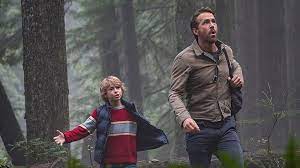
     Hints of Back to the Future waft through The Adam Project, a story in which a time traveler meets his younger self and tries to spare humanity from the oppressive future in which the movie begins.
     Working from a screenplay credited to four writers,  director Shawn Levy (Free Guy and Night at the Museum: Battle of the Smithsonian) does his best to freshen a formula that relies heavily on Ryan Reynolds's already established ability to be charmingly snide. 
       The well-received Free Guy (not by me) paves the way for  a  Levy/Reynolds collaboration that lacks the intricate maneuvers of the first movie but probably will please some fans. 
       Me? I’m lukewarm.
     Levy tries to give his movie a satisfying emotional core; i.e., a sentimental conclusion with wholesome messages attached, one strengthened by the presence of Mark Ruffalo as Adam’s father, a physicist who assures his son that he really did love him.
       Forgive the past tense here. Blame time travel.
       A strong cast that also includes Jennifer Garner, Zoe Saldana, and Catherine Keener adds appeal to a movie that employs action and special effects to show Reynolds's Adam Reed stealing a spaceship in 2050, plunging through a worm hole, and landing in 2022, the year in which he was 12. 
    Walker Scobell portrays young Adam, a quick-witted kid who's bullied at school. He may not be furious with his fists but he's seldom at a loss for words, a quality that sets up lots of verbal byplay between the two Adams.
      In 2022, young Adam is ensconced in middle school. He lives with his recently widowed mom (Garner). She’s confused about how to deal with a kid who can't always avoid trouble.  
     So why is the adult Adam racing through time? He wants to find his wife (Saldana) to alter a future in which she will fall prey to an evil corporate titan (Keener) who’s up to no good no matter what period in which she lands.
    Amid the somewhat generic action, Levy delivers bromides  about mother/son love and father/son reconciliation, not to mention the way lovers are destined to find each other in whatever time they live.
     The supporting cast helps elevate the proceedings, which lean heavily on Reynolds's ability to be the cynical guy who eventually learns that a heartfelt statement can be better than a quip. 
      No point, delving into plot mechanics. Know, though, that some of the interchanges between the two Adams are amusing and the movie establishes itself as amiably familiar, which -- I guess -- is better than stunningly awful.
     Or, as the clerk at the DMV shouted to the long line of license seekers, “Next.”

Tuesday, November 26, 2019

A lawyer takes on a major corporation

Mark Ruffalo stars in Dark Waters, a movie that uses a deliberate approach in creating a drama of betrayed trust.

Making a movie about a complex legal case that spanned 17 years can't be easy. Director Todd Haynes and star Mark Ruffalo accomplish the daunting task in Dark Waters, the story of an Ohio attorney who takes on DuPont, one of the world's leading chemical companies.

Ruffalo portrays Rob Bilott, a Cincinnati-based attorney who specializes in defending companies like DuPont. After some initial foot-dragging, Bilott agrees to represent a West Virginia farmer (Bill Camp) whose cattle are being poisoned by toxic waste that has been dumped near his acreage. Bilott's target: DuPont.

Those familiar with Haynes' work (Wonderstruck, Carol, Far From Heaven) know that he can be as much stylist as a storyteller. But here, Haynes works in an unassuming fashion. He's wise enough to know that a story that impacts so many people needs little embellishment.

Dark Waters moves beyond the plight of a single farmer to encompass the drinking water of an entire town. The chemical in question also was used in Teflon, a non-stick coating familiar to most Americans.

Early on, we meet the head of Bilott's law firm. Tim Robbins portrays an attorney who eventually buys into Bilott's mission, a stance that doesn't please all the partners. Some of them view Bilott as a traitor who's biting the hands that feed the firm.

And Tim's wife ( Anne Hathaway impressive in a smallish role) isn't blindly supportive; she resents the fact that the case takes Bilott away from his children.

Among the supporting cast, Victor Garber also stands out as the head of DuPont. Initially cordial, Garber's character turns vicious when his company's interests are threatened.

But it's Ruffalo who carries the movie; he creates a portrait of an attorney who couldn't be less slick. As a church-going ordinary guy, Bilott feels no need to put self-righteousness on display.

Bilott's case against DuPont involves the use of a chemical called PFOA. It takes lots of heavy research to discover what the chemical is and how it has been used. Persistence trumps genius-level legal maneuvers.

You might say that everyone involved with the production -- from cinematographer Ed Lachman to Haynes -- serves a story that rightly has been compared to movies such as Norma Rae, Erin Brokovich and The Insider.

That's not to say that Dark Waters lacks atmosphere. The movie makes its case while capturing the bleak environs of a failing West Virginia farm and the grayness of Midwestern environments that have seen better days.

Basing the movie on a 2016 article that appeared in The New York Times Magazine, screenwriters Mario Correa and Matthew Michael Carnahan do a fine job capitalizing on the inherent drama of a tale involving betrayed trust.

The film reinforces a sobering conclusion: In the end, we can't rely on the government or on corporations for protection. We have to hope that people such as Bilott will take on fights that initially look futile.

Don't expect an explosive movie. Dark Waters gradually insinuates itself into consciousness in ways that make you shudder; it presents a clear case of a company that put its own interests ahead of the general good.

Wednesday, April 24, 2019

'Endgame' delivers what fans expect

It takes three hours for this Marvel Comics series to reach its conclusion, but the movie mostly succeeds..

Watching Avengers: Endgame —- the last chapter in what seemed an endless series of movies that kicked off in 2008 with Iron Man — another title kept running through my head, Raymond Chandler’s The Long Goodbye. It’s not that Chandler’s 1953 novel, made into a fine movie by director Robert Altman, resembles this Marvel Comics extravaganza in any way. It’s simply the title. At three hours in length, Marvel takes its time bringing this long-running series to a close. Judging by Endgame's sometimes melancholy tone, Marvel itself had a difficult time letting go.

Before we continue, I should tell you that this isn’t the end of Marvel comic movies or of every character who has graced the Avengers series. And, no, I’m not going to dwell on plot, partly because critics have been cautioned about including spoilers and partly because I’m not sure that the plot and its various twists make much difference. The general outline of the story already has been drawn; the last installment —- Infinity War —- pitted the Avengers against Thanos (James Brolin}, a super-villain. Even before the beginning of Endgame, Thanos had wiped out half of the universe's population.

This edition includes a robust cast of characters from the Marvel Universe, so many that all but the most avid Marvel fan would be wise to attend the movie with a scorecard. But if character development doesn’t entirely surpass action in Endgame, it at least stands on equal footing. There’s also a fair amount of humor in the work of directors Anthony and Joe Russo, the brothers who brought us 2018’s Infinity War.

About the movie's humor: Reviewers will mention it for good reason. Endgame doesn’t skimp on humor, much of it self-referential, some of it simply amusing. But this doesn’t mean you’ll be falling out of your seat; it does mean that the filmmakers understand that a three-hour journey can’t be made unless it provides a few laughs.

Endgame stands as a sequel to Infinity War although you probably needn’t have seen that movie to follow this one. Still, if you’re not plugged into the Marvel universe, I see no reason to start now. And, yes, I’m wary of movies that have helped turn popular entertainment into a comic-book-based smorgasbord. I’m also aware that there’s little point railing against an already-established victory. As far as the box office is concerned, these movies represent a Hollywood Olympus that most viewers are happy to revisit with a frequency that has enriched much of Marvel's empire.

As for Endgame, I’ll give you a few of the high points. First, Robert Downey Jr., whose work as Tony Stark, a.k.a. Iron Man, ignited the Avenger's flame. A distressed-looking Stark is seen early in Endgame; he’s on a space ship floating through the outer reaches of space or as he puts it, a thousand light years from the nearest 7-Eleven. Without offering any overly revealing explanations, suffice it to say that Downey gives a real performance; i.e., one in which Stark relates more to his human side than to his superhero self.

Joining Downey are a variety of other superheroes. These include Mark Ruffalo’s Hulk, the anger-motivated muscle man who in this edition has found a way to blend his fury with the normal intelligence of his alter-ego Bruce Banner. Chris Hemsworth’s Thor makes a large impression, not only by wielding his mythic hammer but by displaying a new and expanded girth. Thor, we learn has become a beer-guzzling sloth complete with a potbelly. The newly debauched Thor adds welcome laughs.

We see more of Ant-Man (Paul Rudd) than I expected. Same goes for Scarlett Johansson's Black Widow. As I've said, bring a scorecard and you'll be able to check off every superhero arrival in the movie's bulging roster.

The Russo brothers try to give each of the main characters his or her due by introducing a plot conceit that allows the movie’s structure to be divided into a variety of mini-movies that include moments of genuine poignancy.

Let’s talk about the movie’s ending. Yes, it’s protracted but it’s also marked by a reasonably surprising undertow: Victories seldom come without an underlying sense of what has been lost in the fight. That's not to say that you'll be weeping uncontrollably. The Russos deftly engineer the finale in ways that are bound to elicit cheers from the faithful; they nicely balance moments of loss with the obligatory rush derived from superhero achievements.

But wait; there’s more. The climactic action is followed by a series of epilogues that are meant to tug at the heartstrings and which probably will accomplish this goal for many of the faithful.

Avengers: Endgame goes to great lengths to deliver what its fanbase expects: big battles with cosmic stakes, a bit of self-deprecation and a plethora of superheroes that are happily and reverentially showcased.

Thursday, November 2, 2017

Thor returns to the screen with a wink

Thor Ragnarok has humor (nice), battles (who cares?), and some appealing supporting characters (welcome).

If you've been worrying about the fate of the beleaguered population of Asgardia, you've even more reason to fret now that the residents of that peaceable realm face a dire threat in Thor: Ragnarok, the latest big-screen entry from (who else?) Marvel Comics.

There's even more about which one can fret in this latest Marvel entry. It's possible, for example, to fear that Hela (sister of Thor and daughter of Odin) might seize control of Asgardia and begin her malicious rule.

Actually, you needn't worry about any of that because there's nothing much at stake in the amiable Thor Ragnarok aside from the future of the Thor franchise -- and that's pretty much assured anyway.

Hela, by the way, is brought to life by Cate Blanchett who has been outfitted with a piece of headwear that sprouts what look like antlers when Hela's fury rushes to the surface.

Blanchett's Hela, by the way, must not be trifled with. We know this because she's also known as "the goddess of death," a description that probably doesn't help her on intergalactic dating sites.

Should you find Hela too serious, perhaps you'll be amused to see Chris Hemsworth (as Thor) try to function without his trademark hammer as his brother Loki (Tom Hiddleston) alternates between the roles of ally and foe in the battle to save Asgardia. The banter between Thor and Loki constitutes one of the movie's high points, and the two actors navigate the screenplay's sillier waters with old-pro ease.

New Zealand director Taika Waititi (What We Do in the Shadows and Hunt for the Wilder People) attempts (often successfully) to leaven the proceedings with humor. Even detractors may be forced to acknowledge that Waititi imbues the proceedings with a level of self-mockery that, at the very least, demonstrates that he's aware that the fate of one more Marvel Comics franchise may not be essential to the continuation of our fragile species.

Waititi's also makes nice use of a supporting cast that includes Tessa Thompson as Valkyrie, a valiant warrior woman who drinks too much, and Mark Ruffalo, who -- in this edition -- turns up as Bruce Banner after having spent several years in captivity as his CGI alter ego, The Hulk.

The triumph of Hulk over his Banner self has something to do with the evil Grandmaster (Jeff Goldblum in a one-armed golden cloak). The Grandmaster presides over the planet Sakaar, where he runs an in-house battle between unwitting invaders and his captive champion, the Hulk.

Many Marvel movies depends heavily on the ability of the director to make us overlook their plots, a task you may wish to regard as dramatic accessorizing. In this regard, you'll meet Korg, a creature who looks as if he were made of rocks. Korg (voice by Waititi) is very strong but speaks softly in a signature scene in which he commiserates with Thor over the loss of his mighty hammer.

At one point, Thor also loses his hair -- or at least his long locks are trimmed, making him look like a very buffed businessman who has spent too much time at the company gym, a comic-book Sampson.

OK, so not all the joke are great. At one point, Valkyrie helps Thor escape through something the film inelegantly calls the Devil's Anus, a passageway linking two of the movie's worlds.

You'll also find spaceships, combat and a constellation of jokes, as well as a story in which Karl Urban portrays Skurge, a character who's recruited (more or less against his will) into Hela's evil orbit.

And, yes, Anthony Hopkins shows up (at least briefly) as Odin, although in this outing, Odin has more to do with establishing the plot than with participating in its development.

Parts of Ragnarok slog more than they soar, but Thor Ragnarok offers a bit of fun, and if we must have more Marvel movies (and we have little choice in the matter), we need more directors like Waititi, good-humored souls who refuses to be over-awed by the prospect of steering a movie into blockbuster terrain.

Better, I suppose, than the previous two Thor movies, Ragnarok nonetheless resembles a mirage; it allures, amuses and appeases before quickly receding into the dim recesses of memory.

At this point, you may be asking a pertinent question. What the hell is Ragnarok? I think it has something to do with a Norse prophecy about impending catastrophe.

The movie itself is no catastrophe thanks in part to Hemsworth who gives one of his more likable performances. Besides, it's difficult to hate any movie that allows Blanchett to chew the movie's abundant and not always impressive scenery -- archly, of course.

Thursday, June 9, 2016

A second helping of big-screen trickery

Now You See Me 2 continues the adventures of magicians with larceny up their sleeves..

Now You See Me 2 attempts to occupy brave new franchise turf with a souped-up repetition of a formula that enjoyed success when the original was released in 2013.

Here's what I wrote about the original:

"If you bother to play Now You See Me back in your mind (and there's no compelling reason you should), you'll be hard-pressed to believe that the intricacies of its plot were remotely possible anywhere but in a screenwriter's imagination: Three writers were involved in creating the screenplay and story. They find entertaining moments in what otherwise amounts to a self-defeating hodgepodge of conceits, ploys and attempted fake-outs."

Now, I could say almost the same thing about a second installment that's more unashamedly outlandish than its predecessor and that replaces Isla Fisher with Lizzy Caplan, the female in these male-dominated proceedings. But, for me, this is a case in which the movie's 126-minute running time contains enough amusement to keep boredom at bay.

The movie's Horsemen (Jesse Eisenberg, Woody Harrelson, Dave Franco and Caplan are still magicians with a taste for larceny and for staging the improbably big finale.

This time, The Horsemen are coerced into working for the evil Walter Marbry (Daniel Radcliffe), an entrepreneur who has staged the ultimate vanishing act: He has faked his own death.

Marbry wants the Horsemen to steal something called "the stick," some sort of gizmo capable of deprogramming any computer.

Director Jon M. Chu does a nice job with the scenes involving magic, presenting them with the swiftly efficient wave of his cinematic wand.

Of course, the tricks we see are possible only in a movie where reality readily can be altered and audiences are accustomed to suspending disbelief as easily as they reach for the next bite of popcorn.

Some of the movie takes place in Macau, where the magicians visit Iong's Magic Shop, supposedly the world's best magic store. A grandson (Jay Chou) and his grandma (Tsai Chin) run this cluttered emporium of tricks and illusions.

This year's version also throws in a half-brother for Harrelson's character, an evil sibling (also played by Harrelson) with a predatory smile and a curly wig that makes him look like a demented version of Matthew McConaughey, something McConaughey previously has accomplished all on his own. Still, it's a weird effect.

We also learn that Mark Ruffalo's Dylan -- the FBI agent who's actually in cahoots with the Horsemen -- has reason to harbor a long-standing grudge.

Also returning -- albeit on the movie's fringe -- are Morgan Freeman as Thaddeus Bradley, a man who has made his living exposing the ruses behind magic tricks, and Michael Caine, as ... well ... see the movie.

There's no need to over-praise (or over-trash) a movie such as Now You See Me 2. The actors wear their roles well, and the result is a caper movie that's not afraid to ask us to go with its magical flow -- no matter how phony it seems.

It may help to think of Now You See Me 2 as a teeming helping of what might be called "magic unrealism."

Thursday, November 12, 2015

The Catholic Church meets the press

A compelling look at how the Boston Globe uncovered a scandal..

As the nation lumbers toward another major election, you can be sure that some of the candidates will be taking aim at the media. Many already have.

Tiresome as they may be, these inevitable anti-media rants make Spotlight -- a terrific movie about how the Boston Globe's investigative team uncovered sexual abuses by priests in Boston's archdiocese -- a must-see reminder that journalists can (and often do) make important contributions to the betterment of their communities.

Director Tom McCarthy builds his story around the Globe's Spotlight team, a quartet of reporters who were given time to develop and report stories that required deep digging.

Michael Keaton, who played a newspaper editor in Ron Howard's sometimes overlooked The Paper, returns to the ranks of ink-stained wretches as Walter "Robby" Robinson, the head of the Spotlight team.

The story of pedophile priests didn't really take hold until the Globe got a new editor in 2001. Marty Baron -- played in a masterfully collected performance by Liev Schreiber -- was a Jewish newcomer to Boston. Baron, who's now editor of the Washington Post, thought that the Globe had a responsibility to look at the failings of one of the city's most revered institutions.

McCarthy (Win Win, The Visitor, and The Station Agent) keeps a complicated story on track in ways that sustain interest even though we already know the outcome of this unseemly tale.

In a way that works for the story, Spotlight doesn't really have a main character. It's about individual commitment within a context of team work, a much-needed tribute to role players. There are no star turns in Spotlight; the movie that celebrates journeyman work on every level.

The Spotlight team is ably represented by Mark Ruffalo, Rachel McAdams and Brian D'Arcy.

Ruffalo portrays Michael Rezendes, an avid, monkish reporter who eventually won the confidence of Mitchell Garabedian (Stanley Tucci), a lawyer who represented victims of church abuse. Initially mistrustful of the Globe, Garabedian had spent years trying to interest the paper in what he saw as wide-scale criminality within the church.

McAdams plays Sacha Pfeiffer; she's committed to the story but understands that it will shatter the church-centered world in which her grandmother -- like many Catholic Bostonians -- lives. Catholics made up 53 percent of the Globe's readership.

D'Arcy portrays James Matt Carroll. While working on the story, Carroll discovers that his own home isn't located far from a house where pedophile priests were hidden so that they could be "rehabilitated."

Billy Crudup portrays a lawyer who knows how to keep the lid on things by making settlements with victims; and Jamey Sheridan has a nice turn as a church attorney who wants to avoid scandal for what he deems a greater good: maintaining the order of things.

Len Cariou portrays Cardinal Bernard Francis Law, the church official who eventually was accused of covering up sexual abuses of priests in his archdiocese.

I don't normally like reviews that turn into lists of actors, but it's impossible not to acknowledge all of those who contributed to a fine ensemble cast, including John Slattery, who plays Ben Bradlee Jr., the editor who functions as Robinson's boss.

Spotlight's reach extends beyond the way journalists handle a complicated story, although it certainly shows the required grunt work. It's also about the way a community constructs a protective veneer around its valued institutions and how easy it is for lifelong members of that community to accept such facades as necessary and immutable.

McCarthy doesn't neglect the toll that the investigation takes on the journalists who are conducting it. Keaton, better and much less showy than he was in Birdman, wrestles with the conflicts generated by his varying identities and loyalties: journalist, Catholic and Bostonian.

We meet victims of priests who are conflicted about telling their story, sometimes because they've tried before and were met with indifference. We meet Boston bigwigs; and see what happens when a Cardinal tries to charm a newspaper editor who's not impressed by charm.

Spotlight bravely keeps its eye on truths that don't always make the Globe look good: The paper, we learn, had enough information to have begun reporting the story 20 years before it actually turned to the task.

Credit Spotlight for not imbuing its hardworking journalists with phony nobility, for not sensationalizing a tawdry story and for reminding us that journalists do more than, as some would have you believe, employ cheap tricks to play "gotcha" with politicians.

Thursday, April 30, 2015

'Avengers' strikes again -- but not as deftly

Still, summer's first comic-book movie probably will connect with fans.

Avengers: Age of Ultron is the first of summer's bona-fide comic book movies. As such, it surely will score with fans of the series, as well as with those who've awoken from winter's hibernation hungry for another helping of their cherished Marvel superheroes.

Here's a list for those keeping score: Iron Man (Robert Downey Jr.), Thor (Chris Hemsworth), Hulk (Mark Ruffalo), Captain America (Chris Evans), Black Widow (Scarlett Johansson) and Hawkeye (Jeremy Renner).

These are the same actors who helped turn director Joss Whedon's The Avengers (2012) into an entertaining megahit.

This time out, Whedon and company provide a demonstration of what happens when a culture begins replicating itself, doling out the latest version of the same-old-same-old. The movie plays like an echo of its predecessor -- albeit a very loud one.

Also directed by Whedon, this edition alternates dull exposition with slam-bang action, some of it spectacularly created by the movie's welter of CGI geniuses. For my money, these unseen artists qualify as the movie's real stars, although they probably have been called upon to create more battles than any single movie needs.

The movie opens with an action-packed prologue set in the fictional eastern European country of Sokovia. The commotion has something do with invading the headquarters of Hydra. If you're an aficionado, you need no further explanation. If you're not, you probably don't care anyway.

The story's stakes, of course, are both high and par for the comic-book course: Our superheroes square off against Ultron (voice by James Spader), a super-intelligent robot (or at least some sort of metalic creature) created by Tony Stark, who's also Iron Man.

Uninspired by what he sees of humankind, Ultron decides that he wants to wipe out all of humanity.

Although it has been engineered to give each superhero time in the spotlight, the movie ultimately delivers a message about the importance of team work. The superheroes must use their unique individual skills to accomplish a joint task; i.e., rid the world of Ultron -- while delivering one-liners, of course.

The movie introduces several new characters, two of them twins played by Aaron Taylor-Johnson and Elizabeth Olsen. Taylor-Johnson's Quicksilver is lightning fast; Olsen's Scarlet Witch has some kind of out-sized mental powers.

A few subplots also peek through the action, notably a digression into Hawkeye's civilian life and suggestions of romance between Hulk and Black Widow.

Paul Bettany shows up late the movie as a character named Vision: He reassures us that an invention with artificial intelligence can appreciate humans, despite not being one of them.

All of this tumult results in a somewhat confusing entertainment that still manages to wring a bit of sentiment out its finale.

Before the screening, I was mentioning to a companion that I'm starting to wear out on Robert Downey Jr.'s smart-and-smug act. Ultron did nothing to change my mind.

I enjoyed some of the big set pieces, but at 2 1/2 hours, my biggest reaction upon conclusion of Ultron was relief.

I also wondered whether Whedon and some the principal cast members might not feel the same way. These mega-productions definitely can wear you out.


Thursday, November 20, 2014

Wrestling with a difficult subject

Acting helps elevate weighty Foxcatcher.
Insular and insistently strange, Foxcatcher -- a new film from director Bennett Miller -- tells the twisted story of John E. du Pont, a super-rich heir to the massive du Pont fortune. I found Foxcatcher a difficult movie with which to connect, partly because of its willfully myopic approach to world about which most of us know very little.

In the mid-1980s, du Pont decided to make himself a force in the world of Olympic wrestling. He aspired to be a coach and leader of men in a sport that emphasized strength and agility -- neither of which he seemed to possess in any substantial quantity.

Based on a true story, Foxcatcher -- the movie is named for du Pont's Pennsylvania estate -- is partly about the ways in which a deluded rich man tried to buy his way into a fantasy version of himself.

To date, Foxcatcher's biggest talking point has centered on Steve Carell, who plays du Pont, and who looks nothing like the Steve Carell we're familiar with from other movies.

Made unrecognizable by a large false nose, Carell talks in soft tones. The strange rhythms of his speech and his impenetrable affect make for a character who's blatantly unconcerned about what anyone thinks.

Perhaps that's the idea. Constantly degraded by his dominating mother (Vanessa Redgrave), du Pont -- a published ornithologist and noted philanthropist -- identifies himself as a patriot and wrestling enthusiast. He says his friends call him Eagle or Golden Eagle, but we can assume he picked those names himself. He doesn't seem to have any friends.

Du Pont is the kind of weird fellow whose money protects him from being tagged as a self-important nutcase. Sans his fortune, he might have been found mumbling to himself on a street corner.

In the early going, Miller (Capote and Moneyball) concentrates on the relationship between du Pont and gold medalist Mark Schultz (Channing Tatum).

Feeling neglected by an indifferent world, a nearly impoverished Schultz becomes an easy target for du Pont, who invites him to move onto his Pennsylvania estate and train for the 1988 Olympics in Seoul.

Du Pont also pursues -- and eventually corrals -- Schultz's brother Dave (Mark Ruffalo), another gold medal winner and respected wrestling coach.

The relationship among the three men gives the movie a smoldering undertone that touches on sibling rivalry, absent fatherhood and perhaps even deeply repressed homosexuality. That's an outline more than a description: Foxcatcher opens a basket full of issues, some of which never are particularly well-defined.

Although he presents himself as a dumb jock, Mark seems to understand that he's latched onto a good thing. He's under the wing of someone who admires him and supports him financially. Du Pont also introduces Mark to dissolute pursuits (alcohol and cocaine) that, for a time, turn his head.

Although Dave is the most centered of all the characters, he, too, is caught in du Pont's web. He wants to provide his wife (Sienna Miller) and two kids with a stable home, something neither he nor Mark had as kids. He likes living on du Pont's estate, where he's been given his own house.

All three actors dig deeply into their roles, although Tatum gives the most complex and tormented of all the performances. Don't bother reading that sentence again. It should not come as news to you that Tatum (Magic Mike) can act.

If you don't know how this story ends, I'm not about to tell you.

But I think Miller intends for us to play the movie back in our minds in ways that demand a re-evaluation of each performance in light of the movie's conclusion.

You'll notice that I haven't said much about wrestling. That's because Foxcatcher isn't really a sports movie; it's a study of three different men -- how they mingled and goaded one another.

And when we do see wrestling, it's clearly meant to be more than a sport. Near the movie's opening, Tatum and Ruffalo are seen grappling with each other in a training session. Although both actors appear to have gotten in shape for their roles, Tatum and Ruffalo seem less like athletes than animals, lumbering beasts locked in primal combat.

I found Foxcatcher a bit boring at times, possibly because it feels so sealed off from the natural flow of life. Its intensely observed scenes don't always have a payoff.

Despite the excellence of the acting and the obvious weightiness of Miller's approach, Foxcatcher left me wondering. Can a movie be based on a true story without ever feeling entirely real?

Tuesday, July 1, 2014

Begin again? -- not exactly

Director John Carney, who gave us the irresistibly charming quasi-musical Once, trods on familiar turf with Begin Again, a movie about two characters seeking rebirth and authenticity in the often brutal music business.

Mark Ruffalo provides the most compelling reason to see Begin Again -- which represents a mild falloff from its predecessor, which went on to become an award-winning Broadway play.

Ruffalo mixes rage and ruin in his portrayal of Dan, a down-on-his-luck music producer who once had a big career.

After Dan, who's drinking his way toward total failure, is fired from the record company he helped found, he hooks up with Gretta (Keira Knightley), a singer/songwriter who's trying to recover from a broken relationship with her boyfriend (Adam Levine), a singer whose career is on the rise.

Gretta, we fear, may become a cliche, the totally supportive girlfriend who's left behind by her boyfriend's success.

Dan's marriage already is in the tank. His former wife (Catherine Keener) seems chilly toward him, and his teen-age daughter (Hailee Steinfeld) isn't wowed by him either.

A cheerfully amusing James Corden plays Gretta's only real pal, a street musician.

There's no shame in gimmickry in a movie such as Begin Again, so it didn't bother me that Dan decides to make a record with Gretta. Improbably, all of the tunes are recorded on location in Manhattan using lots of ragtag equipment.

Begin Again was screened a while ago, and, frankly, I don't remember much about the tunes, something that wasn't true of Once.

Carney deserves credit for avoiding the worst romantic cliches, but Begin Again feels ever-so-slightly corny and out of tune. I wouldn't expect to see another Broadway musical, but then who'd have thought the Dublin-based Once -- which had the advantage of taking us by surprise -- would become a theatrical hit?

Thursday, September 19, 2013

A comedy about sex addiction?

After director Steve McQueen's riveting Shame (2011), it's difficult to imagine why anyone would want to make another movie about sex addiction. Think of Thanks for Sharing -- a comedy into which grenade-sized helpings of drama occasionally are tossed -- as a lukewarm attempt to deal with a searingly hot subject. Despite the presence of a strong cast -- led by Mark Ruffalo and Tim Robbins -- director Stuart Blumberg's foray into controversial material plays like a manual about 12-step programs, complete with sex addicted men who refer to their recovery as "sobriety." The always watchable Ruffalo plays Adam, an environmentalist who's five years away from his worst addiction, which consisted of countless one-nighters, constant masturbation, Internet porn and sex with prostitutes. Robbins plays Mike, a contractor who seems to have won the battle against both alcohol and sex addiction and now serves as Adam's mentor. Josh Gad joins the ranks of the sex addicted as a doctor whose compulsive ways threaten his career. Two story revolves around two main events: Adam's budding relationship with a woman he genuinely likes (Gwyneth Paltrow) and Mike's relationship with his son (Patrick Fugit), an addict who insists he's finally cleaned up. The difficulties of those suffering from sex addiction can feel more illustrated than dramatized, and the movie attempts too much: It wants to be a genial romcom, a cautionary tale about addiction and a comedy about extreme male attitudes about sex. It's hardly a compliment to say that too much of Blumberg's look at a serious and debilitating problem proceeds pleasantly.

Friday, May 31, 2013

Too much plot mars the magic

Laden with characters and plot, Now You See Me -- a caper movie involving four magicians -- is more juggling act than magic show.

At one point during Now You See Me -- a caper movie about four larcenous magicians -- Morgan Freeman and Michael Caine are featured in a happily confrontational scene. Caine, as an arrogant tycoon used to getting his way, and Freeman, as a former magician who has built a TV career by exposing other people's tricks, are locked in a toe-to-toe, eyeball-to-eyeball exchange that's fun to watch.

My reperotire of tricks doesn't include mind reading, but I'd like to believe that both Caine and Freeman were thinking, "Take your best shot because no matter how good it is, I'll match it."

I'm not saying that this scene should be added to anyone's list of great movie moments or that it's in a particularly good movie, but it hints at what might have happened had director Louis Leterrier (Clash of the Titans, The Incredible Hulk and Transporter 2) been able to get beyond slick surfaces, brisk pacing and flashy camera work. Now You See Me suggests an anatomical impossibility: It's all pulse and no heart.

The movie begins in promising enough fashion, introducing us to four magicians, each with a distinct skill. Jesse Eisenberg plays Daniel Atlas, a whip-smart master of card tricks. Woody Harrelson portrays Merritt McKinney, a cynical mentalist. Dave Franco is Jack Wilder, a young man who claims to have paranormal mind powers but actually specializes in picking pockets, and Isla Fisher appears as Henley Reeves. Her act consists of trying to unshackle herself in a water tank that's about to be invaded by flesh eating piranhas.

The four magicians are summoned to New York City, where a mysterious and unseen figure involves them in a scheme to use complicated illusions to mask a series of heists -- and to provide the movie with a core of mystery: Just who's pulling the strings here?

This, of course, introduces the opportunity for Leterrier to toss around a variety of red herrings and to stage some glossy show-business spectacles: We see the magicians -- who form a group known as The Four Horsemen -- creating their illusions, most of which eventually are explained.

So long as the movie stays close to the four magicians, it's easy to remain involved, especially if you don't think too much about whether you're watching genuine sleight-of-hand or CGI-assisted magic. But Now You See Me eventually shifts its focus, concentrating on the FBI agent (Mark Ruffalo) who's trying to catch the magicians with help from an Interpol detective played by French actress Melanie Laurent.

Leterrier has been given lots of heavy acting artillery, and any one of the movie's large cast could have provided a compelling center. But instead of conjuring up wily character magic, Leterrier seems more like a juggler who's frantically trying to keep the movie's many plot points aloft.

If you bother to play Now You See Me back in your mind (and there's no compelling reason you should), you'll be hard-pressed to believe that the intricacies of its plot were remotely possible anywhere but in a screenwriter's imagination: Three writers were involved in creating the screenplay and story. They find entertaining moments in what othewise amounts to a self-defeating hodge podge of conceits, ploys and attempted fake-outs.

Thursday, May 3, 2012

A total comic-book extravaganza


The Avengers unites superheroes for a smashing good time.
The world as we know it faces grave danger. An external force from a distant galaxy is poised to plunge through a mysterious space portal and attack the Earth and all dwell upon it. There's hope, but also a problem. To save the world, a group of bickering superheroes must put aside their differences long enough to fight a common enemy.

That's pretty much all there is to the story of Marvel's The Avengers, but an outline of the plot doesn't say enough about what director Joss Whedon has accomplished with the first mega-movie of summer. To me, it seems as if Whedon hasn't so much directed a movie as he has organized a teeming and often entertaining cinema onslaught.

The Avengers boasts a large cast, a galaxy of terrific special effects, some particularly well used 3-D and enough explosive action to stock an entire summer's worth of movies.

All of this should come as good news to the millions who've been waiting for the much-hped movie that unites a variety of Marvel superheroes: Captain America (Chris Evans), The Hulk (Mark Ruffalo), Iron Man (Robert Downey Jr.) and Thor (Chris Hemsworth). This quartet of heroic overachievers receives support from Black Widow, a.k.a. Natalia Romanov (Scarlett Johansson), and Hawkeye (Jeremy Renner). All of these characters are brought together by S.H.I.E.L.D., the secret agency that's run by Nick Fury (Samuel L. Jackson).

So what exactly happens? Well, a lot of noise and clamor as Thor's evil half brother Loki (Tom Hiddleston) opens a portal that will allow an invading army to conquer the Earth. Fiercely played by Hiddleston, Loki embodies every known political evil: He believes that humans must be -- in his words -- "freed from freedom." If humans crave subjugation, Loki's just the man for the job.

Movies such as The Avengers really are elaborate collections of set pieces that have been carefully designed to raise pulse rates. If we're lucky -- as we are here -- the action will be assembled with witty flourish.

In an early scene, Black Widow dispatches a team of vicious Russian interrogators while tied to a chair. In another high point, The Hulk throws Loki around like a rag doll. The Hulk and Thor bump heads. Iron Man and Thor trade blows.

Each superhero's personality emerges as Whedon zooms through the movie's 2 1/2-hour length. Captain America's super-sheld, to cite one example, is matched by his super-sincerity. Downey, an established master of ironic detachment, throws around one-liners as Tony Stark before donning the Iron Man suit that allows him to fly and stave off attackers.

Credit Whedon for injecting humor into proceedings. When The Hulk springs into action, he's motivated with a single and bluntly effective word that, in different circumstances, might be worthy of a Mel Brooks' parody: "Smash!"

If you thought that in a post 9/11 world, you'd never see another movie that ravaged the Manhattan skyline, think again. The movie's lengthy finale -- a more intelligent and imaginative version of the kind of action we've seen in the Transformers movies -- takes a major bite out of the Big Apple.

Look, I know The Avengers is a comic-book fantasy and I know Manhattan hasn't escaped other movie attacks, but I still have trouble watching New York being destroyed. Call me a wimp if it makes you feel better, but that's how I see it.

There are moments when the superheroes are together in the S.H.I.E.L.D. control room when the pace flags, and Avengers could mark Jackson's least interesting performance ever. Until now, I've never seen him look as if he needed a wake-up call. Of all the superheroes, Iron Man and the Hulk struck me as the most fun, but there obviously are more from which to choose.

Enough. I enjoyed The Avengers, but I left the theater entirely unaffected by it. I think that's because I'm still a bit put off by the idea that this much money and effort has been funneled into comic-book escapism that provides the expected thrills but doesn't give us much to chew on.

But, hey, that's just me being me. For what it is, The Avengers definitely delivers the comic-book goods, and I suppose we ought to make room in our hearts for commercial movies that pile on excitement intstead of ripping us off.