Showing posts with label Tommy Lee Jones. Show all posts

Tuesday, October 10, 2023

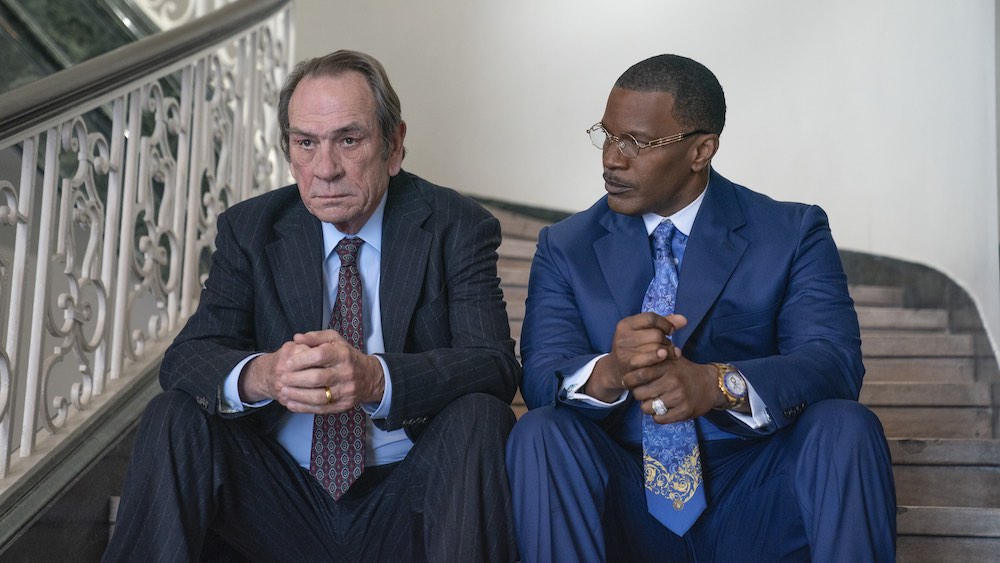
Jamie Foxx scores in "The Burial'


       It may sound improbable, but The Burial might be the most entertaining movie ever made about a contract dispute. Ridiculous? Well, add this to the equation: One of the main characters in the movie owns funeral homes in Mississippi, not exactly an occupation that prompts anticipatory smiles.
      But is The Burial entertaining?
      Yes. I say this because  although The Burial tells a David vs. Goliath story that revolves around a serious issue, the movie has the soul of a feel-good comedy. 
      Moreover, Betts -- with a massive assist from Jamie Foxx -- has us rooting for a lawyer who’s already super-rich when we meet him. Foxx gives a power house performance as Willie E. Gary, a flamboyant attorney with a habit of winning. A whirling dervish of bravura energy, Gary can talk like a country preacher.
         He may be religious, but Gary has taken no vows of poverty. Aspirational to the max, he lives in a Florid mansion with his wife (Amanda Warren). He wears expensive suits, drives expensive cars, and owns a private plane he’s named "Wings of Justice." A diamond-studded watch adorns his wrist. 
      Gary, a real-life character who has been the subject of a 60 Minutes profile, isn't a revolutionary or an innovator; he’s someone who’s defiant enough to beat the opposition at its own game.
     Why not? The son of a sharecropper and one of 11 children, Gary put himself through Shaw University and North Carolina Central University School of Law. Forget Harvard Law, Gary specializes in taking other attorneys to school.
       Oh yeah, the real-life law suit that inspired the movie...
          In 1995, funeral home owner Jerry O'Keefe (Tommy Lee Jones) sued the Loewen Group, an empire-building Canadian company that was devouring smaller American funeral homes. 
       Faced with financial difficulties, O'Keefe, accompanied by his attorney Mike Allred (Alan Ruck), travels to Vancouver to meet with Loewen chief Raymond Loewen (Bill Camp) on his yacht. 
         A deal was made — or so it seemed. O'Keefe would sell several of his funeral homes to Loewen but would keep the profitable burial insurance part of his business. They shook hands. O'Keefe signed the agreement; Loewen didn't. O'Keefe's suit followed.
      Betts could have suffocated the movie in a tangle of legal issues. Instead, she takes an approach more suitable to broad-based entertainment.
   Working from a screenplay she wrote with Doug Wright, author of a New Yorker piece about Gary, Betts builds the movie around her biggest asset, the comic flare and unabashed conviction Foxx brings to the role.
   To sharpen the courtroom conflict, the easily underestimated Gary battles a Harvard Law School graduate (Journee Smollett) brought in to head the Loewen team. Known for her aggressive approach, Smollett's Mame Downs has earned a bitingly descriptive nickname, The Python.
    Infighting among Gary team members, notably between Gary and Ruck's Mike Allred, lights additional sparks. O'Keefe's long-time attorney, Allred regards himself as an expert in contract law. He doesn't easily adjust to working with Gary. Allred hasn't entirely conquered years of Mississippi prejudice.  
   Mamoudou Athie plays Hal Dockins, a young black friend of O'Keefe and recent law school graduate. Hal introduces O'Keefe to Gary and remains involved in the case, a calm counterpoint to Gary's brashness. 
   Hal also makes a discovery that sharpens the case's racial dynamics, which had been in play from the outset. Part of the reason Hal wanted Gary to lead the team involved the make up of Hinds County, Miss., where the trial would be held. Hinds County is more than 70 percent black.
   Jones wisely takes a quietly determined approach. Undemonstrative but forthright, the 75-year-old O'Keefe has a single goal. He wants to protect his fortune for his 13 children and 40 grandchildren.
     Betts keeps the movie from turning into a love fest between Gary and O'Keefe. O'Keefe is Gary's first white client but the two have enough country in them to understand and care about each other. 
    A scene in which Gary, O'Keefe and Loewen meet to discuss a possible settlement is a small classic of gamesmanship -- except O'Keefe doesn't seem to be playing a game, which gives him an edge. He wants what he wants: to drag Loewen down for all the trouble he believes the company has caused him.
   The courtroom scenes are crisply executed, the tension, sufficient, and racial issues add weight to the proceedings.
    Looking back on the movie, I realized The Burial isn't really about a case or a cause. It's not built on outrage nor is it a sardonic take on capitalist greed. Sure, it cheers for the little guy but it runs on Gary's verve; i.e., on Foxx's performance.
  The movie gives Foxx his best showcase since Ray. He wrings every bit of juice from a role he owns from the beginning to the final credits. He looks like he's having a hell of a time; his unleashed brio becomes infectious. 

Thursday, December 3, 2020

Two fine actors, one muddled mess


Some movies just don't work -- nearly from start to finish.
Director April Mullen's Wander, a thriller starring Aaron Eckhart and Tommy Lee Jones, fits the description. Muddled to the max, Wander tells the story of Arthur Bretnik (Eckhart), a former cop who spends his time investigating conspiracy theories. Bretnik is the quintessential emotionally wounded man: An automobile accident resulted in the death of his daughter. As a further result of the crash, his now hospitalized wife (Nicole Steinwedell) has withdrawn into a catatonic state. Did all this havoc result from a crash or was the crash representative of something more sinister? Arthur occupies himself with an assignment: A woman asks him to look into the death of her daughter. A major question arises: Is Bretnik a nut or is he really onto something -- with help, of course, from his pal Jimmy Cleats (Jones)? Arthur and Jimmy host an amateur radio show in which conspiracy-minded folks call in to vent and air their thoughts. Not worth belaboring, Wander is one of those WTF movies that drowns inside its endless convolutions, dodges, and cuts.  The overall confusion breeds wide-eye disbelief and offers the viewer little choice but to give up caring.

Friday, September 20, 2019

'Ad Astra' proves weirdly involving

Brad Pitt travels deep into space -- both inner and outer.

Director James Gray's Ad Astra qualifies as a true oddity, a movie that manages to be both interesting and not entirely successful at the same time. Gray, who has made movies such as The Lost City of Z, Little Odessa and We Own the Night, this time dreams really big, setting his story amid the deep emptiness of space.

As astronaut Roy McBride, Brad Pitt takes a journey to Neptune where he must, roughly in this order, find the father who left him so that he could galavant around the galaxy, stop a powerful electric surge that has sent lethal shock waves to Earth, and, perhaps most importantly, commune with his emotionally wounded inner self so that he might finally be able to connect with someone else.

Pitt provides an offscreen narration in which he reveals Roy's thoughts, which come across as a dissertation on isolation; Roy tells us he's cut off from everyone. He does, however, sometimes confide with an unseen psychologist (an off-screen voice) who conducts a series of psychological evaluations. Roy generally passes -- although you might be tempted to think his answers feel a little too practiced, the speech of someone who's unable to connect his emotions to his thoughts.

The best parts of Ad Astra involve the set pieces that Gray stages with excitement and surprise: These include Roy's free-fall from an antenna that has been constructed at the atmosphere's outer limits, a chase sequence involving rovers on the surface of the moon, and a mission in which Roy and a colleague answer a distress call from a crippled vehicle.

En route to Neptune, Roy makes stops on the moon and on Mars. On Mars, he learns more about his father's fate from Helen Lantos (Ruth Negga), the woman who manages the space outpost.

Along the way, Gray offers commentary on the commercialism of humanity's great adventure. The moon, for example, boasts a dreary mall. No wonder Roy's outlook feels mired in futility: He does his duty; he's calm; his pulse never rises above 80 beats per minute; he screws up relationships; he makes mistakes; he's miserable.

Liv Tyler, who I believe never speaks, is used to suggest Roy's failures with women, but she's more like a vapor than a physical presence in the movie.

You should know that Roy's father -- presumed dead for years but possibly still alive on a spacecraft that floats above Neptune -- is played by Tommy Lee Jones, a bit of casting that tells us that Roy's journey to find his rogue dad needs a lalapalooza of a payoff. It's the dynamic Francis Ford Coppola set up in Apocalypse Now when he sent Martin Sheen up a river in search of Captain Kurtz.

It takes guts for a filmmaker to give his film such singular focus; we're being set up to be blown away should Roy and his father ever meet. If we're not ... well ... let's just say, it's not a good thing.

I'm simplifying Roy's story for the sake of brevity, but -- in the end -- it doesn't prove especially complex. The movie's message (it has one) puts an aphoristic gloss on its promise of something vast, cosmic and mysteriously profound. We're set up to expect Kubrick and Gray gives us daddy issues.

Still, I found myself breathing the thin air Gray creates and moving along with a movie that takes us on a trip that's weirdly arresting -- at least most of the time. Hey, as we're always being told; it's not the destination but the journey that matters.

Gray splays Roy's inner voyage across vast spaces, turning his movie into a metaphor with mythic and psychological overtones centering on absentee fathers (take that where you will) and what it means to be a man. You'll have lots of opportunities to study Pitt's face, as Roy burrows deep into his own psyche. Pitt pulls it off.

I can't say too much more without spoilers, but it's possible that Gray may have made a space adventure that can be read as a critique of every other space adventure, as well as of our desire to watch them. This is either brave or a little crazy -- or some mixture of both.

All I can say is that when I emerged from the auditorium where I saw Ad Astra, the lights in the corridor seemed to emit an eerie glow. Ad Astra teeters on the brink of something awe-inspiring without quite falling over. Can a movie be "nearly" visionary?


Thursday, July 28, 2016

Putting Jason Bourne back into action

Matt Damon returns as an assassin without memory as director Paul Greengrass extends his action set pieces to preposterous extremes.

If you want to spend a couple of hours watching Matt Damon play a character who's running for his life, Jason Bourne -- the latest in the series about an amnesiac spy -- might be the movie for you.

If you're looking for something more, you'll probably have to look elsewhere. We all know that the world seems to be gripped by chaos, but reproducing that chaos on screen doesn't always result in a satisfying movie experience.

With director Paul Greengrass returning to the helm and Damon jumping back into the Bourne saddle, the movie turns into a dizzying attempt to build a story around a reveal in which Bourne learns more background about himself that has been hidden from him by the CIA.

Bourne, you'll recall, has been programmed to kill by the CIA. Aside from quick flashbacks from his past, Bourne has no memory of his pre-espionage life. He often finds himself being chased by the very agency that turned him into a lethal weapon.

When Bourne resurfaces in Greece, a CIA chief (Tommy Lee Jones) tries to "put him down," i.e., Jones' Bob Dewey wants to assassinate Bourne with the help of a ruthless killing machine called "the asset" (Vincent Cassel.)

Dewey receives additional assistance from Heather Lee (Alicia Vikander), an ambitious CIA tech genius who seems to be able to locate Bourne whether he's in Greece, Iceland, London, and ... well ... I think stopped caring after Berlin.

The action set pieces tend to be so interminable, I wondered whether Greengrass was trying to set records. And, of course, Greengrass' approach expectedly races over-the-top.

That means logic doesn't always prevail. If Bourne makes a five-story flop onto concrete, don't fret. He'll be on his feet before you can say, "Splat." Like a politician who won't take "no" for an answer, he keeps on running.

The movie opens with Bourne earning his keep as a bare-knuckle fighter in Greece. It doesn't take long for him to wind up on the CIA's radar.

As the story develops, we also meet a tech whiz (Riz Ahmed), a hotshot whose company has been compromised by the CIA. Ahmed's character allows the movie to raise issues about privacy in a time of pervasive on-line activity, but we don't sense that we're supposed to take any of this seriously.

Much of the action takes place in front of CIA surveillance cameras, giving the movie a kind of fractured vision. CGI-enhanced car carnage comes into play, particularly in a ridiculous Las Vegas-based chase involving Bourne and a formidable SWAT vehicle.

In a movie that moves this quickly, acting tends to be more suggestive than deep. A bulked up but deadly serious Damon makes the movie feel like an aerobics workout. Looking as serpentine as ever, Jones tosses off a few off-kilter line readings, and Vikander opts for lots of furrowed-brow concern.

Julia Stiles makes an early picture appearance as Nicky Parsons, a former CIA agent with an agenda of her own.

Greengrass (Bloody Sunday, United 93 and a couple of previous Bourne movies) disorienting approach to action has its fans, and I've been one of them. He can edit a sequence into smithereens and still have it make some sort of sense, but -- in truth -- I got sick of it in this outing.

No matter how much urgency the actors try to bring to their work, the movie's kinetic charge takes precedence as the story works its way toward an expected and slightly depressing possibility: another sequel.

It would have been nice, though, if the filmmakers had been able to make this Bourne revival better than the movies that spawned it.

Thursday, November 27, 2014

Driven crazy by the West

Tommy Lee Jones and Hilary Swank play an eccentric duet.
Relying on eccentric performances, sparse landscapes and occasional comic flourishes, Tommy Lee Jones returns to directing with The Homesman, a drama with insanity at its core -- literally.

As a knockabout and claim jumper, Jones's George Briggs joins with Hillary Swank's Mary Bee Cuddy to escort three women from the Nebraska territory to Iowa. The three women, we soon learn, are insane, having been made that way either by their husbands or by the severe deprivations of a desolate frontier.

In what amounts to a not-so-cute meet, Mary Bee and Briggs hook up after she saves him from hanging. In return, he agrees to accompany her on her eastward journey and to obey any order she might give.

Swank gives the story its sense of flinty determination. Early on, Mary Bee makes a down-to-earth marriage proposal to a dopey cowboy. She offers children, land and shared work. Nope, says the cowboy. She's too plain looking and too damn bossy.

No surprise, then, that Mary Bee volunteers to take the women eastward -- from the windswept Nebraska territory to the more hospitable embrace of Iowa. Back East, the women (Sonja Richter, Grace Gummer and Miranda Otto) just might restore their lost souls -- or at least put themselves out of harm's way.

Those who've seen Jones's directorial debut -- Three Burials of Melquiades Estrada -- won't be surprised to learn that his second movie displays a taste for imagery that's as unsettling as the barren landscapes over which Briggs and Mary Bee carry their wounded charges. A pair of mules hauls this misbegotten trio of mad women in a wagon that looks like a portable jail.

A couple of early shots evoke the iconic west of John Ford, but Jones's characters never achieve the archetypical shine that Ford gave his characters. If John Wayne was like a mighty oak, Jones seems like a gnarled root that protrudes from the ground, twisting and turning but never really finding the nourishment of the sun.

In some ways, Homesman -- which was adapted from a novel by Glendon Swarthout -- is less a western than an indictment of the West as uncharted territory where greed, lawlessness and squalor easily can trump virtue, but where some kind of primal energies still survive.

The movie, of course, looks at the role of women in the West: The women in this movie aren't the kind to keep the home fires burning; they've been burned by the home fires and turned into damaged goods.

The movie contains a twist you probably won't see coming, and, at times, Jones comes close to trying our collective patience. A little giddyap in the pacing might have helped, along with a little less self-conscious, frontier eccentricity.

But Jones hits some hauntingly strange notes in a movie that takes its own sweet time serving up a pill that's not meant to go down easily.

Thursday, September 12, 2013

Laughs slim in this mob comedy

De Niro, Pfeiffer and Jones. No, it's not a law firm; it's the cast of another superfluous Mafia comedy.
Unimaginative, far-fetched and unable to establish a consistent comic tone, The Family -- the story of the Manzonis, a mob family hiding in France -- feels as stale as a two-day old croissant.

Director Luc Besson's attempt to connect explosive violence with comedy doesn't exactly fizzle, but it's surely not as funny as the filmmaker, who co-write the script with Michael Caleo, must have intended.

The movie's main joke hinges on the fact that the entire Manzoni family has severe anger management issues. Insult mom (Michelle Pfeiffer), and she might blow up your business. Attempt to put one over on dad (Robert De Niro), and he'll try to beat you to death with a baseball bat. It doesn't take much kindling to bring the Manzoni temper to a violent boil.

The two Manzoni kids also seem to have inherited the mobster gene. Warren (John D'Leo) is a conniving high-school student and budding crime czar: His sister, Belle (Dianna Agron) shows no mercy when dealing with a male student who who makes boorish advances.

Safe to say that De Niro, behind a bushy beard, breaks little new ground. Pfeiffer, who made her mob-comedy bones in Jonathan Demme's 1988 Married to the Mob, makes a strong impression, but -- like her compatriots -- can't entirely overcome Besson's tone-deaf approach to humor.

Credibility is not the movie's strong suit. With a $20-million price on his head, De Niro's Gio Manzoni -- a mobster turned snitch -- has been assigned his own personal FBI agent (Tommy Lee Jones). And speaking of not breaking new ground, the always intimidating Jones once again does his "Mr. Severe" act.

The movie builds toward a violent finale that will come as no surprise to anyone familiar with Besson's work (La Femme Nikta and The Professional), but the humor and violence tend to cancel each other out, and the whole project comes across as something that may have out-lived its shelf life even before the curtain rose.

Did we really need another comedy about the Mafia? Is it plausible that so many people would speak English in a dreary and obscure French town? Would the U.S. government really spend big money to send an FBI agent and two assistants to a small French town to protect the Manzonis from vengeful American mobsters.

At one point, Gio discovers a typewriter in the rubble around the rundown house the family has been given. He decides to write a book about his experiences. Maybe his memoir would have been more interesting than a comedy that tries to shuffle the mob-movie deck, but deals a losing hand.

Thursday, November 15, 2012

Spielberg, Day-Lewis tackle Lincoln

Though impressively thorough, Lincoln sometimes loses its way..
Steven Spielberg's Lincoln opened on both coasts last week, receiving mostly glowing reviews for its seriousness of purpose and for Daniel Day-Lewis's performance as a stooped but canny Lincoln, a president who knew how to use his homespun, country lawyer charm to great advantage. And, yes, just about everyone has applauded Spielberg's restraint, praising him for refusing to bury the story under swells of obvious sentiment or corn-fed patriotic goo.

All that's true. Tony Kushner, who wrote Angels in America and also co-authored the screenplay for Spielberg's Munich, has taken his cue from Doris Kearns Goodwin's Team of Rivals: The Political Genius of Abraham Lincoln , paying careful attention to the political in-fighting caused by Lincoln's insistence that the House of Representatives pass the 13th Amendment, the landmark piece of legislation that outlawed slavery.

Taking place two years after Lincoln signed the Emancipation Proclamation, Spielberg's historical opus avoids towering, bio-pic sweep, focusing instead on the ways in which Lincoln plied his Democratic opponents (with jobs and other rewards) to encourage them to vote for the amendment. At the time, Republicans advanced progressive views on slavery and the Democrats insisted on preserving the status quo.

Lincoln also was operating under a deadline of sorts. By January of 1865, it had become apparent that the South would lose the war. Lincoln, who stalled a peace delegation of southerners, wanted slavery abolished before any truce could bring the secessionist southern states back into the union fold.

Day-Lewis's Lincoln seems happier if he can tickle the opposition into submission rather than clobber it into compliance. Lincoln likes to tell pointed stories that he finds terribly amusing and which encourage a good deal of eye-rolling among an entourage that sometimes finds itself eager to take less circuitous routes to the point.

The Lincoln we meet in Spielberg's movie is also a savvy wheeler-dealer who understands that persuasion sometimes requires pliable ethical standards. Spielberg & co. wouldn't have been wrong to see a bit of trenchant topicality in the story of a beleaguered president trying to work with a divided, recalcitrant Congress.

Daw-Lewis puts himself on the fast track for an Academy Award nomination by playing an iconic figure and trying to make him life-sized. He gives such a meticulous, carefully considered performance that I found myself wondering if he wasn't being a little too cautious.

I can't say that I felt as if I were watching Lincoln; I felt as if I were watching Day-Lewis interpret Lincoln, filtering my response to the performance through a stream of recurring questions: Did Lincoln really talk this way? Did he so seldom exude a sense of command?

Although Lincoln tells amusing stories, the real humor in the movie stems from Tommy Lee Jones, who pays the staunch abolitionist Thaddeus Stevens. Jones's caustic Stevens is an out-sized creation that enlivens the movie's sometimes subdued tone, reinforced by cinematographer Janusz Kaminski's fondness for dimly lit interiors, appropriate one supposes for the period.

As Mrs. Lincoln, Sally Field can be vivid, and, I think, right for the role. Bereft over the loss of a young son, she's terrified when her oldest son Robert (Joseph Gordon-Levitt) decides to join the Army. A scene in which Lincoln and Field's Mary Todd Lincoln fight over their children is one of the most fully realized in the movie. Unable to dissuade Robert from joining the army, Lincoln secures him a relatively safe staff position.

At times, I found myself thinking that if C-Span had existed in the 19th century, it might have looked a bit like Lincoln, particularly in scenes that take place on the House floor. And although Lincoln is no museum piece, not every scene springs fully to life, perhaps because the movie sometimes feels constricted by what may have felt like an obligation: Get the historical details right.

As befits a movie with a cast that seems the size of the entire Congress, Lincoln boasts a variety of notable appearances. Jared Harris portrays Ulysses S. Grant. David Strathairn is all starch and polish as Secretary of State William Seward, and an unrecognizable James Spader portrays W.N. Bilbo, a political operative who's not put off if asked to operate on the shady side of any ledger. You'll also find work from John Hawkes, Jackie Earle Haley, Hal Holbrook, and Tim Blake Nelson.

The movie opens with a ferocious battle scene, which probably was necessary. The cost of war weighs heavily on Lincoln and on the movie. We feel the sadness of unprecedented slaughter. I don't suppose I need to tell you how the story ends, although it's worth pointing out that Spielberg's ending (more epilogue than finale) leans toward hagiography; it's too much of a genuflection for a movie that has tried to avoid myth-making.

I certainly wouldn't want to dissuade anyone from seeing Lincoln, but I also would tell you that I watched this movie from the outside, always aware that I was seeing a re-enactment of history rather than experiencing a historical drama. Thorough, brilliantly competent and at times stirring, Lincoln has many obvious virtues, but it never quite attains the greatness its subject seems to demand.


Tuesday, August 7, 2012

Should this marriage be saved?

Tommy Lee Jones and Meryl Streep are unhappy together as a long-time husband and wife in Hope Springs.
,
Hope Springs deals with a marriage that's foundering. I've seen the movie referred to as a "dramady," which means it's supposed to blend comedy and drama. I guess that's a fair description, but I wouldn't call Hope Springs great drama or sharp-edged comedy. Mostly, the movie stands out for being an adult-oriented movie that arrives in the middle of a comic-book summer and for being willing to show aging characters talking -- albeit awkwardly -- about sex.

Nothing dramatic happens to bring this marriage to the brink, which is more or less the point. Hope Springs has more to do with the deadening accrual of habit than with rash infidelities or Virginia Woolf-style knock-down drag-outs.

Initially, I wondered whether Tommy Lee Jones, an actor who can seem as angry as a clenched fist, would team well with Meryl Streep, an actress who excels at both drama and comedy. I'm not sure I ever bought them as a couple, but I watched with interest as they worked over material that vacillates between compelling and second-rate.

Here's the drill: Kay (Streep) and Arnold (Jones) have been married for 31 years. Five years before we meet them, Arnold hurt his back and began sleeping in the guest room. He never returned to the bedroom he and Kay once shared. Arnold's an accountant. Kay works in a clothing store. And if you happened to meet them in real life, you'd probably think they were as happy as most other couples in Omaha, which is where they live.

Kay knows differently. She's not content, even if Arnold is comfortable in the rut he's dug for himself. He goes to the office. He comes home. He eats dinner. He falls asleep in front of the TV while watching the golf channel.

In a bold move, Kay enrolls in a $4,000 intensive marriage counseling session in Maine. These sessions are conducted by Bernie Feld (Steve Carell), a psychologist who has written a best-selling book called You Can Have the Marriage You Want, the title of which pretty much explains what it's about.

Predictably, Arnold has no interest in therapy. When he realizes that he either must accompany Kay to Maine or give up on his marriage, he boards a plane -- not that he quits complaining. Counseling won't do any good. The psychologist's a fraud. The whole thing costs too much.

I've got two views about Hope Springs, which was written by Vanessa Taylor and directed by David Frankel, who also directed Streep in The Devil Wears Prada. There's an undeniable element of daring here, particularly in the therapy scenes, which -- in fairly short order -- address Kay and Arnold's badly depleted sex life.

At its best, the movie plays like a less taxing version HBO's In Treatment, and I half wondered why Carell had usurped Gabriel Byrne's role as one of entertainment's more credible shrinks.

To the movie's credit, therapy isn't shown as an instant cure-all. For Arnold and Kay, therapy is full of bumps, detours, bruised feelings and anger.

Carell plays his role straight in a movie that finds its best moments in his character's office. Frankel's few attempts to open things up can seem superfluous. An example: Kay visits a local bar where she encounters a sympathetic bar tender (Elizabeth Shue).

I said I was of two minds about Hope Springs. Here's the second. I found it almost impossible not to be a little too aware of the acting. Jones gives Arnold the hunched posture of a man who's pushing through life. Arnold's running on residues of resolve and lowered expectations. Streep finds Kay's weariness, her yearning and also her tendency to be a little clueless at times.

The supposedly "humorous" parts of the movie aren't all that funny, although the trailer seems designed to persuade us that Hope Springs is a comedy.

So what am I saying? Although parts of Hope Springs are commendable, I didn't totally buy Taylor and Frankel's exploration of the calcifications that can be wrought by age, habit and lack of imagination. I wish the movie had been a little tougher.

So I'll split the difference. Yes, it's refreshing to see a movie that deals with adult themes. But Arnold and Kay's troubled marriage finds itself in the middle of a movie that seems to want to explore real issues, but -- in the end -- doesn't want to ruffle too many feathers, even those belonging to Arnold and Kay.


Thursday, May 24, 2012

A palatable reprise of 'Men in Black'


Early in Men in Black 3, Emma Thompson -- who plays Agent 0 -- delivers a eulogy for Zed, a character played in the previous movies by Rip Torn. Claiming that she's paraphrasing an alien, O speaks in a bizarre, screeching language that gives new meaning to the word "shrill." Thompson's offbeat moment marks one of many amusing bits in director Barry Sonnefeld's often imaginative reprise of a series that began in 1997.

Men In Black 3, available in 3-D, boasts a high degree of creativity, a serviceable enough story and the expected bickering between agents K and J (Tommy Lee Jones and Will Smith). The movie may not score a bull's-eye, but it's no dud, either.

The first Men in Black movie caught audiences by surprise. Released in 2002, the second didn't do much for me and most other critics, but sold a fair number of tickets. The third is ... well ... a bit of a conundrum.

What I liked about No. 3, I tended to like a lot, but sporadic enjoyment doesn't entirely compensate for the fact that the various pieces that Sonnenfeld has assembled don't always translate into big-time fun.

This edition involves time travel. In brief: Agent J -- part of a black-suited force that monitors alien activity on Earth -- travels back to 1969 to kill Boris the Animal (Jemain Clement), an alien who has a plan for wiping out the Earth or conquering it or something.

J's arrival in 1969 allows Sonnefeld to do a few time-travel jokes, one revolving around J's encounter with a couple of bigoted policeman. Despite such annoyances, J soon meets a younger version of Agent K. Enter Josh Brolin, who seems to have stolen Tommy Lee Jones's voice, mastering Jones's every clipped, sardonic inflection. I don't know if Brolin's giving a performance or a doing an impression. Whatever it is, it's dead-on.

For his part, Jones appears in the opening and closing scenes that bookend the main part of the movie. In short, he's not required to do much heavy lifting, which is fine. I'm betting the always imposing Jones rather would have been elsewhere.

In 1969, J also meets Griffin (Michael Stuhlbarg), a dithering alien who's able to see a variety of versions of the future. J also learns a secret about himself, which adds a bit of unexpected poignancy to the story, which is credited to five writers. The multiple authorship sometimes shows. Men in Black 3 doesn't seem to know where it's headed.

So be prepared to enjoy Men in Black in bits and pieces:
-- An opening sequence in a Chinese restaurant is funny in a downbeat sort of way. It also assembles an appropriately disgusting collection of alien life forms, including a giant alien fish about the size of a small tugboat.

-- To travel through time, Agent J must leap off the Chrysler Building, a feat that gives Sonnenfeld an opportunity to apply some vertiginously effective 3-D, an opportunity that repeats itself during the movie's finale, which takes place at Cape Canaveral, Fla.

-- A joke involving the late Andy Warhol (Bill Hader) doesn't quite pay off, but the filmmakers deserve credit for advancing a novel explanation for Warhol's strange personality.

You get the idea: Men in Black 3 puts lots of ingredients in its bag and shakes them up to mixed effect.

Smith sometimes works a little too hard to ignite an old spark, and there certainly was no pressing reason for anyone to revisit these characters.

Having said that, Sonnefeld & company deserve mild praise for bringing a palatable version of an old favorite into the summer of 2012, where I hope the franchise finds its eternal rest after patting itself on the back for at least trying to hit some strangely amusing notes.


Thursday, July 21, 2011

A salute for 'Captain America'

It may not be great, but the latest Marvel Comics origins movie is better than expected.
Captain America: The First Avenger begins where many comic book stories find their origins -- with vicious Nazis. As World War II rages, a fiendish Nazi harnesses a power that is both occult and mythical. Johann Schmidt, a fiend with the towering posture of a wannabe ubermensch, threatens to destroy all of the world's major cities.

Back in the U.S., diminutive Steve Rogers (Chris Evans) is devastated by the 4-F rating he's assigned by his draft board. Rogers, who weighs an anemic 90 pounds, wants to fight for his country. Eventually, he's given an opportunity to participate in a top-secret program designed by German refugee scientist, Dr. Abraham Erskine (Stanley Tucci with a German accent).

Here's where the comic book fun begins in earnest. After being placed in a machine that zaps his cells, Rogers emerges with a health club physique. He also has lightening speed and the ability to out-leap even the most gifted high jumper. He's transformed into Captain America, and almost immediately swings into action.

I'm condensing, of course, but that's the gist of director Joe Johnston's hearty contribution to the origin stories that precede next year's release of The Avengers. Johnston, who directed the retro favorite Rocketeer, again dips into nostalgia. It's as if the 1940s world he creates == an America full of futuristic expositions and war-bond drives -- has been assembled from dozens of patriotic posters and old movies, a fantasy version of the past that's particularly satisfying.

Evans brings self-effacing charm to the title role. He's joined by a variety of strong performers. Tommy Lee Jones plays a gruff Army officer who's not entirely sold on Rogers' abilities. Hayley Atwell portrays the Army officer who assists in Rogers' training and who eventually becomes his love interest -- in chaste fashion, of course.

Villainy is supplied by Hugo Weaving who plays Dr. Schmidt, a character who eventually reveals himself as Red Skull, a man with a skeletal face that clearly places Johnston's movie in the land of the comic book. Red Skull looks as if his skin has been ripped off, exposing the raw underside of a countenance that already seemed plenty evil.

The action sequences in Captain America tend to be somewhat extended, which I found a bit boring. But there are plenty of battles for action fans, and a prologue and epilogue that explain how Captain America will be catapulted into the present for the upcoming Avengers movie.

And, yes, in some sense, Captain America, like Thor, is a preview of coming attractions for The Avengers, which promises a mega-helping of Marvel Comics heroism.

Still, Captain America has some kick, and it can be found in the star-spangled spirit that, like its title character, carries the day.

Thursday, January 20, 2011

They're casualties of a shifting economy

Woes in the world of management; execs feel the pain, too.
Just about all the men in The Company Men have enjoyed success. Their houses are spacious. They drive upscale cars. Their kids don't want for anything. Class trip to Italy? Not a problem. They're competent businessmen who believe they've earned the fruits of corporate life at a Boston company that made its name building ships. Of course all bubbles eventually burst, and, in the hands of director John Wells, The Company Men becomes a lingering look at what happens when a company begins to shed once valued employees who have turned into excess baggage.

Dead weight, it should be noted, has nothing to do with skill, experience or even prior success. It has to do only with balky parts of the company that have become a drag on profits and, thus, a worry for stockholders. A company that made its bones in the rugged world of manufacturing now sees its future in a newly acquired health-care subsidiary. And all those men who built and sold the ships? Well, that's why we have scrap heaps.

The Company Men has obvious relevance in a time of economic duress. It begins during the Bush administration and continues for a year. For a while, the movie does a good job chronicling the fate of newly unemployed executives, men who are unaccustomed to viewing themselves as failures or showing up at a less-than-luxe placement center.

All well and good, but somewhere along the line, Wells begins to succumb to predictability; he shrinks from the tough conclusions that deserve to be drawn from this story and offers light at the end of a dark economic tunnel. He also concentrates his attention on a well-heeled management class, paying relatively little attention to workers who also have been cast aside. In fact, they're mostly invisible.

Ben Affleck plays Bobby Walker, a confident salesman who's among the first to be fired. He's followed by a variety of others, including Chris Cooper's Phil Woodward, an executive who worked his way up from the factory floor. Tommy Lee Jones plays the tough-minded head of the ship-building division, a guy who values his employes and who believes in the old-fashioned way of doing business; i.e., making things and selling them for a profit. His view obviously is losing traction.

As Bobby's brother-in-law, Kevin Costner gives a nice small performance. He's a contractor who mistrusts what he sees as Bobby's white-collar arrogance. Costner's Jack Dolan ultimately helps Bobby rediscover a sense of purpose in hard, physical labor, not the first evidence of the cliches that increasingly make their presence felt.

Scenes at the fictional GTX Corp. ring true, as does the performance of Craig T. Nelson as the company's hard-assed CEO. Nelson's character has adjusted to new economic realities and is blessed with the ability to avoid looking back. He's aided in his downsizing efforts by an equally tough woman (Maria Bello) who delivers lots of bad news to lots of angry employees.

Affleck gives a convincing performance as a man whose confidence is put to the test. When men are fired, their egos also are downsized. They've lost their place in the world.

It's fair to say, though, that Wells' screenplay might have benefited from a harder edge and a tougher conclusion. The Company Men should not be dismissed, but when it's done, you may realize how much more it could have accomplished.