Showing posts with label Elizabeth Debicki. Show all posts

Tuesday, September 1, 2020

Great action in a muddled ‘Tenet’

    Tenet involves an ingenious conceit: the idea that time can be manipulated to flow forward and backward simultaneously. This means that a car chase could be proceeding at breakneck speeds while the same cars move in opposite directions — or something like that.
    Graspable more in outline than in detail, Tenet creates an often frustrating mixture of consternation and thrills. 
    Director Christopher Nolan brings Inception-like complexity to a story that probably will have fans filling chat rooms and Zoom calls with speculation, insights, and connections to whatever they perceive as the movie’s meaning.
    Then there’s me.
    First off, I saw Tenet at a screening in which a handful of critics were spatially distanced in a large IMAX theater. 
    I’m not sure what awaits moviegoers when they venture into newly re-opened theaters but I admit to feeling a bit of guilt at having seen Tenet under what surely must be the safest possible conditions. I hope you’ll be able to do the same.
     The movie tosses four principal characters into a mind-bending Cuisinart built around the concept of inversion, a state in which effect can precede cause.
     John David Washington (BlacKkKlansman) plays a character described in the credits only as The Protagonist, a secret agent who must save the world from dreams of annihilation by Andrei (Kenneth Branagh), a crazed Russian oligarch.        
     Andrei's art appraiser wife Kat (Elizabeth Debicki) develops a flirtatious relationship with The Protagonist, but her main concern involves rescuing her young son from the clutches of his evil and monumentally abusive father.
     As his mission unfolds, Washington’s character acquires a sidekick, the devilishly stylish Neil (Robert Pattinson).
    Not much else needs to be known about the cast. Michael Caine makes a brief appearance as a British spy and Indian actress Dimple Kapadia plays a sophisticated woman who traffics in arms.
     For all its theories, talk of algorithms and such, Tenet plays like almost every other summer movie, by which I mean it alternates exposition (a lot of it) with imaginatively conceived action set pieces.
      I half wondered whether Tenet might be a movie that’s best enjoyed by throwing out the bathwater (the story) and keeping the baby (the action).
      A chase involving speeding trucks is particularly exciting and Nolan excels at making the movie's theoretical conceits visible: bullets fly backward into guns and demolished buildings reassemble, for example. 
    Did I mention that birds can be seen flying backward?
    Because the characters need to wear oxygen masks when they are "inverting," some of the burdens of performance have been lifted. But these days, not seeing everyone's face all the time seems depressingly familiar.
    Of the performances, Debicki stands out. Her Kat is sexy, calculating, and possessed of worldly intelligence.  Pattinson brings casual charm to his portrayal and Washington gives a forceful, straight-ahead performance that provides the movie with its continuity.
    Speaking with a Russian accent, Branagh alternates understatement and outbursts, giving the movie a full quota of human menace.
    I presume that Nolan and company collected major frequent flyer miles as they location-hopped to places as far-flung as Italy's Amalfi Coast, Mumbai, Estonia, Denmark, Norway, and London.
    All this is accompanied by a score (credit Swiss composer Ludwig Goransson) that pulses and pulses -- and then pulses some more.
    After a well-staged opening which seems to have been inspired by a real-life 2002 terrorist attack on a Moscow theater, the movie quickly leaps from what many will see as Bondian terrain to one involving alternate realities. 
    With Nolan, the reality in which we all reside never seems complex and baffling enough. His worst enemy: the chronological order that marks the way most of us experience the passing of time.
      I leave it to you to determine whether it's important to catch every line of dialogue. I know I missed a lot.
     And that seems to sum up the Tenet conundrum; you’re often left wondering whether you’ve lost your place or whether the story simply has gone on without you. The result, at least for me: Increasing indifference.
    It’s obviously up to you to decide whether you want to see Tenet, which only can be viewed in theaters. Exhibitors, studios, and other representatives of what might be described as the motion-picture industrial complex certainly hope you do.
    I  have mixed feelings about the reopening of theaters and I’m eager to hear from those who go. I’m less interested in what you think of Tenet than in whether you felt safe in a theater where masks could be lowered to consume snacks.
    In the end, how safely theaters can operate during a pandemic (it may take time to tell) strikes me as a far more important question than any I could raise about Nolan's latest spectacle.


Thursday, September 5, 2019

Bob's Cinema Diary: 9/6/19 -- Satanic Panic, Vita & Virginia

I'm never sure whether films have real-world impact, but if Satanic Panic does alter anyone's behavior, it probably will be America's legion of pizza delivery people. In this case, a pizza delivery girl (Hayley Griffith) makes a delivery to a wealthy area that's way out of her normal zone. When the recipient disappears after refusing to tip, she bangs on the door, hoping to shame the stony-faced jerk who stiffed her. Our heroine might normally have gone on her way, but her moped’s nearly out-of-gas and she's afraid she won't make it home. Entering the house through a conveniently open side door, the pizza girl quickly becomes ensnared in a meeting of devil worshipers who want to turn her into a human sacrifice. Purposely overstated performances, particularly by the group's head witch (Rebecca Romijn) seem intended to give a comic spin to the proceedings, but this kind of acting also can create an amateurish feeling that may not have been what director Chelsea Stardust hoped to achieve. Gore gluttons will find enough plasma to satisfy, but too much of the movie simply doesn't work, either as straight-ahead horror or macabre comedy. Ruby Modine supplies a witty spark that's otherwise missing from a movie that aims to produce crowd-pleasing moments for horror buffs who are well enough versed in genre tropes to recognize when the movie is poking fun at them. All else aside, it may be reassuring to know that even Satanists are sensible enough to crave pizza, thus prompting the movie's most intriguing aside: Ritual sacrifices of young virgins never should be performed on an empty stomach.

Vita & Virginia

Vita & Virginia, a well-appointed look at the lesbian relationship between Vita Sackville-West (Gemma Arterton) and Virginia Woolf (Elizabeth Debicki), too often fails to break its period-piece shackles. The Bloomsbury scene depicted by director Chanya Button doesn't prove interesting or eccentric enough to shock us with its rejection of bourgeois convention. Both Vita and Virginia are married, Vita to a husband (Darren Dixon) who indulges his own same-sex interests but fears that his boldly flirtatious wife will jeopardize his public standing. Virginia's husband Leonard (Peter Ferdinando) shows more tolerance for his wife's inclinations. He publishes her books, loves her and even believes that she might benefit from a fling with Sackville-West. Isabella Rossellini shows up as Lady Sackville, a woman who clearly disapproves of Vita's undisguised recklessness. Arterton approaches her role with crisply delivered openness; Debicki's Virginia seems depressed and dreary, perhaps to suggest the despair that ultimately led Woolf to suicide. There's nothing wrong with Vita & Virginia that more unruliness wouldn't have cured. But Vita & Virginia seems too intent on becoming a movie of certifiable cultural significance to feel as if it's full of new insights.

Thursday, November 15, 2018

Too embattled to wallow in grief

Viola Davis leads a strong cast in Widows, a caper movie with plenty of cynical undertow.
In Widows, director Steve McQueen flirts with high-concept formula but never allows it to overwhelm the movie's gritty undertow.

Written by McQueen (Hunger, Shame, and 12 Years A Slave) and Gillian Flynn (Gone Girl), Widows wraps pungent characterizations around a caper-film spine. If the plot strains at times, a fine cast and McQueen's scaldingly cynical view of life in Chicago keep the proceedings percolating.

Viola Davis stars as Veronica Rawlings, a woman whose criminal husband (Liam Neeson) dies in the film's barreling, violent prologue. Neeson's Harry and four colleagues are the in the midst of a robbery when they're killed.

Harry leaves Veronica with a pile of trouble. A local gangster (Brian Tyree Henry) claims that Harry owed him $2 million. He's holding Veronica responsible for the debt.

Henry's Jamal Manning also wants to shift to a new kind of crime. He's running for alderman because he believes it's time that he had the opportunity to dip his crust of bread into the municipal gravy that the Irish too long have sopped up. Manning's brother (Daniel Kaluuya) serves as his happily brutal enforcer.

In a related plot thread, Colin Farrell plays Jack Mulligan, the incumbent who's running against Manning. Mulligan is the son of a corrupt former Chicago alderman (Robert Duvall) with a sour disposition and a strong commitment to holding political turf his family has dominated for years.

So how is Veronica going to pay off Harry's debt? As it turns out, Harry left Veronica plans for a major heist that could yield as much as $5 million. Because all of Harry's henchmen were killed in the movie's explosive opening, it falls to Veronica to gather the surviving widows into an impromptu gang, pull off the heist, settle Harry's debt and divide the remaining spoils.

Everyone in Veronica's crew suffers from need. Linda (Michelle Rodriguez) signs on because she's lost her store to rapacious creditors. Alice (Elizabeth Debicki) is one step away from becoming a full-time escort, saved only by the largess of a wealthy financier (Lukas Haas) who makes her his mistress. Amanda (Carrie Coon) has been left with an infant.

Jacki Weaver shows up as Alice's unapologetically sleazy mother, and Cynthia Erivo adds last-minute energy as a woman recruited to drive the getaway car.

A women's perspective gives the movie's crime and political theater a considerable boost. Think of Widows as feminism without speeches, a genre piece featuring female characters with real agency.

It's hardly surprising that Davis proves impressively steely as a woman who misses her husband's tender embraces but proves tough enough to lead her cronies through dangerous terrain. Displaying iron-willed resolve, Veronica takes charge of her gang of widows, no easy task with this group of independent-minded women.

Widows has enough on its mind to keep from becoming one more helping of multiplex fodder. McQueen wisely lets Davis lead the way as a widow who shouldn't be messed with -- even in a world in which felons and politicians often are indistinguishable.*

*I want to reiterate that I welcome comments, particularly those that expand our knowledge about particular films or films in general. But -- and this is the point of this footnote -- I don't publish anonymous comments. Over the years, I've found that many readers have worthwhile things to say and should in no way be reluctant to take credit for their comments. So, sign your name and chime in.

Thursday, May 9, 2013

A 'Gatsby' full of razzle dazzle

Baz Luhrmann goes way over the top to tell a classic American story.


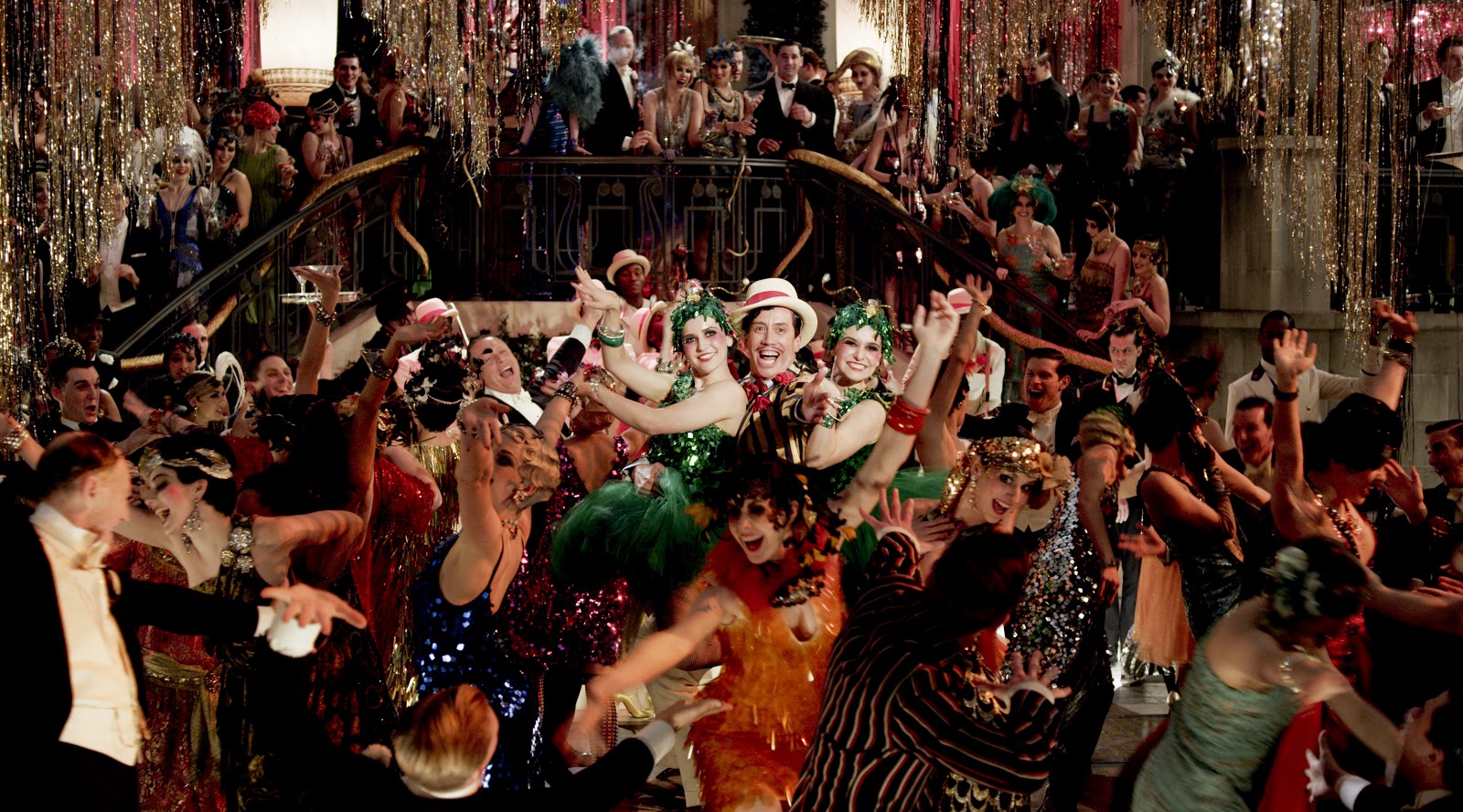
Director Baz Luhrmann has accomplished something close to extraordinary in his vivid, dizzying and ultimately misguided version of The Great Gatsby. He has taken F. Scott Fitzgerald's iconic 1925 novel -- a classic of American literature -- and turned into as glossy and colorful an extravaganza as might have been seen in the days when big-screen spectacles were drenched in three-strip Technicolor.

Put another way: Luhrmann's Gatsby has the glamour-laden production values of a musical -- only one in which somebody forgot to write the songs.

Luhrmann, who already has proven himself a maestro of overstatement in works such as Moulin Rouge! and Romeo & Juliet, has added 3-D to this version of Gatsby, presumably to give the movie a sense of immersive depth. The 3-D images might be the only depth you'll find in this showy, anachronistic and occasionally cartoonish version of the Gatsby story.

In Luhrmann's hands The Great Gatsby has become a frenzied display of technique, much of it devoted to creating the bacchanalian delirium that turned Gatsby's fabled parties into a magnet for New York's high-living crowd. Are we talking Gatsby or outtakes from the Playboy Mansion? You be the judge.

Fitzgerald, of course, told the story through a narrator named Nick Carraway, a Midwesterner who travels to New York and rents a small cottage next to Gatsby's ostentatious Long Island mansion. Nick meets Gatsby because of Gatsby's long-standing and unquenchable love for a woman named Daisy, who happens to be Nick's cousin. Nick is supposed to serve as a go-between for Gatsby and Daisy.

When we meet Daisy, she's already married to Tom Buchanan, Yale graduate and certifiable lout who indulges his libido with Myrtle (Isla Fisher), a low-class mistress from Queens.

Luhrmann uses some of Nick's narration (i.e., Fitzgerald's prose), even allowing pieces of it to wander across the screen in the form of typescript that floats above the fray.

But fidelity to text is hardly the point here: Luhrmann hasn't recreated America of the 1920s. He has invented a dreamscape all his own; the movie -- which mixes rap and Gershwin on its sound track -- isn't so much an evocation of the past, but a visit to an alternate universe stocked with jiggling flappers, feverish jazz musicians and a Jewish gangster played by an Indian actor (Amitabh Bachchan) who seems to have wandered into the story from some multi-cultural universe of the 21st century.

Luhrmann's Gatsby is a bold, vividly realized and distressingly literal retelling of a story that has been put on film before, but never with so much loudly trumpeted artifice and self-conscious daring; the soundtrack arrives complete with musical contributions from Jay Z and Beyonce.

Of course, Luhrmann has made alterations to the story (Nick tells the tale from some sort of rehab facility where he's struggling with alcoholism and regret), but changes to Fitzgerald's story are the least of the problems. Most of those center around the fact that Luhrmann has taken the events of the novel -- always secondary to Fitzgerald's prose -- and added so much technologically created upholstery that everything collapses into it.

Only those who do not own television sets can have escaped prior knowledge that Leonard DiCaprio portrays Jay Gatsby, the hopeful and deluded man who spends a lifetime trying to recreate his past so that he can become a suitable suitor for Daisy, a member of the upper classes to which the low-born Jay longingly aspires.

Looking as if he's posing for a fashion ad in the Sunday New York Times magazine, DiCaprio projects the calm of a man who's willing to create a storm to attract the beautiful Daisy who lives across the bay from him. And, yes, Gatsby spends an inordinate amount of time staring across the dark waters of Long Island Sound at the luminous green light that glows on dock of the Buchanans' East Egg home. The symbolism is inescapable: The light represents everything that remains visible but out of reach for Gatsby.

Gatsby is one of those amorphous figures who tries to create a new version of himself, but only can achieve it by associating with and profiting from the corruption and crime that leads to quick wealth. He has obscene amounts of money, but his affluence never can equal the more seasoned wealth that people such as the Buchanans have come by as a birth right.

Daisy is played by Carey Mulligan, who seems entirely too grounded for the part of a dreamy fantasy girl. A scowling Joel Edgerton portrays her husband Tom, polo player and former Ivy League jock, a man with a smash-mouth personality. In Luhrmann's hands, these pivotal characters seldom seem like plausible people; they move through the movie carrying the weight of the literary archetypes that they seem to represent.

As for Nick, the narrator ... well ... let's just say that Tobey Maguire rises to the challenge of making him as uninteresting as most narrators are, the man who floats outside the story, fascinated by it but unattached to its core.

Of all the characters, only Daisy's friend Jordan Baker -- played by Elizabeth Debicki -- seems to fit into a recognizable universe.

By now, I'm sure you've caught my drift; Luhrmann's movie is more about production design than about the distorting powers of the American dream. Its rewards have more to do with vintage cars, sprinting camera movements and glitzy overstatement than with the tragic undertow of Fitzgerald's story.

A confession of sorts: I watched The Great Gatsby with a sense of sustained amazement at Luhrmann's capacity for emotional amplification, but presenting an entire movie in an over-the-top style doesn't leave much by way of wriggle room.

I suppose sales of Fitzgerald's much-purchased novel will enjoy an inevitable boomlet because of Luhrmann's movie, but I'd be willing to bet that this Gatsby has more influence on American fashion than on the country's intellectual, emotional or cultural life.

In that sense, Luhrmann may have found the key to bringing Fitzgerald's film-resistant novel to the screen. Luhrmann may not get at much that feels real or substantial, but his Gatsby sure as hell is dressed for success.