Rocky Mountain Movies & Denver Movie Review
FOR MOVIE LOVERS WHO AREN'T EASILY SWEPT AWAY
Wednesday, March 4, 2026
'Hoppers': fun with a message
Thursday, December 9, 2021
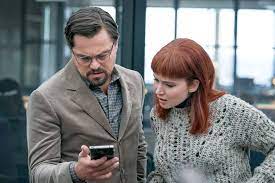
Great cast, less-than-great satire
A massively destructive comet — five to 10 kilometers wide — barrels toward Earth. It's scheduled to hit Earth in six months, destroying all of the planet's life. Extinction looms.
Thursday, December 10, 2020
A musical that's all exclamation points!!!
Garish and bubbly, The Prom makes no attempt to disguise its message, something on the order of the now-familiar yard sign that says, "We believe love is love."
Wednesday, December 9, 2020
Three friends on an uneasy crossing
Sunday, October 20, 2019
A look at the great financial shell game
Director Steven Soderbergh aims at the absurdities of a wealth-obsessed world in The Laundromat, a Netflix movie that feels like a collection of skits revolving around the Panama Papers scandal of 2016.
That financial mess involved a massive leak of files showing how the very rich (or at least some of them) could use shell corporations to shield themselves from a variety of troublesome intrusions, matters such as income tax or various liabilities.
The Laundromat, which begs for comparison with 2015's livelier The Big Short, uses a variety of techniques to create a farrago of sketches, many presented with the kind of gimmickry that defies cinematic convention, everything from breaking the fourth wall to chapter headings such as The Meek Are Screwed.
The movie is held together by two figures played by Gary Oldman and Antonio Banderas. They are, respectively, Oldman's Jurgen Mossack and Banderas's Ramon Fonesca, characters who might have popped out of a Pinter play. They often address the audience, acting as guides to the financial maneuvering at movie's core.
Speaking in a comic German accent, Oldman seems the more pragmatic of the duo. If there's romanticism in financial chicanery, Banderas finds it.
Ramon and Jurgen are lawyers who run a firm that specializes in creating shell companies. No questions asked. Secrecy respected. If these corporations lack substance ... well ... shouldn't wealthy people be allowed to park their cash somewhere without agents from the IRS crawling all over it?
Working from a screenplay by Scott Z. Burns, Soderbergh tries to show how the damage caused by all this subterfuge can impact those whose financial calculations extend no further than trying to balance a checkbook.
Meryl Streep portrays Ellen Martin, a woman who loses her husband (James Cromwell) in a boating accident on Lake George, NY. Ellen believes that she will collect an insurance settlement from the boating company.
Ellen soon learns that the company had been duped by someone who sold it insurance from a company that wended its way toward the portfolio of an outfit that existed only on paper. Ellen turns up at various points in the story to remind us that all this high-flying finagling can actually connect to ordinary folks.
This portion of the movie introduces us to a character played by Jeffrey Wright, an accountant who lives in Nevis, a West Indian island off the beaten tourist track. Ellen shows up there to track down the company that owns the insurance company that was supposed to compensate her for her loss.
None of this is to say that The Laundromat has a great deal of bite. It's mostly bark presented by Soderbergh with the winking buoyancy of a caper movie.
As Soderbergh works his way through the story, the movie makes a long stop at the palatial home of a wealthy man (Nonso Anozie) who's dallying with his daughter's college roommate. Anozie's Charles' approach to problem-solving: Award any aggrieved party with bearer shares that he claims are worth mega-millions.
Later, we meet a slick wheeler-dealer (Mathias Schoenaerts) who tries to exert his power over a Chinese woman (Rosalind Chao) who isn't going to fall so easily.
Put all this together and you have an airy concoction that amuses even if it doesn't pack the clout we might expect. By the end, I half wondered whether Soderbergh wasn't saying that any society that allows its economy to create financial instruments (i.e., paper) that have the appearance of worth without any reality to support them deserves what it gets — in the end, a handful of nothing.
Wednesday, January 10, 2018
A great moment for journalism
I can't imagine anyone who ever has worked at a newspaper not giving a big thumbs up to The Post, director Steven Spielberg's stirring take on a story about the Washington Post's struggle to become a major player in the news game while, at the same time, performing an important national service. The Post, the movie reminds us, grabbed its share of history when it published the Pentagon Papers in 1971.
"Wait," you say. Wasn't The New York Times the first newspaper to publish the Pentagon Papers?>
Yes, The Times was first, but The Post picked up the task after the Times was blocked by a court order from publishing any more of the 7,000-page secret document that proved that the government consistently lied about its "accomplishments" in Vietnam.
It probably takes a director such as Spielberg to take a straightforward approach to a complicated story that involves maneuvering by Post reporters and executives on any number of levels -- from the corporate to the logistical.
When the Post picked up the Pentagon Papers, it wasn't clear that the paper wasn't risking its own future. The company was about to go public so that it could obtain a much-needed infusion of capital. Some of the Post's attorneys argued that defying the government might scare off potential shareholders.
Spielberg's drama begins when Daniel Ellsberg (Matthew Rhys) copies the Pentagon Papers with the idea of making them widely known. Ellsberg turned from a military analyst to a whistleblower after he heard Secretary of Defense Robert McNamara (Bruce Greenwood) lie to the press about how the US was faring in Vietnam.
Spielberg, who understands how to personalize a story, focuses on two characters: Washington Post editor Ben Bradlee (Tom Hanks) and Washington Post publisher Katharine Graham (Meryl Streep).
Graham became the Post's publisher after her husband Phil committed suicide in 1963. She had great respect for the paper but hadn't fully grown into the role of publisher when the Pentagon Papers became available.
Hanks adds some growl to a variable Boston accent as Bradlee, but can't top Jason Robards' version of the much-admired newspaperman in All the President's Men. Still, he captures Bradlee's impatience with fools and his burning desire to kick the Post's reputation up a notch.
Streep gives the movie's best and most complicated performance. Graham was a close friend of McNamara, who implored her not to publish the Pentagon Papers. She traveled in the strata of Washington society geared toward steadying the ship, not rocking the boat. She values her friendships but ultimately understands that her duty is to the truth.
The Post certainly speaks to the current moment; the movie can be read as a reply to those who would tarnish journalism with "fake news" pejoratives. Spielberg throws a counterpunch that the country needs at the moment, a reminder that the press is an indispensable part of democracy.
Now, I should hasten to say that The Post can't equal All the President's Men, which had a sense of fervor that Spielberg's picture can't quite match, perhaps because its approach is so on-the-nose that the movie sometimes feels like an illustrated history augmented by currents of feminism (there weren't many women newspaper executives at the time) and journalistic jousting.
A large and credible supporting cast helps carry the story across the finish line. The movie features a particularly nice turn from Bob Odenkirk of Better Call Saul fame. Odenkirk plays Ben Bagdikian, the Post reporter who persuaded Ellsberg to give the Post copies of the Pentagon Papers: Bagdikian carried the papers to Washington in cardboard boxes on a commercial flight. He bought a seat for the boxes so they'd never be out of his sight.
Spielberg emphasizes the role journalism plays when everything that can be deemed "fake'' is coming not from newsmen but from those whom reporters doggedly cover.
Put another way: Chalk one up for every beleaguered journalist who has been reviled as a member of the media instead of appreciated for working hard to get as close to the truth as possible.
Thursday, August 11, 2016
Summer isn't a total loss. A look at a diverse week of movies: reviews of 'Florence-Foster Jenkins,' 'Hell or High Water' and 'Indignation
Jenkins' solicitous and morally frayed husband (Hugh Grant) protected his wife's delusions. Maintaining Jenkin's image of herself became his occupation.
Because Jenkins raised money for a variety of New York musical endeavors, no one had the courage to tell her that her private recitals were so painful, they could have induced the most saintly of innocents to confess to the most heinous of crimes.
Florence Foster Jenkins is the latest film from director Steven Frears, who began his cinematic journey with what now seem like films from some fading Pleistocene age: The Hit (1984), My Beautiful Launderette (1985); Prick Up Your Ears (1987) and Sammie and Rosie Get Laid (also 1987). Those movies -- practically a British New Wave in themselves -- seem like ancient eruptions from a director who hasn't exactly mellowed, but who, in this outing, focuses attention on a woman whose self-created grandeur is beautifully captured by Streep.
In Streep's hands, Jenkins pretensions are delivered with the piercing exactitude of a soprano's high C.
Jenkins' singing becomes both amusing and painful, particularly as she prepares for a 1944 concert at Carnegie Hall. Jenkins readies herself for the big evening with help from her tutor Cosme McMoon, a deliciously bemused Simon Helberg.
Because Jenkins had contracted syphilis from her first husband, her marriage to Grant's St. Clair Bayfield was chaste. To compensate, Bayfield carried on an affair with his mistress (Rebecca Ferguson).
Grant finally has found a perfect role as he ages out of the British prince charming phase that mostly has served him until now. He's playing an honorable cad.
There's little I can say to prepare you for Streep's attempts at operatic singing. Let's just say that she makes Susan Alexander Kane, the woeful opera singer in Citizen Kane, seem like Joan Sutherland. If screeching were an art form, Jenkins would have been its foremost practitioner.
Thankfully, Frears hasn't totally yielded to the temptation to make a feel-good comedy. He charts Jenkins's inevitable march toward disaster -- albeit not without making note of her pluck and fortitude in the face of a monstrous lack of talent.
I suppose one is obligated to say that Florence Foster Jenkins is a small movie enlarged by big talents.
But two other small movies (both enlarged by big concerns) also open this week.
HOW THE WEST WAS LOST
Hell or High Water belongs in a genre that might be dubbed the neo-western. Set in West Texas, the movie spreads bank robbery, sibling loyalty and violence across a Texas landscape that grows its own form of justice, rolling it out like wind-blown tumbleweeds.
Director David Mackenzie, working from a screenplay by the gifted Taylor Sheridan (Sicario), introduces us to Toby (Chris Pine) and Tanner (Ben Foster), brothers who rob small banks in forgotten towns that seem to shriveling in the Texas heat.
At first, the brothers seem to be another pair of mismatched hoodlums. Toby has a steady hand; Tanner quickly establishes himself as the movie's wild one, an uncontrollable weed sprung from parched Texas soil.
Still most familiar as Captain Kirk in the reborn Star Trek series, Pine gives what might be his best performance yet. As Toby, he must hold things back. Divorced and crippled by a past in which much has gone wrong, Toby is trying to right a very specific wrong.
Looking at iMDB, I was surprised to see that Foster already has 51 movies and TV appearances to his credit. You may remember him from The Messenger, a mournful 2009 story about an Army sergeant assigned to deliver the ultimate bad news to spouses and parents of fallen soldiers.You have to reach the end of Tanner's trail to realize what's driving this irredeemable bad boy, but Foster is one of those rare actors who can scare you just by showing up. He can put a look in his eyes that turns them into bullets just waiting for something to trigger their release.
Jeff Bridges, whose voice has taken on the roughness of weathered leather, plays Marcus, a Texas Ranger who's on the verge of retirement. Marcus hunts the brothers with his Comanche partner, Alberto (Gil Birmingham), a Native American who has learned to live with Marcus' racist taunts.
It's not easy to tell whether Marcus is a racist or just a guy who tries to needle his way under the skin of anyone with whom he feels close.
The story takes us in unexpected directions and gradually builds to a confrontation that's as much about character as it is about violence.
The Scottish-born Mackenzie, who directed the searing prison drama Starred Up, proves that he can handle drama with drawl and something on its mind.
Birmingham's Alberto sounds the chord that plays behind the solos that the rest of the characters deliver. The whites came and took the land from the Indians, and now, in what can be interpreted as a form of karmic retribution, the banks are taking the land from whites.
Mackenzie leads us to a conclusion that feels wise in a way that's far more complex than a movie like this has any right to be.
Like the juice from a wad of sour chewing tobacco, you may to savor the movie's bitterness before you think about spitting it out.
TO BE YOUNG, JEWISH AND BAFFLED BY A SHIKSA
The violence in Hell or High Water doesn't happen without motivation, but there's another kind of violence, the violence of cruelty that's embedded in observation of characters who are pinned to a writer's unforgiving wall. No matter how much they struggle, they'll never be free.
That brings me to Indignation, an adaptation of a small (and some would say "minor") 2008 novel by Philip Roth.
Indignation marks the directorial debut of James Schamus, who has written screenplays for director Ang Lee (Ice Storm, Crouching Tiger, Hidden Dragon, and Brokeback Mountain) and who, as an executive, helped create movies such as Lost in Translation and Milk.
Though presented in straightforward style, Indignation requires contemporary audiences to take an imaginative leap back to 1951, a time when a young woman who'd perform oral sex on a man might be labeled a slut by young men who still kicked around questions about whether they'd marry a woman who wasn't a virgin.In adopting Roth, Schamus pits the Newark, N.J., of Roth's imagination against life in at small Ohio school called Winesburg College. If you're familiar with Roth, you'll immediately know that part of the story's tension centers on moving from a mostly Jewish world into a less-welcoming WASP society.
Logan Lerman plays Marcus, a young man who wants to break from the stultifications of Newark life, which means living at home and occasionally working in his father's kosher butcher shop.
Marcus is the '50s definition of a good Jewish boy; i.e., he's a straight A student. Academic achievement might be the only thing Marcus fully understands. Once grades no longer serve as a standard, he'll likely be lost.
At the college, Marcus meets Olivia (Sarah Gadon), a troubled young woman who introduces him to hand jobs and fellatio, neither of which Marcus is fully prepared to accept.
The movie's best scene involves an extended confrontation between Marcus and Dean Caudwell. During the course of 18 minutes Lerman and Tracy Letts (as Caudwell) play verbal tennis. In essence, Caudwell attempts to persuade Marcus to aspire to WASPishness. Marcus isn't strong enough to resist for the right reasons; he's indignant, but unformed.
As Marcus' complicated but demanding mother Linda Edmond makes the most of her time on screen. During a visit to Winesburg, she warns Marcus off his emotionally distressed shiksa, who once tried to commit suicide. She's certain no good can come of such a relationship.
To raise the stakes, Marcus' coming-of-age drama plays out against a contrivance, a backdrop in which a false move might expose him to the draft and land him in Korea, an unsafe place for young men in the '50s.
The question with all Roth adaptations involve Roth himself. How do directors compensate for Roth's missing voice? Indignation has finely wrought moments, good performances and demonstrable intelligence, and yet, it doesn't always spring fully to life. It's Roth under glass with Marcus ripe for being quashed like a bug.
There is no transition that can take me from Philip Roth to Pete's Dragon, where I began all of this.
That movie seems aimed at young children, so I'll say only this. When a movie wants to make room for magic, it should feel more magical than Pete's Dragon. Kids probably will respond to this good-natured story about a wild child's circuitous route back to civilization, but it also could appeal to adults who want to compare it to the 1977 original or who've been hankering to see Robert Redford play a character who tells stories to kids, presuming there any adults in either of those two categories.
Thursday, November 5, 2015
When British women fought for the vote
Currently, two women (one in each major party) are trying to become president of the United States.
Britain already has had a woman prime minister, and many other countries -- Germany, of course -- have elevated women to their top power positions.
This is not to say that every vestige of gender inequality has been wrung from a still-patriarchal world, but to point out that it wasn't so long ago that the political arena belonged exclusively to men.
Suffragette, a straightforward period piece about the struggle by British women to gain the vote, returns us to a time when women were denied one of the most basic of democratic rights.
Suffragette focuses on one woman's political awakening. She's 24-year-old Maud Watts, played with nuanced intensity by Carey Mulligan.
As the movie develops, Maude must risk everything -- her husband (Ben Whishaw) and her young son (Adam Michael Dodd) -- to push for a cause she deems essential if women are to have a voice in how British society evolves.
Whishaw's character loves his wife, but acquiesces in the way that women are abused at the laundry where Maud works, also his place of employment.
Watts' involvement in an increasingly militant movement begins when she joins a co-worker (Anne-Marie Duff) at a meeting. Pharmacist Edith Ellyn (Helena Bonham Carter) serves as the main organizer, a woman who's eventually driven to extremes to accomplish her goal.
Before Suffragette concludes, some of its women will have resorted to violence: Not surprisingly members of the movement engage in a familiar-sounding debate about how far they are justified in going to advance their cause.
Director Sarah Gavron, working from a screenplay by Abi Morgan, does her best work in scenes that show how the movie's women are subjugated. They are sexually harassed and demeaned in the workplace. And they find little support from male co-workers.
The film takes place in 1912, some 16 years before British women were granted full voting rights.
When we meet the movie's women, the battle for the vote had been going on for some time, led by figures such as Emmeline Pankhurst, portrayed in a cameo by Meryl Streep.
Streep's brief appearance comes off as an attempt at prestige grabbling. It's a way of nodding at history rather than exploring it.
It falls to a character named Steed (Brendan Gleeson) to represent the male opposition. A Scotland Yard detective, Steed tries to convince women they'd be better off if they simply went home and tended to their domestic lives. He also arrests them, and clearly stands as a staunch defender of the current order.
Suffragette attempts to turn itself into a clarion call for activism in a battle that remains unfinished, but the movie's real value has to do with the urgency of many of its performances and with the way in which it reminds us that some of the things we take for granted only resulted from hard-fought and costly battles.
Thursday, August 6, 2015
'Ricki and the Flash' never pans out
Ricki and the Flash, a movie starring Meryl Streep as an aging rocker who never made it to the big time, brims with unintended distractions -- at least for me.
Streep brings credible touches to everything she does, but I couldn't quite forget that I was watching Streep not the character she's playing -- a lead singer named Ricki Rendazzo.
Is that Streep doing her own singing? (Yes)
Did she decide that Ricki always should look as if she's having a bad-hair day. (No idea).
Because Ricki and the Flash also is a mother/daughter story, it's a bit distracting to know that the daughter in the movie is played by Mamie Gummer, Streep's real-life daughter.
In addition to all of that, Jonathan Demme -- who lately seems to have spent a lot of time on music documentaries (Neil Young is a Demme favorite) -- has made a fictional feature that, at times, feels like a wannabe concert film .
Demme devotes a fair amount of time to Ricki and her band's musical numbers, most of them set in a Los Angeles bar where a graying crowd seems to be trying to cling to memories of its boogie-down youth.
Ricki and the Flash come across as a competent bar band. That may be realistic, but it undermines any reason for the movie's extended musical sequences.
Without ever finding an entirely appropriate tone, Demme tries to mix family drama, comedy and music. The approach doesn't add up to much.
The family drama begins when Streep's Ricki (formerly Linda Brummell) is asked to return to Indianapolis by her former husband, a straight-arrow businessman played by Kevin Kline.
Ricki's daughter (Gummer) is in the midst of a crisis because her husband has left her for another woman.
It's not clear why Kline's Pete Brummell thinks Mom may be able to help her aggressively bitter daughter: Mom hasn't really been part of her children's lives (there are two grown sons, as well) since leaving for LA to pursue her musical dreams.
Dad long ago remarried. For her part, Ricki has an unstable relationship with the guitar player (Rick Springfield) in her band, the Flash. He likes her, but she never lets down her guard.
To add to the family drama, Ricki's son Josh (Sebastian Stan) is about to marry a woman (Halley Gates) whose family doesn't approve of Ricki's lifestyle: musician by night, supermarket cashier by day.
Another son (Nick Westrate) from the Pete and Ricki union is gay, a fact Diablo Cody's screenplay treats as a reveal, although you can see it coming from miles away.
Not surprisingly, Ricki's visit to Indianapolis founders: She eventually finds herself in conflict with Dad's second wife (Audra McDonald), the woman who did most of the heavy lifting when it came to raising the Brummell kids.
A pot-fueled scene in which Kline and Streep strain to show what might have brought Ricki and Pete together in the first place feels awkward, a wan attempt by the actors to get at something meaningful.
Come to think of it: That might describe the entire movie.
Wednesday, December 24, 2014
A musical trip 'Into the Woods'
It has taken 27 years for Stephen Sondheim's 1987 musical -- Into the Woods -- to reach the screen. I wish I could say it was totally worth the wait.
But under the direction of Rob Marshall (Chicago and Nine), this megaton Disney production arrives as a mixed blessing with highlights built around Meryl Streep's performance as The Witch, Anna Kendrick's turn as Cinderella, Emily Blunt's portrayal of a baker's wife and a couple of signature musical numbers.
A mash-up of a story incorporates fragments of various, iconic fairy tales: Little Red Riding Hood, Rapunzel, Cinderella and Jack and the Beanstalk.
Shards from these stories are united by the tale of a baker and his wife. The couple tries to gather ingredients needed to break a spell (cast by the witch, of course) that has left them childless.
Credit Marshall with getting the musical off to a rousing start. The opening introduces the major characters in lively, amusing fashion before all head for the woods on a variety of personal quests that sometimes turn sluggish.
For the most part, the movie is well cast. Under a ton of make-up, Streep brings life to every scene in which she appears. James Corden and Blunt are fine as the baker and his wife, and Kendrick makes for a somewhat different Cinderella, a young woman who isn't entirely star struck by the handsome prince (Chris Pine).
Pine, by the way, brings self-absorbed superficiality to the role of the prince, complementing the movie's desire to upend as many fairy-tale stereotypes as possible.
A high point arrives when Red Riding Hood meets the wolf (Johnny Depp made up like a predatory Zoot-suiter). The wolf leers after Red Riding, displaying a lecherous streak. Depp licks his chops, and then vanishes from the screen with a demonstrative howl.
Carefully designed by Dennis Gassner, Into the Woods has a lavish quality that Marshall supplements with special effects when necessary.
The singing -- a key in a musical without big dance numbers -- seems mostly up to snuff, although I have no standard of comparison, never having seen Into the Woods on stage.
The movie's screenplay -- by James Lapine -- reportedly includes a bit of compression and the filing down of a few rough edges, but I leave all that for Sondheim enthusiasts to sort out.
Into the Woods increasingly darkens as it goes against the grain of the original fairy tales. A faux happily ever-after ending is followed by a lengthy final act which goes to great pains to subvert expectations and which, alas, tested my patience.
I found myself longing for this one to conclude before it had worked its way through all of its 124-minute length, but -- in fairness - I'd have to say that Into the Woods seemed acceptable, if not a candidate for movie musical greatness.
What's missing? Goosebumps and a sustained sense that we're watching something that gets beyond its ever-present cleverness.
Thursday, August 14, 2014
A familiar helping of sci-fi
When a society seems perfect, it's probably time to start worrying.
That's part of the warning delivered by The Giver, an artful if slightly bland adaptation of a 1993 young adult novel by Lois Lowry.
Carefully assembled by director Phillip Noyce and boasting strong adult participation from Jeff Bridges, Meryl Streep, Alexander Skarsgard, and Katie Holmes, The Giver serves as a well-made -- if too familiar -- cautionary tale about the perils of an over-controlled society that has tried to eliminate all knowledge of the past.
You needn't have read the book to know that someone -- in this case a young character named Jonas (Brenton Thwaites) -- eventually will challenge the prevailing order.
The story begins when young Jonas is selected as the Receiver of Memory, the one person who'll learn the real history of humanity prior to its imprisonment in this apparently idyllic world.
Jonas is introduced to memory -- and the pain it brings -- by The Giver (Bridges), a grizzled fellow who's allowed to know all of human history.
Because he possesses such knowledge, The Giver occasionally is called upon to advise the ruling elders about potential dangers that need immediate redress -- or something like that.
The Giver also has the power to transmit images from the past simply by grabbing Jason's arms and establishing a mind link, thereby saving his charge the trouble of having to read any of the many books in The Giver's vast library.
The movie opens at a ceremony in which Jason graduates into his adult role. His two best friends: Fiona (Odeya Rush) and Asher (Cameron Monaghan) are assigned their tasks, as well.
Jason's parents (Skarsgard and Holmes) watch the proceedings along with the rest of the parents, who aren't biological parents but adults selected for parenting roles.
Streep plays the Chief Elder, a woman with a school principal's smile and a hair style that looks as if it were borrowed from Cher. The chief elder keeps order by eliminating most of what we regard as human impulse.
Noyce shoots segments in the movie's sterile, smiley-faced utopia in black and white, introducing vivid color as Jason begins to see a more flavorful but dangerous world under The Giver's tutelage.
Of course, the colorless world in which all homes are the same and in which daily injections suppress both positive and negative emotions harbors hidden dangers. Babies judged "inferior" are killed, as are some of the elderly.
Looking like The Dude after a weird makeover, Bridges -- also one of the movie's producers -- adds gravitas, and Streep avoids Cruella de Vil cliches in a role that isn't likely to be pressed into her book of memories.
The young actors give serviceable enough performances. Skarsgard and Holmes are short-changed by the fact that they're playing characters with minimal personalities.
The movie unravels a bit during an ending that underscores the story's implausibilities, and the tale's main issues hardly qualify as startlingly original.
The Giver comes off as a well-intended helping of sci-fi built around a moral lesson: The problem with eliminating all of our worst tendencies is that it also does away with the best. That, of course, proves little aside from demonstrating that The Giver has a firm grasp of the obvious.
Thursday, January 9, 2014
Great cast puts 'Osage' on the map
The big-screen version of Tracy Letts's Pulitzer Prize winning play -- August: Osage County -- may not reach the cinematic stratosphere, but it mostly holds it own. Credit several stand-out performances in the movie's large (and talent heavy) ensemble.
Trimmed from three to two hours, the movie version of Osage County also benefits from the tart humor in Letts's screenplay.
Moreover, director John Wells, known mostly for great TV work such as ER and The West Wing, wisely recognizes that his cast and Letts's writing constitute the movie's strongest suit.
A slight alteration to the movie's ending takes a bit of the sting out of Letts's drama, but Wells and cinematographer Adrinao Goldman add at least one dimension that's difficult to capture on stage.
They make it clear that the drama emanates from the flat desolations of the Oklahoma landscape. This sense of place serves as sturdy foundation for a caustic view of an American family steeped in bitter discord.
The story begins when the family's poet father Beverly (Sam Shepard) vanishes from home, leaving his embittered, pill-popping wife Vi (Meryl Streep) to browbeat the three grown daughters she summons in the wake of her husband's unexplained absence.
Julia Roberts's Barbara arrives with her estranged husband (Ewan McGregor) and her teen-age daughter (Abigail Breslin). Julianne Nicholson plays Ivy, the daughter who stayed behind and has become her mother's caretaker. Juliette Lewis portrays Karen, the wayward daughter who brings her fiancé (Dermot Mulroney) with her for the visit.
Additional characters include Vi's Sister Mattie Fae (Margo Martindale); her husband Charles (Chris Cooper); and their grown son, known to the others as Little Charles (Benedict Cumberbatch).
Streep provides the centerpiece for this deranged family table. Her Vi, a woman suffering from mouth cancer, spews vitriol along with cigarette smoke. She's one of those cruel people who views her venomous attacks as necessary examples of truth telling.
In reality, Vi isn't quite so courageous: She's a woman with a mean streak as wide as the Oklahoma flatlands, one of those people who feels cheated by life and refuses to take it lying down.
Sporting a wig that covers Vi's chemo-assaulted hair, Streep gives the kind of showy performance that demands attention, but her's is not the best work in Osage County.
For that, you need to look to look to Martindale, whose Mattie Fae has a totally lived-in feel. The same goes for Cooper: His Charles is given one of the play's more moving moments. In the face of so much craziness, he becomes a spokesman for simple decency.
Equally good are Roberts as the daughter with guts enough to stand up to her mother, and Nicholson, whose character acquires unexpected strength as the movie progresses. Lewis might be the weakest of the sisters, but when the material calls for Karen to have her moment, she delivers.
Misty Upham appears as the Native American housekeeper hired by Beverly to care for Vi. She's used by Letts as the play's one stabilizing presence.
Wells finds touching moments amid the comic clangor, which -- on screen -- tends to be overwhelmed by a slew of late-picture revelations. There's screwed-up, and then there's "too damned screwed up," a condition of which Osage County becomes an unfortunate example.
Still, a lunch scene packs plenty of comic punch, and there's enough fine acting here to keep August: Osage County on the map -- if not to make it one of the year's most highly regarded destinations.
Tuesday, August 7, 2012
Should this marriage be saved?
,
Hope Springs deals with a marriage that's foundering. I've seen the movie referred to as a "dramady," which means it's supposed to blend comedy and drama. I guess that's a fair description, but I wouldn't call Hope Springs great drama or sharp-edged comedy. Mostly, the movie stands out for being an adult-oriented movie that arrives in the middle of a comic-book summer and for being willing to show aging characters talking -- albeit awkwardly -- about sex.
Nothing dramatic happens to bring this marriage to the brink, which is more or less the point. Hope Springs has more to do with the deadening accrual of habit than with rash infidelities or Virginia Woolf-style knock-down drag-outs.
Initially, I wondered whether Tommy Lee Jones, an actor who can seem as angry as a clenched fist, would team well with Meryl Streep, an actress who excels at both drama and comedy. I'm not sure I ever bought them as a couple, but I watched with interest as they worked over material that vacillates between compelling and second-rate.
Here's the drill: Kay (Streep) and Arnold (Jones) have been married for 31 years. Five years before we meet them, Arnold hurt his back and began sleeping in the guest room. He never returned to the bedroom he and Kay once shared. Arnold's an accountant. Kay works in a clothing store. And if you happened to meet them in real life, you'd probably think they were as happy as most other couples in Omaha, which is where they live.
Kay knows differently. She's not content, even if Arnold is comfortable in the rut he's dug for himself. He goes to the office. He comes home. He eats dinner. He falls asleep in front of the TV while watching the golf channel.
In a bold move, Kay enrolls in a $4,000 intensive marriage counseling session in Maine. These sessions are conducted by Bernie Feld (Steve Carell), a psychologist who has written a best-selling book called You Can Have the Marriage You Want, the title of which pretty much explains what it's about.
Predictably, Arnold has no interest in therapy. When he realizes that he either must accompany Kay to Maine or give up on his marriage, he boards a plane -- not that he quits complaining. Counseling won't do any good. The psychologist's a fraud. The whole thing costs too much.
I've got two views about Hope Springs, which was written by Vanessa Taylor and directed by David Frankel, who also directed Streep in The Devil Wears Prada. There's an undeniable element of daring here, particularly in the therapy scenes, which -- in fairly short order -- address Kay and Arnold's badly depleted sex life.
At its best, the movie plays like a less taxing version HBO's In Treatment, and I half wondered why Carell had usurped Gabriel Byrne's role as one of entertainment's more credible shrinks.
To the movie's credit, therapy isn't shown as an instant cure-all. For Arnold and Kay, therapy is full of bumps, detours, bruised feelings and anger.
Carell plays his role straight in a movie that finds its best moments in his character's office. Frankel's few attempts to open things up can seem superfluous. An example: Kay visits a local bar where she encounters a sympathetic bar tender (Elizabeth Shue).
I said I was of two minds about Hope Springs. Here's the second. I found it almost impossible not to be a little too aware of the acting. Jones gives Arnold the hunched posture of a man who's pushing through life. Arnold's running on residues of resolve and lowered expectations. Streep finds Kay's weariness, her yearning and also her tendency to be a little clueless at times.
The supposedly "humorous" parts of the movie aren't all that funny, although the trailer seems designed to persuade us that Hope Springs is a comedy.
So what am I saying? Although parts of Hope Springs are commendable, I didn't totally buy Taylor and Frankel's exploration of the calcifications that can be wrought by age, habit and lack of imagination. I wish the movie had been a little tougher.
So I'll split the difference. Yes, it's refreshing to see a movie that deals with adult themes. But Arnold and Kay's troubled marriage finds itself in the middle of a movie that seems to want to explore real issues, but -- in the end -- doesn't want to ruffle too many feathers, even those belonging to Arnold and Kay.
Sunday, February 26, 2012
Oscar 2012, a ho-hum evening
I can always tell when it's Oscar night. The dazzling fashions? Not really. The excitement of seeing movie stars on TV? Not so much. I know it's Oscar night because it's the only night of the year that you'll catch me watching E!, the entertainment channel. Of course, I only watch the red carpet ceremonies on E! until ABC begins its Oscar coverage. This year, I was glad I tuned into E! because the highlight of the evening arrived when Sacha Baron Cohen (in full Dictator regalia, dumped ashes on red carpet interviewer Ryan Seacrest.
Cohen, whose next movie is called The Dictator, said the urn he spilled down the front of Seacrest's tuxedo contained the ashes of the late Kim Jong-Il. Kim Jong-Il, said Cohen, wanted his ashes sprinkled on the red carpet, as well as on Halle Berry's chest.
Hey, on a boring and mostly predictable Oscar night, you take your thrills where you find them.
Host Billy Crystal improved over last year's combo of James Franco and Anne Hathaway, but -- let's be honest -- that duo set a very low bar. It didn't take long for me to begin wishing Eddie Murphy hadn't dropped out as the host.
At times, Crystal seemed to be the only person chuckling at his one-liners, and his opening movie montage and subsequent song started well enough, but soon drifted into mediocrity.
Oh well, Crystal inserted himself into a scene from The Descendants, awakening from a fake coma after George Clooney kissed him, which I guess was supposed to be funny and daring.
When Chris Rock appeared to present the award for best animated feature, he joked about how easy it was to provide a voice for an animated character. He also provided a hint of what was missing from the evening, a little sharpness, a little irreverence, a little willingness to make jokes that didn't seem to suffer from varicose veins.
The awards?
It was another year of honoring pictures that didn't exactly go crazy at the box office. I was only surprised once, and that was when Dame Meryl Streep -- she of the 17 Oscar nominations -- won best-actress for playing Margaret Thatcher in
The Iron Lady. On this Oscar night, Meryl became The Gold Lady, beating Viola Davis, who seemed to be the favorite of almost every prognosticator, including me. Streep won for a fine performance in a movie that scored a 53 rating on Rotten Tomatoes, not exactly the stuff of which Oscars are made.Said Streep: “When they called my name, I had this feeling I could hear half of America going, ‘Oh no. Oh, come on. Why her? Again?'"
As a Viola Davis fan, I felt she'd read my mind.
Octavia Spencer won best supporting actress for The Help, though. She was one of the few Oscar recipients who showed some genuine emotion.
Woody Allen won for writing the best original screenplay (Midnight in Paris), but didn't show up at the ceremony. I wondered if he was home watching the Oscars or if he'd switched over to the NBA All-Star Game.
And what was the Academy thinking? Did Adam Sandler really belong in a bit in which various actors ruminated on what makes a great movie?
And what was up with the Cirque Du Soleil number? I took it as one more sign that Hollywood -- which spent the whole evening trying to remind us how much we love movies -- has lost confidence in itself.
Angelina Jolie figured out that the best way to get attention at the Oscars is to do a little flaunting; she showed some leg. Granted, it was only the right leg that protruded brazenly from her gown, but she made a show of it.
I had one genuinely happy moment watching the Oscars, aside from the fact that I impressed with myself for being able to Tweet throughout the program, a minor achievement to be sure, but an achievement nonetheless. My moment of joy arrived when Daniel Junge and Sharmeen Obaid-Chinoy won an Oscar for the best documentary short. Junge (They Killed Sister Dorothy and Iron Ladies of Liberia) lives in Denver, and, more importantly, is building an impressive body of documentary work. He's a true talent, and his Oscar was well-deserved, especially since he was nominated a year ago in the same category (The Last Campaign of Governor Booth Gardner) and lost.
Saving Face tells the story of Pakistani women who have become victims of acid attacks, mostly by crazed husbands. It's an eye-opening film, and amid its horror and suffering, it manages to suggest that a bit of surprising evolution may be taking place in Pakistan, at least when it comes to such abused women. (For the record, Junge is the second Denver filmmaker to win an Oscar in this category: Donna Dewey -- A Story of Healing == was the first.)
Enough with the local color.
I thought it was mildly ironic that a French filmmaker (Michel Hazanavicius) won an Oscar for making a film in Los Angeles that celebrated movie history. He beat Martin Scorsese (for both best director and best picture), an America who went to Paris to make Hugo, a film that also captured some of the wonder of early moviemaking.
Oscar predictors may have been feeling slightly uneasy early in the evening when Scorsese's Hugo began to pile up technical awards (cinematography, production design), but the evening ultimately worked its way toward the expected finale with The Artist winning best picture, its fifth Oscar.
And one thing's for sure. You can bet that there'll be plenty of rueful jokes from industry insiders about Harvey Weinstein (of the Weinstein Company) and his uncanny ability to win Oscars. The Weinstein Company distributed The Artist in the U.S.)
Oh well, it's late in the evening, and I'm ready to put Oscar to bed. If you've been at an Oscar party, you're probably just arriving home, wondering why you have to get up for work tomorrow morning and unable to escape the slightly depressing fact that you do.
You can find a complete list of winners at The Academy of Motion Picture Arts and Sciences web site.
Thursday, January 12, 2012
Streep's strong. 'Iron Lady?' Not so much
The moment I saw Meryl Streep's meticulously aged and slightly unrecognizable face in The Iron Lady, two words inevitably leaped to mind: Oscar nomination. This isn't necessarily Streep's fault, but thoughts of future encomiums automatically seem to crop up whenever Streep appears in a movie that requires an accent.
And in this case, Streep's not only playing a famous and controversial woman, she's playing someone suffering from dementia, which turns over an additional Oscar trump: the disease card.
I don't meant to diminish Streep's achievement, which is considerable, but she -- like everyone else -- must live with a reputation, and I think it says something (not necessarily positive) that you may leave Iron Lady talking more about Streep's performance than about the woman she's playing.
Thatcher, of course, is a movie-worthy subject. The former British Prime Minister -- more or less Britain's answer to Ronald Reagan -- spent 11 years trying to dismantle Britain's version of what conservatives pejoratively call "the welfare state." I'm always wary of politicians who want to save their countries from decline, and Thatcher was that kind of leader. The daughter of a grocer, she thought that hard work and grit were life's great cure-alls.
Whatever you think of Thatcher, it's fair to say that Iron Lady misses the mark. Streep may be pitch perfect as the doddering Thatcher, but the movie spends entirely too much time on this part of the prime minister's life, which is sad but not nearly as interesting as her rise to power -- first as a member of Parliament, then as Secretary of State for Education and Science, then as leader of the opposition party and, finally, as prime minister.
As directed by Phyllida Lloyd, from a script by Abi Morgan, Iron Lady falls victim to its own flashback structure. While recalling her past, Thatcher wanders about her quarters having conversations with her dead husband (Jim Broadbent), who we see. Thatcher's canny enough not to conduct these hallucinatory talks in the company of others.
Because she's smart and practiced, Thatcher knows how to maintain a decent front, although the people closest to her -- notably her daughter (Olivia Colman) -- know what kind of shape she's in. Thatcher seems to miss her son Mark, who lives in South Africa and who remains unseen throughout the proceedings.
Streep and Broadbent have some nice moments together, and Broadbent seems to capture some of Denis Thatcher's pluck, even though we only see him as a figment of his wife's imagination.
Although she doesn't look like Streep, Alexandra Roach does an equally nice job as a young and upcoming Thatcher, a woman who begins to explore a political career and who is encouraged by her beau and future husband (Harry Lloyd).
Credit Lloyd with pulling off a tricky bit of business; he looks nothing like Broadbent, but somehow manages to suggest that he grew into the man we meet in Thatcher's delusions.
The movie's 13-member make-up department, which includes prosthetics people, a contact lens optician and a silicon technician -- turns Streep into Fort Thatcher, an imposing and fortified woman whose frailties have begun to show through. Streep looks too much like Thatcher in her dotage and not enough like Thatcher in her prime. Maybe it doesn't matter: She has some pleasingly arch scenes with the men who surround her, listening to their advice while retaining a sense of independence and authority that ultimately veers into tyrannical dominance.
But as the movie fluctuates between Thatcher's addled present and her powerful past, it can't seem to decide whether to applaud her feminist pluck or condemn her political ego. And in dealing with such matters as Britain's war in the Falklands, I'm not sure Iron Lady takes much of a position at all, except to say that the victory restored Thatcher's waning popularity.
So, yes, Streep no doubt will get her Oscar nomination, but we didn't need a movie about Margaret Thatcher to tell us that it's sad to watch a once-commanding person ravaged by dementia or that a long marriage has its tender moments or that an ambitious, intelligent woman worked hard to become one of the most powerful people on the planet. And we certainly didn't need a movie that doesn't seem to know which of those things qualifies as most intriguing.