Showing posts with label Leonardo DiCaprio. Show all posts

Wednesday, September 24, 2025

A look at America’s craziness


   One Battle After Another, director Paul Thomas Anderson's loose adaptation of Thomas Pynchon's 1990 Vineland, captures more of the novelist's feverish absurdity, incendiary comedy, and ragtag relevance than I would have thought possible. I don't think that was the case with Anderson's Inherent Vice (2014), another attempt at bringing Pynchon to the screen.
   In large part, One Battle After Another uses Pynchon as a springboard for an updated story that seems to sync with contemporary concerns about a badly fractured society that spins out one dizzying scenario after another.
   Wild and scattered, One Battle After Another takes a big dare. It's like a dinner brimming with side dishes and no main course. Don't take that as a failure but as an overriding observation about the incoherence of a time without a clear center. 
    A sprawling canvas allows Anderson to introduce a range of characters, some bordering on caricature. Looking like he's shedding the last vestiges of youth, Leonardo DiCaprio plays Bob Ferguson, a rebel who -- in his younger days  -- blew up buildings in cahoots with Perfidia (Teyana Taylor), a Black woman and bold provocateur who finds sexual kick in armed defiance. Wielding power turns her on.
    The revolutionaries -- dubbed French 75 -- rob banks and free captured immigrants, saving them from internment, deportation, or worse. In one scene, Black women rob a bank, stamping bold fury onto the screen.
    The insurrectionists are opposed by a militaristic government police force in which Sean Penn's Colonel Lockjaw serves as a chief field officer. Lockjaw's sexual desires push him into racist hypocrisy when he's aroused by Perfidia. His ramrod walk -- a rigid rooster's strut -- makes for an ongoing sight gag.
    The opening scenes offer an unsettling blur of incident without much context. Anderson leaves it to us to ride the roiling wave he creates.  The characters will become more defined when the film leaps ahead 16 years. Still active, the revolution seems to be sputtering. 
     Time remains fuzzy throughout. Characters use cell phones, but pay phones still can be found in the story's dystopian surroundings.
     After her fierce opening salvo, Perfidia disappears from the story; we learn that she was captured and saved herself by turning rat. She entered the Witness Protection Program but escaped. She hasn't been seen since. For his part, Bob has retreated to a remote rural area where he's raising Willa (Chase Infiniti), the assertive high-school-aged daughter he had with Perfidia.
     Bob lives in a marijuana-induced haze, but his paranoia seems reasonable; the military would like to find him. I won't say more about it, but doubts are raised about Willa's parenthood.
      To the extent that there's a plot, it kicks into second gear when Willa is captured. Bob gropes his way out of a drug-induced fog as he tries to rescue her.
       An emerging string of characters adds to the movie's encompassing weirdness. Among them are members of the bizarrely named Christmas Adventurer's Club, a highly selective fraternity of powerful white men who stand for racial purity. Lockjaw yearns to join their ranks.
      Benicio del Toro delivers a funny comic turn as a martial arts instructor who sides with the revolutionaries. He also shelters immigrants the government would like to expel.  
      The humor hinges on overstatement, broadly drawn characters, shaggy detail, and unconstrained lunacy. Always a bit confused, Ferguson spends most of the movie trying to evade capture while still wearing the tattered bathrobe in which he flees the police. To make matters worse, time and drugs have obliterated the passwords Bob needs to reconnect with his former revolutionary colleagues so that he can discover where they've taken Willa.
     Action augments the gunplay and tension. A climactic car chase over rolling hills has a stomach-dropping quality that Anderson sustains for several minutes, and just about everything in One Battle After Another benefits from Jonny Greenwood's edgy score.
     Is One Battle After Another intended as a cautionary tale about where our divided country might be heading? Some may see it that way, but I didn’t view the movie as a flashing red light. Rather, it struck me as a depiction of the febrile craziness of a moment in which nearly everything seems possessed by an over-blown sense of absurdity that’s ridiculous, dangerous, and resistant to comprehension
     Of course, it’s all too much, but that’s how things often feel.

Thursday, October 19, 2023

Greed and murder on Osage land

  First things first: Credit director Martin Scorsese and screenwriter Joe Roth with trying to wrestle David Grann's best-selling 2017 book, Killers of the Flower Moon, into a viable screenplay, not because they have succeeded brilliantly but because they're bound to shine additional light on a neglected chapter of American history.
   Scorsese's Killers of the Flower Moon tells the story of a wealthy white man who viewed himself as a benefactor of Oklahoma's Osage people while he schemed to steal the wealth the tribe acquired when oil was unexpectedly discovered on its land in 1897.
    Scorsese teams with frequent collaborators Robert De Niro and Leonardo DiCaprio for immersion into a world of betrayal, deceit, and unmitigated greed, taking a deep dive into period-piece trappings thanks to cinematographer Rodrigo Preito and production designer Jack Fisk. 
    The core story is too complex to reiterate in a review, so I'll give only a brief outline:
     De Niro's Bill "King" Hale connives to find a "legal" way to steal oil revenues from the Osage. Hale enlists the help of his nephew Ernest Burkhart (DiCaprio), a returning World War I veteran who treats his uncle like a mentor.
    Hale tells dim-bulb Ernest that if he were to marry an Osage woman, he'd put himself in line to inherit her wealth should she die before he does. In Fairfax, Okla., marriage bred thoughts of murder among unscrupulous whites.
      As Hale and his cohorts saw it, the Osage needed help dying. 
      A character without a moral center, Ernest falls for Mollie (Lily Gladstone) but soon recognizes that he's married into money. When his uncle leans on him to keep the money in the family, he's not talking about Mollie's family. 
       Mysterious, tender, and balancing life between two cultures (Osage and Catholicism), Gladstone gives a memorable performance. As a diabetic, Mollie spends the last half of the movie languishing in bed, as Ernest injects her with supposed doses of insulin, augmented by drugs Hale says will “calm her down.”
       Flower Moon is littered with murders, all of them prompted by racism and greed. Even at that, the movie doesn't show the full scope of the crimes against the Osage. Many of the Osage took ill with something corrupt doctors mysteriously called "wasting disease."
       Early on, Scorsese shows how the Osage reacted to their newfound wealth, enjoying the same excesses that whites might have indulged in given similar circumstances. Men bought flashy new cars. Women donned fashionable dresses, and a sense of Jazz Age inhibition took hold.
       Mollie's sister Anna (Cara Jade Myers) becomes a wild child of the age, a fiercely independent party girl destined to become a victim.
       Hale's strange blend of  righteous posturing ("a friend to the Osage") and evil make for an interesting combination. De Niro gives Hale a clenched nasty quality, accented by spectacles and button-down period attire. 
       DiCaprio has a more difficult task because he's walking a fine line between Ernest's oft-declared love of money and devotion to his wife and family. Ernest plays a role in the murder of Mollie's sister and her husband and he's generally in league with his uncle.
      Sporting a perpetual scowl, DiCaprio's Ernest eventually realizes  he's selling his soul. He does it anyway. 
      I'd say that neither actor totally blends into the proceedings; it's almost impossible for them not to dominate the movie.
      The white actors speak with Oklahoma accents that may make you think you've stumbled into a Cormack McCarthy novel;  Scorsese and Roth may try a little too hard to capture the rhythms of the American West.
      Osage women are represented by Mollie's sisters (Jillian Dion,  MeyersJanae Collins) and by Mollie's mother (Tantoo Cardinal), a woman who makes no bones about mistrusting white ways.
      When an FBI agent (Jesse Plemons's Tom White) arrives to investigate the murders in the movie's third hour, the story gains some much-needed steam. White turns up long after the Osage had begged Washington to help solve crimes local law enforcement, under Hill's sway, ignored.
      The subtitle of Grann's book reads, The Osage Murders and the Birth of the FBI.  The second part of the title doesn't receive much attention here, leaving Plemons to play an ordinary man who gets the best of people who thought they easily could outwit him.
       A through line of the detection, trial and punishment unfolds, albeit with wobbles. After his arrest, Ernest waffles about whether to testify against his uncle, supervised reunions between Ernest and Mollie take place, and other developments slow the march toward legal justice -- or a 1920s attenuated version of it.
        An epilogue in the form of a recreated true crime radio broadcast about the murders takes the movie into another dimension that not only robs the finale of some of its potency but introduces a new subject, media exploitation of crime.
        Scorsese could have devoted more time to the workings of the Osage Tribal Council and to the Osage themselves, and his movie is steeped more in mournful sadness than outrage, which tamps down its overall dramatic fire. 
         I wouldn't discourage anyone from seeing Killers of the Flower Moon. Scorsese may already have done that by making the movie three-and-a-half hours long, but I wouldn't call the movie a masterwork. Because we're talking about Scorsese and an important subject, that pretty much sums up what I have to say.


Thursday, December 9, 2021

Great cast, less-than-great satire


    A massively destructive comet — five to 10 kilometers wide — barrels toward Earth. It's scheduled to hit Earth in six months, destroying all of the planet's life. Extinction looms.
   Writer/director Adam McKay thinks that’s funny -- in a satirical way, of course. But whether everyone else is laughing remains to be seen -- not because audiences are likely to be shaken by the prospect of global demise but because McKay plucks too much low-hanging fruit. He takes bold swings at familiar targets — the media can be easily diverted by celebrities, for example.
   McKay (The Big Short) knows how to find absurd twists in serious subjects. He makes wide-ranging comedies with a free-form feel. Here, he offers what might be regarded as mini-takes on a major theme that suggests current climate concerns: Wake up or be doomed. 
   But turning his movie into a parade of scenes that recall movies such as Network and Dr. Strangelove doesn't work to his advantage. Don't Look Up is a movie infused with trace elements of better predecessors.  
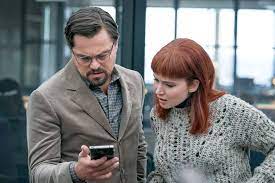
   McKay employs a large cast, turning a team of big-name actors into ensemble players. The list: Leonardo DiCaprio, Jennifer LawrenceCate Blanchett, and Meryl Streep. 
   He finds room for Ariana Grande and Kid Cudi -- not to mention Jonah Hill, Timothee Chalamet, and Mark Rylance.
   As much as it has one, DiCaprio and Lawrence occupy the film's center. Looking plump and nerdy, DiCaprio plays Randall Mindy, an astronomer who teaches at a Michigan university. 
   Lawrence appears as Kate Dibiasky, one of Mindy's grad students, Kate discovers the comet that's hurtling toward Earth.
   Duly alarmed, Mindy and Dibiasky travel to Washington to inform the president, a preoccupied hack played by Streep. Streep's Jeanie Orlean worries about saving a jeopardized Supreme Court nominee who has been caught in a porn scandal. Hill plays her patronizing chief of staff.
    Frustrated, Mindy and Dibiasky turn to the media, a morning TV show hosted by an aggressively genial team (Tyler Perry and Blanchett) who spend more time on a celebrity break-ups than on looming catastrophe.
     And when they do turn to the comet, they try to establish Mindy as a lovable scientist with what just might be a whacky theory. 
    Blanchett's Brie Evantee struck me as a riff on the character played by Faye Dunaway in Network, an ambitious, amoral, thrill-seeking woman who turns Mindy's head away from the loyal wife he's left in Michigan with their two teenage sons.
    Mindy eventually breaks ranks with the power brokers to give a Howard Beal-like speech intended to shock an over-entertained public out of its slumber.
   After much hemming and hawing, the US opts to send a tough-guy astronaut (Ron Perlman) into space to blow up the comet. McKay also introduces a tech company entrepreneurial genius (Mark Rylance in a gem of a performance) who has his own ideas about how to save the planet.
     McKay knows how to mine (perhaps over-mine) scenes for amusement and, as the movie progresses, the satirical strokes become bolder and more alarming -- at least that must have been the intent. The populace divides over whether the comet is actually on its way or whether it's another hoax. 
   The anti-comet folks adopt a slogan ("Don't Look Up") and wear red baseball caps. Remind you of anything?
    If you see the movie, stay through the credits for an epilogue that ties up a loose end that otherwise would have been left dangling.
    Did I laugh? Occasionally. Were some of the performances dead on? Sure. After all, McKay’s working with a great cast.
     But Don’t Look Up could be a case of misguided effort: It's possible that reality already is so ripe with extremes that it no longer can be satirized — or perhaps satirical efforts must be so keenly focused that absurdity is handled piece-by-piece. 
    As for the whole ball of wax? Well, as someone once said of a particularly brazen tabloid. It can't be parodied. All you have to do is quote it. Sounding as if you’re quoting it — which often is the case with Don’t Look Up — isn’t enough.
     

Thursday, July 25, 2019

Tarantino: adrift at the end of the '60s

Leonardo DiCaprio and Brad Pitt excel in Once Upon a Time in Hollywood, but not everything about the movie clicks.
A preview screening of Once Upon a Time in Hollywood was preceded by a contest. Members of the audience, many in costume, were asked to decide who had done the best job of representing their favorite character from director Quentin Tarantino's previous eight movies. I bring this up because the costumes (and the effort that some members of the audience put into them) suggest something particular about Tarantino, something that seldom applies to other filmmakers: Tarantino has a committed, devoted, and demonstrative fan base.

It's no small thing for a director to generate that kind of enthusiasm and it has been a long time since I've been at a screening where the pre-movie atmosphere was so contagiously upbeat. Normally, I disdain promotional efforts, but I have to admit that, after some initial dismay, I enjoyed all the anticipatory zeal.

So, in my view, did the movie meet expectations? I wish I could answer that question with an emphatic yes or no. But for me, the answer turns out to be blurrier. Put another way, parts of the movie are enjoyable and parts -- shocking considering who made the movie -- drift toward dullness.

Let me break it down:

Tarantino builds his movie around two major characters, a once-popular film and television actor (Leonardo DiCaprio's Rick Dalton) with a fading career. Dalton's stand-in and stuntman (Brad Pitt's Cliff Booth) functions as the actor's devoted aide. Cliff provides Dalton with friendship and support.

At the same time, the movie rubs shoulders with real-life events of 1969, the shadowy operations of the Manson family as it makes its way toward the now-famous Tate/LaBianca murders. The Manson family hovers like a putrid cloud over the counterculture, waiting to unleash a bloody, destructive rain on its purported sweetness.

These two parts of the movie eventually must intersect. As it turns out, Dalton lives on Cielo Drive next door to actress Sharon Tate (Margot Robbie) and her husband, director Roman Polanski (Rafal Zawierucha).

Among his many skills, Tarantino has been a master of creating movies with moving parts while, at the same time, energizing each narrative thread, wheels within wheels or something like it. This time, not all of the parts move, some stagnate, and I wouldn't say that Once Upon a Time offers Tarantino's sharpest dialogue.

The major performances in Once Upon a Time do, however, stand out. DiCaprio infuses his portrait of a narcissistic actor with deep pathos. Not only is Dalton trying to salvage a sagging career, but he's also desperate to prove to himself that hasn't totally lost his acting chops to alcohol, indulgence and the industry's increasing indifference to him.

Pitt's work as Cliff represents another triumph. Less ego-driven than his boss, Cliff has a loosey-goosey spirit that's underlined by toughness. When the screenplay raises questions about whether Cliff murdered his wife, we're not sure what to make of this guy. Pitt delivers a comic classic when his character smokes a joint that has been dipped in LSD. And a scene in which Cliff confronts Bruce Lee (Mike Moh) on a studio backlot comes close to justifying the price of admission.

Not surprisingly for a sprawling movie, Once Upon a Time has a large cast. The actors who register include Margaret Qualley as Pussycat, one of Manson's followers, a teenaged harpy who projects levels of bravado she couldn't possibly have earned. At the same time, her street-kid pluck catches Cliff's eye.

Robbie's Sharon Tate emerges as a blithe presence, a starlet floating wide-eyed through her life, either partying or reveling in the small parts she's played in movies. She seems a bit vacuous, a woman happy in her world.

Tarantino also dots the movie with references to the kind of '60s flotsam for which he presumably has some fondness. These are embedded in the movie when characters listen to the radio, watch TV or drive past movie marquees. They become tiresome, self-conscious in-jokes.

Although Once Upon a Time in Hollywood doesn't have much of a story, its atmosphere -- LA in the '60s -- surrounds the characters. It's the air they breathe.

Now, it's impossible to talk about the movie's ending without spoilers. I'll say nothing, except to say that it allows Tarantino to indulge his taste for comic violence, something at which he has few peers. One other aside: Tarantino knows movies, but I wouldn't turn to him for historical interpretation.

What to make of all this? I saw the movie as a grab bag of episodes, some well-constructed, others slack. And I wouldn't call the movie an endorsement of the counterculture. Both Dalton and Booth are contemptuous of hippies. They live in show-business isolation. If anything, the movie displays more affection for bygone TV (shows like Mannix than for other aspects of the '60s.

There's also something disturbing about the fact that the movie draws most of its tension from what we know about the looming Manson crime. When Cliff visits the Spahn ranch where the Manson family resides, the movie becomes intensely creepy.

What I've most enjoyed about my favorite Tarantino movies (Reservoir Dogs, Pulp Fiction and the Kill Bill movies) is their audacious desire to entertain on their own terms. I guess that leads to my last word. I found Once Upon a Time a movie to be savored in pieces, sketches that never amount to a fully realized painting.

Tarantino may have wanted to flood a single movie with jaded savvy and affection for parts of the culture he once avidly consumed, all topped with fairy tale flourish. Does the approach work? Sometimes, but not for all of the movie's two-hour and 40-minute running time.

Monday, February 29, 2016

Best picture 'Spotlight,' a welcome upset

Host Chris Rock scored big in the opening as Oscar lumbered its way through a controversial year.

In the end -- and the end was a long time coming -- the Academy of Motion Picture Arts and Sciences did the right thing: It awarded the best picture Oscar to the best picture. Spotlight, which did not have a stellar night otherwise, walked away with the evening's biggest prize.

I have to admit that I was surprised. Most prognosticators thought The Revenant would win best picture: I expected The Big Short to pull off an upset because it was both entertaining and meaningful. The Academy went me one better, and recognized Spotlight. I've never been happier to be wrong about an Oscar prediction.

As for the rest ...

It was an OK but typically labored evening that was guided by a mostly sharp Chris Rock, whose opening monologue lived up to just about everyone's expectations. I could spend time quoting lines from it, but I don't need to. I'll refer you instead to a link at which you can read his entire opening.

Suffice it to say that Rock was trenchant when he needed to be, immediately addressing the elephant in Oscar's room, the diversity issue that has dominated this year's awards season.

Once it got rolling, the program pretty much conformed to the standard model, receiving an energy boost from the lone upset that broke the tedium of watching Mad Max: Fury Road clean up in the costume, make-up, editing, sound and production design categories. As a fan of Ex Machina, I was particularly glad to see that movie win an Oscar for visual effects.

Mark Rylance's win in the best supporting actor category counts as another of the evening's surprises. Sylvester Stallone, who reprised his role as Rocky Balboa in Creed, had been the sentimental favorite.

Could voters have been reluctant to acknowledge Stallone in a year when there was much complaining about the fact that Creed's star -- Michael B. Jordan -- was ignored by the Academy?

That's not to say that Rylance wasn't deserving. He gave a fine performance as a Russian spy in Bridge of Spies.

If you're of a cynical bent, you might think the evening's many black presenters were on hand to counter the #OscarsSoWhite campaign that's been raging since the nominations were announced.

Some recipients -- notably Alejandro G. Inarritu, who won best director for The Revenant -- called for more opportunity for people of color.

In some ways, though, Oscars are only the tip of Hollywood's institutionally white iceberg.

A real increase in inclusion depends on diversifying the ranks of those who make key decisions at studios, as well as on breaking down stereotypical casting habits.

As is customary, there were bits that didn't work, notably the production number that accompanied Earned It, the nominated song from 50 Shades of Grey. As he sang, The Weekend was encircled by dancers who looked as if they were auditioning for 50 Shades of Victoria's Secret.

It's nearly impossible this time of year to go to the supermarket without being asked to buy Girl Scout cookies. Now, the Girl Scouts have invaded the Oscars. About midway through the proceedings, Rock brought out a troop of Los Angeles Girl Scouts who sold cookies to the audience, raising more than $65,000.

In what surely was a lapse in judgment, Rock neglected to say whether Tagalongs outsold Samoas.

What else? Showing lists of those who were being thanked at the bottom of our screens was a dumb idea. Without people to thank, most recipients had little to say.

An exception: Brie Larson, who won best actress for her performance as a kidnapped young woman in Room. Larson thanked both the Telluride and Toronto Film Festivals, which served as launch pads for her movie. In an additional display of Oscar graciousness, she also thanked those who went to see her movie.

I suppose it's important to mention Joe Biden. The vice president introduced his "friend" Lady Gaga who sang 'Til It Happens to You, the emotional song from The Hunting Ground, a documentary about rape on college campuses. That song lost to Writing's On the Wall, the theme from Spectre, a tune I hope never to hear again.

And, of course, there was Leo. Leonardo DiCaprio finally won his Oscar for his physically challenging performance in The Revenant.

That, and a considerable amount of Oscar fatigue, leads me to the real moral of last night's Oscars: One never should underestimate the power of crawling inside a dead horse. You never know what good will come of it.

For a complete list of winners, try ABC News.

Thursday, January 7, 2016

Raw, brutal 'Revenant' proves riveting

Leonardo DiCaprio plays a man locked in a ferocious battle for survival.

After a brief prologue, The Revenant immerses us in a fierce battle that takes place in a forest bathed in eerie light. I'm not sure I've ever seen anything quite like the way director Alejandro Gonzalez Inarritu's camera captures an Arikara Indian attack on a white hunting party.

Instantly, Inarritu -- with an amazingly able assist from cinematographer Emmanuel Lubezki (Birdman, Gravity and The Tree of Life) -- throws us off balance. Inarritu's images are shockingly realistic, yet his movie almost feels as if it's taking place in an alien world where the natural environment alternates between beauty and cold indifference.

I've read that Inarritu (Birdman and Babel) did most of his filming at dawn or dusk, times when the light feels chilled and elusive. His decision paid off.

There's not much build-up to the movie's opening bloodbath, but that may be fitting: The Revenant isn't about pauses and reflection; it's a heart-pounding story of one man's attempt to survive the frontier in the 1830s.

In what surely was a physically grueling experience, Leonardo DiCaprio plays Hugh Glass, the tracker who tries to plot a course that will save the small group of men who survive the movie's opening attack. These surviving hunters are being led by Andrew Henry (Domhnall Gleeson), a man who struggles to remain even-handed in what increasingly looks like a blood-thirsty slaughterhouse.

DiCaprio's Glass spans two worlds. He's a white man who was married to a Pawnee woman who was killed by white soldiers. He has a half-Pawnee, teen-age son (Forrest Goodluck) to whom he's entirely devoted.

If you've read anything about The Revenant, you already know that one of the movie's most shocking scenes occurs when a bear attacks Glass. Making use of convincing CGI, Inarritu presents a harrowing assault in which Glass is so severely mauled, we expect him to die on the spot.

The word "revenant" means one who has returned from the dead, and the term never has been more aptly applied than to the character DiCaprio portrays in this bloody, physical and obviously demanding performance.

As The Revenant progresses, it becomes clear that Glass again and again will be tested.

If you're looking for survival strategies, you could do worse than multiple viewings of Inarritu's adventure. The Revenant offers lessons in how to catch and eat raw fish or cauterize a severe wound.

In another of its memorably gory scenes, Glass removes the entrails from a newly dead horse so that he can crawl into the animal's carcass, using what's left of its warmth to preserve himself from the cold. His emergence from the animal after a blizzard stands as one of Glass' many symbolic rebirths.

Not only does Glass face natural obstacles; he also must deal with a human enemy. John Fitzgerald (Tom Hardy) believes in money and survival; he tries to convince his companion, Bridger (Will Poulter), that they should put the wounded Glass -- reunited with the other hunters after the bear attack -- out of his misery. So long as Glass remains alive, he only can slow the party down. They must drag him over rough terrain on a litter made of wood.

Speaking with a frontier accent that sounds like a cross between a garbage compactor and Tommy Lee Jones, Hardy again loses himself in a role, so much so that it may take you a while even to realize he's in the movie. Nothing about The Revenant dissuaded me from thinking of Hardy as one of the best screen actors working today.

Working from a screenplay by Mark L. Smith and Inarritu that's partly based on a novel by Michael Punke, The Revenant forces Glass into one life threatening situation after another, each presented in convincing enough fashion to make the movie a stomach-tightening ordeal.

Late-picture attempts to add an ethical dimension to the movie's revenge plot (I haven't talked about it much to avoid spoilers) aren't especially convincing, and at two and a half hours, Glass probably faces one challenge too many.

But The Revenant provides Inarritu with an opportunity to present a view of the frontier as a place of nearly unrelieved brutality and looming death, all augmented by Lubezki's brilliant cinematography.

If Inarritu was trying to give his movie mythic status, I don't believe he succeeds. In some ways, The Revenant is a glorified action movie, its scenery coated with ice and snow and brimming with forest mystery. But there's no denying that The Revenant feels as if it's taking place in a frozen expanse where both Glass and an audience are effectively put through a merciless wringer.

Lament it if you will, but that's part of what we've come to regard as entertainment.

Tuesday, December 24, 2013

Boys will be boys -- on Wall Street, too

Scorsese and DiCaprio whip up excitement, but where's the depth?
If director as talented as Martin Scorsese tackles the subject of Wall Street greed, it's probably appropriate for us to expect a little greatness, a movie that puts its finger on the pulse of something deep and important in the American moment. We want (or at least I want) a movie that scores a thematic bullseye.

That's not what we get with The Wolf of Wall Street, Scorsese's hopped-up look at the wheeling-dealing world of corrupt brokers whose piles of money grew tall, but whose ambitions remained distressingly shallow.

Don't get me wrong: The Wolf of Wall Street -- which is based on a true story -- can be wildly, even rudely, entertaining. In one surprisingly funny scene, Scorsese and Leonardo DiCaprio -- as swindler Jordan Belfort -- demonstrate an unexpected facility for slapstick: Belfort tries to function after Quaaludes have brought him to a state of near-paralysis.

Beyond such antic moments, Wolf of Wall Street brims with the kind of whirling energy that reflects the unbridled hedonism of its central character and his gang of eager cohorts.

Working from a script by Terrence Winter, Scorsese uses his considerable powers to immerse us in a gleefully amoral world of drugs, cocaine, sex and wanton spending. It's the 1990s, and money and libido rule.

Judging by the movie, Belfort's greatest (and perhaps only) insight may have been his realization that it's more lucrative to swindle the wealthy than to mess with working stiffs. He elevated his game from a low-rent clientele to the upper reaches of society. He called his company Stratton Oakmont.

Belfort and his unscrupulous cronies got rich by driving up the price of obscure penny stocks. They unloaded shares they controlled at the high point, forcing those same stocks to tank. They reaped obscene profits; unwary customers were hit with big losses.

In a performance that must have required every ounce of energy he possesses, DiCaprio turns Belfort into a cheerleader for self-interest. In a series of fervent speeches to the brokers who work for him, he creates a frenzied atmosphere. He feeds their appetites with encouragement, motivational blather and occasional visits from hookers.

Less a carefully shaped drama than a feverish accumulation of comedy and excess, Wolf of Wall Street begins when a naive Belfort learns the ways of Wall Street from a seasoned broker (Matthew McConaughey), a guy who might be an older version of what Belfort's destined to become.

The ethos espoused by McConaughey's character is as simple as it is jaded: The point of working on Wall Street isn't to make money for clients, it's to make money for oneself. This means snaring customers in a trap in which irresistible promises blur all reason. One stock sale is supposed to lead to another.

Although the firm he initially works for goes belly up after the Black Monday collapse of 1987, Belfort finds his way to a boiler-room brokerage operation on Long Island. There, he learns that he had an uncommon gift for selling penny stocks.

Belfort brings what he learned about big-time Wall Street hustling to a disreputable portion of the market. He eventually strikes out on his own, establishing his first operation in a converted garage.

He does this with help: Sporting a set of false teeth that transform his face, Jonah Hill gives what might be a career-changing performance as Donnie Azoff, Belfort's partner in dissipation and crime.

Azoff sometimes plays bad cop for Belfort. At one point, he swallows an employee's live goldfish: The poor sap has had the audacity to clean the fish's bowl while the staff is supposed to be preparing to take a hot new company -- fashionable Steve Madden Shoes -- public.

Hill makes Azoff crassly funny in ways that would be repulsive if it weren't for his apparently boundless lack of self-consciousness.

As is usually the case with Scorsese movies, milieu dominates. Wolf of Wall Street is not populated by MBA-wielding sharks; it's full of lower middle-class guys, strivers from New York's outer boroughs trying to strike it rich.

I wish Scorsese had done more to emphasize this Wall Street class gap: It might have helped more fully to explain Belfort's motivations and to give events in the movie some useful context.

Belfort sees his ascendance as an expression of his right to maximize opportunity. He talks about money as if were a territory, a land to be conquered and claimed. Those too timid for the task will be left behind, assigned to lives dominated by Ford Pintos and wives growing wide in the bottom. Belford made sleaziness seem heroic.

Scorsese makes sure that debauchery arrives in epic proportions, reaching its height (no pun intended) on an orgiastic airplane flight from New York to Las Vegas.

Scorsese's supporting cast is mostly dwarfed by DiCaprio and Hill. Australian actress Margot Robbie impresses as Naomi Lapaglia, the blonde model for whom Belfort dumps his first wife (Cristin Meloiti).

You'll find cameos from a group as diverse as director Spike Jonze (as a boiler room broker) and author Fran Leibowitz (as a judge).

Rob Reiner has a nice turn as Belford's hot-tempered father. Jon Favreau portrays a lawyer. Former New York cop Bo Dietl appears as himself. Jean Dujardin, familiar from The Artist, plays a Swiss banker who's knowledgeable when it comes to money laundering.

Some scenes are first rate, notably a confrontation between Belfort and a canny FBI agent (Kyle Chandler). The scene takes place on Belfort's yacht and leaves little doubt that Chandler's character can't be seduced or bought, two of Belfort's specialities.

Is the movie watchable? You bet.

But like nagging second thoughts after you've made a big purchase, questions ultimately arise. How much sex and drug-taking do we need to see before we get the point? Does Winter's script -- evidently embellished by a fair amount of improvisation from the actors -- ever get around to expressing a viewpoint about's taking place? Has Scorsese given his raving romp any real depth? Does he ever get beneath the movie's libidinous surfaces?

I think you already know how I'd answer those questions.

At three hours in length, Scorsese's wild opus is never boring, but it seems to have been made with the same kind of irrepressible smile you might see on faces at a reunion of aging, former frat brothers, all of them sitting around a bar, happily and a little too eagerly recalling the shameless excesses of yesteryear.

And one more thing: Let's say we're meant to be appalled by the cartoonish carnality of Belfort and his wild-living bunch. Would it have been better if they had used their ill-gotten gains to buy critically acclaimed art work? Should they have been more community minded and given money to charities or endowed a chair at a major university?

What are we supposed to see as their worst crime, that they may have ruined a lot of lives or that they had hopelessly boorish tastes?


Thursday, May 9, 2013

A 'Gatsby' full of razzle dazzle

Baz Luhrmann goes way over the top to tell a classic American story.


Director Baz Luhrmann has accomplished something close to extraordinary in his vivid, dizzying and ultimately misguided version of The Great Gatsby. He has taken F. Scott Fitzgerald's iconic 1925 novel -- a classic of American literature -- and turned into as glossy and colorful an extravaganza as might have been seen in the days when big-screen spectacles were drenched in three-strip Technicolor.

Put another way: Luhrmann's Gatsby has the glamour-laden production values of a musical -- only one in which somebody forgot to write the songs.

Luhrmann, who already has proven himself a maestro of overstatement in works such as Moulin Rouge! and Romeo & Juliet, has added 3-D to this version of Gatsby, presumably to give the movie a sense of immersive depth. The 3-D images might be the only depth you'll find in this showy, anachronistic and occasionally cartoonish version of the Gatsby story.

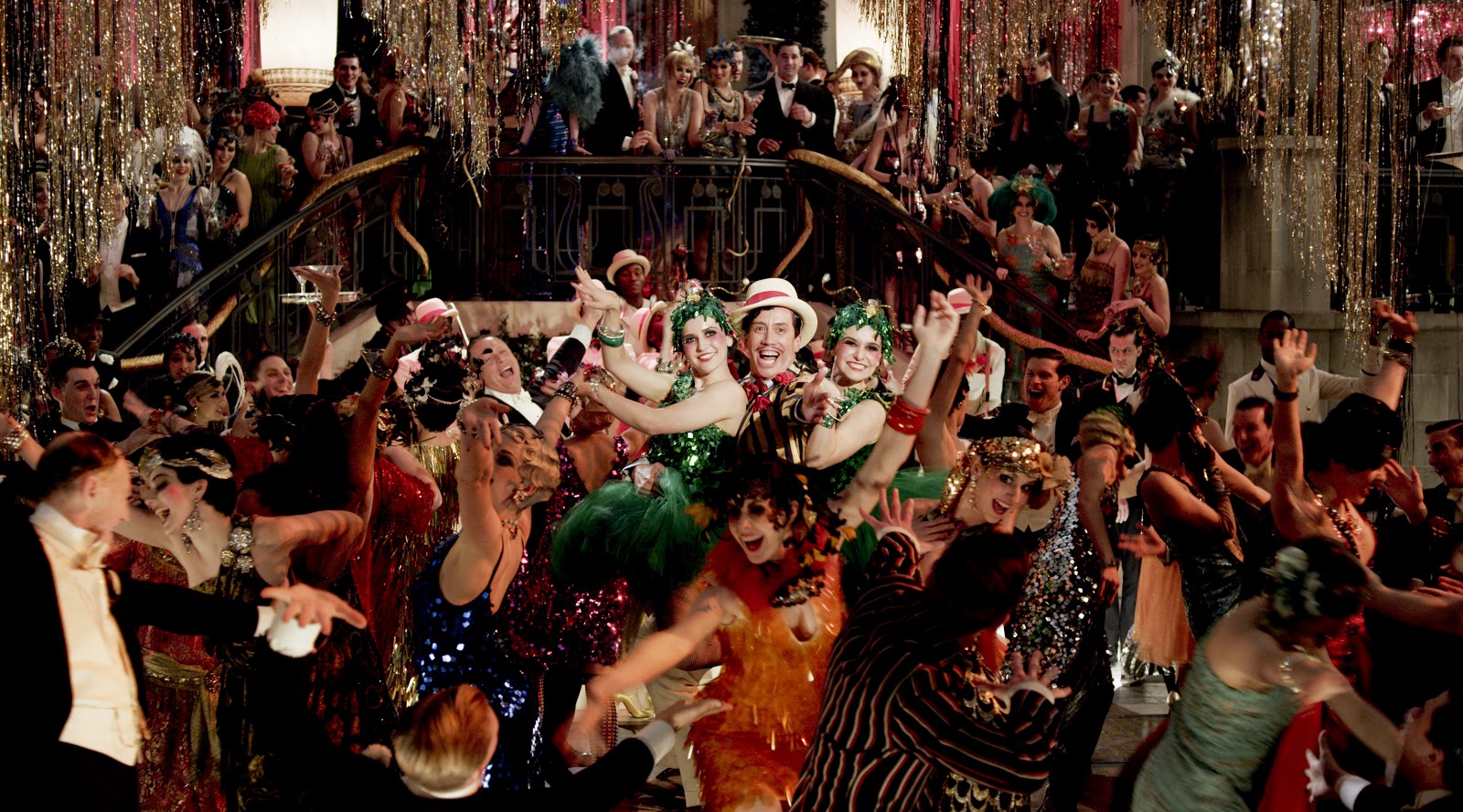
In Luhrmann's hands The Great Gatsby has become a frenzied display of technique, much of it devoted to creating the bacchanalian delirium that turned Gatsby's fabled parties into a magnet for New York's high-living crowd. Are we talking Gatsby or outtakes from the Playboy Mansion? You be the judge.

Fitzgerald, of course, told the story through a narrator named Nick Carraway, a Midwesterner who travels to New York and rents a small cottage next to Gatsby's ostentatious Long Island mansion. Nick meets Gatsby because of Gatsby's long-standing and unquenchable love for a woman named Daisy, who happens to be Nick's cousin. Nick is supposed to serve as a go-between for Gatsby and Daisy.

When we meet Daisy, she's already married to Tom Buchanan, Yale graduate and certifiable lout who indulges his libido with Myrtle (Isla Fisher), a low-class mistress from Queens.

Luhrmann uses some of Nick's narration (i.e., Fitzgerald's prose), even allowing pieces of it to wander across the screen in the form of typescript that floats above the fray.

But fidelity to text is hardly the point here: Luhrmann hasn't recreated America of the 1920s. He has invented a dreamscape all his own; the movie -- which mixes rap and Gershwin on its sound track -- isn't so much an evocation of the past, but a visit to an alternate universe stocked with jiggling flappers, feverish jazz musicians and a Jewish gangster played by an Indian actor (Amitabh Bachchan) who seems to have wandered into the story from some multi-cultural universe of the 21st century.

Luhrmann's Gatsby is a bold, vividly realized and distressingly literal retelling of a story that has been put on film before, but never with so much loudly trumpeted artifice and self-conscious daring; the soundtrack arrives complete with musical contributions from Jay Z and Beyonce.

Of course, Luhrmann has made alterations to the story (Nick tells the tale from some sort of rehab facility where he's struggling with alcoholism and regret), but changes to Fitzgerald's story are the least of the problems. Most of those center around the fact that Luhrmann has taken the events of the novel -- always secondary to Fitzgerald's prose -- and added so much technologically created upholstery that everything collapses into it.

Only those who do not own television sets can have escaped prior knowledge that Leonard DiCaprio portrays Jay Gatsby, the hopeful and deluded man who spends a lifetime trying to recreate his past so that he can become a suitable suitor for Daisy, a member of the upper classes to which the low-born Jay longingly aspires.

Looking as if he's posing for a fashion ad in the Sunday New York Times magazine, DiCaprio projects the calm of a man who's willing to create a storm to attract the beautiful Daisy who lives across the bay from him. And, yes, Gatsby spends an inordinate amount of time staring across the dark waters of Long Island Sound at the luminous green light that glows on dock of the Buchanans' East Egg home. The symbolism is inescapable: The light represents everything that remains visible but out of reach for Gatsby.

Gatsby is one of those amorphous figures who tries to create a new version of himself, but only can achieve it by associating with and profiting from the corruption and crime that leads to quick wealth. He has obscene amounts of money, but his affluence never can equal the more seasoned wealth that people such as the Buchanans have come by as a birth right.

Daisy is played by Carey Mulligan, who seems entirely too grounded for the part of a dreamy fantasy girl. A scowling Joel Edgerton portrays her husband Tom, polo player and former Ivy League jock, a man with a smash-mouth personality. In Luhrmann's hands, these pivotal characters seldom seem like plausible people; they move through the movie carrying the weight of the literary archetypes that they seem to represent.

As for Nick, the narrator ... well ... let's just say that Tobey Maguire rises to the challenge of making him as uninteresting as most narrators are, the man who floats outside the story, fascinated by it but unattached to its core.

Of all the characters, only Daisy's friend Jordan Baker -- played by Elizabeth Debicki -- seems to fit into a recognizable universe.

By now, I'm sure you've caught my drift; Luhrmann's movie is more about production design than about the distorting powers of the American dream. Its rewards have more to do with vintage cars, sprinting camera movements and glitzy overstatement than with the tragic undertow of Fitzgerald's story.

A confession of sorts: I watched The Great Gatsby with a sense of sustained amazement at Luhrmann's capacity for emotional amplification, but presenting an entire movie in an over-the-top style doesn't leave much by way of wriggle room.

I suppose sales of Fitzgerald's much-purchased novel will enjoy an inevitable boomlet because of Luhrmann's movie, but I'd be willing to bet that this Gatsby has more influence on American fashion than on the country's intellectual, emotional or cultural life.

In that sense, Luhrmann may have found the key to bringing Fitzgerald's film-resistant novel to the screen. Luhrmann may not get at much that feels real or substantial, but his Gatsby sure as hell is dressed for success.

Monday, December 24, 2012

'Django Unchained,' also unhinged

A different setting, but it's the same old Tarantino.
Having taken vengeance for the horrors Jews suffered at the hands of the Nazis in Inglourious Basterds, Quentin Tarantino shifts his attention to blacks in Django Unchained, a wild assault on the antebellum South: land of plantations, slavery, sexual perversity, leering sadism and bloody violence.

If you're wondering -- as I am -- why Tarantino has assumed so many vengeful burdens, I'll wonder along with you. I leave it you to decide whether Jews and blacks should be grateful, offended or indifferent to revisionist fantasies conducted on their behalf.

I wasn't a total fan of Inglourious Basterds, but I'd rank it above Django Unchained, another Tarantino exercise in genre eclecticism that twists the past into something as lurid as an exploitation movie -- only one in which the comic elements have ceased being inadvertent and clearly were intended.

Django Unchained borrows from Spaghetti Westerns (notably 1966's Django by Sergio Corbucci), rap music (I'm not kidding), Blaxploitation movies of the '70s and even other Tarantino movies. In assembling the movie's several acts, Tarantino creates a work that's wanton in its excessiveness -- and that includes its two-hour and 46-minute length.

That's an awfully long time to tell a relatively simple story about Django (Jamie Foxx), a slave who's freed by a bounty hunter and who develops into a kind of laconic cowboy hero with whom no one would want to mess.

Those who know Tarantino's movies (and who doesn't?) won't be surprised to learn that Django Unchained lets the N-word flow freely, includes a surfeit of vividly mounted violence and splashes its way through the kind of old-fashioned southern racism that looks indistinguishable from sadism.

Tarantino fans probably won't mind any of this, and those who don't count themselves among the director's devotees may be consoled by performances that include tasty turns from the incomparable Christoph Waltz (as the bounty hunter who frees Django from slavery and makes him a partner) and Leonardo DiCaprio (as a genteel southern slave owner and monstrous example of humanity).

In many ways, Django is a tonal free-for-all, even boasting a scene that may remind you of Mel Brooks. Tarantino depicts a gathering of Klansman as a convocation of dimwits who complain about not being able to see through the eye holes in masks that have been crudely and ineptly made by the wife of a Klansman.

Other scenes seem to transpose familiar Tarantino tropes (exchanges of dialog that play like gunfights) into new settings.

The story seems nothing more than an outline onto which Tarantino grafts numerous riffs. Waltz's Dr. King Schultz, a former dentist turned bounty hunter, liberates Django in the early going. Schultz's motives aren't entirely altruistic; he knows Django can identify a couple of hoodlums he's been hunting. He wants to collect the reward money.

Django and Dr. Schultz work together before heading to Mississippi to rescue Django's wife (Kerry Washington), who was sold to another slaver after the couple was caught trying to run away. Washington's Broomhilde even speaks a little German, a skill that the screenplay makes use of later.

During this phase of the movie, Foxx pretty much holds himself in reserve, saving Django's blossoming fury for a finale in which it emerges with explosive force.

But Foxx carries a big -- and perhaps impossible -- burden here: He's not only playing a character, he's illustrating ideas about the ways in which blacks have been portrayed on screen with a view, one supposes, toward ultimately subverting such stereotypical images.

To rescue Broomhilda, Django and Dr. Schultz must invade the preposterously named Candieland, a massive planation owned by DiCaprio's Calvin Candie, a plutocrat who enjoys watching dogs tear apart runaway slaves, has a black mistress and forces strapping black men to fight to the death for his personal amusement.

Schultz and Django concoct a ruse that gains them entry into Candieland. They pretend to want to buy a fighter of their own. They hope that Candie will include Broomhilda as an add-on, someone with whom the German-born Schultz can enjoy chatting in his native tongue.

Once in Candieland, Django and Schultz also encounter Stephen (Samuel L. Jackson), a house slave whose speech and inflections recall Jules, the character Jackson played in Tarantino's Pulp Fiction. Stephen, who has served the Candie family for years, isn't outwardly subservient, but he knows where his Big House bread is buttered. He remains loyal to his master.

Tarantino builds tension, and some of the scenes in Django Unchained are beautifully executed, DiCaprio, Waltz, Foxx and others at a tense formal dinner in Candieland, for example.

Enjoyable in bits and pieces Django Unchained is another off-the-hook helping of Tarantino. If you want to take the movie seriously, you can argue that Tarantino is playing around with film iconography from several generations of "B" and mainstream movies, although that may make Django Unchained a tough talking entertainment for cinema geeks. You also can look at it as a full-blown exercise in absurdity or as a simple revenge saga.

But whatever it aspires to be, Django Unchained felt a little old hat to me, Tarantino strutting his stuff in another genre playground. And by now, Tarantino movies have acquired an almost clubby aura in which cinematic in-jokes, outré slices of violence and ample helpings of the "MF" word act as signifiers of a brand of movie "cool" that forgives every indulgence and all manner of cruelty, so long as the tables eventually are turned.

But the trouble with revisionist revenge sagas is that they don't really loosen the grip of the past; they take aim at images and play with situations we know from other movies, often standing them on their heads. The whole business is a bit like shooting at ghosts. You make a lot of noise, but, in the end, you have to wonder whether you've actually hit anything.


Thursday, November 10, 2011

'J. Edgar' lacks a compelling point of view

There's much to admire about Clint Eastwood's look at J. Edgar Hoover, but the movie eventually becomes far too laborious.
He loathed Communism, saw himself as a staunch patriot and kept secret files on anyone he thought might threaten his ascendance. J. Edgar Hoover was a world-class intimidator, who used his manipulative skills and power to build the FBI into a national crime-fighting force.

It has been widely speculated that Hoover had yet another side to him, that he was a closeted homosexual who shared a marriage-like intimacy - if not carnal pleasures - with Clyde Tolson, his second in command.

This man of stunning contradiction is the subject of J. Edgar, a new and carefully assembled biopic from director Clint Eastwood and screenwriter Dustin Lance Black. Eastwood needs no introduction: Black, you may recall, won an Oscar for his screenplay for Milk, the story of slain San Francisco board supervisor* Harvey Milk.

Eastwood and Black seem to have genuine sympathy for the torment of those who are unable to acknowledge important parts of themselves - in this case, gayness. Eastwood treats Hoover's death in 1972 with a tenderness that's almost mournful.

And then there's the performance of Leonardo DiCaprio, who creates a stark and convincing portrait of Hoover as a troubled man who seldom lost his composure. Heralded in a recent New York Times piece as an actor who welcomes risk, DiCaprio hardly seems a natural fit for the role Hoover, but he meets the challenge.

DiCaprio provides the movie with a solid center, and he receives able support from Armie Hammer, who plays Tolson. Depicted as cultured and witty, Tolson became the second most powerful figure in Hoover's FBI. He also inherited Hoover's estate after the FBI director passed away.

Overall, Eastwood and Black seem to be trying for a tempered approach to Hoover's story, telling us that if he had them, Hoover never acted on any homosexual urges, that he was an early champion of forensic evidence, that he sometimes abused his power and that, on at least one occasion, he put on his mother's clothes.

But what do we take from a movie that's beautifully crafted and earnest to a fault? Not enough, I think. I kept waiting for J. Edgar to catch fire, but it moves somewhat laboriously over its two-hour and 16-minute length, never really finding a compelling point of view.

Moreover, J. Edgar suffers from a depressingly conventional structure: An aged and embattled Hoover tells what he bills as his side of his story to various young FBI agents, dictating chapter after chapter of a self-serving autobiography. Eastwood uses flash backs to develop the story from Hoover's perspective.

This gives the movie a kind "Hoover's Greatest Hits'' quality; "J. Edgar" lacks the organic punch of a great biopic. Hoover tells the story of the kidnapping of the Lindbergh baby and of his stormy relationship with Bobby Kennedy and more. But the movie has a near reportorial tone at times when outrage over Hoover's excesses (his campaign against Martin Luther King, for example) might have been more appropriate. Two women influence the story - albeit in small doses. Judi Dench portrays Hoover's strikingly imperious mother. She bossed him around; he didn't seem to mind. Naomi Watts fares equally well as Helen Gandy, Hoover's long-time secretary.

Any review of J. Edgar must also deal with the make-up issue.

I couldn't entirely shake my awareness of the make-up under which DiCaprio and Hammer (especially Hammer) are buried and which tends to give them eerie wax-works countenances, the look of the embalmed. If a character is aged for a final scene or two of a movie, it's easier to accept, but we see DiCaprio in full make-up throughout the movie.

Look, I respect Eastwood as a filmmaker, and he deserves credit for tackling a difficult subject, but he doesn't seem to have wrested his subject to the ground. J. Edgar moves from one incident to another, sampling an awful lot of history without ever quite knowing what to make of the man who gives the picture its name.


*In an earlier copy of this review, I incorrectly referred to Milk as having held the post of mayor.

Thursday, July 15, 2010

'Inception' knocks us off our moorings

It's not easy trying to survive in a world of dreams.

A supremely talented thief gathers a crew and readies himself for one last job, the caper that finally will allow him to abandon life on the run.

Sure you've heard it before, but Christopher Nolan, who directed the mega-hit The Dark Knight and who made a splash on the filmmaking scene in 2000 with Memento, energizes familiar cinematic ploys by putting them in a fresh context: Almost all of his new movie, Inception, takes place in dreams.

Already hailed as a masterpiece in some quarters, Inception arrives in theaters with high expectations in tow, and it would be dishonest of me not to begin by saying that the movie - which boasts some of the more impressive visuals of the year - does not require us to hoist flags and proclaim a national holiday.

Inception, which stars Leonardo DiCaprio, provokes plenty of thought, but operating in the world of dreams seems to have given Nolan license to confound, as well as to illuminate. He does equal amounts of both in a movie that contains a fair measure of visual wit and lots of ferocious energy.

Nolan employs a terrific cast as he develops the ideas in Inception - and, yes, we're talking about the ideas in the movie, not the ideas behind it. Tricky as it tries to be, Inception hardly misses a chance to tell us what it's up to, not that you'll get it all.

Because Nolan, who also wrote the script, is creating an entire universe, he needs to supply lots of rules-of-the-game dialog. In speedy fashion that virtually dares you to keep up, Nolan has DiCaprio's Dom Cobb explaining the ground rules. What happens if someone dies in a dream? Is it possible to get lost in dreams and never re-emerge? Where in the hell do all those projections inside our dreams originate? Is time in a dream the same as time in an awakened state?

Cobb, we soon learn, is an extractor by trade and training. He's able to invade dreams and come away with secrets buried in a dreamer's subconscious, a skill that he's evidently employed mostly to conduct industrial espionage. (And, no, that wouldn't be my first choice if I had a similar ability.)

Contacted by a Japanese entrepreneur (Ken Watanabe), Cobb is asked to conduct a perilous mission. He must invade the subconscious of the son (Cillian Murphy) of a recently deceased industrialist and plant an idea in the young man's head. It's an idea that will change the course of the future.

Nolan definitely is attuned to something intriguing, notably a view of dreaming as one of the strangest of human activities, the state in which we escape the rules that bind us throughout our waking moments. Working with his usual cinematographer, the gifted Wally Pfister, Nolan pulls out all the stops, and if you're able to give yourself over to the imagery, you'll definitely find yourself tripping right along with the filmmakers.

As is the case with more conventional "caper" movies, characterization is kept to a minimum. Joseph Gordon-Levitt, sporting a slicked back, bullet-head look, signs on as one of Cobb's assistants. Ellen Page, the gifted young actress who wowed the world in Juno, plays an architect who's engaged by Cobb to design dreamscapes.

Oops, I forgot to mention, the movie also introduces us to the concept of shared dreaming, the possibility that a variety of skilled folks can enter the same dream, each assuming responsibility for a different task.

Every dream needs to feel a little haunted. In this case, the talented Marion Cotillard adds spectral presence. She plays Cobb's wife, a woman from whom he has become estranged for reasons that can't be revealed in a review.

It's just here that Nolan should be credited for his most inspired casting. There's something ethereal, dreamy and dangerous about Cotillard's Mal, and she contrasts nicely with Page's Ariadne, a down-to-earth, practical woman who always seems to have one foot in reality.

And, yes, the images can be mind bending. At one point, Ariadne learns to manipulate dream realities, bending a cityscape in an effect that you may have seen in the movie's trailer, but which still manages to be breathtaking in the context of the movie. How long has it been since you've said, "Oh, wow?"

So what's Nolan up to, really? On one level, he's making a thriller. On another, he's trying to knock us off our moorings, and because movies often are compared to dreams - they can have the same sort of reality-defying fluidity - he may be commenting on the way we allow ourselves to be sucked in by filmmakers.

Novel as Inception can seem, it does evoke memories of other films. You may find yourself thinking about The Matrix, for example. I wouldn't have been at all surprised if Laurence Fishburne had wandered in for a quick scene. It would have made as much sense as anything else in Inception.

DiCaprio holds the screen throughout all of this planned chaos. He's playing a man who makes his living entering other people's subconscious minds, but who can't entirely control his own. That's another issue with which the movie toys: The idea of control. Who's the author of our dreams anyway? And on and on and on - for a not-quite-justifiable two and a half hours.

Now, it's my belief that Nolan could have accomplished all this with a little more narrative clarity. At various times, I found myself talking to myself, "OK, this is a dream. Now, we're in the dream within the dream. This seems to be the waking state."Am I watching a movie or am I experiencing short-term memory loss?"

A little such disorientation goes a long way, and Hans Zimmer's ubiquitous score doesn't provide a moment's respite, either. (Last time I checked, my dreams didn't have musical scores. Maybe that's just me.)

For my money, David Lynch is far better at showing the elasticity of reality and at luring us into worlds where we're never sure what's real and what's imagined. But Nolan has bigger commercial fish to fry than Lynch. With a major summer release, he must fuse art and action. Imagine if someone had told Fellini, a director who know something about dreamy imagery, that he had to add a few car chases to 8 1/2.

Should you go? Sure. See Inception, and get into your own dialog with the movie. Know this, though: My dreams - and I hope yours -- never have included noisy car chases, exploding fireballs or automatic weapons fire, a claim I'm not sure Nolan can make. But then again, I don't sell tickets to my dreams or expect them to reach blockbuster proportions. I'm just happy if I wake up.

Thursday, February 18, 2010

Scorsese's way creepy 'Shutter Island'

There's no shortage of gloom on Shutter Island.

The quickest way to sum up Martin Scorsese's Shutter Island is with a mild distortion of a cliché every writer is encouraged to avoid: It's one hell of a dark and stormy movie. Drenched in weirdness and flooded with water (in the form of hurricane-driven rains and bobbing seas), Shutter Island makes you feel as if reality is receding as steadily as an outgoing tide.

I can't say I totally believed what was happening in Shutter Island, but that may be part of Scorsese's strategy. In its own creepy way, the movie delves into the elusive nature of reality. It also finds an impressively strange setting in which to conduct its inquiries: A prison and mental hospital for the criminally insane located on a lonely island off the coast of Massachusetts.

Working from an adaptation of a Dennis Lahane novel, Scorsese has devoted his obviously substantial talents to creating an encompassing world of entrapment and dread. True to its name and location, Shutter Island definitely floats away from the mainland. It's always dangerous to speculate about a filmmaker's motivations, but I'm guessing Scorsese wants us to lose our grip.

In his fourth major collaboration with Scorsese, Leonardo DiCaprio plays U.S. Marshall Teddy Daniels. It's 1954, and Daniels and his new partner (Mark Ruffalo) have been summoned to Shutter Island to investigate the mysterious disappearance of Rachel Soldano, a woman who murdered her three children, but who has insisted throughout her incarceration that her kids are still alive.

As they investigate, DiCaprio and his partner are met with a series of confounding revelations. First off, the island seems escape proof. Soldano vanished while locked in her room. Orderlies she would have had to pass on her way to any exit claim they never saw her leave. So where the hell did she go?

The always crisp Ben Kingsley plays Dr. Joseph Cawley, the shrink in charge, and Max von Sydow, as severe as ever, portrays another psychiatrist. Von Sydow's Dr. Naehring seems to wield ultimate authority on Shutter Island, a place where prisoners are referred to as “patients” and where lobotomy looms for the most intractable of the island's residents. Cawley insists that he's more interested in helping his patients find a measure of peace than in turning them into harmless, post-lobotomy blobs. Could he be up to something more nefarious?

It should come as no surprise that Scorsese whips up a fair measure of bravura filmmaking. In a brilliant opening, a seasick Daniels and his partner approach the island on a ferry. What we first take as the ferry's fog horn morphs into the musical score in brilliant, ominous fashion. A hurricane that strikes the island is presented with palpable force, and even scenes in which Daniels thinks he's seeing his late wife (Michelle Williams) have an eerie imbalance. The same goes for flashbacks to Daniels' war-time service in which he helped liberate Dachau, the German concentration camp.

It's difficult to think of a recent movie that has made such distinctive use of music. I was conscious of the music – normally not a good thing – but it began to feel like one more element in the environment of dislocation that Scorsese successfully creates. With a potent assist from musical director Robbie Robertson, Scorsese makes use of lots of contemporary classical works from notables such as Krzysztof Penderecki, whose music (The Dream of Jacob, I think) will give you a major case of the willies.

If you're looking for some previous movie references you'll find evocations of Stanley Kubrick and Alfred Hitchcock. And Dante Ferretti's production design – particularly for the hospital's dreaded Ward C – virtually defines the world “dank.”
Although the filmmaking in Shutter Island, which is based on a novel by Dennis Lahane, is as good as you'd expect and DiCaprio offers Scorsese an able assist, the movie suggests more than it's ultimately able to deliver. The payoff doesn't match the promise, and the story – which occasionally seems to be stumbling in the island's wilderness – begins to feel as if it's taking too long to find its way to a conclusion you may at least have glimpsed before it actually arrives. The ending? Well, we'll talk later.

Shutter Island poses a question that's wedded to the surface of things: Is seeing really believing? Scorsese makes us wonder, and keep on wondering after we've left the theater, but he doesn't dig deeply into the most perilous corners of the human heart nor does shake us to the core.

Think of how you felt after watching Taxi Driver or Raging Bull, and you'll know exactly what I mean.