Showing posts with label Jennifer Garner. Show all posts

Thursday, March 10, 2022

He brings quips on his time-travel trip


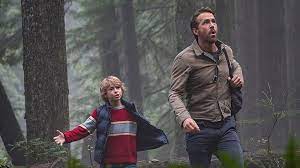
     Hints of Back to the Future waft through The Adam Project, a story in which a time traveler meets his younger self and tries to spare humanity from the oppressive future in which the movie begins.
     Working from a screenplay credited to four writers,  director Shawn Levy (Free Guy and Night at the Museum: Battle of the Smithsonian) does his best to freshen a formula that relies heavily on Ryan Reynolds's already established ability to be charmingly snide. 
       The well-received Free Guy (not by me) paves the way for  a  Levy/Reynolds collaboration that lacks the intricate maneuvers of the first movie but probably will please some fans. 
       Me? I’m lukewarm.
     Levy tries to give his movie a satisfying emotional core; i.e., a sentimental conclusion with wholesome messages attached, one strengthened by the presence of Mark Ruffalo as Adam’s father, a physicist who assures his son that he really did love him.
       Forgive the past tense here. Blame time travel.
       A strong cast that also includes Jennifer Garner, Zoe Saldana, and Catherine Keener adds appeal to a movie that employs action and special effects to show Reynolds's Adam Reed stealing a spaceship in 2050, plunging through a worm hole, and landing in 2022, the year in which he was 12. 
    Walker Scobell portrays young Adam, a quick-witted kid who's bullied at school. He may not be furious with his fists but he's seldom at a loss for words, a quality that sets up lots of verbal byplay between the two Adams.
      In 2022, young Adam is ensconced in middle school. He lives with his recently widowed mom (Garner). She’s confused about how to deal with a kid who can't always avoid trouble.  
     So why is the adult Adam racing through time? He wants to find his wife (Saldana) to alter a future in which she will fall prey to an evil corporate titan (Keener) who’s up to no good no matter what period in which she lands.
    Amid the somewhat generic action, Levy delivers bromides  about mother/son love and father/son reconciliation, not to mention the way lovers are destined to find each other in whatever time they live.
     The supporting cast helps elevate the proceedings, which lean heavily on Reynolds's ability to be the cynical guy who eventually learns that a heartfelt statement can be better than a quip. 
      No point, delving into plot mechanics. Know, though, that some of the interchanges between the two Adams are amusing and the movie establishes itself as amiably familiar, which -- I guess -- is better than stunningly awful.
     Or, as the clerk at the DMV shouted to the long line of license seekers, “Next.”

Thursday, September 6, 2018

'Peppermint': a kickless revenge saga

Jennifer Garner plays a character out for revenge, but a female star can't mask Peppermint's shamefully derivative approach.
Jennifer Garner's performance proves impressively convincing as a woman with a sparkling sense of humor and an obvious concern for the welfare of her audience, a pleasant variation of the girl-next-door image that seems to have taken over the actress's career.

Unfortunately, I'm not talking about the new movie Peppermint, a revenge saga in which the actress has been cast in the kind of role that's usually slotted for men. I'm referring instead to Garner's work in a series of Capital One Venture commercials in which Garner wonders what card might be in our wallets.

In Peppermint, Garner might still be playing the girl next door, but she's the kind of girl next door who happens to have acquired the stealthy prowess of a ninja, the lethality of a serial killer and the determination of Liam Neeson when he's in full Taken mode. No surprise there because in this lurid outing, Garner is being directed by Pierre Morel, who also directed Taken.

Gratuitously violent and ultimately serving as an irresponsible endorsement of vigilantism, Peppermint can't duck criticism by claiming that its formulaic approach should be accepted as a necessary helping of female empowerment. Man or woman at pulling the trigger, it's the same old movie.

Early on, Peppermint puts its bloody cards on the table: Garner's Riley North, her husband, and her daughter are gunned down -- on her daughter's tenth birthday and at a Christmas festival no less. Talk about piling on.

Riley's husband had become the target of a drug cartel, members of which mistakenly thought he was involved in a plot to steal some of their money.

After the legal system fails Riley, the only surviving member of her family, she disappears for five years, a time on which I'm not sure the movie devotes five minutes. Riley re-emerges as a warrior who somehow has acquired the skills necessary to avenge her family's horrible demise.

Garner gives her all to a movie in which her character tortures and blows up a judge (corrupt, of course), wields a mean knife and subscribes to a theory that that raises the ante on the old saw about an eye-for-an-eye. In Riley's case, one eye seems to be worth a hundred eyes. She piles up a war-like body count.

Most of Riley's victims seem to be fierce-looking Hispanic men with enough tattoos to cover a wall. I won't say which wall, but did so many Latino people need to be blown away?

There are two ways in which a movie such as Peppermint could have succeeded. First, it could have made us complicit in Riley's hunger for revenge; i.e., it could have induced us to share the satisfaction that accrues from seeing obvious miscreants brought to justice. Peppermint doesn't offer even this pleasure, guilt-ridden as it might be.

A surer road to success has to do with style. When the wave of Hong Kong movies from masters such as John Woo (Better Tomorrow, The Killer and Hard Boiled) were making their international bones in the 1980s and early '90s, they brought wild creativity to the choreography of violence. American descendants include such recent movies as John Wick.

Morel brings little by way of twisted panache to the movie's ample violence, which is presented without much by way of directorial innovation.

The supporting cast includes John Ortiz as an LA cop, John Gallagher Jr. as another detective and Juan Pablo Raba as head of the drug cartel. Each of these characters has his own reason for wanting to corral Riley, an avenging angel who has been lionized by Los Angeles' homeless and on social media.

This isn't a case in which there's reason to fault any performance. Blame the movie's shamelessly derivative plot, its joyless overkill and a blatant end-of-picture suggestion that sequels may loom.

Perhaps naively, we expect an uplift from summer movie fatigue come September. Labor Day may have passed, but with Peppermint, the dog days continue. Peppermint, an ice cream flavor for which Riley's daughter fleetingly expresses fondness, may add flavor to desserts and chewing gum; it doesn't do much for this movie.

Thursday, May 25, 2017

He watches life evolve without him

Brian Cranston stars in Wakefield, the story of a father and husband who withdraws from his life.

A capsule summary of Wakefield suggests that it's mildly miraculous that the movie ever got made. Here's a movie that takes place almost entirely inside of one man's head. That man, evidently at wit's end with his repetitive suburban life, suddenly deserts his job and family.

A night spent in his garage attic after a late arrival home turns into months as Howard Wakefield observes activities in his home through a window in the room where his family has been storing its junk. Howard becomes an observer of his wife and two daughters, and his thoughts serve as a narration for a movie about a selfish character who becomes a dubious spokesman for upper-middle-class men who hate their lives.

Never mind that Howard is a successful partner in a Manhattan law firm or that his wife, Diana, is beautiful or that his twin daughters seem to be growing up without any real problems. Howard is fed up with his marriage, but -- at the same time -- lacks the guts to tell his wife that he wants out.

If anyone but Brian Cranston were playing Howard, the movie might have been unwatchable. But Cranston takes us inside Howard's mind, allowing us to see what's happening in the house through Howard's often jaundiced, sometimes sarcastic point of view. Howard tries to make us conspirators in an act of unparalleled irresponsibility.

Director Robin Swicord, who also wrote the screenplay for Wakefield, uses flashbacks at times and eventually allows Howard to leave the house. His appearance degenerates: Starting as a competent looking executive, he morphs into a bearded bum, leaving his attic perch only when he must do some scavaging. He claims to feel a new-found freedom.

Wakefield takes a big risk: We're watching Howard watch the movie of the life he abandoned as he spews a stream of dialog that sounds as if it were lifted from a novel. At times, you wonder whether we should be reading Howard's story, not watching it.

As Howard's wife, Jennifer Garner does her best to define the stages of Diana's adjustment to Howard's disappearance: Grief and panic gradually give way to acceptance.

We also learn that during his marriage, Howard was prone to express unwarranted jealousy to his wife, even when she was doing little more than being sociable at parties.

I suppose the irony of all this is that if Howard saw himself as superfluous before his vanishing act, his disappearance only serves to reinforce his conclusion.

Perhaps it's best to think of Wakefield as an experimental movie with an A-list cast. The experiment proves only partially successful, perhaps because it's difficult not to be a little too aware of the pitfalls such a solipsistic story faces and the strategies Swicord uses to overcome them.

Thursday, March 26, 2015

An aging rocker seeks redemption

Al Pacino stars as a singer who squandered his talent.
In 2005, a British musician named Steve Tilston learned that John Lennon had written him an encouraging letter. The catch: Tilston never received the letter, which was written in 1971 and sent to a rock magazine, where it apparently languished until it wound up in the hands of a collector.

The story instantly raised questions about how Tilston's life might have unfolded had he been able to read that letter when it was sent.

That mind-blowing incident inspired director Dan Fogelman's Danny Collins, the fictionalized story of a sell-out American musician (Al Pacino) who -- like his real-life counterpart -- learns too late that he once received a letter from Lennon urging him to pursue his own vision.

Never having seen the letter, Danny followed a commercial path. When we meet Danny, he has become a kind of show-business joke, a singer whose work appeals to aging boomers who implore him to repeat what amounts to a series of insipid hits, most notably a song entitled "Hey, Baby Doll."

When Danny's manager (Christopher Plummer) finds the letter and presents it to Danny as a birthday present, the singer's world is ... you'll pardon the expression ... rocked.

Danny suddenly realizes what he's known all along: He's wasted his life on trivial rock and wanton sex, much of it to the accompaniment of drugs and alcohol.

From an artistic point of view, Danny committed the worst of all sins: He betrayed his own talent.

Deep into his 60s, Danny decides that it's time for a change.

He drops a pre-arranged tour, junks his philandering young girlfriend, leaves his plush Los Angeles home and heads to New Jersey, where he checks into a Hilton hotel. He insists on having a baby grand piano delivered to his room so he can write the music he should have been creating all along.

Why New Jersey? Danny has a grown son (Bobby Cannavale) in New Jersey. He's never seen the young man, but Danny thinks it's time to set his personal life straight. To do this, Danny must overcome the justifiable resentments of a son he essentially abandoned.

Cannavale's Tom works construction. His wife (Jennifer Garner) is expecting the couple's second child. The first child, a daughter, suffers from ADHD, and touches Danny's heart. He wants to be a grandpa.

Danny's commitment to sobriety wavers with the ups and downs of his developing relationship with his son. He also tries to seduce the hotel's manager (Annette Bening), a prim woman who's smart enough not to fall for Danny's banter -- at least not at first.

Neither drippy enough to slop over into sentiment nor observant enough to be entirely convincing, Danny Collins hardly qualifies as the kind of movie in which you'd like to see Pacino.

Pacino makes it clear that Danny isn't the least bit deluded about the kind of figure he cuts. He's tired of being preposterous, but he's also addicted to the material success that a one-note career has given him.

Fogelman (Crazy, Stupid Love) doesn't always make obvious choices, although much of what transpires in Danny Collins feels contrived.

Watching Pacino has its rewards, but this story of a man seeking redemption in his golden years fails to provide either him or us with sufficient challenge.

Thursday, April 10, 2014

Football drama doesn't hit hard enough

Kevin Costner returns to sports, but Draft Day doesn't score big.
I suppose it was only a matter of time until Kevin Costner -- having dealt with baseball (Bull Durham, Field of Dreams and For Love of the Game) and golf (Tin Cup) -- turned his attention to football.

In Draft Day -- an Ivan Reitman-directed story set in Cleveland -- Costner plays Sonny Weaver, general manager of the beleaguered Cleveland Browns.

Sonny's struggling to establish his legitimacy. He's the son of a late Browns coach who was revered by one and all, but who was fired by Sonny toward the end of his career.

Sonny, who has the number one pick in the draft, has his eye on a great defensive player (Chadwick Boseman) and a running back with a troubled past (Adrian Foster).

The team's owner (Frank Langella) and just about everyone else wants Sonny to draft a hot-shot quarterback (Josh Pence).

The movie evolves over the course of one draft day, leading up to the moment when general managers must make their picks.

The big question: Will Sonny follow his instincts or try to appease Cleveland's discontented fans?

Sonny's personal life adds further complications. His girlfriend (Jennifer Garner) -- who handles the team's salary cap -- happens to be pregnant.

No faulting Costner who's convincing as a man trying to navigate a difficult course. But Draft Day could have used more kick.

In what appears to be an overzealous search of authenticity, Reitman populates Draft Day with NFL types, ESPN stalwarts and anyone else who can make the proceedings feel real.

It's possible that screenwriters Scott Rothman and Rajiv Joseph wanted to give Draft Day inside-football appeal, but at times the movie seems to be looking for the NFL's seal of approval. This is not football's Moneyball.

The GMs wheel and deal, and try to out-maneuver one another, but there's little in Draft Day that can be read as critical of the NFL, an organization that doesn't exactly welcome criticism.

It has been 15 years since Oliver Stone's Any Given Sunday (1999), but it's almost as if Draft Day was conceived as an antidote for Stone's cynicism.

Cynicism among players in Draft Day proves equally scarce. For that, you'll have to go back to North Dallas Forty (1979), possibly the best football movie yet.

The supporting cast doesn't have a lot to do except try to look savvy. Denis Leary signs on as the coach of the Browns, another guy who wants Costner to draft a quarterback.

And if you're looking for incongruity try this: Ellen Burstyn -- hardly an actress you expect to see in a sports movie -- plays Sonny's mother.

I don't know how wise it is to make a football movie in which the bulk of the action takes over telephones. But for me, it wasn't the grunt of hard-hitting that I missed, but the high, lofty spiral of critical analysis that might have made Draft Day more socially relevant.

When it comes to attitude and a strong point of view -- invaluable in a contempoary sports movie -- Draft Day fails to put enough spin on the ball.


Thursday, November 7, 2013

A club no one would want to join

Matthew McConaughey and Jared Leto give Dallas Buyers Club its heart and soul.
Dallas Buyers Club -- the real-life story of a dissolute Texas homophobe who in 1985 was diagnosed with AIDS -- has been written about almost exclusively in terms of its two stars: Matthew McConaughey and Jared Leto.

McConaughey plays rodeo cowboy and electrician Ron Woodroof, and Leto plays Rayon, a transvestite who becomes an unlikely friend to Woodroof, as well as a business associate of sorts.

The fact that most of the writing about the movie has focused on McConaughey and Leto -- and the truly amazing performances each gives -- is understandable.

It's impossible to write about Dallas Buyers Club without mentioning that the movie caps a transition in McConaughey's career -- from promising pretty boy to a full-fledged character actor who can be eccentric, fearless and unnervingly immersive. McConaughey's engine always seems to be running at high speeds, even when he's idling.

To play Woodroof, McConaughey reduced himself to skeletal weight, unflinchingly embraced the ugly side of Woodroof's character and wound up offering a piece of performance-art caliber acting that poses a seldom-debated question: How much can experience really change a person?

Can a good-ole Texas boy, with a proclivity for drugs and hookers, develop unexpected sensitivities? How far in that direction could he possibly go? How would it look if he did begin to see the world through different eyes?

To McConaughey's and the film's credit, Dallas Buyers Club never totally files away Woodroof's rough edges: His bigotry, his boundless capacity for hustling and his unapologetic self-absorption remain constant throughout.

If you're familiar with Leto -- i.e., if you know what he looks like -- you'll find him unrecognizable as Rayon, a transvestite who forms an initially uneasy alliance with Woodroof.

Woodroof and Rayon meet in a hospital, after both have been diagnosed with AIDS. Rayon approaches the wary Woodroof, and as the movie progresses, it becomes increasingly clear that Leto has put himself as far out on an emotional limb as McConaughey. He's playing a good-hearted character whose AIDS leads him down a path of heightened self-destruction.

Woodroof develops a personal connection to Rayon, but he also sees an opportunity to cash in on other people's troubles.

After he visits a rogue doctor (Griffin Dunne) in Mexico, Woodroof finds a way around U.S. law. He sets up a club that allows him to import and provide vitamin concoctions that Dunne's character dispenses. Club members pay dues: The drugs are free.

Woodroof initially was told he could expect to live another 30 days. The movie suggests that abandoning AZT and switching to an entirely different drug regimen allowed Woodroof to live another seven years.

Not surprisingly, Woodroof's new business venture puts him in conflict with the DEA, FDA and other government agencies. It also allows him to find a measure of unexpected fulfillment as a drug entrepreneur.

McConaughey amply conveys Woodroof's delight in running a burgeoning business. He might be the only person in the world whose disease resulted in an ego boost.

Two major figures represent the medical community. Denis O'Hare plays a doctor in charge of AZT trials at a Texas hospital. Jennifer Garner portrays another doctor, a physician who begins to understand that rules promulgated by the medical establishment may actually be harming patients.

Dallas Buyers Club seems to want to give us insights about AIDS, about the perils of early treatments with AZT, about the blind recalcitrance of the FDA, about the bureaucratic foolishness of the DEA and about the ways in which helpful potentially alternative medicines have difficulty finding their way into the mainstream.

I don't know what director Jean-Marc Vallé intended, but his actors tend to overwhelm the medical issues at the movie's core. I have no problem with that: Some of those issues have been explored elsewhere. Besides, McConaughey and Leto have done what movies do best. They've given us a couple of unforgettable characters.

Thursday, October 4, 2012

'Butter,' an uneven comedy spread

This may be a week for small movies with something to offer. Not only does Liberal Arts open in Denver, but Butter also hits area screens. Butter doesn't always spread smoothly, but it definitely whips up laughs as it tells the improbable story of Laura Pickler (Jennifer Garner), a staunchly ambitious housewife who tries to replace her husband (Ty Burrell) as Iowa's butter-sculpting champion. Her husband Bob -- whose masterpiece was a life-sized butter sculpture of The Last Supper -- held the title for 15 years. The picture opens with the contest organizers asking the unbeatable Bob to retire so that someone else can have a shot at glory. Amiable Bob agrees, but Laura wants to keep the title in the family and decides to enter the race. First-time director Jim Field Smith -- working from a screenplay by Jason A. Micallef -- contrives to have Garner's Laura Pickler square off against an adorable and wise 10-year-old black girl (Yara Shahidi) who has been put into the care of foster parents played by Rob Corddry and Alicia Silverstone. Olivia Wilde turns up as stripper whose pole dancing awakens Bob's libido. Field's approach ranges from satire to straight-forward comedy, the latter finding representation in the work of Hugh Jackman in a small role as the owner of a car dealership who assists Laura in her devious ways. Garner, Shahidi and Corddry are responsible for the movie's high points -- of which there are more than a few. Put another way, Butter isn't fat with revelations, but it's blessed with a strong cast, and the movie's satirical sense gives it plenty of sharp edges, some of which cut it and some of which don't.


Wednesday, August 15, 2012

A fable that's beyond belief

Soaked in sentiment, The Odd Life of Timothy Green requires a leap of faith the movie never enabled me to make. A Disney-produced fantasy, Odd Life tells a story in which a couple that's been unable to procreate decides to rip pages from a small pad and write down their wishes for an ideal child. Perhaps to put the matter permanently to rest, they bury the papers in a box in their backyard garden. A violent storm hits, and magic ensues: A dirt-covered boy with leaves sprouting from his legs appears. He's Timothy, and he grew in the garden. The couple (Jennifer Garner and Joel Edgerton) are flabbergasted by this child of the soil, but gradually adjust to the presence of their "son'' (CJ Adams). As Timothy tries to fit into his new family and community, he's enrolled in school, plays soccer (badly), cheers up his dying grandfather (M. Emmet Walsh) and fulfills his parents dreams. Everything's going fine until Timothy's leaves begin to yellow and fall. (No, I'm not making this up.) There's also a subplot about how dad, who works at the town's pencil factory, must fight to keep the factory open. Mom has a job, too. She gives tours at the local pencil museum. Interesting actors are wasted in support. Rosemarie DeWitt plays Garner's stuffy sister, and David Morse portrays Timothy's other grandfather. Dianne Wiest signs on as a local sourpuss. I'm sure some folks who will buy this family-friendly fluff as sweet, sad and stirring. I'm not one of them. It struck me as a little creepy.