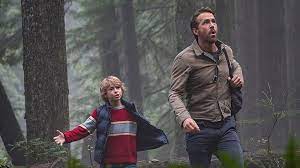
Watching Guardians of the Galaxy Vol. 3, I slouched in my seat, looking upward at the screen, wondering whether reality hadn’t played a trick on me. Had I regressed into an alternate reality that resembled a slightly demented version of Saturday morning TV?
Rocky Mountain Movies & Denver Movie Review
FOR MOVIE LOVERS WHO AREN'T EASILY SWEPT AWAY
Wednesday, May 3, 2023
Guarding the Galaxy one more time
Watching Guardians of the Galaxy Vol. 3, I slouched in my seat, looking upward at the screen, wondering whether reality hadn’t played a trick on me. Had I regressed into an alternate reality that resembled a slightly demented version of Saturday morning TV?
Wednesday, December 14, 2022
Sights and sounds dominate new 'Avatar'
You almost can write a review of Avatar: The Way of Water without seeing the movie. In the hands of director James Cameron, you can be sure the movie will boast an abundance of visuals that dazzle and delight.
Thursday, March 10, 2022
He brings quips on his time-travel trip
Hints of Back to the Future waft through The Adam Project, a story in which a time traveler meets his younger self and tries to spare humanity from the oppressive future in which the movie begins.
Thursday, May 4, 2017
Those guardians of the galaxy return
The original Guardians of the Galaxy took the market by storm in 2014, providing a refreshing antidote to the self-seriousness that infiltrates many parts of Marvel's vast comic-book repertoire. Unexpected and slightly bizarre, the movie featured Rocket Raccoon (voice by Bradley Cooper), a snarky animal who delivered the movie's best wisecracks, and a diminutive creature named Groot (voice by Vin Diesel), a mini-tree of an alien who added an element of off-kilter cuteness.
Now comes Guardians of the Galaxy Vol. 2 sporting a name that makes the movie sound as if it aspires to find a home in The Library of Congress catalog. Not Guardians 2 or even Part II, but "Volume 2."
This is not to say that the movie, written and directed by a returning James Gunn, mires itself in big themes. Gunn tries to replicate the self-aware attitude of the first installment, something along the lines of recognition that joyfully teeters on the rim of the pop-cultural toilet without falling in.
If that's too abstract for you, let me put it another way: The first movie was fun. The second movie? Sometimes it's fun.
A creative application of special effects and CGI help keep Vol. 2 from tarnishing the franchise, even as it falls prey to a typical second-helping problem, overcrowding in just about every department.
Vol. 2 plunges viewers into a self-referential universe that makes room for musical and TV nostalgia from the 1980s, one of the fascinations of a Guardian played by Chris Pratt; i.e., Quill. The movie's 1980s nostalgia trip also includes a recurring reference to David Hasselhoff of TV's Knight Rider and Baywatch fame.
I'm always amazed at the pop-cultural knowledge that aficionados bring to these movies. Without prompting, they can tell you all about Drax (Dave Bautista), the muscular man with the hearty laugh that always sounds forced to me, like he has to think about it before letting loose with a guffaw.
During this episode, Quill meets a character who claims to be his father. He's Ego, played by Kurt Russell. If you had any doubts, Ego's name serves as a clue about the character's intentions. Ego wants to enlist Quill's help in fulfilling a long-standing ambition. Trouble, of course, looms.
In what amounts to a glut of characters, Michael Rooker stands out as Yondo, the alien who raised Quill.
You'll also find a cameo appearance by Sylvester Stallone, and we meet Mantis (Pom Klementieff), a creature with an antenna that enables her to function as an empath. Mantis touches people and instantly knows what they're feeling.
Zoe Saldana returns as Gamora, who this time faces off against Nebula (Karen Gillan), a cyborg with blue skin who began her life as Gamora's sister. Hey, a little sibling rivalry never hurts.
Additional female power emanates for Ayesha, a golden-skinned character played by Elizabeth Debicki.
One of the movie's better bits involves a character named Taserface (Chris Sullivan), a brutish fellow whose descriptive but preposterous name prevents his victims from taking him seriously. If you're keeping score, Taserface belongs to a group called the Ravagers.
Gunn provides enough explosions to satisfy action-hungry audiences, and after a third-act dip, the movie picks up for an ending that tempers the obligatory mayhem with a bit of emotion that stems from the self-sacrificing act of one of the movie's characters.
You may be getting the impression that the movie virtually bursts with characters, effects, action and amusements. Some hit; some don't. But Vol. 2's mixed bag won't keep it from reaping a box-office bonanza. I can't say that Vol. 2 matches the enjoyment of the first movie, but, boy, can you see it trying.
Thursday, January 12, 2017
A gangster epic that falls short
In Live By Night -- Affleck's second adaptation of a novel by author Dennis Lahane after 2007's Gone Baby Gone -- the director broadens his reach with a gangster story that begins with crime in Boston and moves to Prohibition rum-running in Florida.
But once Live By Night leaves Boston for Tampa, Fla., the movie goes South, as well, losing both focus and authenticity. Put another way, Live By Night represents a step backward from Affleck's work in both The Town and in Argo.
In look and in scope, Live by Night qualifies as a big, rambling gangster movie with Affleck at its center. Affleck plays Joe Coughlin, an ordinary guy who returned from World War I determined never to be bossed around again. As a result, Joe becomes an outlaw, probably not the occupation his police official father (Brendan Gleeson) had in mind for his son.
Joe quickly gets crosswise with Albert White (Robert Glenister), the head of the Boston's Irish mob. How could it be otherwise? Joe has been carrying on an affair with one of the mobster's mistresses (Sienna Miller). Joe's in love with Miller's Emma Gould. Let's just say she's more pragmatic about the relationship.
After a stint in jail, Joe winds up in Tampa where he takes over the rum-running business for the head of the Boston Italian mob, one Maso Pescatore (Remo Girone). Joe has two ambitions: to support himself and to avenge himself on Albert White, who also has moved to Florida.
Back in Boston, White not only nearly beat Joe to death; he also took out his rage on Emma.
Joe's romantic life moves on when he falls for the sister of a Cuban rum runner (Zoe Salanda). His crime dealings also put him in contact with the local sheriff (Chris Cooper), a man who claims to be incorruptible but who ignores the criminals who thrive in his midst, as well as the local chapter of the KKK, which is lead by a sneering sadist named RD Pruitt (Matthew Maher).
In all matters violent, Joe receives help from his pal Dion (a bulked up Chris Messina).
If all this weren't enough, an additional subplot introduces the sheriff's daughter (Elle Fanning), a young woman who's corrupted before turning to evangelism.
Affleck loads up on gangster glamor, vintage cars and a variety of locations that create the impression that the movie wants to enter the big-time gangster pantheon.
Affleck also doesn't skimp on gun play and harsh violence, which he punctuates with double-barreled blasts of portentous dialogue about fate, justice and the way things tend to come back to haunt a person in unexpected ways.
As Joe, Affleck appears in nearly every frame, but this is one of his more subdued performances, maybe because he's also overseeing the logistics of a large-scale production with a big cast and tons of atmosphere, much of it confined to a crime-riddled section of Tampa during the 1930s.
Intermittently intriguing, Live by Night doesn't pack the intended wallop. Its ideas seem to grow artificially from a story that badly needed paring down. In the end, Live By Night feels more like a well-appointed imitation of a gangster epic rather than the real thing.
Thursday, July 31, 2014
'Guardians:' Junk and proud of it
Guardians of the Galaxy, another Marvel Studios space adventure, seems to have been cobbled together from diverse genre elements in an effort to achieve a supreme level of silliness -- and that's one of its good points.
You have to give some kind of credit to a movie that asks us to develop affection for a talking tree that does little more than repeat its name: "I am Groot." Voice courtesy of Vin Diesel, who -- as it turns out -- may be better heard than seen.
Then there's Rocket, a talking raccoon (voice by Bradley Cooper) who fills the obligatory wise-ass niche.
2001, this ain't, but Guardians inoculates itself against serious criticism by adopting an ethos that goes something like this: Hey, we know this is crap, but we've gone through a lot of trouble to make the best crap possible.
If that's too pejorative, substitute the word "junk" and you're on your way.
To take the most generous view, it's fair to call Guardians a celebration of genre junk: The movie's director -- James Gunn -- also directed Slither, an unashamed and reasonably well-received B-movie from 2006. Guardians qualifies as a more expensive, but still unashamed leap into B-movie tropes.
Chris Pratt plays Peter Quill -- a.k.a. Star Lord -- a galactic scavenger who steals and re-sells his plunder.
The movie begins with a prologue explaining that Quill was born on Earth during the 1980s, but was abducted by aliens shortly after the death of his mother. The story then leaps ahead 26 years, locating itself in a mixed-species galaxy.
Familiar from TV's Parks and Recreation and from small roles in Moneyball and Zero Dark Thirty, Pratt relaxes into a big screen lead as the mildly cynical hero who, in the end, takes his galactic responsibilities seriously and who clearly evokes memories of Star Wars' Han Solo.
The drama revolves around a stolen object called The Orb, a soft-ball sized gizmo with major destructive powers. Lots of folks want to get their hands on The Orb, including Ronan the Accuser (Lee Pace).
Ronan yearns to destroy the planet Xander, which is led by Nova Prime, Glenn Close with a platinum blonde hairdo that curlicues upward like something that plopped out of a Dairy Queen spigot.
Is it possible to care whether Ronan succeeds? Not really: The movie's fight against evil couldn't be more generic: The intention, one presumes, is to keep the characters engaging enough to sustain involvement.
Sometimes it works.
Zoe Saldana plays Gamora, a green-skinned alien who's also trying to take possession of The Orb, but who ultimately joins forces with Quill.
The other fledgling Guardians -- aside from Rocket and Groot -- include Drax (Dave Bautista), a heavily muscled hulk who comes from an alien race that has yet to master the concept of metaphors. No, really.
Then there's Yondu (Michael Rooker), the space pirate who abducted Quill and who since has become his ostensible boss.
Gunn manages a couple of tender moments between Quill and Gamora, but they amount to little more than flirtations. The movie's PG-13 rating derives from violence and language.
Guardians is one of those movies that blurs the line between violence and action. There's plenty of it, although none of it struck me as particularly exciting absent anything more than the most perfunctory of rooting interests.
Gunn has given the movie the kind of borderlne cheesy look that requires lots of effort: Like Star Wars, Guardians tries to capture some of the cheap-looking innocence of a bygone days -- albeit in hipper fashion.
Not your average comic book hero, Quill has a fondness for a mix tape that was given to him by his mother. Gunn uses '70s music from this tape throughout, adding an element that may be foreign to younger audiences who know as much about Walkmans as they do about typewriters.
Will there be another Guardians movie?
Is The Orb round? Is Gamora green? Is Marvel an apparently bottomless well of comic-book characters?
I think you know the answer.
Thursday, December 5, 2013
Hard times in Pennsylvania
Almost every moment in Out of the Furnace -- a brooding working-class drama steeped in Rust Belt realism -- seems amplified in what feels like a strained search for meaning.
Boasting a terrific bad-ass performance by Woody Harrelson, the movie nonetheless seems an ultimately failed attempt to give pulpy material a socially significant boost. Director Scott Cooper (Crazy Heart) tries for thematic elevation by garnishing a revenge-oriented drama with woes created by diminished economic opportunity and the psychological suffering of Iraqi war veterans.
Cooper (Crazy Heart) builds his generally grim movie around an intense performance by Christian Bale, who plays Russell Baze, a Pennsylvania steel mill worker and the older brother of Rodney Baze (Casey Affleck), a troubled veteran of four tours in Iraq.
Credited to Brad Ingelsby and Cooper, the screenplay piles on plenty of complications.
Principal among these twists: Russell winds up in prison after a fatal car accident. He was drinking.
Meanwhile, Rodney pleads with a local bookmaker (Willem Dafoe) to arrange a big-money, bare-knuckle fight for him in New Jersey.
As it turns out, the Jersey bare-knuckle scene and a variety of other criminal activities are presided over by Harrelson's Harlan DeGroat, a character cast in the fires of unapologetic evil.
But wait ... there's more:
While he's in jail, Russell's former girlfriend Lena (Zoe Saldana) takes up with a new lover, a sheriff played by Forest Whitaker, who might just as well have found something else to do for all the impact the script allows his character to make.
We also meet Russell's uncle (Sam Shepard), a character who rounds out the cast of hard-working, salt-of-the-earth Pennsylvanians, guys who toed the line, drank their beer, prayed the rosary, asked for nothing and went deer hunting for recreation.
You can tell that a movie is going for high-voltage impact when Dafoe -- no stranger to tough-textured realism -- gives one of the film's more relaxed performances.
There's no reason to fault any of the acting, but Harrelson's frightening performance achieves stand-out prominence.
Harrelson's DeGroat makes his presence known in the movie's opening scene, a brutal encounter that takes place in a drive-in and which calls for DeGroat to ram a hotdog down his date's throat before mercilessly assaulting a good samaritan who tries to intervene in the poor woman's behalf. DeGroat's wearing shorts at the time, a sartorial choice that gives his violence an alarmingly informal air.
It's equally clear that Affleck's Rodney has veered out of control -- albeit in a completely different way. Rodney has no interest in working in a steel mill, has accumulated substantial gambling debts and simmers with rage over lost comrades and memories of war-time carnage.
Cooper and cinematographer Masanobu Takayanagi do their best to give the gritty Pennsylvania settings -- steel mills, bars, dreary row houses and abandoned factories -- the kind of polished decay that movies can bring to towns that have seen better days.
Bale's deep-immersion performance doesn't leave much on the table, but Out of the Furnace can't quite transcend revenge impulses that ultimately take over and cheapen a drama that seems to be trying for more.
And try it does. If it were possible to get a hernia from attempting something meaningful, everyone involved in Out of the Furnace would need abdominal surgery. In the end, though, I'm not sure that this isn't a case in which black-and-blue marks outnumber serious insights -- despite all the heavy lifting.
Thursday, May 16, 2013
'Star Trek' sets its phasers on heavy fun

Watching the abundantly entertaining Star Trek Into Darkness, it sometimes seems as if we're seeing a spot-on replication of the original series -- only one that's been invaded by a new set of actors. Credit a cast led by Chris Pine (as Captain Kirk) and Zachary Quinto (as Spock) with working hard to keep their much-loved characters on track.
Made familiar by director J.J. Abrams as younger versions of the characters we knew from the venerated TV series, it's Kirk and Spock who keep the The Enterprise aloft -- with help, of course, from their ever reliable crew mates.
I'm not sure how fanboys will react to this mega-helping of Star Trek -- shown to many critics at 9 p.m. on the Wednesday night the movie was set to debut at a variety of midnight shows -- but it seemed to me that for most the picture, Abrams did a reasonably good job of balancing the fabled Star Trek ethos with lots of boldly conceived action.
Although everything in Into Darkness takes place in the time before the TV series began, the movie keeps the door open for as many prequels as Abrams is willing to make.
Is Into Darkness as good as 2009's Star Trek? Probably not, but Abrams & company can't be accused of hitting the sophomore skids, either. Messy plotting seldom detracts from the proceedings, although it's worth pointing out that the movie owes a major debt to the well-reviewed Star Trek II: The Wrath of Khan, released in 1982.
As is the case with the better Star Trek episodes, this edition places an ethical issue at the story's core: Should Starfleet stick to its mission of exploring space while allowing alien civilizations to develop without interference or should it militarize and prepare for endless battles with threatening civilizations, say the ferocious Klingons?
I'm not saying Star Trek Into Darkness astonishes you with its philosophical depth and thoughtful nuance, but at least it's trying to be about something more than warp speed and explosions.
The screenplay also reprises a reliable Star Trek tension, the perpetual tug of war between emotion and logic, played out in the evolving relationship between an overly impetuous Kirk and an amusingly impassive Spock. Both characters still are feeling their way toward maturity.
Abrams' second Star Trek movie derives significant benefit from its villain, a super strongman played by British actor Benedict Cumberbatch, who projects (boy, does he ever) enough piercing menace to keep him from being overwhelmed by the movie's special effects. How impressive is he? Sometimes, the guy seems even smarter than Spock.
The rest of the Enterprise crew is on board and in decent form: Zoë Saldana as Uhura, John Cho as Mr. Sulu; Simon Pegg as Mr. Scott, and Anton Yelchin as Chekov. It's of some interest that Uhura and Spock are still lovers, although it takes a while for them to kiss and make-up after a spat. Karl Urban makes a fine Dr. McCoy or more familiarly "Bones," the character responsible for providing home-spun comic relief.
Most audiences probably will forgive Abrams for kicking Star Trek into the kind of action-oriented overdrive that defines summer at the movies -- especially during its finale. Me? I won't describe it here, but I could have done without a destructively indulgent climax that takes a terrorist-like wrecking ball to yet another vulnerable cityscape.
You'd think after 9/11, this kind of devastation would long have fallen into disrepute. Sadly, it hasn't.
Thankfully, though, Abrams' movie has more to offer than late-picture carnage and crumbling concrete. If you're looking for summer enjoyment, Into the Darkness provides it in ample measure through most of its 132-minute running time, and -- just as important -- it leaves you ready to sign on for the Enterprise's next voyage.
Thursday, September 6, 2012
''The Words:" How about a rewrite?
A successful and well-respected author takes the stage for a public reading of his latest novel. Our willingness to accept this supposed literary titan as the real deal depends on what we think of his writing.
So here's the first sentence that Dennis Quaid's Clay Hammond reads: "The old man stood in the rain." Really? That's it? A bit of scrawl that's only a step above "a dark and stormy night?"
Fortunately, the movie quickly leaves Quaid and begins showing us the story his character is reading, an improvement (though a small one) over the writing we've just heard.
Hammond's tale centers on Rory (Bradley Cooper), an aspiring writer who lives in New York City with his girlfriend and soon-to-be-wife (Zoe Saldana). Rory's writing career is going nowhere. His confidence is ebbing. His father (J.K. Simmons) suggests that it might be time to look for a job.
A frustrated Rory eventually does seek employment, landing a low-level position at a literary agency. But Rory still dreams of becoming a literary success, and his self-image is tied to that dream.
As often happens in lesser works of fiction, contrivance -- masquerading as fate -- intervenes.
During a honeymoon trip to Paris, Saldana's Dora buys Rory an old briefcase. Upon returning to the U.S., Rory discovers an unpublished manuscript tucked in one of the briefcases folds. Lo, it's a terrific book about an American GI in post-war France.
Because The Words has been operating with a kind of precise predictability, we immediately know that Rory is going to appropriate the novel, that it will become a major success and that he will have launched an impressive (if fraudulent) career.
To add another layer of complexity, directors Brian Klugman and Lee Sternthal, who also wrote the screenplay, dramatize the story told in the purloined novel. That tale features Ben Barnes as a GI turned writer and Nora Arnezeder as the French woman who steals his heart and with whom his life hits a tragic snare.
But back to the story that Quaid's character is reading.
In that melodramatic tale, the old man who was standing in the rain (a withered-looking, bearded Jeremy Irons) reappears to claim authorship of the book Rory has passed off as his own. Irons's character wants Rory to wrestle with his conscience.
Rather than adding dizzying complexity, the movie's stories-within-stories approach feels entirely routine. It does, however, bring about a few minor realizations. Among them: Cooper should henceforth try to avoid appearing with Irons, who -- even in a silly role -- can't entirely hide his superior acting chops.
The rest of the cast doesn't exactly soar, either. Quaid's face shows plenty of mileage, but he's stuck in slim role in which he's both admired and challenged by a literary groupie (Olivia Wilde). Wilde's character attends Hammond's reading and very obviously is looking for more than bookish inspiration.
It's entirely possible that The Words wants to explore big themes: The tension between life and art and what happens when a young man's ambition is unmatched by his talent, but the movie winds up feeling as thin as the paper on which its multiple novels are printed.
The Words tells many stories. Unfortunately, all of them are mediocre.