Showing posts with label Andy Muschietti. Show all posts

Monday, June 19, 2023

A ‘Flash’’ too long’ -- but there's Keaton


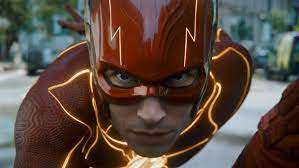
The first thing to know about The Flash is that it's 144 minutes long. Go ahead, sigh. I did. I begin here because this overstuffed helping of DC Comics chaos has trouble sustaining engagement beyond maybe the first hour and a half of its two-hour and 24-minute run time. A little more than halfway through, I started looking at my watch as I wondered how much more director Andy Muschietti (It) would throw into this frenzied whirl of a movie. The answer: a lot. We're talking Batman, supervillain Zod, Supergirl, time travel, and even two Flashes, both played by Ezra Miller, the actor who has had his
 share of legal troubles. You can look up Miller's woes, but I hope that he's able to straighten out his life and continue his career. Here, Barry Allen (a.k.a. The Flash) encounters a younger version of himself when he travels back in time. When we first meet Barry, he's troubled because his mother (Maribel Verdu) has been murdered, a crime for which his father (Ron Livingston) has been arrested. The movie's big kick involves the appearance of Michael Keaton, who reprises his role as Batman. I thought donning Batman’s cape weighed Keaton down; he's playing a reluctant, weary Batman, but Keaton’s work exceeds cameo levels and his presence registers as a plus. An early scene in which babies are vaulted through the sky (a baby shower of sorts) is almost weird enough to justify a look but Miller's high-strung performance wears thin as the movie wears on — and it does wear on. Despite its title, the last thing The Flash does is race quickly across the finish line. Keep an eye on Sasha Calle (Supergirl), though. She has enough edge to cut through  the flying bric-a-brac, self-referential nods, noisy action, and plot overload. *

*A brief confession: As someone who grew up reading DC comics (not Marvel), I keep rooting for the DC characters, but prefer them when seen as individuals not part of a repertory company of superheroes. Fingers crossed for next time. 


Thursday, September 5, 2019

More 'It' proves less than rewarding

The second chapter of Stephen King's massive novel has high points, but, overall, qualifies as a miss.

It Chapter Two, the eagerly awaited second half of the big-screen adaptation of Stephen King’s 1,000-page novel, feels more like a hundred chapters than the single, concluding act of a drama based on teen bonding and supernatural terror.

Not surprisingly, given the movie's nearly three-hour length and King’s pedigree, Chapter Two has high points (the psychology that brings adults in touch with their worst childhood memories) and low points (a bloated finale that’s so effects-oriented, it puts one in mind of second-rate sci-fi.

Normally, I don’t care about a movie’s length, but in the case of Chapter Two, length fatigue sets in, overwhelming the movie’s virtues. Moreover, last-minute attempts to add sentiment and uplifting instruction doesn’t connect emotionally.

The first movie, popular but very much over-rated, created enough of a fan base to ensure that this second helping will succeed at the box office. Moreover, a cast that includes Bill Hader, James McAvoy, Jessica Chastain, Isaiah Mustafa, and James Ransone) adds to the movie’s appeal, suggesting that this is no cynically motivated knockoff.

The story takes place 27 years after the first installment. As it turns out, Pennywise -- the lethal clown played by Bill Skarsgard -- returns in 27-year intervals, which means he's again ready to terrorize the idyllic town of Derry, Me.

Director Andy Muschietti, who also directed the first installment, skillfully uses the original’s young cast in flashbacks that help enrich the darkly hued adventures experienced by the now-adult characters of the first installment. Most of these adults don't want to travel to their hometown and only one of them (Mustafa's Mike) remembers exactly what happened 27 years ago.

Not a bad set-up, but Muschietti and screenwriter Gary Dauberman can't solve structural problems inherent in a story that doesn't flow smoothly through its various episodes. Instead, Muschietti lays out chapter after chapter, as each of the returnees confronts an individual horror before the group can unite for a meaningful stand against Pennywise.

I suppose one major question emerges: Is the movie scary?

The answer depends on what you consider frightening. For me, the scares arrive in the form of fun-house attractions augmented by lots of high-end CGI. Muschietti takes full advantage of Pennywise’s shape-shifting abilities, sometimes to comic effect, as the clown transforms into a variety of bizarre creatures and desiccated demons with skin problems.

There are jump scares, to be sure, but it almost feels as if Chapter Two has been designed around the “horror” sequences rather than allowing the horror to emerge naturally (or supernaturally, if you will) from the story.

No faulting the performances, I suppose. Some care has been taken to ensure that the young actors evoke their adult counterparts (except possibly for McAvoy). Among the adults, Hader makes the strongest impression as a stand-up comic in the midst of a mid-level career.

I could go on and talk about the insight (yes, there is some) exhibited in Chapter Two, particularly in the way it understands the humiliations, fears, abuses, missed opportunities and embarrassments of childhood. I also could mention a gratuitous and very cruel prologue in which town bullies attack two gay men at a carnival.

I suppose you'll also want to know that Stephen King and director Peter Bogdanovich make cameo appearances.

But I’m going to put Chapter Two to rest by saying that the movie might have been more entertaining at two hours. Put another way, I’ll ask this question: Does anyone really want to take a three-hour theme-park ride? If you do, you’ll probably be happy with Chapter Two.

Otherwise, you may find a movie that wears you out before it has the sense to conclude.

Thursday, September 7, 2017

'It' sends in the clown -- and he's a killer

Latest Stephen King adaptation likely to score with audiences. To me? A yawn.
The working-class adults in It, an adaptation of a 1,000-plus page 1986 Stephen King novel, are abusive, cruel and, in some cases, detestable. Whether this arises from economic pressures or stands as some sort of class bias isn't entirely clear. Maybe it doesn't matter because the adults aren't the obvious focal point of director Andy Muschietti's adaptation; it's their kids.

To explore the fears of adolescent life, It follows -- if distantly -- a 1990 TV adaptation in which Tim Curry distinguished himself as Pennywise, the clown who terrorizes the children of Derry, Maine.

Muschietti and a trio of writers (Chase Palmer, Cary Fukunaga and Gary Dauberman) shift the time frame of King's novel from the 1950s to the 1980s and deal only with the first half of King's opus. A sequel is set to follow in which the teens of this edition return as adults.

Arriving more than 30 years after the novel's publication, this big screen version suffers from inevitable comparisons with a rash of other horror movies in which teens are terrorized by evil forces and by memories of another King-inspired movie, Stand By Me (1986).

By now, gory horror (icky streams of blood, razor-sharp teeth and other foul manifestations of malignant forces) make it seem as if we've seen It before and deprive the movie of some of the resonance that King must have intended.

Full of familiar King tropes, It tries to follow King's lead, allowing evil figures to provoke familiar fears of childhood. Who, at one time or another, hasn't trembled at the thought of entering a dank basement? That sort of thing.

In what can be viewed as thematic piling on, the teens of Derry not only must confront the buck-toothed Pennywise but are also taunted by the town bully (Nicholas Hamilton). Anyone who remembers his or her teen years may find Hamilton's character a good deal more frightening than any of the movie's booming effects, delivered with considerable verve and polish but too easily left behind in the theater, along with kernels of spilled popcorn.

The teens in the movie have named themselves the Losers Club. Bill (Jaeden Lieberher) leads the group. Bill's younger brother Georgie (Jackson Robert Scott) is taken by Pennywise in the movie's swiftly stated prologue.

The rest of the club members mostly are distinguished by single traits. One kid (Wyatt Oleff) is Jewish; another kid (Chosen Jacobs) is black; still another (Jeremy Ray Taylor) is overweight.

Every group of screen kids needs a wise-ass. In this case, the job falls to Finn Wolfhard. Jack Dylan Grazer portrays a kid dominated by his mother.

As the story develops, a girl (Sophia Lillis) joins the pack. Lillis' Beverly has a sexually abusive father and, unfairly, has been branded as "a slut" by her classmates.

Among the movie's problems: Pennywise (Bill Skarsgard), the scary clown whose makeup and goofy affect conceal his true nature, hovers near cliche, even with his ability to transform from a clown into his horrific real self.

Having pretty much found It to be a yawn, I should hasten to say that the movie likely will add some spin to the multiplex turnstiles after a lackluster couple of late-summer weeks.

Before a preview screening of It, King appeared in a short clip addressed to the audience. He said he was happy with the adaptation and praised the movie's young cast, all of whom do fine work as they spout profanities, shriek and behave as credibly as the story allows; they also discover that their hometown is targeted by waves of violence that appear in 27-year intervals.

Sometimes, it feels as if It lumbers from one set piece to another, giving each of the teens a scene that plays to his or her major fear. Each eruption of shock creates the aura of a super-charged fun house -- vivid but depthless. And at 135 minutes, the film begins to feel as lengthy as the book.

The movie teaches the members of the Losers Club a lesson that might have been culled from Hillary Clinton's campaign slogan: "Stronger together." The monster can't win if the kids unite to overcome their fears.

Although It takes full advantage of current technology in producing its many effects, the movie nonetheless feels trapped by the well-worn demands of a genre in which nearly every move feels too ingrained to break the bounds of the screen and take up residence deep inside our worst nightmares.