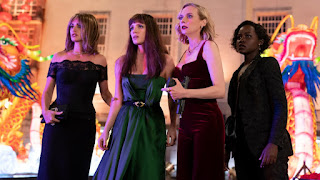
Jessica Chastain and Eddie Redmayne give strong performances in The Good Nurse, a reality-based thriller grounded in the hospital environment in which two intensive-care nurses ply their trade.
Rocky Mountain Movies & Denver Movie Review
FOR MOVIE LOVERS WHO AREN'T EASILY SWEPT AWAY
It Chapter Two, the eagerly awaited second half of the big-screen adaptation of Stephen King’s 1,000-page novel, feels more like a hundred chapters than the single, concluding act of a drama based on teen bonding and supernatural terror.
Not surprisingly, given the movie's nearly three-hour length and King’s pedigree, Chapter Two has high points (the psychology that brings adults in touch with their worst childhood memories) and low points (a bloated finale that’s so effects-oriented, it puts one in mind of second-rate sci-fi.
Normally, I don’t care about a movie’s length, but in the case of Chapter Two, length fatigue sets in, overwhelming the movie’s virtues. Moreover, last-minute attempts to add sentiment and uplifting instruction doesn’t connect emotionally.
The first movie, popular but very much over-rated, created enough of a fan base to ensure that this second helping will succeed at the box office. Moreover, a cast that includes Bill Hader, James McAvoy, Jessica Chastain, Isaiah Mustafa, and James Ransone) adds to the movie’s appeal, suggesting that this is no cynically motivated knockoff.
The story takes place 27 years after the first installment. As it turns out, Pennywise -- the lethal clown played by Bill Skarsgard -- returns in 27-year intervals, which means he's again ready to terrorize the idyllic town of Derry, Me.
Director Andy Muschietti, who also directed the first installment, skillfully uses the original’s young cast in flashbacks that help enrich the darkly hued adventures experienced by the now-adult characters of the first installment. Most of these adults don't want to travel to their hometown and only one of them (Mustafa's Mike) remembers exactly what happened 27 years ago.
Not a bad set-up, but Muschietti and screenwriter Gary Dauberman can't solve structural problems inherent in a story that doesn't flow smoothly through its various episodes. Instead, Muschietti lays out chapter after chapter, as each of the returnees confronts an individual horror before the group can unite for a meaningful stand against Pennywise.
I suppose one major question emerges: Is the movie scary?
The answer depends on what you consider frightening. For me, the scares arrive in the form of fun-house attractions augmented by lots of high-end CGI. Muschietti takes full advantage of Pennywise’s shape-shifting abilities, sometimes to comic effect, as the clown transforms into a variety of bizarre creatures and desiccated demons with skin problems.
There are jump scares, to be sure, but it almost feels as if Chapter Two has been designed around the “horror” sequences rather than allowing the horror to emerge naturally (or supernaturally, if you will) from the story.
No faulting the performances, I suppose. Some care has been taken to ensure that the young actors evoke their adult counterparts (except possibly for McAvoy). Among the adults, Hader makes the strongest impression as a stand-up comic in the midst of a mid-level career.
I could go on and talk about the insight (yes, there is some) exhibited in Chapter Two, particularly in the way it understands the humiliations, fears, abuses, missed opportunities and embarrassments of childhood. I also could mention a gratuitous and very cruel prologue in which town bullies attack two gay men at a carnival.
I suppose you'll also want to know that Stephen King and director Peter Bogdanovich make cameo appearances.
But I’m going to put Chapter Two to rest by saying that the movie might have been more entertaining at two hours. Put another way, I’ll ask this question: Does anyone really want to take a three-hour theme-park ride? If you do, you’ll probably be happy with Chapter Two.
Otherwise, you may find a movie that wears you out before it has the sense to conclude.
Billed as the final chapter in the X-Men series, Dark Phoenix doesn't exactly qualify as the fondest of farewells.
By no means awful, Dark Phoenix nonetheless fails to make a major splash with a concluding chapter that revolves around Jean Grey (Sophie Turner of Game of Thrones fame). Although Jean acquires great powers, she never totally dominates a story that becomes the wobbly foundation on which an uneven variety of set pieces and side trips are built.
A mind-reading mutant, the young Jean (Summer Fontana) falls under Charles Xavier's (James McAvoy) protection after her parents are killed in an auto accident in which she was a passenger and also the cause.
The story then leaps ahead. Now-grown, Jean (Turner) is still learning how to navigate the X-world. An early-picture outer-space rescue mission brings Jean into contact with a force that super-charges her powers in ways she isn't prepared to handle. She leaves the X-Men estate to search for background about her pre-X-Men childhood. She also unleashes terrible destructive powers as she morphs into Phoenix.
With Jean on the verge of raging out of control, the movie begins to question Charles' motives. Raven (Jennifer Lawrence) wonders whether Xavier isn't more interested in bolstering his ego than in maintaining the integrity of the X-Men force. Lawrence, whose superhero alter ego goes by the name Mystique, doesn't seem especially engaged, but she's given the movie's best line.
A rebellious Raven tells Charles that the women always seem to be saving the men in these stories. She wonders whether a name change isn't in order: How about X-Women? Good idea.
Nicholas Hoult's Beast also begins to wonder about Charles' motives. Is Charles putting X-Men in danger to maintain his growing status with humans who, at this moment, are happy to rely on X-Men to save them from whatever disaster happens to loom?
Meanwhile, aliens led by Vuk (Jessica Chastain) try to control Jean whose powers are so great they can be life-giving -- or some such. She might help them revive their moribund civilization, hardly the freshest of ideas.
Tye Sheridan portrays Scott Summers/Cyclops, an X-er who's romantically involved with Jean and who can't accept the fact that she might have become a world-threatening menace.
Michael Fassbender turns up as Erik/Magneto, bringing gravitas to the proceedings, which are dotted with action and special effects, some of them well executed by director Simon Kinberg. CGI and physical combat blend nicely in an extended sequence on a speeding train.
Dark Phoenix doesn't come close to the best and most serious of all the X-Men movies, 2017's Logan. You can also throw in X-Men: First Class (2011) and X-Men: Days of Future Past (2014), if you're looking for more of Phoenix's betters.
In general, I've liked the X-Men movies with their devotion to talented outcasts. If Phoenix really marks the end of the series, I'll fondly remember the movies I enjoyed, forget the rest and move on to something else.
When I was browsing the internet looking for information on the real Molly Bloom, I came across a review of Bloom's book, which serves as the basis for writer Aaron Sorkin's eagerly awaited directorial debut.
A website devoted to books about poker featured a headline that suggested that the book struggled to find both an audience and a point.
I'm not sure that Sorkin's adaptation of Bloom's book, Molly's Game, will have trouble finding an audience, but it does have a bit of difficulty finding a larger point. Bloom's journey took her from an Olympic caliber skier to a woman who made a ton of money running high-stakes poker games before running afoul of the law.
In real life, Bloom's LA-based game attracted players such as Ben Affleck and Tobey Maguire. She evidently operated legally until she began taking a cut of the biggest pots. Such "raking" is illegal and evidently changes friendly games (even when played for ridiculously large stakes) into crimes.
Don't get me wrong. Molly's Game can be entertaining, and it features an energized performance from Jessica Chastain as Bloom, a woman whose brother Jeremy Bloom became both an Olympian and an NFL player.
Molly Bloom was on a similar Olympic track until a freak accident derailed her career. At loose ends, she headed to LA where she eventually moved from a gofer at high-stakes card games to an impresario of such big-money affairs.
Perhaps taking a cue from Bloom's book, Sorkin has Molly narrate the movie, a dialogue-heavy plunge into her point of view that, at times, makes it feel as if Molly's reading us the movie.
As much as any writer, Sorkin has a way of making it seem as if he's in the know about whatever subject he tackles. He floods the screen with poker jargon and makes sure that every actor speaks with the kind of rapidity that marked the great screwball comedies of yesteryear. The result can be dizzying, skilled actors engaging in tricky verbal workouts.
Idris Elba adds weight as Molly's attorney. Watching Elba and Chastain bat words over the metaphorical net that separates their characters creates a pleasure all its own.
Bloom's story moves from Los Angeles to New York City, unfolding in episodic fashion, almost as if Sorkin drops little short stories into the larger mix. This approach highlights the work of a strong supporting cast.
Jeremy Strong portrays Molly's first LA boss, a character who makes no attempt to be anything less than obnoxious. Michael Cera does good work as an arrogant player with skills; Bill Camp does a terrific job as a skilled player who swan-dives into a terrible losing streak, and Chris O'Dowd impresses as a dim-witted drunk who works off a gambling debt by bringing some troubling folks into one of Molly's New York games, figures from the Russian mob.
Kevin Costner has one of the movie's best small roles. He plays Molly's authoritarian father, a philandering psychology professor who presides over a flock of high-achieving offspring.
Up to a point, Sorkin benefits from the lavish surroundings that Molly created for those who gambled at her table: drinks, fine food, fancy hotel rooms and beautiful women to wait on both winners and losers.
Earlier, I mentioned that the movie might have difficulty making a point. By the end, it seems as if Sorkin wants to hold Molly out as an example of female achievement. She used her wits to create a small empire and honorably refuses to supply the FBI with the names of those who sat at her table. Public exposure might have ruined lives and destroyed families.
Pretty noble for someone who knows she made a small fortune serving the gambling addictions and fantasies of men who were willing to throw money at her in the form of out-sized tips.
I was entertained by much of Molly's Game, which -- at 140 minutes in length -- probably runs 20 minutes longer than necessary: Sorkin turns cards over with enough flair and snap to keep his movie watchable, but, in its entirety, the movie doesn't make the case for why Bloom's story is more than a sketch in a bigger picture that remains unpainted.
Senate hearings, sex, a ruthless lobbyist and a vicious political fight over gun control.
Those are some of the ingredients that could have turned Miss Sloane into a butt-kicking political drama if only the movie had been able to pass the credibility test.
Jessica Chastain portrays Liz Sloane, a fast-talking, fast-thinking lobbyist who boosts her energy with a steady stream of pill-popping breaks. Let's put it this way: Sloane doesn't visit bathrooms simply to take care of bodily needs.
The movie opens with the apparently discredited Sloane testifying before a committee led by a reproachful senator (John Lithgow) who makes little attempt to conceal his disdain for her. As she faces a volley of questions, Sloane repeatedly takes the Fifth -- until anger gets the best of her, and she tells the committee what she really thinks.
She's doomed -- or is she?
The drama, which tells its story in flashbacks from that committee hearing, centers on gun control legislation. Early on, we learn that Sloane works for a top-ranked lobbying firm where she's earned a reputation as a perpetual winner.
The head of the agency (Sam Waterston) expects Sloane to help the firm win the business of a gun advocacy group that wants her to create a program designed to sway women to its cause.
Because she believes in background checks, Sloane balks. Not only that, but she goes to work for the other side.
How busy is Liz? Sloane periodically hooks up with a male escort named Forde (Jake Lacy). We're supposed to believe that an attractive, ambitious woman is so eager to avoid compromising personal ties that she's willing to pay for sex. What? This amazingly talented lobbyist, a woman who can't be out-calculated, isn't skillful enough to play bedroom games?
Jonathan Perera's screenplay alternates fast-paced, civics-lesson dialogue with plot twists that strain credibility.
Somewhere in my notes, I wrote that watching Miss Sloane was a bit like watching bad Aaron Sorkin -- or at least second-rate Sorkin.
It's hardly surprising that even when she's fighting for a righteous cause, Sloane remains ruthless. She's still willing to play dirty, in one instance throwing a subordinate (Gugu Mbatha-Raw) under the bus to boost her chances of winning.
As directed by John Madden (Shakespeare in Love, The Best Exotic Marigold Hotel), Miss Sloane suggests that something in Sloane's childhood may have helped turn her into the fastest rat in the rat race. We never learn what that might be.
Miss Sloane barrels along with a sense of faux urgency, right up until an ending that brings incredulity to a head-scratching crescendo.
Chastain is gifted enough to carry this kind of movie, but for a drama such as Miss Sloane to work, we must believe that it understands who really pulls the levers of national power.
Suffice it to say, in the political reality that dawned on Nov. 8, that may prove an uphill battle for even the most intrepid of screenwriters.
I was hoping that Guillermo del Toro's Crimson Peak would rival the alluring weirdness of the director's 2006 Pan's Labyrinth, but this lavish Gothic romance/ghost story wastes a ton of production design and a capable cast on a story that (at its most dramatic points) had members of a preview audience chuckling.
As best as I can tell, chuckles aren't what del Toro had in mind for a movie that's striving to be eerie and chilling.
To make matters worse, Crimson Peak brims with the kinds of behavior found only in second-rate horror movies.
Consider: A young bride (Mia Wasikowska) arrives with her dashing husband (Tom Hiddleston) at his family estate in England. A staggeringly gloomy home looks as if it was lifted from an over-priced theme park.
Leaves and later snow drift through a large hole in the roof, but Wasikowska's Edith doesn't bother to ask whether Hiddleston's Sir Thomas Sharp has any repair plans in mind.
Did I mention that Edith, who aspires to be a novelist, is warned never to go below the house's first floor? Well, of course, she is.
To add color and perhaps symbolism, the Sharp home is built atop blood-red clay that seeps through some of the walls of Sharp's Allerdale estate.
Edith's arrival at the Sharp manse isn't exactly joyous. Jessica Chastain plays Lucille, Sharpe's sourpuss sister, a woman with an unnaturally possessive attitude toward her sibling. Lucille doesn't take kindly to her brother's new wife.
All of this takes place after Edith loses her father, who's ruthlessly murdered in the bathroom of his Buffalo, N.Y, club. The movie opens in the U.S. before moving to Sharp's isolated British wreck of a mansion.
Del Toro's depiction of Buffalo society in 1901 seems to have some potential. At minimum, it demonstrates what a movie looks like when some considerable part of the costumer's budget appears to have been spent on women's hats.
Edith's father (Jim Beaver) immediately mistrusts the aristocratic Sharp, who's trying to persuade him to invest in a machine that mines clay. A self-made industrialist, Beaver's Carter Cushing prides himself on being a good judge of character.
These early scenes -- sort of an extended prologue -- also introduce us to a doctor (Charlie Hunnam), an earnest fellow who cares about Edith, and who quite predictably will figure into the movie's over-the-top finale.
Del Toro lays on the funhouse effects (skeletal-looking creatures emerge from floors or soak in bathtubs), but the story evolves in ways that seldom surprise.
Perhaps del Toro was betting that audiences would delight in seeing these musty horror tropes exhumed and presented with unashamed blatancy, but -- in the clinches -- the resultant movie proves as silly as it is somber.
If Crimson Peak had been intended as a comedy, it might have worked, but del Toro seems to take the movie's swooning melodrama seriously.
Beyond all that, Crimson Peak's ghosts seem less like expressions of supernatural unrest than effects that seep into a movie like wandering strangers with no place else to go.
In 1979, Ridley Scott made his first journey into to space with Alien, a landmark movie that spawned sequels and turned the universe into a source of abiding terror.
Rather than harboring wondrous possibilities for communication with alien life (see Steven Spielberg's Close Encounters of the Third Kind), Alien , introduced us to acid drooling monsters that hatched inside human bodies.
In 2012's Prometheus, Scott returned to space with a competent movie, but one that failed to gather Alien's cultural steam.
The same might be said about Scott's The Martian, but it's a much better movie than Prometheus, and its view of what awaits us in space may be more realistic; i.e., nothing but hardship and emptiness.
The story centers on a mission to Mars in which an early picture twist leaves botanist Mark Watney (Matt Damon) abandoned on the planet's desolate surface.
Believing Watney to be dead, his companions on the Ares III mission head back toward Earth. Watney must use all his scientific knowledge and ingenuity if he's going to have a chance at survival.
Despite its stark setting, the resultant film goes against the dystopian grain that distinguishes most contemporary sci-fi. The longer The Martian goes on, the more it becomes clear that Scott is making his ode to science. Brain power not brawn gives Watney a chance.
I don't know if the science in The Martian will make scientists happy. I'm hopeful that astrophysicist Neil deGrasse Tyson will weigh in on the subject as he did on Gravity, a movie he didn't like.
But Scott has gone to great lengths to make the movie feel scientifically plausible, and from a dramatic point of view that's more important than turning the screen into a 3D science lesson.
Based on popular novel by Andy Weir, the story also makes us aware of what's happening on Earth. The head of NASA (Jeff Daniels) tries to figure out how to keep his program viable while hatching a rescue plan.
Daniels is joined by Chiwetel Ejiofor and Kristen Wiig in his efforts to determine whether Watney can be saved.
From time to time, we also check in on the crew that's headed back to Earth under the guidance of Commander Lewis (Jessica Chastain). Also on board the spaceship that fled the Martian storm believed to have killed Watney are astronauts played by Kate Mara, Sean Bean, Sebastian Stan and Michael Pena.
Watney, who talks to himself for a long time before he discovers how to communicate with Earth, narrates some of the story. These "chats" add self-reflective humor to the proceedings and don't really intrude on the story, which addresses three important questions: How will Watney deal with problems revolving involving diminishing supplies of food, air and water?
As a piece of filmmaking, The Martian is more clear-eyed than visionary. and it's weighed down by an unnecessary epilogue that follows tense finale with enough white-knuckle potential to satisfy action junkies.
Scott makes witty use of Gloria Gaynor's I Will Survive and other '70s disco music, and receives a strong assist from cinematographer Darisuz Wolski, who makes reasonable -- if not dazzling -- use of 3D.
For the most part, Scott maintains focus. He doesn't suggest that science will save us, but builds an exciting entertainment around the notion that some problems are best solved by knowledge, cooperation and courage bred of necessity.
No weapons required. I'd call that both a profession of faith and a relief.
How bad would it really be if a burgeoning business fudged a bit on its taxes? How far should one go in an attempt to outdo one's competition?
And in the world of urban business, how do things begin to shake out when new ethnic groups start to assert their dominance? Can there be room for new kids on the block?
A Most Violent Year -- the drama that encompasses all these questions -- demonstrates how big issues can be found by narrowing and sharpening one's focus. Directed by J.C. Chandor, A Most Violent Year revolves around a business that delivers home heating oil in New York City.
Within this narrow gauge, Chandor -- aided by a terrific cast -- has made a rare and quietly compelling movie that's willing to examine how people try to reconcile ambition and morality.
Chandor (Margin Call and All Is Lost) focuses on Abel Morales, played by Oscar Isaac. Abel wants to expand his footprint in the heating oil business.
To accomplish his goal, he decides to buy several storage tanks owned by a Hasidic Jewish family that drives a hard bargain. Abel must make a large cash down payment and come up the rest of the money -- another $1.5 million -- within 30 days.
If he can't, he loses his down payment and his business along with it.
The scene in which Abel and his attorney make the deal is a rich one. The sellers are careful to point out that what they're asking could have devastating consequences for Abel. He's set his mind on the purchase, and won't be deterred. He likes to own the things he uses, he says.
As is the case with many scenes in A Most Violent Year, the drama is carefully developed, even understated, and unlike many movies I see, I believed every moment of it.
Chandor allows the tension in Abel's situation to emerge through the performances and through the establishment of a dreary slice of urban winter.
Last seen in Inside Llewyn Davis, Isaac proves masterful as a well-dressed businessman who says he's trying to operate in legitimate fashion. It's not always clear where Abel is willing to draw the line that will keep him from felonious behavior.
That's because Abel doesn't arrive on screen in prefabricated form; he's in the process of picking his way through a tough world while keeping as much of his integrity as possible.
A man of pride, composure and impeccable dress, Abel's a commanding figure in his camel-colored overcoat.
In one of her best performances yet, Jessica Chastain plays Abel's wife Anna, the daughter of a Mafia don. Anna wonders whether her husband -- for all his attempts to control everything -- has the right stuff to make his way in a business environment in which someone is hijacking his trucks and stealing his oil.
She wants Abel to bring her family into the mix. Abel refuses.
Abel's nothing if not determined, but Anna seems the tougher of the two. Everything about her suggests that she understands more about the way the world works than her husband. He doesn't want to be defined as a gangster. That's less of a problem for Anna.
The supporting players are all in fine form. Two are especially noteworthy: Albert Brooks plays Abel's morally dubious attorney, a man whose face shows the wear of a career spent making deals that probably were ethically challenged.
David Oyelowo -- currently on views as Dr. Martin Luther King in Selma -- portrays a district attorney who's investigating the heating oil business, using Abel's company as a target.
When you're expecting to borrow big money from a bank -- as Abel is -- a criminal investigation isn't exactly what you want on your resume.
As the story develops, Abel's forced to juggle any number of balls. Drop even one and he could be ruined.
Working with cinematographer Bradford Young, Chandor creates an urban environment that gives A Most Violent Year the feel and texture of a crime drama. Some reviewers have likened A Most Violent Year to a Sidney Lumet movie.
It's an apt enough comparison, although Chandor's style tends to be less teeming and comprehensive than the approach the late Lumet took in movies such as Serpico, Prince of the City, Dog Day Afternoon and Q & A.
Still, the fact that Chandor is continuing this tradition at all strikes me as worthy, honorable and important.
There's nothing mythic about A Most violent Year. The movie takes us into a world populated by strivers, thieves and wannabes, and it sets out an ethic that -- for better or worse -- may be the only one that works in a time of compromised morality:
In the end, the honorable man does what's most right. Maybe that's all he can do.
Nolan, who wrote the screenplay for Interstellar with his brother Jonathan, includes some surprisingly opaque dialogue that -- at least momentarily -- deflates the grandeur of his deep-space enterprise.
Kubrick's genius consisted of not trying to explain everything. He allowed the mystery of his movie to match the incomprehensible vastness of space.
Nolan, on the other hand, offers dialogue that explains without always clarifying all of the movie's narrative lapses in what amounts to a strange and not quite digestible mixture of homespun virtue and theoretical physics.
It's one hell of a tall order, I suppose, trying to span the distance from dirt farms to black holes.
To be fair, it should be noted that along the way, Nolan creates images that give the movie a stunning, forceful presence -- no small achievement.
It's the conception behind the drama that sometimes falters. Nolan begins with yet another view of a depleted Earth. Agriculture is failing, population has diminished and breathable air is on schedule to run out.
Is there a way out of this dystopian trap?
Enter Matthew McConaughey as Cooper, a NASA pilot turned farmer, who finds his way to a secret NASA hideout where he's recruited by Dr. Brand, a renowned physicist played by a weary-looking Michael Caine.
Cooper's assignment: to fly the ship that will journey through a worm hole and beyond. It's part of an attempt to find a new galactic home for the dwindling populace of Earth.
To pursue this mission, Cooper -- a widower and father of two -- must leave his young kids (Mackenzie Foy and Timothee Chalamet) in the care of their grandfather (John Lithgow).
The explanation for how Cooper goes from farmer to space hero is not especially convincing, but it launches him on a voyage of salvation along with a crew that includes Anne Hathaway's Amelia, the daughter of Dr. Brand.
I don't think it's spoiling anything to tell you that the scientists in Interstellar are operating under the assumption that an unspecified being (or beings) is providing humanity with an assist in its quest for survival.
After his acceptance speech at this year's Oscars, I wondered whether McConaughey already had traveled in space, but he brings a down-home Texas twang and lots of high-level fretting to the role of a man thrust into the position of trying, as a mere human, to do something usually reserved for superheroes; i.e., saving all of humanity.
If there's a truly compelling reason to see Interstellar, it centers on the grandiosity of Nolan's space vision, made significantly more powerful when seen in Imax. Nolan captures the vastness of space, and some of the action scenes involving docking maneuvers of space craft are suitably impressive.
Cooper's adventures keep him away from Earth for quite a while. So it's not surprising that somewhere toward the middle of the movie's two-hour and 49-minute span, Cooper's kids become adults, played by Jessica Chastain and Casey Affleck.
Of the two, Chastain has the more important role because we're told that her character has a powerful love bond with her space-voyaging father. More about that later.
Nolan fills individual set pieces with tension, but the greater question (will mankind survive?) doesn't exactly keep us on the edge of our seats, and when the dialogue tries to incorporate scientific jargon, the outlines of Nolan's human drama tend to blur.
Those familiar with Nolan's blockbuster filmography (a couple of Batman movies and Inception) hardly will be surprised by the movie's ambition, but it's a bit odd that Interstellar tries to bring the whole business to its conclusion by telling us that love (in this case between father and daughter) has the potential to bridge the space/time continuum -- or something like that.
At times, Interstellar feels reminiscent of Kubrick, and at other times it feels almost Spielbergian, particularly in opening segments that take place in a future that has been made to resemble the Dust Bowl years of the Great Depression.
I wore out on Hans Zimmer's creative but inescapable score, which provides both menace and cosmic inspiration. Zimmer hits highs, and then tries to repeat them.
One of those highs involves a Michael Caine recitation of Dylan Thomas' Do Not Go Gentle into That Good Night, which serves as a kind of poetic bit of cheerleading, encouraging humanity to rage against the dying of the light -- which in this case reaches beyond individual death to the extinction of the entire species.
Nolan's gigantic exercise soars and sinks, even as its boosted by amazing sights: a planet on which ocean waves reach mountainous heights and a journey past a black hole, for example.
Some viewers may find that Nolan has infused Interstellar with palpable human longing. If you share that view, the movie may strike a deep chord with you.
Me? I can't think of a recent movie that gave thrills with one hand while eliciting groans with the other. You'll have to see Interstellar for yourself to determine on which side of the line you land.
I'm not sure you'll agree, but I thought Nolan's movie represented an outsized amalgam of unlikely bedfellows, the Beatles and Einstein. It goes something like this: All you need is love -- and quite possibly an advanced degree in physics.
This amalgamated production, which stars James McAvoy and Jessica Chastain, may not achieve greatness, but it's not without its virtues.
Chastain gives another deeply inhabited performance, this time playing a woman who's trying to shut down most of her feelings, and you certainly sense the high ambition in director Ned Benson's approach. He includes the work lives of the characters, as well as their relationships with parents and friends.
In this version, Benson proves a master of slow disclosure, gradually dispensing relevant information as we become more familiar with the characters. An estranged husband and wife are dealing with a tragic event that totally upended their marriage and just about everything else in their lives.
The movie moves back and forth between Eleanor (Chastain) and Conor (McAvoy). They open the movie in a scene set during their courtship. They're in a restaurant, and Conor lacks sufficient funds to pay the bill.
The adventurous Eleanor devises an escape route, bonding the couple with an illicit act that suggests the outlines of the relationship we'll get to known better as the story progresses.
After a suicide attempt, the shattered Eleanor moves in with her parents (Isabelle Huppert and William Hurt). A university professor, Hurt's character tries to help Eleanor, often to no avail.
Dad does, however, introduce her to a professor and former colleague (Viola Davis) who's teaching a course on identity formation, and who approaches life with a savvy, slightly cynical air that's a bit too unvaried to be totally convincing.
McAvoy's Conor, who's trying to keep a struggling bar and restaurant afloat, moves in with his father (Ciaran Hinds). In contrast to his son, Hinds' character operates a highly successful bar and restaurant, but seems stuck in his own brand of misery anyway.
Bill Hader plays Conor's pal and the chef at his restaurant, a guy who evidently has had a long-standing relationship with his buddy.
Eleanor Rigby (an avid Beatles fan, her father saddled her with the name) vanishes from Conor's life. Again and again, he tries to make contact with her.
At about two hours in length, the movie overstays its welcome, but I found it watchable, even when I felt as if I were observing actors trying to work out difficult issues in various challenging scene studies.
The Disappearance of Eleanor Rigby makes you (at least it did me) eager to see Benson's two-film study of a marriage. Perhaps, then, its best parts -- and there are many -- would cohere in a more impressive way.
A trifecta of senators -- Dianne Feinstein (D-Ca.), Carl Levin (D-Mich.) and John McCain (R-Ariz.) -- have accused the film of being "grossly inaccurate." Others have chimed in, saying the movie wrongly suggests that waterboarding and other forms of extreme interrogation led to information vital to locating Bin Laden.
I leave it to you to decide whether the film makes an argument for the efficacy of torture. I didn't think so. The captive who's being humiliated, waterboarded and shoved in a box only begins to spill the beans when he's treated well, fed decently and not humiliated. Is this a case of good cop trumping bad cop? I don't really know. Maybe the movie doesn't, either.
If I were going to quibble with Zero Dark Thirty, which I found seriously compelling and generally provocative, I'd say that it's most vulnerable for not taking a moral stance about many of the events that it depicts.
When I first saw the movie, the absence of such a clearly defined position bothered me; I kept wondering what Bigelow and screenwriter Mark Boal thought about the events they were depicting in the complex narrative they've assembled with skill and finesse.
But the more I thought about it, the more I began to feel grateful that Bigelow presents the material in ways that allow us to reach our own conclusions. I certainly didn't leave the theater thinking it was commendable that the U.S. tortured people -- and, yes, waterboarding certainly looks like torture.
Remember, though, the CIA's use of waterboarding was endorsed by some pretty high level politicians in the immediate wake of Sept. 11, 2001. Maybe you even felt that extreme measures were justifiable if they helped to prevent another attack.
For my part, I viewed Zero Dark Thirty mostly as a backstage drama to history. Bigelow won an Oscar for The Hurt Locker (2008), a film about a small squad that disarmed explosive devises in Iraq. Like that movie, Zero Dark Thirty presents us with a slice of reality that remains remote for most of us. It reminds us that in our consumer-oriented, mall-driven lives, few of us pay attention to the brutal realities that preoccupy some Americans, in this case numerous CIA operatives.
The movie's credit, it doesn't lionize its main character. Jessica Chastain plays Maya, a CIA agent whose persistence -- often in the face of stiff opposition -- leads to the killing of Bin Laden. Chastain's Maya, a CIA newbie, enters the movie when she's thrust into an interrogation that's not easy to watch. The session is being led by a seasoned CIA agent (Jason Clarke), a man who seems to believe that a certain amount of "dirty" work comes along with the job, but that not everyone can (or should) try to do it.
Loose limbed and comfortably informal, Clarke's Dan maintains that no prisoner will talk until he accepts the fact that his position is entirely hopeless.
Chastain has the good sense not to turn Maya into a conventional heroine. She's often at odds with others; she's insistent when she believes she's got the goods; and she seems to have no life beyond her CIA duties.
Instead of dwelling on Maya as a character, Bigelow makes her a lynchpin in a story that hopscotches the world, prying open the lid that normally keeps CIA activities under wraps.
Throughout, Chastain receives able support from a large cast. Stand-outs include Kyle Chandler, as the head of CIA operations in Islamabad; Jennifer Ehle, as a CIA veteran who, unlike Maya, has a family and a less obsessive view of her work; and James Gandolfini, as the head of the CIA.
Boal's narrative compresses the 10 years that preceded a SEAL team's foray into Pakistan, where Bin Laden was killed. Such concision is bound to result in omissions and maybe even some misrepresentations. But both Boal and Bigelow say that the movie has been thoroughly researched. And even if Zero Dark Thirty isn't 100 percent accurate, it serves as an intriguing catalog of the complex and often-troubling responses that have developed in a post 9/11 world.
To provide context, Bigelow begins with a dark screen. We hear snippets of real phone conversations from people trapped in the World Trade Center. We don't need to see the twin towers fall to be reminded that the grief and panic that followed 9/11 helped create the atmosphere in which the rest of the movie unfolds.
Don't get me wrong. Zero Dark Thirty is no faux documentary or even a ''docudrama." It's a dramatic recreation of events that provides an involving and detailed look at how the CIA worked to find Bin Laden.
It spoils nothing to tell you that Bigelow doesn't trump up the killing for extra kick, although the raid on Bin Laden's Abbottabad compound is plenty tense. After 10 years of sleuthing, interrogating, bribery, conniving, obsession, stretched ethics and internal CIA bickering, we wind up with one guy in a body bag. It's not exactly a triumphant moment, in part because just about everybody looks smaller when they're dead.
So, you decide whether it was all worth it. You decide how you feel about this shadow world of espionage, namely what you think of some of the means employed to achieve the goal of finding Bin Laden. As I've said, Zero Dark Thirty won't tell you how to feel, but it will, I think, demand that you ask some difficult questions.
In this case, three moonshining brothers face off against a corrupt lawman. Bondurant's novel, by the way, derives from his family history, and the movie begins with a title card telling us that it's inspired by a true story.
In Lawless, Hillcoat (The Road ) focuses on Jake Bondurant (Shia LaBeouf), the youngest of three Bondurant brothers and the tale's narrator. The Bondurants are hard-core moonshiners led by Forrest Bondurant (Tom Hardy). Brother Howard Bondurant (Jason Clarke) brings muscle to the proceedings. Jack is considered "the runt" of the Bondurant litter, a young man not naturally given to violence.
In this case, the bootleggers aren't the bad guys. That job falls squarely on the shoulders of Guy Pearce, who pushes the limits of stereotype as Charlie Rakes, a citified sadist of a lawman who travels to Virginia from Chicago. Rakes has been hired to enforce a system of payoffs to local officials.
Fiercely committed to controlling his own affairs, Forrest refuses to play ball with the local pols, and the building blocks fall into place for a story that turns white-lightning outlaws into advocates for untrammeled independence.
Lawless boasts an impressive supporting cast. Gary Oldman has a small role as Floyd Banner, a Tommy-gun toting gangster. Jessica Chastain shows up as a red-headed refugee from Chicago, a woman with a checkered past who hopes find a little peace in a small town. Chastain's Maggie has an eye for Forrest, who -- as played by the stoically impressive Hardy -- seems as immovable as a tree stump.
When Forrest thinks or speaks, he tends to start with a murmured growl that sounds as if it's somewhere between a sigh and grunt. He's the brutal brains and backbone of the Bondurant brothers' thriving booze business. Hardy, who gave one of the bravura performances of cinema in the British movie Bronson, remains an impressive actor whose very presence can seem like a threat. When he really wants to make a point, Forrest uses a set of brass knuckles.
Working with cinematographer Benoît Delhomme, Hillcoat gives his images a romanticized burnish, but when the screenplay calls for brutality, the director presents it with full force. The action builds toward a showdown between the Bondurants and Rakes at a covered bridge.
LaBeouf doesn't always seem perfectly cast as a young man who has an eye for a preacher's daughter (Mia Wasikowska), but he has his moments. LaBeouf's Jack lacks the killer instinct of his tougher brothers, a deficiency that sets up one of the movie's big (and all-too-obvious) questions. Will Jake be able to pull the trigger when the chips are down?
In the end, Lawless comes across as an artfully made genre piece that seems to have been aiming for quite a bit more: It's not in a class with Hillcoat and Cave's previous collaboration, The Proposition, an astringent western set in the Australian outback.
You also may find yourself wondering about the moral calculus that turns the brutal Bondurant boys into heroes. Still, there's a wistful air of longing about this violent movie, an attempt to hold onto a robust moment of Bondurant family history, even if that moment doesn't quite rise to the level of legend.
Set in Jackson, Miss., The Help boasts some impressive acting, as well as some understanding of the indigestible mixture of gentility, brutality, tension and moral rot that defined the Jim Crow era.
Deluded whites may have thought of their maids as part of the family, but they objected if the maids wanted to use the same bathrooms as the rest of the "family," and they certainly weren't above patronizing and exploiting women who labored for as little as $182 per month.
Despite all this, The Help shows that black maids often loved their white charges. Struggling to make ends meet, black women raised white kids with wisdom and affection -- even while being subjected to unconscionable doses of daily humiliation.
On screen, The Help displays great sympathy for the maids on which the story focuses, but the movie's also saddled with a tired ploy, building its story around a recent white college graduate (Emma Stone) who aspires to be a writer. Hoping to provide a platform for voices that hitherto had not been heard in the white community, Stone's Skeeter decides to tell the stories of Jackson's black maids.
Skeeter approaches Aibileen (Viola Davis) about helping to tell these stories from a black point of view. Aibileen, we learn, raised 17 white kids, and when we meet her she's tending to the daughter of an incompetent and indifferent white mother.
A word about Davis, who was nominated for a best-supporting actress Oscar for her work opposite Meryl Streep in Doubt. Davis seems incapable of hitting a wrong note. She carries the weight of Aibileen's past with bitterness, rue and grace. You get the sense that Davis knows the truth of every scene in which she finds herself, and isn't afraid to speak it.
The outspoken Minny (Octavia Spencer) emerges as the movie's other principal maid, a sout powerhouse of a woman who winds up working for Celia Foote (Jessica Chastain), a befuddled bleach-blonde who's inept at being a wife and whose lower-class origins revolt Jackson's bridge-playing set.
Spencer can be a funny and quick, but I had a slight qualm about the way she turned Minny's indignation into entertainment.
Sporting a mass of tangled curls, Stone creates an intelligent small portrait of rebellion as Skeeter deals with her mother (Allison Janney), a cancer-stricken woman who wants nothing more than to see her daughter marry.
Bryce Dallas Howard plays Hilly Holbrook, the movie's resident ogre, a white woman of bitchy, racist sensibilities. The Help has been criticized for turning Howard's character into a caricature. I get that, but it's worth remembering that subtlety wasn't a hallmark of Southern racism in 1963.
As non-threatening as a racial drama can be, The Help unfolds episodically with occasional references to brewing turmoil in the South, notably the murder of Medgar Evers. Evers' murder galvanizes the maids, encouraging them to tell their stories to Skeeter, who needs at least a dozen such tales to get her book published.
Carefully appointed and prone to nostalgia, The Help hits its share of wrong notes: A joke about "the terrible awful" -- perhaps the movie's biggest crowd-pleaser -- is as overworked as the movie's maids; and first time director Tate Taylor, an actor and friend of the novel's author, can't resist drawing out the movie's ending lest he leave risk leaving us even a little uninspired.
Worse than any of that, The Help -- which is a bit of a curio -- may encourage misguided feelings that racism somehow has been safely locked in the closet of the past where it no longer can do any harm. For all its virtues, The Help doesn't go far enough, hit hard enough or dig deep enough. It could have benefited from less burnish and more bite.
Whatever else can be said about the 67-year-old Malick, it’s clear that he insists on charting his own course. With The Tree of Life, he tries for a movie that embraces both the intimate and cosmic, wondering out loud whether there’s any connection between the two.
Not surprisingly, the movie’s intimate scenes involve family. With help from a perfectly cast Brad Pitt, Tree of Life captures the dictatorial authority of a 1950s father better than any movie I’ve seen. On the cosmic side, the movie includes special effects sequences about the creation of the world and the evolution of life, even making room for what appear to be CGI dinosaurs that look as if they’ve wandered in from some wayward summer blockbuster.
In other hands, Tree of Life might have come off as a cockeyed, reeling mess. In Malick’s hands, it becomes something elevated and sorrowful, a movie that captures the mournful sweep of time.
The bulk of the movie revolves around a Texas family in which Pitt plays the patriarch. Through the course of many domestic vignettes set in the 1950s, Pitt’s Mr. O’Brien emerges as a disciplined failure, a father who wants to harden his two sons against the disappointments of an unforgiving world.
The boys’ mother (Jessica Chastain) is softer, bringing hints of grace and relief into the lives of her boys.
It’s important to know that these pivotal characters are not caricatures; they’re shaded and drawn in ways that allow for nuances and gray areas.
Having grown up in the 1950s, I can’t say that Malick offers a comprehensive depiction of the period. He has, however, found an essential truth about it, a sense of longing and pain that must have been dredged from memories of Malick's own Texas youth.
These “memory” segments memorialize the past without nostalgia, as Malick finds a tone that mixes emotion and detachment.
The story, such as it is, begins with the death of one of the O'Brien sons at age 19. Did he die in a war? A car accident? Malick never says. But the young man’s death establishes a mood of grief that hangs over the rest of the movie – not only for this lost son, but also for the great army of the dead that has preceded all of us.
Beautifully played by Hunter McCracken, young Jack – the oldest of the O’Brien sons -- becomes the central figure in the movie's '50s-based scenes. Sean Penn provides counterpoint in scenes set much later. Penn plays Jack as an adult, an architect whose memories invade the brittle modernity of the environments in which he operates.
I can’t say that the segments involving Penn (including a depiction of a reconciling moment in the afterlife) work. And Tree of Life surely can be picked at. Of course, the birth-of-the-universe scenes evoke the chilly grandeur of 2001: A Space Odyssey. It's also possible that Malick’s vision to end all visions isn’t especially well thought-out. I’m not sure that the movie’s two-hour and 18-minute running time couldn’t have been shortened without damage to the overall enterprise.
But it’s best to take The Tree of Life in its strange entirety, to respect its ambitions and cherish its achievements, even as we strain to hear what the characters are saying when they whisper to God, wondering where He is. Quiet thoughts are projected toward an unseen and unresponsive vastness. It’s as if every life amounts to a whispered question that always remains unanswered.
I don’t totally understand Malick’s spirituality. Maybe he doesn’t understand it, either. He sees a world of oppositional forces represented by nature and grace. But whatever drives Malick leads him to a movie that seems to risk everything.
Malick takes the broadest possible aim, yet here's something deeply personal about Tree of Life, a humanity that's reflected in the way we hold the fragments of memory that make up a life. Dad played classical piano. At one point, Dad took a long and mysterious trip. When he departed, it felt to his sons as if a country had been liberated. An incident with the younger O'Brien brother and a BB gun lingers as a source of guilt for Jack. And on and on, snapshots from some recurrent dream.
The only other filmmaker I know who has attempted this kind of somber reflection is another Terrence, British director Terrence Davies. I thought about Davies’ Distant Voices, Still Lives while watching Malick’s more expansive movie. Both are attempts to salvage the past or maybe just to review it as part of some restless search that resists definition, as if we can't help watching our own movie.
With the exception of The New World, I've liked all of Malick's movies. Maybe I’ll see that one again. Perhaps I’ll reconsider. I definitely will see The Tree of Life again – not because I think I’ll figure it out on second viewing, but because I want to re-experience its nobility and sadness.
I understand those who view Malick's efforts as a spectacular form of self-indulgence, but in Tree of Life, I joined him for worship at the church of cinema. Think of Tree of Life as a beautifully somber cathedral with a ceiling that reaches toward infinity and stained glass windows made of memory.
*Terrence Malick's Features: The Tree of Life (2011), The New World (2005), The Thin Red Line (1998), Days of Heaven (1978), and Badlands (1973)