Showing posts with label Quintessa Swindell. Show all posts

Wednesday, August 5, 2026

When sex happens once a year


  Boasting a blatantly contrived high-concept premise, One Night Only is better than it ought to be. At the same time, the movie — which rides on  agreeable performances from Monica Barbaro and Collum Tower — isn’t the winning charmer it might have been.
  The contrivance: One Night Only, directed by Will Gluck and written by Travis Baum, creates a world in which unmarried people are subject to an oppressive government mandate: They’re allowed to have sex on only one night a year. 
  Don't expect a hard satirical punch; the movie delivers more of a powder-puff pat. The sex mandate stems from a fascistic government that wants to promote marriage and restrain what it regards as profligacy. 
   Gluck surrounds this implausible premise with a spiffed-up version of New York City, where Tower’s Owen operates a pizza restaurant and Barbaro’s Allie sings for a living. 
    Afflicted by stage fright, Allie is relegated to recording songs for commercials, in this case for a drug that’s supposed to help with psoriasis. Is there a compelling reason that psoriasis maintains its cliched status as joke material? 
   After an initial flop of a meet-cute, Allie and Owen try to find someone with whom to have sex while the clock ticks its way towards celibacy. 
    A romantic at heart, Allie gives up on any hope of finding love after an ill-fated foray to a bar with a pal.  She heads home, but her gay roommate (Quintessa Swindell) gives her a sexy dress and pushes her out again.
    For his part, Owen is stranded by his girlfriend (Maya Hawke). Over an expensive omakase dinner, she announces that she doesn’t plan to sleep with him. She's after a new experience. 
   Allie and Owen keep encountering each other as the movie works its way through a variety of contrivances, notably a search for condoms in a market where they seem to have sold out.
   Eventually we meet Owen’s mom (Molly Ringwald). She has planned a sexual evening with her partner (LeVar Burton). Still, the movie mostly wanders through a Gen Z world, introducing a set piece involving a hip private party. Allie easily gains admission. Owen is shut out.
    At the party, Allie meets a rock star (Charlie Gillespie) who pushes her to sing in public. He charms her until their encounter goes bad with a bit that lands an unneeded sour note.
    A determined socialite (a sharp Ella Loudon) gets Owen into the club, but that relationship also goes awry in another scene that hovers on the border of tastelessness.
     Look, we know that Owen and Allie are destined to be together. Some of the dialogue is amusing, as is a precocious kid (Mateo Ray) who boldly presents himself as a possible sex partner for Allie.
     So back to the beginning. Gluck (Easy A and Anyone But You) gets good work from his cast, but can't liberate enough laughs from this gimmicky fable. 


Monday, June 5, 2023

'Master Gardener' intrigues, confounds


    Sometimes I wonder how keenly Paul Schrader, like some of his characters, feels what it’s like to reside alone in a dimly lit room with an alarming lack of amenities. I thought about this after watching Joel Edgerton in The Master Gardener, the third in a string of movies Schrader began six years ago, the other two being First Reformed (2017) and The Card Counter (2021).
   Schrader is one of the few directors who seems to pursue his interests wherever then take him and they often take him to dark places. Remember this is the guy who wrote Taxi Driver, perhaps director Martin Scorsese's most luridly compelling movie.
    In The Master Gardner, Schrader, as he often does, charts another search for redemption. But the movie resists categorization. Despite the specificity of its settings -- a garden tended by Edgerton's Narvel Roth,  a few downscale southern neighborhoods, and several last-resort motels -- Master Gardner can't be taken as realistic. 
   The Master Gardener isn't exactly dreamlike either; it occupies a world scoured of human bustle and although the characters don't always make sense -- at least when you step back for further reflection -- Schrader encourages buy-in while you're watching.
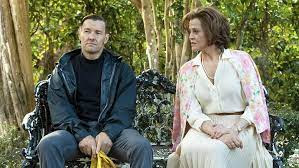
    Working minimally and with his emotions clipped as tight as his slicked down hair, Edgerton plays a former Neo Nazi living in the witness protection program after turning on nine of his former colleagues. Narvel since has tried to rehabilitate himself by becoming a skilled gardener: He heads the team that takes care of a showpiece garden for a wealthy woman (Sigourney Weaver).
    Sigourney’s Norma Haverhill (yes, the name sounds Dickensian) saw something in Narvel and took a chance on him -- or maybe she got an erotic charge from sleeping with a guy with a spray of SS and white supremacist tattoos that are revealed when he removes his shirt. Narvel's torso has become a poster for his past. Usually, he keeps it covered.
      None of the characters are easily understood. Weaver's Norma has a cruel streak fortified by flinty determination. Norma can be beneficent but she's also threatening and severe. She doesn’t like to be questioned.
   The arrival at the garden of Norma's grandniece, a mixed raced young woman played by Quintesssa Swindell, gives the story a jolt.
   Norma instructs Narvel to take Swindell's Maya under wing, educate her in the horticultural arts, and prepare her to inherit Gracewood Gardens. He obliges.
    A fast learner, Maya adapts to the gardening life and begins to develop a close relationship with Narvel.
    Despite bits of gardening information that are dispensed during Narvel's narration of the movie, Schrader isn't content simply to putter around the garden. When he brings Maya's drug-dealing ex boyfriend (Jared Bankens) into the story, the winds of corruption begin to ruffle the flower petals.
     The plot, such as it is, finds Narvel and Maya getting crosswise with Norma. Putting on her most judgmental face, Norma expels them from the garden, turning them into an unlikely Adam and Eve.
    Time for the elephant in the room.
    How can an intelligent woman of color, even one such as Maya who’s addicted to drugs, fall for an older man who happens to be a former white supremacist? Narvel is supposed to have seen the error of his brutal ways, but Edgerton keeps us away from Narvel's inner life. Flashbacks to Narvel's violent racist days haunt him but he carries himself stiffly, like a dutiful soldier who's following a new set of orders.
     Perhaps we’re meant to think that Narvel channels his former racist fury into a commitment to protecting Maya, a woman whose existence represents the racial mixing he once despised. 
    But Maya isn't a helpless damsel in distress; she's got some fire of her own. She doesn’t ignore Narvel’s past. Still, it’s a stretch to think she could live with it.
     Schrader builds toward a violent confrontation. In Master Gardner, violence can be both destructive and purgative.
    Schrader mixes beauty and shabbiness and leaves us to ponder deep questions: Can the most rotted among us find redemption? Can the corruption of the world be detoxified by those who've helped corrupt it? Can what has been destroyed by hate be restored by love?     
     So where do I stand on the movie? I'll say only this:  It sometimes can be better for a movie to be interesting than gratifying and whatever else I thought about The Master Gardener, I did find it interesting. 
    Such a movie, even when not fully realized, can reflect the uncompromising integrity of the artist who made it. That’s something to consider.