Showing posts with label Sigourney Weaver. Show all posts

Tuesday, May 19, 2026

'The Mandalorian' hits the big screen


   In some respects, Star Wars: The Mandalorian and Grogu qualifies as one of the biggest puppet shows ever staged. The creatures who populate The Mandalorian may not look entirely real, but they display the imagination and skill created by a seamless mix of CGI, animatronics, puppetry, and models.
      I guess I'm saying that realism takes a backseat to craft in The Mandalorian and Grogu, a movie that's better than I thought it would be, even if it lacks the super thrills of the best Star Wars movies.
     For those unversed in the Mandalorian world, here are a few essentials:
     The Mandalorian, a.k.a. Din Djarin, works as a hired gun for the anti-imperial New Republic.
      In this case, The Mandalorian is charged with finding and arresting Lord Janu (Jonny Coyne), one of the series' villains. The Republic makes a deal with a couple of Hutts (yes, a duo of the familiar blubbery creatures) to locate Rotta the Hutt and return him to Hutt control.
      Jeremy Allen White gives voice to Rotta. If you're expecting to hear the voice associated with White's character in The Bear, forget it. White's voice sounds as if it has been given an electronic assist.
       Whatever else it is, The Mandalorian isn't a star showcase. The Mandalorian seldom appears without his helmet, which means Pedro Pascal, makes heavy use of voice work.
       Martin Scorsese's jangled delivery as a four-armed food truck operator feels more connected to Scorsese's personality and provides a welcome dash of humor.
       Looking unsettlingly like ... well ... herself, Sigourney Weaver turns up as Col. Ward, the New Republic commander who sends the Mandalorian on the mission that defines the movie's structure: Set a goal, confront an obstacle, stage a fight, and then proceed to the next set piece.
      The movie's emotional core involves father/son issues, a Star Wars favorite. Imprisoned by Lord Janu, Rotta -- son of Jabba-- has attained a degree of stardom as a kind of gladiator. He rejects his father's criminal past, and aims to lead a life of his own, once he escapes Janu's clutches.
      More importantly, The Mandalorian serves as a father figure to Grogu, who's devoted to him, and, who, thanks to one of the movie's better plot twists, eventually is asked to save his surrogate father.
      There's something happily unsophisticated about The Mandalorian, both in its dialogue and characterizations. Although he's responsible for the movie's more tender moments, Grogu offers as much cuteness as clout, underscoring a vibe that feels less like hard-core sci-fi than Disneyesque fantasy.
        Maybe it fits the current moment, but The Mandalaorian works for money rather than for a vision of a free and thriving universe. To ensure that we don't see him as too greedy, the screenplay offers instances in which The Mandalorian doesn't accept payment. If nothing else, he deserves a vacation after engaging in an exhaustive (and sometimes exhausting) string of battles.
         I should note that I haven't watched the series on Disney Plus and still found the story easy enough to follow.  I didn't expect a deep-space adventure rendered in epic proportions; a bit of Googling primed me for a Star Wars descendant with less imposing villains and lower stakes. That's what I got.
       Scale aside, the battle between the New Republic and the forces of evil imperialism have been dragging on for nearly 50 years. Who knows? Maybe Grogu  one day will no longer rest on The Mandalorian's shoulders, but ....
        Oh, forget it.
         The Star Wars universe is geared for endless battling to save the Republic. One expects the fight to continue. Talk about "forever wars."


Thursday, February 13, 2025

Failures of ‘The Gorge’ go deep


 Billed as an action/romance, The Gorge is set to bow on Apple TV+. I’ve been hesitant about reviewing movies released exclusively on streaming services. 
My reluctance doesn’t necessarily speak to the quality of such films, but a lingering prejudice about the superiority of theatrical releases has proven difficult to shake, at least for me.
  I nonetheless opted to watch The Gorge. Given the chaos of the moment, I craved a diversion that might contain vertiginous thrills — no matter how obviously delivered. 
   Here’s the premise. Miles Teller and Anya Taylor-Joy play two sharpshooters — one a former Marine, the other a servant of Russian overlords—who are assigned to remote posts in what appears to be an Eastern European wilderness. They are separated by a deep gorge that's home to an ominous threat. 
   Their job: Prevent the threat — dubbed The Hollow Men — from climbing out of the gorge, a task that requires ample amounts of ammunition.
   Don't get too excited. Sure, T.S. Eliot wrote a poem called The Hollow Men and the screenplay includes other erudite references but they play more like Post-it notes than deeply felt revelations.
    A simple story arc emerges. Independent sorts, the sharpshooters must bridge the physical gap that keeps them apart, join forces in a battle for survival, and, of course, fall in love.
   At first, I remained hopeful. Sigourney Weaver turns up as a no-nonsense official who sends Teller’s Levi on his mission. Of course, we don’t trust her; she’s too crisp, too smart to be straightforward. 
   After providing some background about Taylor-Joy’s character, director Scott Derrickson lands the two assassins at their outposts, towers flanking both sides of the wide gorge. They’ve been instructed  to communicate with each other, but Taylor-Joy’s Drassa makes signs for Teller's Levi to read through his high-powered binoculars. She invites him to help her celebrate her birthday.
    Derrickson doesn’t waste time revealing the danger,  mutant creatures that look as though they’ve been assembled from sticks, leaves, slime, and animal parts. 
     Joy-Taylor's boldness gives the movie one of its few highlights carrying us to the moment when the two killers wind up in the gorge. There, Derrickson and his team build a world shrouded in fog and populated by weird creatures.
   Considering that both characters are deadly shots at long distances, it's odd that the movie forces them into so much close-quarters combat, slathering the action with gook and gore.
    When our heroes find an abandoned laboratory, we learn how the creatures were spawned, another letdown. A film made by a long-gone scientist explains the whole movie, but not without a heavy reliance on devices that the scientist and her colleagues conveniently left behind.
   You'll have little trouble finding your own examples of contrivance, so I'll conclude by saying that The Gorge returned me unrewarded to the world I'd been trying to escape. 

Monday, June 5, 2023

'Master Gardener' intrigues, confounds


    Sometimes I wonder how keenly Paul Schrader, like some of his characters, feels what it’s like to reside alone in a dimly lit room with an alarming lack of amenities. I thought about this after watching Joel Edgerton in The Master Gardener, the third in a string of movies Schrader began six years ago, the other two being First Reformed (2017) and The Card Counter (2021).
   Schrader is one of the few directors who seems to pursue his interests wherever then take him and they often take him to dark places. Remember this is the guy who wrote Taxi Driver, perhaps director Martin Scorsese's most luridly compelling movie.
    In The Master Gardner, Schrader, as he often does, charts another search for redemption. But the movie resists categorization. Despite the specificity of its settings -- a garden tended by Edgerton's Narvel Roth,  a few downscale southern neighborhoods, and several last-resort motels -- Master Gardner can't be taken as realistic. 
   The Master Gardener isn't exactly dreamlike either; it occupies a world scoured of human bustle and although the characters don't always make sense -- at least when you step back for further reflection -- Schrader encourages buy-in while you're watching.
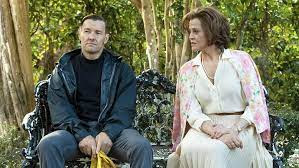
    Working minimally and with his emotions clipped as tight as his slicked down hair, Edgerton plays a former Neo Nazi living in the witness protection program after turning on nine of his former colleagues. Narvel since has tried to rehabilitate himself by becoming a skilled gardener: He heads the team that takes care of a showpiece garden for a wealthy woman (Sigourney Weaver).
    Sigourney’s Norma Haverhill (yes, the name sounds Dickensian) saw something in Narvel and took a chance on him -- or maybe she got an erotic charge from sleeping with a guy with a spray of SS and white supremacist tattoos that are revealed when he removes his shirt. Narvel's torso has become a poster for his past. Usually, he keeps it covered.
      None of the characters are easily understood. Weaver's Norma has a cruel streak fortified by flinty determination. Norma can be beneficent but she's also threatening and severe. She doesn’t like to be questioned.
   The arrival at the garden of Norma's grandniece, a mixed raced young woman played by Quintesssa Swindell, gives the story a jolt.
   Norma instructs Narvel to take Swindell's Maya under wing, educate her in the horticultural arts, and prepare her to inherit Gracewood Gardens. He obliges.
    A fast learner, Maya adapts to the gardening life and begins to develop a close relationship with Narvel.
    Despite bits of gardening information that are dispensed during Narvel's narration of the movie, Schrader isn't content simply to putter around the garden. When he brings Maya's drug-dealing ex boyfriend (Jared Bankens) into the story, the winds of corruption begin to ruffle the flower petals.
     The plot, such as it is, finds Narvel and Maya getting crosswise with Norma. Putting on her most judgmental face, Norma expels them from the garden, turning them into an unlikely Adam and Eve.
    Time for the elephant in the room.
    How can an intelligent woman of color, even one such as Maya who’s addicted to drugs, fall for an older man who happens to be a former white supremacist? Narvel is supposed to have seen the error of his brutal ways, but Edgerton keeps us away from Narvel's inner life. Flashbacks to Narvel's violent racist days haunt him but he carries himself stiffly, like a dutiful soldier who's following a new set of orders.
     Perhaps we’re meant to think that Narvel channels his former racist fury into a commitment to protecting Maya, a woman whose existence represents the racial mixing he once despised. 
    But Maya isn't a helpless damsel in distress; she's got some fire of her own. She doesn’t ignore Narvel’s past. Still, it’s a stretch to think she could live with it.
     Schrader builds toward a violent confrontation. In Master Gardner, violence can be both destructive and purgative.
    Schrader mixes beauty and shabbiness and leaves us to ponder deep questions: Can the most rotted among us find redemption? Can the corruption of the world be detoxified by those who've helped corrupt it? Can what has been destroyed by hate be restored by love?     
     So where do I stand on the movie? I'll say only this:  It sometimes can be better for a movie to be interesting than gratifying and whatever else I thought about The Master Gardener, I did find it interesting. 
    Such a movie, even when not fully realized, can reflect the uncompromising integrity of the artist who made it. That’s something to consider.

Wednesday, December 14, 2022

Sights and sounds dominate new 'Avatar'


  You almost can write a review of Avatar: The Way of Water without seeing the movie. In the hands of director James Cameron, you can be sure the movie will boast an abundance of visuals that dazzle and delight.
  In this case, kudos to Cameron for underwater footage that features beautifully imagined sea creatures and flora. If you see the movie in 3D, you may feel as if you can touch what you're watching.
   When it comes to the technical aspects of imaginative expression, Cameron excels, and his mixture of live and digital imagery unfolds seamlessly.
   You also know that, in broad terms, the movie, like the first installment, will pit environmentally oriented tribal creatures of the planet Pandora (good) against the military/industrial forces of people from the dying planet of Earth (bad). 
    You also know that Cameron will freshen the story, in this case focusing on the children of Jake (Sam Worthington) and Neytiri (Zoe Saldana), a trio of kids who are also befriended by Kiri (Sigourney Weaver), a girl whose mother Grace (also Weaver) appeared in the last installment. 
    I’m not going to get into the genetic history of these characters because ... well ... beats me.
    Not surprisingly, the movie's third act offers a tremendous jolt of action, and, unlike what you'll find in the work of some of his contemporaries, Cameron's combat proves legible. You can tell what’s happening. Really.
    In full awed-by-nature mode, Cameron also pays homage to whale-like creatures — here called tulkuns —- giant sea mammals who are intelligent and helpful. 
    The tulkun are linked to a newly introduced tribe, the Metakayina, Pandora island folks who can swim underwater for long periods and who have developed an ethos based on their relationship to the sea and its creatures. 
    The plot begins moving when Sully and his family take refuge among the Metakayina, who are ruled by Ronal (Kate Winslet) and Tonowari (Cliff Curtis). The children of this royal pair interact with Jake and Neytiri's kids, giving Cameron an opportunity to explain Metakayina culture while offering some fairly typical teen conflict.
   You also know that Sky People (Earthlings) will be greedy and brutal. The Sky People have devised a way to use the memories of the previous military characters to create clones that appear to be Na’vi. So Quaritch (Stephen Lang), the last movie's villain, has a tail and a narrow Na’vi physique.
    Of course, he's still a jerk.
    Motivated by something akin to revenge, Quaritch wants to destroy Jake, ostensibly because Jake has become the leader of the rebels. 
   Every time, Quaritch opens his mouth, the movie sounds as if it's channeling a Vietnam war movie, complete with episodes in which soldiers attempt to brutalize the local population of Pandora's islands.
    All this means that The Way if Water has been engineered to generate big-time box office returns by filling the screen with  better realized visuals than can be found in the first edition — and those were pretty impressive, too.
   Shifting the focus to teenagers and turning Jake into a stern but worried dad adds a more juvenile flavor, but most adults probably won’t mind. 
    Look, if you’re searching for a sophisticated story, eloquent dialog, and revelatory thinking, Avatar probably is not the place to start. 
     Cameron aims for immersive experience, so much so that when you visit a new environment, you may feel like you’re entering another terrifically designed attraction in the Cameron collection of theme parks.
    I don’t mean that as a criticism but as a way of suggesting how it feels like to watch a spectacle-oriented movie, which has an ending (several actually) in which Cameron keeps trying to top himself and often succeeds. 
   In the idyllic world of my imagination, The Way of Water wouldn't  be an event movie that's poised to break records for popcorn sales. But in the real world governed by spinning turnstiles, we probably should be grateful that The Way of Water comes from Cameron, a filmmaker who gives audiences what they pay for — richly realized journeys to other worlds.
    The Way of Water, if you haven't heard, is three hours long, but I wasn't much bothered by its length. It did, however, give me time to think. During an underwater battle involving a sinking vessel, for example, I couldn't help asking myself, "What? Cameron didn't get enough of this with Titanic?"

Thursday, January 5, 2017

A monster calls, a boy listens

A 12-year-old struggles with the looming death of his mother.
Few movies deal with what happens when a child must confront the death of a loved one. Fair to say, then, that A Monster Calls musters considerable courage in taking on a difficult subject by telling the story of Conor (Lewis MacDougall), a 12-year-old boy who's losing his mother (Felicity Jones) to cancer.

Adapted from a YA novel by Patrick Ness, who based his story on an idea by Siobhan Dowd, another YA novelist who really did die of cancer, A Monster Calls plumbs young Conor's imagination by introducing him to a tree monster (voiced by Liam Neeson) who guides the boy through what may turn out to be the worst period of his life.

The monster follows a tough love approach, reinforced by Neeson's fine voice performance. The monster doesn't coddle Conor, but informs him that he'll be told three stories (beautifully animated set pieces within the movie) before learning the most important truth pertaining to his situation.

Conor isn't entirely captivated by the stories, which the monster concludes with some observations that probably are too directly expressed: People occupy various places on the moral spectrum at various times; few are entirely good or irredeemably bad; sometimes bad deeds have positive outcomes.

Aside from his mother's condition, Conor has other worries. He's bullied at school, and he dreads the prospect of living with his stern grandmother (Sigourney Weaver) after his mother dies. Conor's dad (Toby Kebbell) has moved to America, and has started a new family.

Director J.A. Bayona does a fine job mixing the movie's live action, animation and effects-driven scenes, so much so that the movie's somber mood may remind you of something that another Spanish director (Guillermo del Toro) might have rendered -- albeit in even more ominous fashion.

The performances are all good; it's particularly refreshing that MacDougall isn't a generically cute movie kid.

It's also touching that Conor and his mom are soulmates in the world of the imagination. Both have artistic inclinations. Perhaps that's how Conor learned to use his imagination both to cope with and escape from a situation he doesn't want to face.

I could go on, but let me say the most important thing: The movie put a lump in my throat, even as I wondered whether adults will want to see what can be construed as a kids' movie -- even if it really isn't a kids' movie of standard-issue variety. It's possible that A Monster Calls is more a movie about a kid than a movie for kids, particularly younger ones.

And some of the scenes may challenge parents to do some explaining, notably one in which a furious Conor destroys his grandmother's living room, an instance in which Conor vents his darker impulses.

Despite such cautions, Bayona and company have managed to make a movie that doesn't shrink from a difficult subject. Good for them -- and good for those viewers willing to give it a try.

After all, it's worth remembering that not everything that happens in childhood qualifies as kid stuff.

Thursday, March 5, 2015

'Chappie' is ... finish the rhyme yourself

A robot with consciousness gets lost in another junkyard of a movie.
Chappie -- a movie about a robot with the same consciousness as humans -- never seems able to resolve a rash of internal conflicts. Is it unashamed B-movie trash? Is it a goofy send-up that turns a robot into a silly child? Is it a descendant of Short Circuit or of RoboCop? Is it something else entirely?

Because it never answers these questions Chappie turns into another junkyard of a movie that takes what might generously be called a casual approach to logic.

For director Neill Blomkamp (District 9 and Elysium), the third time hardly qualifies as a charm.

So what do we get?

Blomkamp's story about a robot who's given consciousness and then is captured by thugs features:

-- An over-amped Dev Patel as an engineer who has figured out how to make a fully conscious robot.
-- Then there's Hugh Jackman as a brooding former military man who wants to make the ultimate fighting robot, but whose creation has been put on hold.

-- And don't forget Yo-Landi Visser and Ninja, South African rappers who belong to a group called Die Antwoord. They appear as a team of tattooed miscreants who are softened to the point of redemption by their contact with Chappie.

-- Sigourney Weaver, in an entirely negligible role, plays the head of a company that builds police robots for the city of Johannesburg.

When the movie opens, the city's crime rate is down and the robot cops seem to be functioning with great efficiency.

This germ of an idea could have provided the basis for an interesting merger of sci-fi and police procedural.

Instead, Blomkamp vents his impulse for rampant action coupled with moments of oddball comedy in which the innocent robot refers to the shady characters who are trying to teach it their felonious ways as "mommy" and "daddy."

Chappie trying to mimic the strut and speech of the street-wise gangstas who have taken control of him seems puerile.

These ploys may have been intended to be amusing, but to me, they looked dumb, particularly because they're repeated ad nauseam as the movie builds (or perhaps stumbles) toward the moment when Johannesburg's robot police force is hacked and criminals run unimpeded throughout the city's streets.

One more thing before we leave the world of artificial intelligence behind.

I'm sick of seeing real newspeople in works of fiction. Chappie opens with CNN's Anderson Cooper narrating a feature about the way robots have helped reduce crime in South Africa. Cooper sets the stage for what's to come, but it's time newspeople gave more thought to the ways in which they're used to lend an aura of authenticity to otherwise preposterous movies.

Such participation may give a movie an air of credibility, but it doesn't necessarily do the same for the participating newspeople.

Back to Chappie.

At times, Blomkamp tosses an idea at us, say when Chappie -- who's rather lithe for a robot and is voiced by Sharlto Copley -- wonders why Deon bothered to make him in the first place if he's doomed to expire when his batteries, which can't be replaced, run out.

Just what we needed, a reminder of another movie, a bit of A.I.-like poignancy?

Chappie, by the way, ends in a way that seems to open the door for a sequel. I couldn't help thinking that a second movie might be more interesting than the one I just watched.

That doesn't mean I'm advocating for another helping. Take it as a statement about the inadequacies of this first installment.

Thursday, December 11, 2014

Escaping bondage -- with help

Ridley Scott directs, Christian Bale plays Moses and the Hebrews flee.
If I were able to talk to Ridley Scott, who directed Exodus: Gods and Kings -- a 3-D rendering of one of the best-known Bible stories -- I'd ask him what on Earth (or under the heavens) attracted him to the material.

It's a question the movie itself never entirely answers.

Cecil B. DeMille's Ten Commandments combined gaudy spectacle with an Americanized freedom agenda as the benighted children of Israel -- with a snarling Edward G. Robinson in tow -- fled 400 years of bondage in Egypt.

Scott downplays the story's religious/spiritual aspects, but doesn't find enough by way of replacement. I'm no literalist when it comes to Bible stories so I have no problem with an artist using the Bible's rich and venerable stories as a springboard for an interpretive statement.

But in skipping some of the key ingredients of the story -- serial confrontations between Moses and Pharaoh, for example -- Scott not only makes an interpretive choice: He abandons some of the story's most fertile dramatic ground.

Gods and Kings makes masterful use of CGI to create great battles (Egyptians vs. Hittites), the fabled plagues -- frogs, boils, rivers turned to blood, etc. -- and, of course, the parting of the Red Sea. It would be shocking if a 21st Century filmmaker couldn't outdo DeMille in the effects department. Scott clearly does.

But then there's the rest of the movie ....

I suppose the movie's most controversial element involves Scott's depiction of God, the prime mover in the Exodus narrative. Turns out that Moses sees God as a shepherd boy (Isaac Andrews) with a close-cropped hair, a British accent and a confrontational attitude.

This vision -- it should be noted -- may be a hallucination, an image resulting from a rock slide that beans Moses and leaves him buried under a ton of mud.

Hallucination or not, the relationship between God and Moses sometimes gets testy. They argue about such details as whether God has gone too far over the top with the plagues, particularly the final one which takes the lives of the first born of all the Egyptians, including Pharaoh's son.

Are we supposed to find irony in the fact that mighty Pharaoh is undone by a child whose voice has yet to change?

Then there's Moses himself. Poor Christian Bale. Any actor who tackles this kind of iconic role must pit himself against the cumulative weight of centuries of western art and kitsch -- from Michelangelo to Charlton Heston.

Bale opts for a contemporary interpretation, aided by language in a script by a quartet of credited writers (Adam Cooper, Bill Collage, Jeffrey Caine and Steven Zaillian) that does its best to avoid any trace of poetry. The movie treats Moses as a warrior/general and early action hero.

Moses's greatest internal struggle seems to revolve around his initial inability to accept his ethnic origins as a Hebrew, but even that conflict lacks much by way of urgency.

Joel Edgerton plays the movie's other key figure: Ramses. With a bulbous shaved head, Edgerton more resembles Kojack than a king.

Perhaps in an effort to give Ramses a bit of shading, he's presented as a cruel man, but one who loves his son and who sometimes seems confounded, particularly when his own priests and priestesses are unable to stem the tide of so many vicious plagues.

What's a Pharaoh to do? Grumble and, on at least one occasion, play with his pet snakes.

The rest of the cast largely is reduced to non-entity status. That would include Aaron Paul as Joshua, and Andrew Tarbet as Aaron, key figures in the story who are reduced to ... well ... almost nothing.

John Turturro makes an interesting Seti, Rhamses's father, a god/king who prefers Moses to his own son. Blink and you'll miss Sigourney Weaver as Seti's duplicitous wife.

Ben Kingsley makes a bit of an impression as Nun, a wise old Hebrew slave who knows Moses's true identity.

The always interesting Ben Mendelsohn brings a seamy twist to the role of Hegep, a conniving Egyptian who exposes Moses as a Hebrew, the development that pushes Moses into exile where he meets his wife (Maria Valverde), a woman made to look like a Bedouin princess.

Beset by structural flaws, including a tendency not to build toward the story's key events, Scott's Exodus shortchanges both the spiritual and political relevancies of a story that still resonates on many levels. The movie doesn't exactly break new ground as an action/adventure, either.

Most memorable shot: An upward look at the corpses of Egyptian soldiers floating in the Red Sea after the Hebrews have reached safety.

So what are we left with? At times, Moses seems like an actor who can't quite find a center for his portrayal -- or maybe that's Bale. Ramses can come off as a bit of a schlub, and God seems like a cosmic spoilsport.

When Moses reunites with his wife after his Egyptian exploits, she quite reasonably asks about the throngs who are traveling with him.

Who are they?

My people, says Moses, demonstrating that he finally has accepted his true identity.

What else to say but, "Mazel tov, Moses." Or maybe, where's Mel Brooks when we need him?