An intriguing movie gets lost somewhere in The Drama, the story of a pending marriage that's shaken when one of the partners reveals something horrible about her past.
Rocky Mountain Movies & Denver Movie Review
FOR MOVIE LOVERS WHO AREN'T EASILY SWEPT AWAY
Friday, April 3, 2026
'The Drama' can't find its footing
Wednesday, November 5, 2025
She's no stay-at-home wife
Never timid, always willing to push toward extremes, and unflinching in her boldness, Scottish director Lynne Ramsay remains an unabashed risk taker.
Monday, March 10, 2025
'Mickey 17' fails to stick a landing
Korean director Bong Joon Ho finds his way to Hollywood for Mickey 17, a teeming, cockeyed adaptation of a novel by Edward Ashton. Ashton titled his novel Mickey7.
Tuesday, March 1, 2022
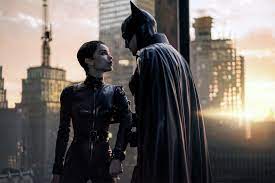
Can a despairing Batman still fight crime?
Tuesday, September 15, 2020
Maybe the devil made them do it
Judging by the characters in The Devil All the Time, some of the folks in West Virginia and parts of southern Ohio are mighty weird, screwed-up in ways once taken for common coin in Southern Gothic literary circles.
These are just a couple of the more lurid examples from director Antonio Campos’ cinematic take on a novel by Donald Ray Pollock, who narrates a taxing two-and-a-half hour Appalachian journey that sometimes feels like a near-parodic take on one of Flannery O’Connor’s novels.
Campos doesn’t skimp on the number of characters who populate his movie, some arriving and disappearing before the story settles on Arvin (Tom Holland), a young man struggling to find his place in this strange, violent world.
The death of his mother and the resultant suicide of his father put young Arvin in the care of his grandmother (Kristin Griffin). As Arvin grows into manhood, the story also tracks the twisted progress of a serial killer (Jason Clarke) and his wife (Riley Keough).
Their MO: He takes photos of his victims having sex with his wife before slaughtering them. She goes along with his twisted plans, although she eventually tires of their murderous travels.
A frighteningly intense Harry Melling plays the preacher who believes the Lord will help him resurrect the dead. Mia Wasikowska portrays his hapless wife.
Arvin's grandmother adopts Leonora, the daughter of this less-than-happy couple. Eliza Scanlen plays Leonora as an adolescent.
To further complicate matters, Keough’s character is the sister of a corrupt local sheriff (Sebastian Stan).
I haven’t read Pollock’s novel, but in his review in The New York Times, Josh Ritter wrote, “Pollock’s prose is as sickly beautiful as it is hard-boiled.”
I can’t say the same for the filmmaking here; sans Pollock’s prose, the movie strips the characters to their bare-bones lunacy and becomes a bit of an endurance test, making us wonder just how much of this ruthlessly unpleasant crowd we can take.
Tuesday, September 1, 2020
Great action in a muddled ‘Tenet’
Director Christopher Nolan brings Inception-like complexity to a story that probably will have fans filling chat rooms and Zoom calls with speculation, insights, and connections to whatever they perceive as the movie’s meaning.
I’m not sure what awaits moviegoers when they venture into newly re-opened theaters but I admit to feeling a bit of guilt at having seen Tenet under what surely must be the safest possible conditions. I hope you’ll be able to do the same.
John David Washington (BlacKkKlansman) plays a character described in the credits only as The Protagonist, a secret agent who must save the world from dreams of annihilation by Andrei (Kenneth Branagh), a crazed Russian oligarch.
Andrei's art appraiser wife Kat (Elizabeth Debicki) develops a flirtatious relationship with The Protagonist, but her main concern involves rescuing her young son from the clutches of his evil and monumentally abusive father.
As his mission unfolds, Washington’s character acquires a sidekick, the devilishly stylish Neil (Robert Pattinson).
Not much else needs to be known about the cast. Michael Caine makes a brief appearance as a British spy and Indian actress Dimple Kapadia plays a sophisticated woman who traffics in arms.
For all its theories, talk of algorithms and such, Tenet plays like almost every other summer movie, by which I mean it alternates exposition (a lot of it) with imaginatively conceived action set pieces.
I half wondered whether Tenet might be a movie that’s best enjoyed by throwing out the bathwater (the story) and keeping the baby (the action).
A chase involving speeding trucks is particularly exciting and Nolan excels at making the movie's theoretical conceits visible: bullets fly backward into guns and demolished buildings reassemble, for example.
Did I mention that birds can be seen flying backward?
Because the characters need to wear oxygen masks when they are "inverting," some of the burdens of performance have been lifted. But these days, not seeing everyone's face all the time seems depressingly familiar.
Of the performances, Debicki stands out. Her Kat is sexy, calculating, and possessed of worldly intelligence. Pattinson brings casual charm to his portrayal and Washington gives a forceful, straight-ahead performance that provides the movie with its continuity.
Speaking with a Russian accent, Branagh alternates understatement and outbursts, giving the movie a full quota of human menace.
I presume that Nolan and company collected major frequent flyer miles as they location-hopped to places as far-flung as Italy's Amalfi Coast, Mumbai, Estonia, Denmark, Norway, and London.
All this is accompanied by a score (credit Swiss composer Ludwig Goransson) that pulses and pulses -- and then pulses some more.
After a well-staged opening which seems to have been inspired by a real-life 2002 terrorist attack on a Moscow theater, the movie quickly leaps from what many will see as Bondian terrain to one involving alternate realities.
With Nolan, the reality in which we all reside never seems complex and baffling enough. His worst enemy: the chronological order that marks the way most of us experience the passing of time.
I leave it to you to determine whether it's important to catch every line of dialogue. I know I missed a lot.
And that seems to sum up the Tenet conundrum; you’re often left wondering whether you’ve lost your place or whether the story simply has gone on without you. The result, at least for me: Increasing indifference.
It’s obviously up to you to decide whether you want to see Tenet, which only can be viewed in theaters. Exhibitors, studios, and other representatives of what might be described as the motion-picture industrial complex certainly hope you do.
I have mixed feelings about the reopening of theaters and I’m eager to hear from those who go. I’m less interested in what you think of Tenet than in whether you felt safe in a theater where masks could be lowered to consume snacks.
In the end, how safely theaters can operate during a pandemic (it may take time to tell) strikes me as a far more important question than any I could raise about Nolan's latest spectacle.
Monday, October 28, 2019
The dark world of "The Lighthouse"
Filmed in black-and-white and locked in a claustrophobic square image that makes the frame seem like a prison cell, director Robert Eggers's The Lighthouse qualifies as one of the year’s weirdest movies.
The set-up is as spare as a picked over bone. Two men played by Robert Pattinson and Willem Dafoe arrive on a small rocky island off the mainland. They’re supposed to spend a month manning the island's lighthouse, but wind up stranded when a major storm hits.
This may make it sound as though the movie has a plot. It doesn’t, not really. It’s about a strained, sometimes collegial relationship between two men — with overtones of homoeroticism thrown into an atmosphere that resists definition. In a way, you could say that The Lighthouse isn’t about either of the two men; it’s about the forces that fill the space between them.
Dafoe plays the older and more experienced of Eggers’ duo; Dafoe’s character bosses Pattinson’s character around, assigning him the dirtiest jobs, tasks such as emptying waste, carting coal for fires and scrubbing floors.
Dafoe’s character fancies himself a sea captain and, the movie — set in the 1890s — treats him like one. His speech is archaic and, as you’ll learn from a note at the movie’s end, some of the dialogue derives from Melville and some from the diaries of various men who tended lighthouses.
Dafoe's character may be delusional, no more a captain than Pattinson’s character is a member of his crew. The men are playing roles and, in some sense, the movie wants to see who can break out of his role to attain dominance.
I’ve seen The Lighthouse classified as a horror movie. I'd say it's creepier than it is scary. Pattinson finds a small sculpture of a mermaid in the bedroom the men share. Is he dreaming when she seems to come to life and beckons to him? And what’s with the lamp in the lighthouse, which Dafoe’s character insists only he can tend? Why do we see Dafoe’s character standing naked in front of the light as if immersed in some kind of erotic transcendence? Does a demonic presence lurk nearby?
I leave it to you to ponder such questions but I'll suggest that answers may matter less than the way Eggers (The Witch) creates an atmosphere of desperation and dread. He makes us the island's haunted isolation.
The shabby interior of the building where the men reside almost makes you cringe at its meager possibilities. When the two men sit to down dinner, you know that the food probably tastes awful. The wooden floors and walls of the men's quarters are on the verge of rot — if they haven’t already crossed the line.
I don’t know whether The Lighthouse is too weird to garner awards attention for the actors, but Dafoe — one of the screen's most adventurous actors — hits stunning notes, mixing cruelty and the urge to dominate with a kind of manly cordiality. The more wary Pattinson keeps pace, and I would say that these are two of the most fearless performances I’ve seen in some time.
Eggers fuels the tension by having his two characters consume increasingly large amounts of alcohol. They get drunk. Dafoe’s character delivers salty, poetic orations and you can see rebellion brewing in Pattinson’s face, his mouth threatening a sneer. He seems to be hiding a dangerous intelligence. He has an unpleasant relationship with the island's seagulls and maybe with all of nature.
Wild and unhinged, The Lighthouse may not be entirely comprehensible, but it sends you out of the theater in a way that colors perception, making your surroundings look more alien, more forbidding. Years ago, I remember reading a quote by Abel Gance, who directed the great silent epic, Napoleon. Said Gance, a movie should make you see the world differently than before you sat down to watch it. By that measure, Eggers has accomplished his task.
Friday, April 12, 2019
Floating toward the void in a spaceship
A group of convicts floats through space in a vessel that looks more like a barge than something designed by anyone who'd ever seen a spaceship or a movie about one. These unfortunate souls evidently thought that traveling through the darkened void en route to a black hole would be better than submitting to the death penalty on Earth.
Earth, by the way, has become so distant for them that there's barely enough memory of it left to fuel a decent flashback. Later, we'll learn that the Earth is pretty much doomed and that these voyagers might be what's left of humanity. In the movies, humanity never has difficulty finding its way toward extinction. All connections to reality, we presume, are purely intentional.
French director Claire Denis begins her movie by showing us an onboard garden where vegetables are cultivated. A shoe, apparently detached from its owner, peeks out from beneath the soil. We'll also see a man in a space suit (Robert Pattinson) tightening bolts outside the craft. Inside, an infant girl happily makes infant-girl noises. We presume the man in the space suit is the girl's father.
Gradually, Denis -- working in English for the first time -- reveals her approach, which has less to do with sci-fi than with quietly subjecting her characters to the kinds of cruelty desperate people are prone to inflict on one another. She's also studying sexual gratification, which takes place on the ship in a device called "The Box."
In conjunction with the movie's approach to sex, we meet a crazed scientist (Juliette Binoche) who's obsessed with reproducing life in deep space. Many bodily fluids flow as Dibs, who seems to be in charge of the others, collects sperm samples from the men as part of her experiments.
The scene in which Binoche's character enters "The Box" for sexual stimulation requires the actress to abandon all inhibition. At the same time, it can feel more squirm-inducing than erotic. Dibs, after all, is getting it on with a machine, perhaps the most elaborate sex toy ever to spring from someone's imagination.
No, I haven't forgotten the infant, who showed up early in the movie but who represents a later development in the story's shuffled chronology. Baby Willow (Scarlett Lindsey) receives tender treatment from Pattinson's Monte. She also drives him crazy with her crying.
Denis gradually reveals what happens to the rest of the crew, pacing her movie so slowly you might wonder whether she regards anything resembling narrative drive as a cardinal sin.
Other passengers on this voyage include a black man (Andre Benjamin) who says he volunteered to bring glory to his family and a variety of women (Mia Goth, Agata Buzek, Claire Tran, and Gloria Obianyo).
After the passage of time, Jessie Ross portrays the teenage Willow. Ewan Mitchell appears as one of the more violent passengers on this trip toward the void.
Pattinson, who often whispers his character's thoughts, continues to be one of today's most adventurous actors. Same goes for Binoche. I didn't always know what Denis' purposes were, but these two actors seem to suit them perfectly.
Credit Denis with creating a pervasive sense of weirdness that gets under the skin, insinuating itself into consciousness, somewhat in the way that the steady flow of an IV drip invades the veins. You may leave the movie in a kind of art-induced daze.
But what does it all mean? Too much? Too little?
Denis operates light years away from thrill-a-minute Hollywood cinema; her style requires patience and perhaps a little caffeine. I wish I could say, High Life produced a more discernible reward. I'm not sure that the movie's images lend themselves to any resounding thematic statement. High Life just might be a movie that wants to say something profound but leaves us wondering exactly what that might be.
Thursday, August 24, 2017
'Good Time' takes propulsive flight
This adrenalized movie about a couple of guys who botch a robbery may be about the ways in which movies can get in your face and stay there. At times exhilarating and at times overbearing, Good Time never backs off, which can make watching it akin to the experience of being unable to escape a conversation you're not always sure you want to have.
Directors Josh and Benny Safdie come across as unashamed proponents of the cinema of immediacy; the Safdies' characters are pushed through panic-fueled flight in a race to avoid capture, an old story but one viewed through a jangled urban lens.
Robert Pattinson, who rose to prominence in the Twilight series, continues to demonstrate that he has significant acting ability by playing small-time crook Connie Nikas.
Early on, Connie ropes his mentally challenged brother (portrayed by Benny Safdie) into joining him for a bank robbery. A wily bank teller outsmarts this masked duo by inserting a dye pack into their haul of cash. When the pack explodes, the brothers are marked by paint and doomed to run.
Battered in jail after being arrested, Nick winds up in a hospital: Connie, who's still running, attempts to spring his brother. Whether Connie does this out of love or out of fear that his brother, lacking in larcenous wiles, will spill the beans, remains an open question.
Before that, Connie tries to raise bail money with his girlfriend (Jennifer Jason Leigh), a woman who evidently has been pulled into Connie's dangerous orbit before.
The movie's great gimmicky twist introduces us to Ray (Buddy Duress), a man newly released from prison. Never mind how the movie works Ray into the story. That's something to be discovered in a theater and it helps give the movie some comic edge.
While seeking refuge from the police, Connie hides out with a Haitian woman and her teenage granddaughter (Taliah Webster). Connie uses and betrays Webster's character, but also shows flickers of genuine concern for her. Street-smart, but inexperienced, Webster's Crystal can't keep up with Connie's manipulations.
Lest we mistake Connie for a lovable goofball, the Safdies show him brutally beating an amusement park security guard (Barkhad Abdi) who discovers Connie and Ray's intrusion into the park where they're searching for a hidden stash of drugs and money.
It's not the only time the Safdies make you wonder whether they've gone a little too far.
I don't know if Pattinson is improvising, but he creates the illusion of a character who's entire approach to life is improvisational. Connie doesn't plan; he reacts and relies on his instincts.
Duress adds humor as a guy too dim and drunk to avoid trouble. Duress's Ray is motivated by a desire to celebrate his recent release from prison, a place he doesn't wish to revisit. You don't need to be a seer to know that Ray's evening won't end well.
With the skilled help of cinematographer Sean Price Williams, the Safdies give their movie kinetic life that seems to be spring right from their nerve endings.
What they can't do is make us -- or at least me -- root for Connie's redemption, and they sometimes left me wondering as Pauline Kael did at one point in her contrarian review of Martin Scorsese's Raging Bull: "What am I doing here watching these two dumb f...ks?". (Jake LaMotta and his brother Joey.)
I didn't agree with Kael about Raging Bull, but after her review, I began to look for a genre you might call "dumb f...k" movies, if I may borrow the New Yorker's ellipsis. I'm not talking stupid comedies, but films with serious aspirations.
Compelling and impressive as it can be, Good Time left me mulling whether it shouldn't be tagged with a little bit of that label.
Thursday, April 20, 2017
When a search becomes a destiny
These days, the movies give us lots of synthetic adventure, including gargantuan comic-book creations for a generation of couch potatoes. It's been a while since anyone tried to serve up any real adventure. Credit director James Gray with doing just that in The Lost City of Z, the amazing story of a 20th Century explorer who journeyed deep into the Amazon jungle in search of an ancient city he dubbed "Z" and which others called El Dorado.
Percy Fawcett (Charlie Hunnam) was a British army officer who was sent to Latin America to help chart the border between Brazil and Peru. During his mapping expedition, Fawcett became convinced that he had found archeological evidence of a lost civilization that was far more advanced than anyone believed possible. European prejudice against Latin America's non-white indigenous populations preferred to see savages, not innovators.
Basing his movie on David Grann's 2009 non-fiction bestseller, Gray tells a story that shifts between England and the Amazon -- with a brief stop for some compelling war footage. Fawcett served as an officer in World War I; he was wounded during a vicious trench battle.
Populated with stuffed-shirt Brits, Amazonian tribesman, and Fawcett's loyal crew, the movie proves a stirring adventure that opts for credible realism rather than over-inflated drama.
Joining Hunnam -- quietly fierce in his commitment to finding the lost city -- is a nearly unrecognizable Robert Pattinson, who plays Henry Costin, one of Fawcett's crew. On his last expedition to the jungle, Fawcett also was accompanied by his son Jack (Tom Holland). A fine Sienna Miller portrays Fawcett's wife, a woman who wanted to participate in an Amazonian mission but wound up staying home. She cared for the couple's three children and endured a life of committed loneliness. She supported her husband's dreams.
At one point, tension erupts between Fawcett and arctic explorer James Murray (Angus Macfadyen), a man who initially supports the search for the lost city but who becomes a liability when he faces the jungle's heat and hardships.
Gray (We Own the Night, Two Lovers and The Immigrant) never before has worked on such a large scale. With support from cinematographer Darius Khondji, Gray gives the jungle sequences vigor and excitement that surpasses the scenes in England, a location to which the movie periodically returns.
I have to admit, though, at times I found myself yearning for a more rapturous approach to the movie's imagery. Maybe that's more my problem than the movie's. The British interludes tend to disrupt the adventure but that may be the point. We share Fawcett's impatience about returning to the jungle.
When Fawcett encounters an opera company in the middle of the jungle, viewers may be reminded of Werner Herzog's Fitzcarraldo, another Amazon-based movie about doomed obsession.
But Hunnam (Pacific Rim and Crimson Peak) makes an interesting choice: His Fawcett is not a man of febrile passions; he's a man of mettle, and he approaches adventure as a kind of solemn duty. It's his reason for being.
Fawcett eventually loses his heart to the jungle. The jungle, however, isn't the most accommodating of lovers, a reality that underlies the movie's best sequences: Arrows of tribesman raining down on the explorers' raft, an encounter with head hunters and the crew caught in torrents of onrushing water.
At one point, Miller delivers the line that underscores Fawcett's ambition and perhaps the movie's, as well. She cites Robert Browning's poem, Andrea del Sarto, "Ah, but a man's reach should exceed his grasp or what's a heaven for?"
Despite references to Britain's imperial racism and slavery, I'm not sure that Gray attains the thematic heights that a film such as this could have reached. But his grasp proves strong: As the story of a man who consistently risked his life in search of a city only he believes existed, Lost City serves up more genuine excitement than most of its artificially inflated competitors.
Thursday, April 6, 2017
Kidman of Arabia (really)
Werner Herzog isn't David Lean, and Nicole Kidman is no Peter O'Toole. I don't mean that as a slam on either Herzog or Kidman, the talented director and fine actress who have teamed for Queen of the Desert, an historical epic about Gertrude Lowthian Bell. Bell, a woman who probably will be unknown to most audiences, was a writer and adventurer who helped Winston Churchill draw the lines that carved up the Ottoman Empire after World War I.
Herzog fans immediately will be struck by the movie's surprisingly conventional style, which (alas) relies heavily on images of Kidman riding camels, on two somewhat listless romances and on the less-than-exciting intricacies of tribal politics among the Arab populations of the empire once controlled by the Turks.
A miscast James Franco portrays Henry Cadogan, Bell's first love. As he whispers his way through a British accent, it's difficult to take Franco seriously. Robert Pattinson, who shows up as T.E. Lawrence at least uses his crooked half-smile to suggest Lawrence's mischievousness.
Damian Lewis plays the third man in Belle's life, Maj. Charles Doughty-Wylie; Bell writes to Doughty-Wylie as she wanders across the desert. Periodically, we hear Kidman reading these letters in hushed tones.
Kidman captures Bell's courage, her confusion when it comes to romance and her determination not to be limited by gender. But Herzog relies on far too many glamor shots of Kidman, who manages to look beautiful even in extreme circumstances of desert heat and dust, not to mention the threat of hostile Arabs, most of whom ultimately are charmed by Bell's tenacity.
Herzog can't be accused of skimping on scenery; many of the desert images are steeped in grandeur, but the movie's swelling musical score feels like something lifted from another era.
Bell supposedly drew up the boundaries of modern Iraq, a skill that may have inspired Herzog to use on-screen maps to follow Bell's progress around the region, an old-fashioned technique that he presents without any trace of irony. Same goes for some of the cornball dialogue in which Bell talks about giving her heart to the desert.
Aside from telling us that Bell -- one of the first women to attend Oxford -- was an early example of feminine assertion, it's not exactly clear what Herzog hoped to say. Such is the price of reigning in idiosyncrasy: Herzog seldom has made a movie this sparkless and generic in its feel.
Thursday, June 19, 2014
Another brutal, unforgiving world
Now comes Michod's second movie, The Rover, a grim journey through a trashed-out world that has emerged after an economic catastrophe rendered the outback (and perhaps the rest of the globe) lawless.
With actor Robert Pattinson trying hard to put Twilight behind him and Guy Pearce doing his best to feign numbed indifference in the face of unrestrained violence, Michod's grit-laden march across the outback becomes a movie that's all dressed down with no place to go. The Rover itself can seem like an exercise in futility.
Unshaven and scuzzy looking, Pearce plays Eric, a brooding loner who sets out to capture three gun-toting felons who have stolen his car. As he travels from one arid location to the next, Eric comes across the wounded Rey (Pattinson), a dim-witted fellow who happens to be the brother of one of the men who stole the sought-after car.
Rey was left behind in whatever skirmish the trio had engaged in before taking flight.
Speaking with a southern accent that adds to the movie's hodgepodge of types (blacks, Asians and whites), Pattinson creates a character of skittish energy, a kid with traces of innocence clinging to him like the Australian dirt. Pattinson has been de-prettified for the role, complete with teeth in bad need of dentistry.
Believing that Rey can help him track the felonious trio, Eric saves the wounded man's life, and then brings him along as a guide and for some quiet scenes in which Eric parcels out a bit of background.
The movie becomes an exercise in brutal minimalism, but one that's drained of the kind of thematic vitality that would have redeemed its barren tone. It's also a little too eager to prove how awful life has become.
At one point -- for example -- Eric needlessly kills a dwarf from whom he's attempting to purchse a revolver. Oh well, what's a guy to do when someone tries to overcharge for a weapon and there's no Better Business Bureau in sight?
Michod includes some memorable touches. Most notable among them: The image of an upside down vehicle skimming across the surface of a road, as seen through the window of a bar in which the obviously worn-out Eric sits.
Part of the mystery, to the extent that there is any, has to do with why Eric would expend so much energy to retrieve his vehicle, particularly when one destination seems no different from the next.
Fashionably devoid of hope, The Rover isn't subtle about taking us into an anarchic world where decency has been forgotten, a theme that's reinforced by Antony Partos's weirdly pounding score, the aural equivalent of body blows.
Despite the talent that's on display here, The Rover becomes a been-there, done-that exercise in atmospherics that reminds us how quickly life can be reduced to a quest for brute survival.
A cogent reading of reality?
Nah, just one more plunge into the rot of one more big-screen dystopia.
Thursday, November 15, 2012
Bye Bye Bella: Farewell Edward
On screen, the series wraps with a multitude of soggy scenes that build toward a climactic final battle as Hollywood bids farewell to Bella and Edward, who, by this time, have been joined in matrimony.
The movie begins with Bella awakening after her conversion from human to vampire. It seems that Bella and Edward also have become parents of a daughter, Renesmee. It's just here that the movie sinks its teeth into the semblance of a plot: The Volturi -- nose-in-the-air vampires who reside in Italy -- want to snuff out poor Renesmee because they think kiddie vampires are so uncontrollably destructive, they're likely to give more decorous vampires a bad name.
But Renesmee is only half vampire. She's not immortal. And it's up to the Cullen clan of vamps either to persuade the Volturi that Renesmee poses no threat or to battle them to the death, with a little help from werewolf friends. Or something like that.
I find it nearly impossible to pay close attention to the story points in these movies because I'm too busy waiting for what have become a series of obligatory audience responses -- oohs, ahs and screaming, not at the horror of a vampiric threat, but at the sight of Taylor Lautner revealing his carefully sculpted abs.
This time, Lautner's Jacob -- a werewolf -- spends a lot of time hanging around the Cullen clan because he has "imprinted" himself on young Renesmee, who grows to maturity at an alarmingly fast rate. It takes Bella time to accept the fact that Jacob will retain a lifetime connection to her daughter.
The movie has a full plate: It must somehow settle things between Bella and her father; it must set Renesmee on some sort of life course, and it must let us know that Bella and Edward will remain undead in some perpetual happily-ever-after.
Director Bill Condon has some fun showing how Bella discovers her vampiric powers. Her senses are heightened. She develops extraordinary strength. Like other vampires, she also can move at hyper-speeds. My favorite lesson: Bella has to learn how to make believe that she's breathing so that she can pass as a human when necessary.
By now, the cast has become comfortably familiar. Robert Pattinson's Edward gets gets to watch as Kristen Stewart's Bella evolves as a vampire, but he's still capable of falling into moments of swooning adoration. Stewart grows Bella's confidence as she masters a new skill set.
As head of the Volturi, Michael Sheen gives the movie's most archly entertaining performance.
The Twilight series has proven itself critic proof. Its fans don't care what critics think -- and they've turned out in large enough numbers to create a phenomenon that has sustained high box-office levels since 2008.
The most enduring lesson I learned came in the final chapter when it became apparent that vampires can be killed by ripping their heads off and throwing them into a fire. No stakes through the heart for these folks.
As for love between Bella and Edward -- which oozes adolescent ache like an overripe piece of fruit that's being squeezed too hard -- I bid it a fond, if relieved, farewell. Unlike the movie's legions of fans, I have no desire to see it go on forever.
Friday, November 18, 2011
'Twilight' series nears the end
Thursday, April 21, 2011
A slow-moving 'Water for Elephants'
Water for Elephants - a carefully burnished adaptation of Sara Gruen's best-selling 2007 novel about a struggling circus -- proves the point, at least it did for me. Humans aside, the character I most cared about in this diligent adaptation of Gruen's novel was Rosie, an elephant.
Set during the Depression, Water for Elephants quickly establishes itself as a nostalgia-heavy hybrid: part love story and part animal act.
A welcome crack of the ringmaster's whip might have sped us through some of the movie's duller spots, and the movie's cast never quite gets, but Water for Elephants survives on atmosphere and grace, partly because it has been photographed with a keen appreciation for Americana by cinematographer Rodrigo Prieto.
Working from a script by Richard LaGravenese, director Francis Lawrence applies liberal amounts of storybook glow to a production that makes improbable co-stars out of Pattinson of Twilight fame and Oscar winners Reese Witherspoon (Walk the Line) and Christoph Waltz (Inglourious Basterds).
Pattinson may draw fans to a movie that displays him in a warmer light than the Twilight series in which he plays a vampire and world-class brooder. I'm still not sure about Pattinson's acting, but I'm relieved to know he can smile.
In Water for Elephants, Pattinson plays Jacob Jankowsi, a senior at Cornell University. Jacob's about to receive his degree in veterinary science, when he learns that his Polish immigrant parents have been killed in an automobile accident.
Distraught and disoriented, Jacob leaves school and hops a freight. He quickly learns that he's caught a ride with a train belonging to the Benzini Bros. Circus. Jacob signs on as a roustabout, but his veterinary talents soon earn him a higher spot on the circus totem.
The movie, of course, is no Dr. Dolitte. Jacob's immediately attracted to Marlena (Witherspoon), the star of the circus' centerpiece act. Decked out in glittering costumes, Marlena stands on the backs of galloping horses. Why this is such a special act never is made clear: I'm no circus expert, but women atop horses seems like three-ring boilerplate to me.
Every movie romance needs an obstacle. So it's no surprise that Marlena is married. Her husband August (Waltz) owns the circus; he's an impresario who blends old-world charm, entrepreneurial gusto, show-business savvy and outright sadism.
August, who regards himself as the ruler of this empire of illusion, employs a unique method of downsizing. When times get tough, he throws an excess worker or two off his moving train, a procedure called "redlighting." He also brutalizes the animals in his circus.
Someone decided that Witherspoon should adopt a Jean Harlow platinum blonde look that fits the period. But she's in a role that would have perfectly fit a young Jessica Lange, someone with less of a cheerleader vibe.
Pattinson and Witherspoon may be a bit of a mismatch. There's chemistry between them - just not enough.
An alternately charming and scary Waltz does a semi-reprise of the sadistic Nazi he played in Inglourious Basterds. "The guy certainly knows how to hold the screen.
Water for Elephants both sentimentalizes and deglamorizes circus life, where all the patrons are known as rubes and the workers make up a close-knit fraternity of the alienated.
Lawrence begins the story with framing device. Hal Holbrook appears as the aged Jacob, a 90-year-old who has escaped from the old age home where he resides to visit a circus that has hit town. A circus manager listens as Jacob tells what has become a legendary story: how the Benzini Bros. Circus finally collapsed.
Because Jacob provides the story with off-screen narration, I found it mildly troubling that Lawrence used Pattinson to narrate instead of relying on Holbook's barrel-aged tones, which would have given the story more flavor.
The story becomes increasingly melodramatic, and no one is likely to confuse Water for Elephants with a realistic look at the Depression, but Lawrence seems to be bending over backward to be respectful of Gruen's novel, an understandable strategy but one that doesn't always result in the best movie.
Fittingly, the other star of Water for Elephants is Rosie, an elephant August buys to boost the circus' sagging box office. And, yes, Rosie steals every scene in which she appears. So let me relieve you of some guilt. If you feel more for Rosie than for any of the movie's human characters, I doubt whether you'll be alone. That says a lot for Tai (the 42-year-old elephant playing Rosie) and not as much for the movie itself.