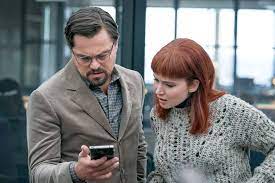
A massively destructive comet — five to 10 kilometers wide — barrels toward Earth. It's scheduled to hit Earth in six months, destroying all of the planet's life. Extinction looms.
Rocky Mountain Movies & Denver Movie Review
FOR MOVIE LOVERS WHO AREN'T EASILY SWEPT AWAY
Thursday, December 9, 2021
Great cast, less-than-great satire
A massively destructive comet — five to 10 kilometers wide — barrels toward Earth. It's scheduled to hit Earth in six months, destroying all of the planet's life. Extinction looms.
Monday, December 24, 2018
A scattered 'Vice' falls short
Regarded by many as the insidious power behind George Bush's empty presidential throne, Dick Cheney represents one of the strangest of political anomalies: Throughout his career, Cheney occupied a variety of power positions without ever revealing anything resembling an intriguing personality.
In excoriating Cheney, Vice, introduces us to an empty vessel of a man who tried (and mostly succeeded) at filling himself with power, either being near it or having it himself. It's a thesis of sorts, but Vice is too busy being clever to get much beyond that. At times, I wondered if the movie weren't more about its own comically rueful tone than it is about Dick Cheney.
Director Adam McKay delivers a free-wheeling, but not entirely fresh satirical indictment of Cheney and, only by inference, of many of the Neocons who supported similar positions.
McKay (The Big Short) leaves no doubt about where the movie stands. Vice opens with a howlingly drunk Cheney, as a young man, being pulled over by the cops. McKay then jumps to 9/11 as the vice president bypasses the president and gives the Defense Department authorization to shoot down any plane deemed a threat. This is followed by a quick view of real footage depicting a beleaguered America that would have fit nicely into a Michael Moore documentary.
The approach seems clear: Pieces of Cheney's career will be juxtaposed in ways that create a dizzying mosaic of bold strokes and blunt observations. Some work; some don't.
Still, audiences may want to see Vice for Christian Bale's impressive disappearing act of a performance as Cheney or for Sam Rockwell's amusing turn as an eager George Bush or for Steve Carrel's unashamedly conniving Donald Rumsfeld or for Amy Adam's no-nonsense portrayal of Lynne Cheney, the woman who evidently launched Cheney's career. She insisted that Cheney, then her fiancee, shed his wastrel ways after getting kicked out of Yale.
In his post-Yale days of the early '60s, Cheney had been spending his time in his home state of Wyoming working as a telephone lineman. When he got his second DWI, an embarrassed Lynne laid down the law; shape up or she'd find a more suitable partner. Cheney began to straighten himself out.
McKay's wild -- some might say "scattered" -- approach worked well in The Big Short, but it's overdone here with the movie racing through Cheney's resume: a stint as an intern to then-congressman Rumsfeld, a turn as Gerald Ford's Chief of Staff, 10 years in the House of Representatives, service as Secretary of Defense and, of course, an eight-year run as George W. Bush's vice president.
According to the movie, when Cheney took the vice presidential job he was determined to run the show. Desperate to have the more experienced Cheney as a running mate, Bush agreed to allow Cheney to take over the burden of matters such as foreign affairs and the military.
Vice takes a scalding -- and many will say appropriate -- view of Cheney's vice presidential activities, which include maneuvering the country into the Iraq war, justifying torture and ... well ... the list is long and, at times, as messy as McKay's movie.
McKay seems to have adopted a more-is-more approach to the material. At one point, Alfred Molina shows up as a waiter at a Washington restaurant who recites the menu, which for comic purposes has been turned into a checklist of Cheneyesque ideas. How about some "enhanced interrogation?" Care for some Guantanamo Bay?
The movie also features voice-over narration by Jesse Plemons and a last-minute reveal about why Plemons’ character is narrating the movie. At times, the narration makes it seem as if the movie is being read to us.
A set of fake end-credits rolls at a time when, or so the movie fantasizes, Cheney could have retired from public life in order to protect his gay daughter Mary (Alison Pill) from unwanted scrutiny. Fantasy, yes, but the closest the movie comes to saying anything positive about Cheney involves its depiction of his supportive relationship with Mary. Cheney tries his best to stand by her, although expedience eventually wins out.
You'll probably see Bale's name on the short list for a best-actor Oscar. Prosthetics and weight gain help, but he has captured Cheney's incipient smile, his understated venality and the matter-of-fact attitude he seemed to bring to even the most outrageous suggestions. He was a big believer in the unitary executive theory that concentrated power in the president's hands and minimized the need for any balance of power. The idea seemed to come to its fullest fruition after 9/11, the point at which the movie begins to bog down in expositional chores.
What's missing from all of this? New insight into Cheney, a politician whose career was punctuated by heart problems that become more prominent in the latter part of the movie.
Vice tells Cheney's story and, by extension examines what can be seen as an on-going deterioration of American political life. But the movie's dramatic potential is undercut by its view of Cheney as a political hollow man driven only by ambition and a thirst for power: He's pretty much the same guy from start to finish.
There's entertainment in McKay's movie and a variety of sharp-edged comic performances, but by the end, you may find yourself vainly waiting for McKay to pull the thematic string that unifies his jigsaw of a movie and keeps Vice from falling onto the side of the ledger where disappointments are recorded.
Tuesday, December 22, 2015
A comic look at the road to ruin
The weird thing about The Big Short is this: At some point you realize (as do some of the movie's characters) that you're rooting for a group of guys to make a financial killing, but you also know that their success means the whole economy will tank.
So watching the movie leaves you feeling elated, dejected and angry in quick succession, which, I presume, is precisely what director Adam McKay intended when he adapted Michael Lewis' book about the devastations caused by the collapse of the subprime-mortgage market.
I've read criticisms of McKay's movie that focused on the fact that it's entertaining without being infuriating enough.
Maybe so, but I think McKay's effort has a different value: It focuses on the insanity that drove the mortgage market prior to 2008 when the bottom fell out. When confronted with this kind of damaging absurdity, we're tempted to think that two choices manifest: We either laugh or sink into the deepest of funks.
But McKay and a very able cast offer a third alternative: We do both -- and we applaud the efforts of a filmmaker who rips the mask off a brand of stupidity and greed that may not entirely have disappeared just because the economy has improved.
Now, the chances are pretty good that a whole lot of people don't really understand what happened with sub-prime mortgages. If someone asked you to define a CDO (collateralized debt obligation) could you do it? Same goes for a credit default swap.
Charles Randolph's screenplay goes a long way toward explaining such financial instruments, sometimes interrupting the movie's narrative flow with brief lectures from celebrities such as Margot Robbie, seen in a bathtub speaking directly to the camera. Anthony Bourdain and Selena Gomez also chime in.
At first, you wonder what the hell these people are doing in the movie, but you quickly realize that McKay has decided to make the necessary explanations as diverting as possible before returning to a story that's driven by terrific performances.
The tone is set early when Ryan Gosling appears as a Deutsche Bank hotshot who intermittently serves as our cynical guide through the story.
Christian Bale plays Michael Burry, a former MD who wears T-shirts and shorts at work, walks around his office barefoot and sometimes sits at desk beating a pair of drumsticks against his thighs. Burry's the genius who actually peeked inside the packaging and re-packaging of mortgage-backed securities and realized that they were built on air.
Given enough time, Burry knew the whole structure would collapse, which prompted him to set about inventing a mechanism to bet against a mortgage market that most regarded as rock solid.
Then there's Mark Baum (Steve Carell) a New York hedge fund manager with a conscience. When Gosling's Jared Venentt insists that it's time to bet against mortgages, Baum voices skepticism. So does his team.
Baum seems to combine two traits that can make life difficult for an ambitious investor: He wants to make money, and he also wants to view himself as an ethical player.
When Baum and his team tour Florida's devastated luxury housing market, they hardly can believe the mortgage bankers they encounter, guys who are more likely to sprout wings than develop anything resembling a conscience.
At a conference in Las Vegas, Baum meets with another wheeler-dealer. Again, he can't believe what he's hearing from a supposed maven. It may be a rationalization on Baum's part, but he convinces himself that these smug idiots deserve a comeuppance. He's more certain than ever that it's time to sell short.
But in what may be his best performance yet, Carell makes it clear that Baum won't be laughing all the way to the bank. He's genuinely worried about the pain the economy will suffer.
Those familiar with Lewis' book quickly will note that McKay has made alterations. But the gist is the same: For a time (and who knows if that time truly has ended) the economy was based on fraud, greed and a near-total disconnect from reality.
The economy became paper, and, in the end, wasn't worth what it was printed on.
And then there's Brad Pitt. Pitt has a very nice turn as Ben Rickert, a guy who made a fortune, turned his back on Wall Street and retired to Boulder.
A couple of newbies (Finn Wittrock and John Magaro) discover that they'd be smart to bet against all the phony/baloney mortgages. They convince the reclusive Rickert to help them move from the kids' table to the one where the high rollers sit.
Pitt's Rickert believes this duo, which sometimes provides straight-ahead comic relief, but he also tries to educate them: If they win, the world loses.
And, yes, before it's done, The Big Short reminds us that ordinary people suffered because of what the big boys did.
So don't bet against The Big Short. It's an exuberant, smart and pointed reminder that much of what we believe about the economy takes place in a world of smoke and mirrors.
When the smoke clears and the mirrors break, it's people like us who are left wondering what wrong. The Big Short wants us to know.
Tuesday, December 17, 2013
A funny, messy 'Anchorman 2'
In full Ron Burgundy regalia, Ferrell seems to have turned up everywhere. In some markets, willing news anchors have acted as if Ferrell's promotions are the funniest thing ever. To which I only can say, "Puh-leeze."
Not that Ferrell isn't funny: It's just that his Anchorman 2 promotional shtick wore me out.
Now, allow me to equivocate some more. There's little question that Ferrell's Ron Burgundy qualifies as a classic comic character, a self-absorbed anchorman who's as devoted to his hair as he is to the pursuit of truth, justice and the American way.
The original movie, a modest box-office success, has done landmark business in the secondary market. Excitement about the sequel, even though it arrives nine years after release of the original, is running high.
So what's the verdict?
Let me put it this way: Anchorman 2: The Legend Continues put me in mind of Charles Dickens's famous opening for A Tale of Two Cities: To paraphrase and perhaps overstate matters: Anchorman 2 is the best of comedies; it's also the worst of comedies. If you read a little further into Dickens' opening paragraph, you'll find this sentence, as well: "It was the age of foolishness."
If Anchorman 2 is representative of its time, we are indeed living in another age of foolishness. Unashamedly ridiculous, this sequel catches up with characters from the first installment some 10 years after we first met them.
Ron and his wife Victoria (Christina Applegate) are now a news team in New York City. When the anchor of the network evening news (Harrison Ford) cedes his job to Victoria, a jealous Ron goes into a tailspin, abandoning his wife and young son (Judah Nelson) and landing work as an announcer at San Diego's SeaWorld.
Ron's rescued from exile when an eager representative (Dylan Baker) of an emerging 24-hour news network invites him to gather his old team and become part of the fledgling GNN family.
This gives director Adam McKay, who wrote the screenplay with Ferrell, an opportunity to bring back the cast from the first installment: Paul Rudd returns as Brian Fantana, hard-partying investigative reporter; Steve Carell reprises his role as Brick Tamland, the world's weirdest weatherman; and David Koechner revives Champ Kind, America's crudest sportscaster.
Added to the mix are Kristen Wiig, as a weirdly intense love interest for Carell's Brick; Megan Good, as GNN's hard-charging boss; and James Marsden as Jack Lime, GNN's handsome anchor and network star.
While Lime headlines GNN's newscast, Burgundy and his cohorts are relegated to the 2 a.m. slot, which is about as close to prime time as Burgundy is to Edward R. Murrow.
But wait....
Burgundy regains prime-time exposure when he stumbles upon a rating-boosting formula, a mix of feel-good news and mindless patriotism, all presented with Ferrell's masterful pomposity.
Setting the story during the period when non-stop news was born gives Ferrell and McKay an opportunity to add a bit of trenchancy to their comedy, serving up satire about the 24-hour news cycle and the vacuousness of so much of broadcast news.
It would be nearly impossible to sum up all the gags and sketchy plot lines in Anchorman 2, which survives a woeful beginning before providing its biggest laughs. It also would be unfair to reveal the many big-name cameos that are stuffed into the picture's finale. Discovering their presence is half the fun.
By the time, the end credits roll, you either will have submitted to the movie's unashamed foolishness or you'll have found the nearest exit.
If memory serves (and who knows about that), the approach here seems more scattershot than in the original, which also was directed by McKay. Anchorman 2 emerges as a disjointed collection of gags -- one involving a rescued shark, another mocking the over-produced oomph of summer movies, another reducing Ron to bawling infancy. The list goes on -- and then on some more.
You get the idea, when it's bad, Anchorman 2 falls flat; when it's good, it's a preposterously silly look at ... well ... I'm not entirely sure what.
Still, I laughed enough to leave the theater with a smile on my face or maybe it was a half smile, inspired partly by my puzzlement at the hit-and-miss quality of the whole affair and partly by the bits I found too funny to resist.


