Showing posts with label Mark Rylance. Show all posts

Friday, November 18, 2022

‘Bones and All’ difficult to digest


    If you simply described the premise of Bones and All, a story about two cannibalistic teenagers trying to find their place in society, it might sound like an ordinary horror film with lots of coagulated blood and amped up tension. 
   In the hands of director Luca Guadagnino (Call Me By Your Name) the movie turns into something different, an indie-spirited accumulation of strange scenes that suggests deeper meanings, “suggest” being the operative word. 
   But suggesting and saying aren’t the same thing, and for most of it two-hour and 10-minute running time, I kept waiting for Bones and All to find something. I'm no sure what. Not some on-the-nose declaration of purpose but perhaps a door that swings open, inviting us to drop beneath the surface.
   Instead, Guadagnino suspends his movie in a low-rent limbo where nearly everything seems drab, unappealing and only potentially meaningful.
  Those looking for color will find it mostly in the blood that stains the faces of the movie’s young cannibals after they chow down.
   Without making too big a fuss about it, Guadagnino lets us know that the film, based on a YA novel by Camille DeAngelis,  is taking place during the ‘80s. Working phone booths. A TV repairman’s truck. (Yes, kids, people once had their TVs repaired). Music on the soundtrack. It's all from the '80s.
  In the film’s best performance, Taylor Russell portrays Maren, an 18-year-old cannibal kid who’s abandoned by her father (Andre Holland), a caring man no longer able to cope with his daughter’s proclivities. Every time she bites, they must uproot.
  Once dad is gone, Maren sets out on her own. Early in her journey, she encounters Sully, played by Mark Rylance with a vaguely southern accent, a long braid, and skin-crawling creepiness. Sully wants to teach Maren how to live as an “eater,” which is how those driven by irresistible flesh-eating urges refer to themselves. He also craves company.
  After wisely splitting from Sully, Maren meets Lee (Call Me By Your Name star, Timothee Chalamet), another “eater. 
   Unable to find niches in the “normal” world, the two travel around the country in Lee’s pick-up truck. During one encounter, they meet a couple of good-ole boys, also eaters (an unrecognizable Michael Stuhlbarg and David Gordon Green). 
  Stuhlbarg’s character explains the title. Ominously, he tells Maren and Lee that they won’t be full-fledged eaters until they consume a body “bones and all.”  
   There’s before bones & all and after, he says, signaling what I took to mean full and gleeful submission to one’s cannibal self. 
   Unlike the movie’s two main characters, these two are barbaric eaters. Or maybe they just don’t like leftovers.
  In another encounter, Maren meets her institutionalized mother (Chloe Sevigny), who presumably passed the macabre genetic heritage of “eating” to her daughter. Mom, by the way, had herself locked up so that she wouldn’t victimize anyone else. 
  The supporting cast fully embraces these whacky roles. Chalamet charts his own weird course.
  The movie attempts to redeem itself by showing that Maren and Lee don’t really want to be “eaters,” although they take different approaches to their unexplained  “affliction.” 
  Maren adopts a moral stance: She’d rather not kill. Lee says he has no choice. It’s not clear, though, whether Maren can choose to be a more acceptable kind of carnivore.
  Guadagnino doesn’t cop out on gore and those who are squeamish about such things should probably find another movie about two outsiders roaming a lonely, creepy world. 
   If you’re wondering whether Maren and Lee eat regular food, they do — at least until the need to feed on human flesh overcomes them. I guess the movie wants us to see them as a couple of kids desperately in need of connection. 
  The movie's saving grace, such as it is,  lies in Guadagnino’s understanding of the sadness of outcasts.
   And, yes, it takes talent to draw us into this bizarre world and accept (or at least adjust to) its terms, so much so that we forget to step outside and consider what we’re watching. 
   Should we do that, we might see Maren and Lee as needy kids who also happen to be killers who can’t control themselves. 
   When these kids get hungry someone dies. Just sayin’.

Friday, June 17, 2022

He played some of the world's worst golf


If you look at the picture on the right, you might suspect that you're about to read about a movie set in the world of golf. You'd be half right. There's golf in The Phantom of the Open, a British movie comedy starring Mark Rylance, but most of the golf is bad enough to be laughable. Early on, we learn that Rylance's Maurice Flitcroft qualifies as a caring guy: He married his wife Jean (Sally Hawkins) even though she was pregnant with another man's child. That child (Jake Davies) grows up to become become Maurice's boss at a shipyard in the port town of Barrow-in-Furness.  Maurice and Jean have children together, twins played by Christian and Jonah LeesThe twins dream of becoming famous disco dances. Why not?  It's the '70s. Maurice, who's 46, has his own dream. He wants to compete in the British Open, even though he knows nothing about golf and has never played the game. Based on a true story, Phantom of the Open follows the exploits of Maurice who in 1976 actually made his way into the British Open, where he chalked up a miserably high score of 121, the worst in the tournament's history. Rhys Ifans signs on as the official who wants to boot Flitcroft from the sport.  The golf establishment is dutifully alarmed but the bumbling and unflappable Maurice assembles a fan base. Don't look for a life-changing experience, but Rylance and the rest of the cast keep director Craig Roberts' Phantom of the Open close to par.

Thursday, December 9, 2021

Great cast, less-than-great satire


    A massively destructive comet — five to 10 kilometers wide — barrels toward Earth. It's scheduled to hit Earth in six months, destroying all of the planet's life. Extinction looms.
   Writer/director Adam McKay thinks that’s funny -- in a satirical way, of course. But whether everyone else is laughing remains to be seen -- not because audiences are likely to be shaken by the prospect of global demise but because McKay plucks too much low-hanging fruit. He takes bold swings at familiar targets — the media can be easily diverted by celebrities, for example.
   McKay (The Big Short) knows how to find absurd twists in serious subjects. He makes wide-ranging comedies with a free-form feel. Here, he offers what might be regarded as mini-takes on a major theme that suggests current climate concerns: Wake up or be doomed. 
   But turning his movie into a parade of scenes that recall movies such as Network and Dr. Strangelove doesn't work to his advantage. Don't Look Up is a movie infused with trace elements of better predecessors.  
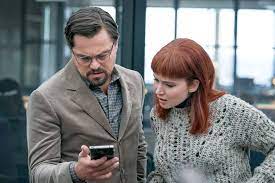
   McKay employs a large cast, turning a team of big-name actors into ensemble players. The list: Leonardo DiCaprio, Jennifer LawrenceCate Blanchett, and Meryl Streep. 
   He finds room for Ariana Grande and Kid Cudi -- not to mention Jonah Hill, Timothee Chalamet, and Mark Rylance.
   As much as it has one, DiCaprio and Lawrence occupy the film's center. Looking plump and nerdy, DiCaprio plays Randall Mindy, an astronomer who teaches at a Michigan university. 
   Lawrence appears as Kate Dibiasky, one of Mindy's grad students, Kate discovers the comet that's hurtling toward Earth.
   Duly alarmed, Mindy and Dibiasky travel to Washington to inform the president, a preoccupied hack played by Streep. Streep's Jeanie Orlean worries about saving a jeopardized Supreme Court nominee who has been caught in a porn scandal. Hill plays her patronizing chief of staff.
    Frustrated, Mindy and Dibiasky turn to the media, a morning TV show hosted by an aggressively genial team (Tyler Perry and Blanchett) who spend more time on a celebrity break-ups than on looming catastrophe.
     And when they do turn to the comet, they try to establish Mindy as a lovable scientist with what just might be a whacky theory. 
    Blanchett's Brie Evantee struck me as a riff on the character played by Faye Dunaway in Network, an ambitious, amoral, thrill-seeking woman who turns Mindy's head away from the loyal wife he's left in Michigan with their two teenage sons.
    Mindy eventually breaks ranks with the power brokers to give a Howard Beal-like speech intended to shock an over-entertained public out of its slumber.
   After much hemming and hawing, the US opts to send a tough-guy astronaut (Ron Perlman) into space to blow up the comet. McKay also introduces a tech company entrepreneurial genius (Mark Rylance in a gem of a performance) who has his own ideas about how to save the planet.
     McKay knows how to mine (perhaps over-mine) scenes for amusement and, as the movie progresses, the satirical strokes become bolder and more alarming -- at least that must have been the intent. The populace divides over whether the comet is actually on its way or whether it's another hoax. 
   The anti-comet folks adopt a slogan ("Don't Look Up") and wear red baseball caps. Remind you of anything?
    If you see the movie, stay through the credits for an epilogue that ties up a loose end that otherwise would have been left dangling.
    Did I laugh? Occasionally. Were some of the performances dead on? Sure. After all, McKay’s working with a great cast.
     But Don’t Look Up could be a case of misguided effort: It's possible that reality already is so ripe with extremes that it no longer can be satirized — or perhaps satirical efforts must be so keenly focused that absurdity is handled piece-by-piece. 
    As for the whole ball of wax? Well, as someone once said of a particularly brazen tabloid. It can't be parodied. All you have to do is quote it. Sounding as if you’re quoting it — which often is the case with Don’t Look Up — isn’t enough.
     

Wednesday, September 30, 2020

When absurdity becomes very serious


     The 1969 Trial of the Chicago 7 was an early piece of real-life political theater, a warped legal proceeding staged against a backdrop of roiling protest against the Vietnam War. 
      In The Trial of the Chicago 7, writer/director Aaron Sorkin mixes the account of an absurd courtroom drama with a slightly dimmed appreciation of the American spirit as embodied in the "radical" defendants and their rebellious lawyer.
     In addition to the seven white defendants, Bobby Seale, a member of the Black Panthers, was attached to the proceedings as a kind of sidecar on the countercultural rollercoaster. 
      And rollercoaster it was: Sorkin zips his way through scene-after-scene as he dramatizes portions of a trial that lasted five months. Flashbacks enable him to abandon the confines of the courtroom. The organizers seek permits for the demonstrations. The police fire tear gas. A female FBI agent tries to cozy up to Jerry Rubin.
     The period was chaotic and so, at times, is the movie, a series of sketches that bump up against one another, sometimes without great finesse. And for all its tumult, the movie offers little by way of game-changing overviews either of the period or of trial.
     Limitations aside, the greatest allure of Sorkin's entertaining effort involves the work of a strong cast, an ensemble of gifted actors who walk us down the movie's countercultural memory lane.
     Standouts include Sacha Baron Cohen as Abbie Hoffman and Eddie Redmayne as Tom Hayden, a founder of Students for a Democratic Society. Hoffman and Hayden shared common goals but disagreed on how to attain their goals.
     Hoffman, who was very funny, relished theatrics; Hayden approached protest with high-stakes seriousness. Their disagreements and ultimate rapprochement underlies Sorkin's recreation of the trial. 
      The defendants weren't the only stars of the proceedings. A fine Mark Rylance portrays William Kunstler, the radical  attorney who defended the seven. 
     Yahya Abdul-Mateen II makes a formidable Seal, the Black Panther who, along with the others, was charged with conspiracy to cross state lines to incite a riot. But unlike his co-defendants, Seal wasn't involved in planning the event and had been in Chicago for only two days during the 1o68 convention.
    The so-called riot that's at the heart of the case took place in Chicago's Grant Park during the Democratic convention at which Hubert Humphrey was nominated to run against Richard Nixon. 
      In an introduction to the movie, Sorkin uses real footage in which the esteemed Walter Cronkite sets the stage: "The Democratic convention is about to begin in a police state. There just doesn't seem to be any other way to say it." 
     The defendants ran a gamut of personalities, but the size of the cast forces Sorkin into sketching rather than painting detailed portraits. David Dellinger (John Carroll Lynch) serves as a conventional guy with deep political convictions and Jeremy Strong portrays Jerry Rubin, who plays a kind of goofy second fiddle to Hoffman.
     And, yes, Cohen gets pretty close to capturing Hoffman's Massachusetts accent and comedic instincts.
    Hoffman and Rubin were Yippies; i.e., members of the Youth International Party, a group that flew a sex, drugs and rock 'n' roll banner over its protests.
    Every trial needs a judge and this one had a particularly incapable one. Frank Langella's Julius Hoffman makes ridiculous decisions without ever really sensing the absurdity that threatens to overwhelm him.
    Perhaps Hoffman's greatest faux pas occurred when he had the disruptive Seal, who eventually asked to defend himself, bound and gagged in the courtroom. The judge made Seal an advertisement for the oppressive nature of the trial. Charges against Seal were dropped before the trial finished.
     Joseph Gordon Levitt plays the prosecutor, a decent enough fellow who, nonetheless, approaches his job seriously. John Mitchell (John Doman) -- Nixon's Attorney General -- personally assigned Gordon-Levitt's character to the trial for reasons that had more to do with what he thought the seven represented than with anything they did.
    Michael Keaton does effective cameo duty as Ramsey Clark, the attorney general under Lyndon Johnson, who became a witness for the defense in the trial.
    It may be difficult for those who weren't alive during the '60s to grasp just how incendiary the times were. The trial may have had a disembodied theatrical quality, but Americans and Vietnamese people were dying in a senseless war that awoke a generation of protest.
     When the chips are down, Sorkin turns earnest and I wondered how another director might have lit  the match that needed to be thrown onto this political gas can of a movie. 
     Still, the performances and byplay (a Sorkin specialty) give the movie plenty of burn. 

Wednesday, March 28, 2018

Trying to conquer a virtual world

Steven Spielberg brings plenty of visual spark to Ready Player One. The story? Less than spectacular.
In Steven Spielberg’s adaptation of Ready Player One -- Ernest Cline’s popular 2011 novel -- almost everyone obsesses about virtual reality.

Why are so many in need of so much escapism? Because the movie takes place in the dystopian year of 1945 and reality sucks: Suffering from all manner of deprivation, folks are forced to live in the Stacks, trailers piled atop one another in tenement fashion.

Not surprisingly, the downtrodden residents of Columbus, Ohio -- the movie's main real-world setting -- don headgear and special gloves as they try to experience excitement through personal avatars that travel around a virtual universe known as the Oasis.

The book has major fans and I'm guessing that they'll mostly enjoy Spielberg's movie.

Speaking for myself, I’d put it this way. In Ready Player One, the side trips are significantly more rewarding than the main story, which puts a youthful resident of Columbus (Tye Sheridan) in the middle of a high-stakes video game inside the Oasis.

Sheridan's Wade Watts -- make that his avatar Parzival -- sifts through clues as he searches for three keys. Should Parzival acquire all three, Wade will inherit ownership of the Oasis, thus saving everyone's favorite synthetic playground from the clutches of IOI, an evil corporation that wants to monetize the Oasis experience. A greedy corporate shark (Ben Mendelsohn) runs IOI.

I should point out that these side trips really are the point of a movie that tells a story that never seems all that momentous. Minute-by-minute, the stakes in Ready Player One feel significantly higher than what happens at the end of the movie's 140 minutes.

It’s also possible to look at Ready Player One as Spielberg's chance to command a broad swath of the pre-summer market. Visually sophisticated and full of invention, the movie harkens back to one of Spielberg’s career sweet spots: the 1980s.

Conveniently, James Halliday (Mark Rylance) -- the man who designed the Oasis -- was deeply immersed in ‘80s popular culture, so much so that he loaded his virtual creation with references to it. You'll find nods to Back to the Future, The Shining (one of the movie’s best and most amusing set pieces), Duran Duran and … oh, well … you get the idea. There's lots of '80s stuff.

When the story kicks off, Rylance's Halliday, who set up the game in the first place, has been dead for five years. A skilled Oasis gamer, Wade wants to own the Oasis, not just for himself but for all who would resist IOI's insidious corporate intrusion into everyone's personal headspace.

Inside the Oasis, Wade meets Art3mis (Olivia Cooke), a sexy, spunky avatar who immediately captures his heart. He also has other virtual allies, notably the gruff but inventive Aech, a giant-sized man who looks like he wandered into the movie from a Marvel Comic.

Some of the movie's action is fun, notably an early-picture car race that Spielberg mounts with tipsy fury. Imagine speeding along a road when the road suddenly comes to an abrupt end or when King Kong leaps off a building and tries to crush your vehicle.

For me, Ready Player One's third — and needlessly protracted final act — took a bit of the gleam off the movie’s virtual shine. Spielberg brings real life and virtual reality together. Real-life gamers must meet people they've known only as avatars. All of this builds toward massive battles as Wade seeks his triumph. Really? Noisy battles are the best the movie can do?

As difficult as it must have been to create Ready Player One's teeming visual environment, it’s also true that the movie lacks the sophisticated spin of the best sci-fi, something that couldn’t be said of Spielberg’s work in A.I. or Minority Report.

In the end, Ready Player One predictably endorses reality over virtual fantasy, although almost nothing about the movie suggests that anyone involved with this massive project really believes that.

Obviously, Spielberg is no slouch when it comes to handling gigantic projects. He keeps the action coherent, jams images with information without getting lost in them and propels his characters through the movie's effects.

So enjoy the side trips for as long as you can. This is one movie in which the ride definitely beats arrival at the final destination.

Thursday, July 20, 2017

'Dunkirk' makes fear feel real

Trapped on a beach, British soldiers scramble to survive in the early days of World War II..

In 1940, some 400,000 British troops (along with French, Canadian and Belgian soldiers) were stranded on a beach in France. The soldiers were backed into a military cul-de-sac by German forces that rapidly were moving westward. The troops had little support from the air or the sea. On this lonely stretch of beach in northern France, they were strafed by German planes. Their only way out was to be transported back across the English Channel.

That's the backdrop for Dunkirk, the latest, and perhaps most masterful, film from director Christopher Nolan (Interstellar, The Dark Night Rises and Inception).
Watching Dunkirk, I kept recalling a long ago conversation I had with a World War II veteran who worked at the Rocky Mountain News. We were having coffee in a room behind what was called "the backshop," the place where the printers worked when newspapers still employed printers. I was telling him about some war movie I'd seen.

"You know what war is?'' he asked.

"What?" I responded, readily conceding that his knowledge of the subject was far greater than mine since he had served with Patton's Third Army in France and Germany. For him, war wasn't a movie.

"Fear. Nothing else," he replied.

It's too early to determine whether Dunkirk is a great war movie, but I believe Nolan got one thing right. He conveys the fear of men who, minus air support or ships to transport them off the beach, became targets. The term "sitting ducks" seldom has been more appropriately employed.

Nolan uses all of his considerable cinematic skills to make us feel the explosive force of bombs, the startling eruption of bullets or the vulnerability of the few British pilots who made their way to Dunkirk in planes that, by today's standards, seem like little more than flying crates.

Nolan divides his story into several related parts. In the first, a British soldier (Fionn Whitehead) escapes German gunfire that wipes out all his fellow soldiers on the streets of Dunkirk. He arrives on the beach, where thousands of British soldiers have assembled.

He and another soldier (Aneurin Barnard) carry a wounded soldier to a Red Cross rescue ship. They race through masses of soldiers carrying a stretcher toward the pier where the boat has docked. Their motives have a double edge. They want to board the ship themselves.

The officers on the beach are played by Kenneth Branagh (Navy) and James D'Arcy (Army). The soldiers await help, but Branagh's character knows that the British command wants to preserve its destroyers for later battles. Prospects for rescue are dim.

Another story focuses on a British civilian (Mark Rylance) who decides to sail his private boat to Dunkirk to help rescue the stranded soldiers. He's accompanied by his son (Tom Glynn-Carney) and a local teenager (Barry Keoghan).

On their way to Dunkirk, this civilian crew saves a stranded soldier (Cillian Murphy) whose ship was sunk by a German torpedo. Cillian's shell shocked soldier wants Rylance's character to turn his boat around. He doesn't want to return to the nightmare he just left.

If you see the film in an IMAX theater with the sound cranked, you'll feel every shock and rumble -- many of them enhanced by Hans Zimmer's score, a pounding affair that rises like an adrenalized pulse. It's the musical equivalent of writing in all capital letters: DREAD. FEAR. PANIC.

Nolan's third story deals with the air war. Tom Hardy files a RAF Spitfire. Hardy's character -- his face mostly obscured by the mask that supplies him with oxygen -- engages in dogfights with German planes. These dizzying air battles rank among the best ever filmed. (Nolan shot his film with IMAX cameras on 65 mm film; he puts us in the cockpit with Hardy in ways that are disorienting and, of course, frightening.)

It's difficult to imagine that cinematographer Hoyte van Hoytema won't win an Oscar for his stunning work here.

Nolan shifts between all these stories in an effort to provide an encompassing view of Dunkirk. Individual stories are subordinated to the creation of an overall feeling of war chaos.

We can assume things about the characters from their behavior -- Rylance's steadfastness, Branagh's leadership, Whitehead's "ordinary-Joe" qualities, but Nolan leaves most of that work to us.

In some respects, the movie's heroism belongs mainly to its civilians. As it turns out, a small armada of private boats traveled to Dunkirk to rescue the stranded soldiers. It was a stirring moment of British unity that defined the pluck and spirit of a united people facing terrible duress. To portray it, Nolan mostly dispenses with dialogue.

If I have a beef with Dunkirk, it's this: Nolan's movie consists almost entirely of climaxes, the kind of scenes that other war movies build toward. And once, the chaos subsides, Nolan doesn't seem to know what to do. Scale overwhelms everything in ways that make sense if you acknowledge that Nolan's aim is to make us feel as if we, too, are on that beach.

That's part of the point, I think, to make us understand that once the fighting starts, thoughts about patriotism tend to give way to the urge simply to survive.

Nolan has made a movie full of fear and frenzy. It's impressive for sure but sensation-oriented films tend to fade once the sensation stops.

Judging by the inescapable sadness in the eyes of the veteran I mentioned earlier, that's not the case for those whose wars weren't fought at the movies.

Thursday, June 30, 2016

'BFG' is a bit of a bore

The magic is only intermittent in director Steven Spielberg's adaptation of a Roald Dahl story..

The real giant behind the movie The BFG is Steven Spielberg, a director whose amazing track record ranges from the serious to the sublimely whimsical. Inspired by a story by Roald Dahl, Spielberg abandons the brooding intelligence of his last movie -- Bridge of Spies -- to focus on a tale aimed at children.

With a screenplay by ET screenwriter, the late Melissa Mathieson, The BFG centers on young Sophie (Ruby Barnhill), a lonely orphan who early on is whisked off to a giant's lair. Thanks to his vegetarian preferences, the giant -- known as the BFG or Big Friendly Giant -- doesn't eat little kids. He dines on glop that bares little resemblance to food as we know it.

A generally affable sort, the BFG frequently finds himself at odds with his monstrous giant colleagues who do like to gobble up kids. These bad giants look like floating ogres in a Thanksgiving Day parade. Very frightening -- if, say, you're five years old.

Younger audiences may also respond to the movie's fart jokes. The BFG aids his digestion with a drink called Frobscottle, a fizzy brew that gives him gas inducing bouts of flatulence that he calls "whizpoppers."

All of this offers mild amusement with Spielberg obtaining fine, motion-capture work from Mark Rylance as the BFG; Rylance, you'll recall, won a supporting actor Oscar for his work in Bridge of Spies.

An unlikely duo, Sophie and the BFG spend lots of time together at the BFG's home in Giant Country. Unfortunately, this house-bound part of the movie becomes a bit of slog and early enchantment gives way to monotony.

The movie perks up significantly during a late-picture tea party attended by Sophie, the BFG and the Queen of England (Penelope Wilton). Finally, you may think, some fun.

Spielberg ably handles the technical challenges of Dahl's story, and the movie's production design has an admirable story-book quality.

Ultimately, though, story takes a back seat to tricks of scale. Spielberg and his crew must have had a great time playing with size differences between young Sophie and those who inhabit Giant Country. The movie is at its best when the BFG enters the world of normal humans, puny in comparison to the big guys.

Dull as it can be, the movie deserves credit for at least one bold stroke: A fart joke in Buckingham Palace unwinds with whizpopping gusto. But much of the movie drags in ways that seem uncharacteristic of Spielberg who usually sets a brisk pace.

For all his prowess, Spielberg can't carve a giant-sized slice of charm out of The BFG.

Monday, February 29, 2016

Best picture 'Spotlight,' a welcome upset

Host Chris Rock scored big in the opening as Oscar lumbered its way through a controversial year.

In the end -- and the end was a long time coming -- the Academy of Motion Picture Arts and Sciences did the right thing: It awarded the best picture Oscar to the best picture. Spotlight, which did not have a stellar night otherwise, walked away with the evening's biggest prize.

I have to admit that I was surprised. Most prognosticators thought The Revenant would win best picture: I expected The Big Short to pull off an upset because it was both entertaining and meaningful. The Academy went me one better, and recognized Spotlight. I've never been happier to be wrong about an Oscar prediction.

As for the rest ...

It was an OK but typically labored evening that was guided by a mostly sharp Chris Rock, whose opening monologue lived up to just about everyone's expectations. I could spend time quoting lines from it, but I don't need to. I'll refer you instead to a link at which you can read his entire opening.

Suffice it to say that Rock was trenchant when he needed to be, immediately addressing the elephant in Oscar's room, the diversity issue that has dominated this year's awards season.

Once it got rolling, the program pretty much conformed to the standard model, receiving an energy boost from the lone upset that broke the tedium of watching Mad Max: Fury Road clean up in the costume, make-up, editing, sound and production design categories. As a fan of Ex Machina, I was particularly glad to see that movie win an Oscar for visual effects.

Mark Rylance's win in the best supporting actor category counts as another of the evening's surprises. Sylvester Stallone, who reprised his role as Rocky Balboa in Creed, had been the sentimental favorite.

Could voters have been reluctant to acknowledge Stallone in a year when there was much complaining about the fact that Creed's star -- Michael B. Jordan -- was ignored by the Academy?

That's not to say that Rylance wasn't deserving. He gave a fine performance as a Russian spy in Bridge of Spies.

If you're of a cynical bent, you might think the evening's many black presenters were on hand to counter the #OscarsSoWhite campaign that's been raging since the nominations were announced.

Some recipients -- notably Alejandro G. Inarritu, who won best director for The Revenant -- called for more opportunity for people of color.

In some ways, though, Oscars are only the tip of Hollywood's institutionally white iceberg.

A real increase in inclusion depends on diversifying the ranks of those who make key decisions at studios, as well as on breaking down stereotypical casting habits.

As is customary, there were bits that didn't work, notably the production number that accompanied Earned It, the nominated song from 50 Shades of Grey. As he sang, The Weekend was encircled by dancers who looked as if they were auditioning for 50 Shades of Victoria's Secret.

It's nearly impossible this time of year to go to the supermarket without being asked to buy Girl Scout cookies. Now, the Girl Scouts have invaded the Oscars. About midway through the proceedings, Rock brought out a troop of Los Angeles Girl Scouts who sold cookies to the audience, raising more than $65,000.

In what surely was a lapse in judgment, Rock neglected to say whether Tagalongs outsold Samoas.

What else? Showing lists of those who were being thanked at the bottom of our screens was a dumb idea. Without people to thank, most recipients had little to say.

An exception: Brie Larson, who won best actress for her performance as a kidnapped young woman in Room. Larson thanked both the Telluride and Toronto Film Festivals, which served as launch pads for her movie. In an additional display of Oscar graciousness, she also thanked those who went to see her movie.

I suppose it's important to mention Joe Biden. The vice president introduced his "friend" Lady Gaga who sang 'Til It Happens to You, the emotional song from The Hunting Ground, a documentary about rape on college campuses. That song lost to Writing's On the Wall, the theme from Spectre, a tune I hope never to hear again.

And, of course, there was Leo. Leonardo DiCaprio finally won his Oscar for his physically challenging performance in The Revenant.

That, and a considerable amount of Oscar fatigue, leads me to the real moral of last night's Oscars: One never should underestimate the power of crawling inside a dead horse. You never know what good will come of it.

For a complete list of winners, try ABC News.

Thursday, October 15, 2015

Hanks, Spielberg reunite for thriller

Well-made Bridge of Spies takes us back to the '50s for a story of espionage and intrigue.

The opening sequences of Steven Spielberg's Bridge of Spies deal with the arrest of a Russian spy, an incident that allows Spielberg masterfully to establish time (the 1950s) and place (Brooklyn, N.Y.), as well as to infuse a situation we don't yet understand with gloomy tension.

Suspenseful, atmospheric and brilliantly underplayed, the film's early going reminds us just how good a director Spielberg can be.

Based on a true story, Bridge of Spies allows Spielberg to reunite with Tom Hanks for the fourth time.* The movie also provides Spielberg with a canvas on which he can sketch a complicated story about a period when U.S./Soviet tensions were at their peak.

Hanks plays James B. Donovan, a New York insurance lawyer who's drawn into international intrigue when he's asked to defend Rudolph Abel (Mark Rylance), the Soviet spy who's caught by the FBI in the movie's opening.

The legal fraternity feels homage must be paid to the notion of a fair trail, but just about everyone believes that Abel should be convicted without much fuss.

In full decency mode, the instantly likable Hanks paints a portrait of a man trying his best under difficult circumstances. Abel is convicted, but Donavan saves him from the death penalty with a pragmatic argument: Someday the U.S. may need a spy to trade for an American prisoner who has been accused by the Soviets of espionage.

Defending Abel proves costly for Donovan who becomes a bit of a pariah. A brick thrown is thrown through the window of his family's home, and many think he's betraying his country.

But Donovan isn't willing to temporize for the sake of appearances. He's a decent man.

Not only is Donovan a good guy, but -- as it turns out -- he's also prophetic.

Working from a screenplay by Matt Charman and Joel and Ethan Coen, Spielberg also introduces the story of Francis Gary Powers (Austin Stowell), the U-2 spy pilot whose plane was shot down over Russia in 1960. Donovan is asked to travel to Berlin to broker the trade he foresaw.

These chilly Berlin scenes heighten the spy drama as Donovan travels back and forth between West and East Berlin. To further complicate matters, an American student (Will Rogers) also is captured by the East Germans.

Donovan wants both Rogers' character and Powers to be swapped for Abel. The Russians are more interested in a one-for-one deal. So is the CIA, which regards the student as a negligible part of any negotiation.

No James Bond, Donovan struggles through his time in Berlin with a terrible cold that's made worse when several East German thugs mug him and steal his overcoat.

Hanks again gives the movie a reliable center, and a subtly entertaining Rylance makes his mark as a wry but resigned fellow who answers every question about why he's not more panicky with another question: "Would it help?"

Spielberg overworks the line, and can't resist a few Spielbergian touches that go against the movie's dark grain. I won't describe them here, but if you know Spielberg, you'll have no trouble picking them out.

In sum, Bridge of Spies stands as a mature and involving entertainment that recalls a time when our only concern seemed to be with the Soviet Union, and a sense of Cold War menace cast a chill over everything it touched.


*Hanks/Spielberg collaborations include The Terminal (2004); Catch Me If You Can (2002); and Saving Private Ryan (1998).