Showing posts with label Jennifer Lawrence. Show all posts

Wednesday, November 5, 2025

She's no stay-at-home wife


   Never timid, always willing to push toward extremes, and unflinching in her boldness, Scottish director Lynne Ramsay remains an unabashed risk taker. 
   In Die My Love, Ramsay adapts a 2012 novel by Ariana Harwicz, an Argentine writer who set her story in rural France. Working from a screenplay she wrote with Enda Walsh and Alice Birch, Ramsay moves the story to Montana and leaves it to Jennifer Lawrence to convey the complex inner life of new mom Grace, a bored, libidinous wife mired in postpartum depression.
    But don't mistake Die My Love for a disease-related TV movie. Lawrence and Ramsey stretch the story's metaphoric possibilities to the breaking point. Grace seems to embody a near-primal spirit that can't accommodate the life of a stay-at-home mom. Like a cat stalking prey, Grace crawls on all fours through the grass surrounding her house.
    As the movie progresses, Grace becomes both more volatile. At one point, she crashes through a plate glass window in the ramshackle home that she and her husband (Robert Pattinson) occupy, a shocking, rebellious eruption.
    Jackson's mother (Sissy Spacek) and his addled father (Nick Nolte) live nearby. As a wife who submitted to  convention, Spacek's Pam recognizes Grace's "craziness" as a powerful expression that deserves respect.
    Graphic sex scenes and nudity are on full display early on. Grace is a sexual being, but Jackson can't keep pace with his ravenous wife. Predictably, she winds up having sex with a biker (LaKeith Stanfield) who enters the movie as if he's casing the house where Grace and Jackson live.
     Did the movie need such a digression? Probably not.
     Ramsay fragments time, destroying chronological order. Frequently, we must recalibrate where in the story we might be. Ramsay allows parts of the movie to burst onto the screen, throwing scenes at us with an abandon that can mirror Grace's volatility.
     Grace's condition grows progressively more outlandish. At a social gathering, she takes off her clothes and jumps into a swimming pool where kids are playing. If you haven't already, you'll begin to wonder why no one has tried to deal with what seems like an obvious case of mental illness. 
      Ramsey tests us in the same way that she tests her characters. The baby's crying grates on our nerves. Ditto for the incessant barking of dog that Jackson brings home.
      I'll include a spoiler for those who'd rather not witness Grace taking a rifle from her mother-in-law's house, walking back to her home, and shooting the unfortunate dog, a creature that's evidently ill and neglected.
    Lawrence's purposefully erratic performance seems in sync with the movie's intentions. The world in which Grace finds herself can't accommodate her essential self. OK, that's vague, but it's as close as I can get.
    Pattinson's character makes less sense. With a multi-directional haircut and a sheepish demeanor, Jackson looks like a lost traveler in need of directions.
    The movie builds toward a finale that can be taken literally or metaphorically, but it's preceded by a kind of gentle detente between Jackson and Grace. Maybe he finally understands the woman he married.
     I had my reservations about Die My Love, but I can't finish without an addendum.
     I respect Ramsay's courage, something she displayed when she brought her 1999 movie Ratcatcher to the screen and continued in 2002 with Morvern Callar, which relied heavily on the work of Samantha Morton as another difficult character.
      Die My Love is Ramsay's first movie since 2018's You Were Never Really Here, which starred Joaquin Phoenix. I hope we don't have to wait another seven years for the next film.
      Whatever you think of Die My Love, you should know that Ramsay has a powerful voice, and isn't  afraid to raise it. Sometimes, I wondered why I was watching Grace unleash her furies, often in cruel ways. But if Ramsay and Lawrence set out to create a character too combustible for "normal'' life, they've succeeded. Like Grace, Ramsay refuses to be pigeonholed. That's a quality worthy of respect.
    

Wednesday, June 21, 2023

No prizes for ‘No Hard Feelings'


    With or without clothes, Jennifer Lawrence knows how to hold the screen. 
    And, yes, newcomer Andrew Barth Feldman makes a fine teenage foil for Lawrence’s character in No Hard Feelings
    Comedies are nothing without contrivance, but some contrivances are better than others, and No Hard Feelings can’t parley a sex-worker premise into a consistently winning entertainment.
     Lawrence plays a down-on-her luck resident of Montauk, Long Island who answers an ad placed by two affluent parents. These overly involved parents want their son to loosen up (i.e., lose his virginity) prior to leaving for his freshman year at Princeton.
    Heaven forbid a shy but bright kid arrive at Princeton equipped only to learn something.
     Employing her substantial gifts for physical comedy, Lawrence plays Maddie Barker, a woman who hates watching wealthy visitors invade her hometown, a seaside heaven that once welcomed folks who weren't seven-figure earners.
     A remnant of older days,  Maddie has fallen behind in her taxes, and might lose the house her late mother left her. 
     She’s desperate when she sees the ad that sets the plot in motion. Wanted: a young woman to help break through the shell of inhibited 19-year-old kid. If she succeeds, Maddie will be given a Buick Regal, a car that might save her career as an Uber driver.
    In the movie's opening scene, a tow-truck driving former boyfriend (Ebon Moss-Bachrach) reposes Maddie's car.
     About those clothes. In a night-time skinny dipping scene, Lawrence does full-frontal nudity as she races from the ocean to confront pranksters who threaten to steal her clothes, as well as the clothes of Feldman’s Percy.
      Necessary? Not really. Maybe it's meant to impress us with its boldness.
      Although most of the movie revolves around 32-year-old Maddie and her relationship with Percy, a small supporting cast doesn't have much to do.
     Laura Benanti and Matthew Broderick play Percy’s parents. Natalie Morales and Scott MacArthur portray Maddie’s friends.
      It’s pretty easy to guess what’s going to happen. What starts as a crass plunge into sex work for the intimacy-averse Maddie softens as she develops a genuine fondness for Percy, a kid who doesn't want to have sex with someone he doesn't really know.
      Despite a formulaic backdrop, No Hard Feelings, which was directed by Gene Stupnitsky (Good Boys), occasionally detours into moments that feel genuine and Lawrence makes sure that Maddie barges her way through all manner of difficulties. 
     A few moments suggest what might have been. When Percy plays piano and sings his version of Hall & Oates' Maneater, the movie takes a welcome and unexpected turn.
     Some of the movie’s comic high points (Percy riding naked on the hood of a car, for example) strain to be funny, raunchy and memorable. They miss the mark. 
     Too often, No Hard Feelings follows suit. It's not as bad as you might have feared given its premise nor as good as you might have hoped. I guess that adds up to a fair to middling effort.

Thursday, November 3, 2022

A vet returns from combat with scars


Since her breakthrough in Winter's Bone (2010), Jennifer Lawrence has become a major star and it's difficult to look at her new movie, Causeway, without being aware that she's committed herself to a narrowly focused project that's unburdened by anything resembling Hollywood glare. Lawrence plays a combat veteran whose brain was damaged when an IED exploded during her service in Afghanistan. Lawrence's Linsey returns to New Orleans where it becomes clear that her mother (Linda Edmond) hadn't been the most attentive of parents. She also has a brother whose life was ravaged by drugs. Director Lila Neugebauer's modest debut film revolves around a relationship that the emotionally scarred Lynsey forms with an auto mechanic (Brian Tyree Henry), who's carrying plenty of his own emotional baggage, including ample amounts of guilt and regret. As a gay woman, Lynsey responds to Henry's openness without having to commit to a romantic relationship which -- at least for the moment -- would be beyond her anyway. Both Lawrence and Henry are quite good with Henry creating a character who's juggling his emotions while trying to understand Lynsey, who doesn't always make it easy for him. Neugebauer utilizes New Orleans locations we don't normally see in movies. Lynsey takes a job cleaning swimming pools, which opens Neugebauer's camera to some wonderfully secluded backyards that have a nearly secretive vibe.  Hardly a knockout story but Lawrence and Henry create characters of great vulnerability and emerging need.

Thursday, December 9, 2021

Great cast, less-than-great satire


    A massively destructive comet — five to 10 kilometers wide — barrels toward Earth. It's scheduled to hit Earth in six months, destroying all of the planet's life. Extinction looms.
   Writer/director Adam McKay thinks that’s funny -- in a satirical way, of course. But whether everyone else is laughing remains to be seen -- not because audiences are likely to be shaken by the prospect of global demise but because McKay plucks too much low-hanging fruit. He takes bold swings at familiar targets — the media can be easily diverted by celebrities, for example.
   McKay (The Big Short) knows how to find absurd twists in serious subjects. He makes wide-ranging comedies with a free-form feel. Here, he offers what might be regarded as mini-takes on a major theme that suggests current climate concerns: Wake up or be doomed. 
   But turning his movie into a parade of scenes that recall movies such as Network and Dr. Strangelove doesn't work to his advantage. Don't Look Up is a movie infused with trace elements of better predecessors.  
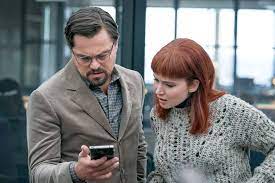
   McKay employs a large cast, turning a team of big-name actors into ensemble players. The list: Leonardo DiCaprio, Jennifer LawrenceCate Blanchett, and Meryl Streep. 
   He finds room for Ariana Grande and Kid Cudi -- not to mention Jonah Hill, Timothee Chalamet, and Mark Rylance.
   As much as it has one, DiCaprio and Lawrence occupy the film's center. Looking plump and nerdy, DiCaprio plays Randall Mindy, an astronomer who teaches at a Michigan university. 
   Lawrence appears as Kate Dibiasky, one of Mindy's grad students, Kate discovers the comet that's hurtling toward Earth.
   Duly alarmed, Mindy and Dibiasky travel to Washington to inform the president, a preoccupied hack played by Streep. Streep's Jeanie Orlean worries about saving a jeopardized Supreme Court nominee who has been caught in a porn scandal. Hill plays her patronizing chief of staff.
    Frustrated, Mindy and Dibiasky turn to the media, a morning TV show hosted by an aggressively genial team (Tyler Perry and Blanchett) who spend more time on a celebrity break-ups than on looming catastrophe.
     And when they do turn to the comet, they try to establish Mindy as a lovable scientist with what just might be a whacky theory. 
    Blanchett's Brie Evantee struck me as a riff on the character played by Faye Dunaway in Network, an ambitious, amoral, thrill-seeking woman who turns Mindy's head away from the loyal wife he's left in Michigan with their two teenage sons.
    Mindy eventually breaks ranks with the power brokers to give a Howard Beal-like speech intended to shock an over-entertained public out of its slumber.
   After much hemming and hawing, the US opts to send a tough-guy astronaut (Ron Perlman) into space to blow up the comet. McKay also introduces a tech company entrepreneurial genius (Mark Rylance in a gem of a performance) who has his own ideas about how to save the planet.
     McKay knows how to mine (perhaps over-mine) scenes for amusement and, as the movie progresses, the satirical strokes become bolder and more alarming -- at least that must have been the intent. The populace divides over whether the comet is actually on its way or whether it's another hoax. 
   The anti-comet folks adopt a slogan ("Don't Look Up") and wear red baseball caps. Remind you of anything?
    If you see the movie, stay through the credits for an epilogue that ties up a loose end that otherwise would have been left dangling.
    Did I laugh? Occasionally. Were some of the performances dead on? Sure. After all, McKay’s working with a great cast.
     But Don’t Look Up could be a case of misguided effort: It's possible that reality already is so ripe with extremes that it no longer can be satirized — or perhaps satirical efforts must be so keenly focused that absurdity is handled piece-by-piece. 
    As for the whole ball of wax? Well, as someone once said of a particularly brazen tabloid. It can't be parodied. All you have to do is quote it. Sounding as if you’re quoting it — which often is the case with Don’t Look Up — isn’t enough.
     

Thursday, June 6, 2019

She wields power. The movie, not so much.

Dark Phoenix may be the final X-Men movie but it falls short of a grand finale.

Billed as the final chapter in the X-Men series, Dark Phoenix doesn't exactly qualify as the fondest of farewells.

By no means awful, Dark Phoenix nonetheless fails to make a major splash with a concluding chapter that revolves around Jean Grey (Sophie Turner of Game of Thrones fame). Although Jean acquires great powers, she never totally dominates a story that becomes the wobbly foundation on which an uneven variety of set pieces and side trips are built.

A mind-reading mutant, the young Jean (Summer Fontana) falls under Charles Xavier's (James McAvoy) protection after her parents are killed in an auto accident in which she was a passenger and also the cause.

The story then leaps ahead. Now-grown, Jean (Turner) is still learning how to navigate the X-world. An early-picture outer-space rescue mission brings Jean into contact with a force that super-charges her powers in ways she isn't prepared to handle. She leaves the X-Men estate to search for background about her pre-X-Men childhood. She also unleashes terrible destructive powers as she morphs into Phoenix.

With Jean on the verge of raging out of control, the movie begins to question Charles' motives. Raven (Jennifer Lawrence) wonders whether Xavier isn't more interested in bolstering his ego than in maintaining the integrity of the X-Men force. Lawrence, whose superhero alter ego goes by the name Mystique, doesn't seem especially engaged, but she's given the movie's best line.

A rebellious Raven tells Charles that the women always seem to be saving the men in these stories. She wonders whether a name change isn't in order: How about X-Women? Good idea.

Nicholas Hoult's Beast also begins to wonder about Charles' motives. Is Charles putting X-Men in danger to maintain his growing status with humans who, at this moment, are happy to rely on X-Men to save them from whatever disaster happens to loom?

Meanwhile, aliens led by Vuk (Jessica Chastain) try to control Jean whose powers are so great they can be life-giving -- or some such. She might help them revive their moribund civilization, hardly the freshest of ideas.

Tye Sheridan portrays Scott Summers/Cyclops, an X-er who's romantically involved with Jean and who can't accept the fact that she might have become a world-threatening menace.

Michael Fassbender turns up as Erik/Magneto, bringing gravitas to the proceedings, which are dotted with action and special effects, some of them well executed by director Simon Kinberg. CGI and physical combat blend nicely in an extended sequence on a speeding train.

Dark Phoenix doesn't come close to the best and most serious of all the X-Men movies, 2017's Logan. You can also throw in X-Men: First Class (2011) and X-Men: Days of Future Past (2014), if you're looking for more of Phoenix's betters.

In general, I've liked the X-Men movies with their devotion to talented outcasts. If Phoenix really marks the end of the series, I'll fondly remember the movies I enjoyed, forget the rest and move on to something else.

Thursday, March 1, 2018

'Red Sparrow' doesn't fly high

Jennifer Lawrence takes up the role of a Russian spy.
Those damn Russians will stop at nothing when it comes to advancing their cause.

\
No, we're not talking about interference in the last presidential election, but about the spycraft that tends to shape relations between Russia and the rest of the world.

Of course, we're also talking about a movie in which the Russians have invented a special spy-training agency that teaches men and women the fine arts of seduction and manipulation. Humiliation and intimidation are used to turn female students into "whores" for the Motherland, wiping out any traces of propriety or pity.

Those who make it out of the program are called Sparrows.

The aptly titled Red Sparrow stars Jennifer Lawrence as Dominika Egorova, who -- at the movie's outset -- is an acclaimed star of the Bolshoi ballet. Dominika’s career comes to an abrupt end when her leg is broken by a clumsy dance partner during a performance.

Eager to preserve her Bolshoi privileges — mostly for the sake of her ailing mother — Dominika follows the advice of her sleazy uncle (Matthias Schoenaerts), a man who happens to be a part of the Russian intelligence establishment. Without knowing exactly what's involved, Dominika agrees to be trained as a Sparrow.

Working with director Francis Lawrence, who directed Lawrence in a couple of Hunger Games movies, Lawrence (Jennifer, that is) has no trouble portraying a powerful woman who learns to walk the fine line between convincing her superiors that she’s all in with the Sparrow program and trying to preserve some of her personal integrity.

That’s no easy task considering she’s working for a branch of the intelligence service that believes her body belongs to the state.

Added to the mix are an American CIA agent (Joel Edgerton) who offers Dominika a way out of her complicated predicament, Dominika’s hardened instructor in Sparrow World (Charlotte Rampling), another Russian intelligence agency big-wig (Jeremy Irons) and the head of Russian intelligence (an under-utilized Ciaran Hinds).

Much has been written about Lawrence’s nude scene, which reveals most (but not all) of an actress who certainly has the charisma and smarts to carry a movie that’s presumably trying to attain franchise status. Lawrence creates a bold, sexy character who's also capable of calculated bursts of fury.

Unfortunatley, Lawrence isn't enough to save the day. A convoluted plot, boiled down from a novel by Jason Matthews, results in an often murky spy drama enriched by a variety of locations — from Moscow to Budapest.

The movie attempts a somewhat tepid romance between Edgerton’s CIA man, a character who finds himself on the outs with the CIA after he blows his cover protecting a source. Edgerton gives a muted performance that dampens any sparks that could have enlivened his relationship with Dominika. p>
The movie's atmosphere isn’t one defined by virtue. Many of the characters are advancing personal agendas, notably, an American traitor portrayed by Mary-Louise Parker who has possession of floppy discs that both the Russians and Americans are eager to get their hands on.

There’s no point dwelling on a plot that generates too little suspense, but it should be noted that Red Sparrow includes a brutal scene of torture which many will find difficult to watch.

Downbeat and doom-struck, Red Sparrow doesn’t reflect the kind of intricate intelligence that defines spy movies adapted, say, from the work of author John LeCarre nor does it offer the brash pleasures of overstated action we associate with movies with blockbuster aspirations.

The result: A medium-grade thriller that relies on Lawrence and a reliable cast, but which comes off as watered-down and more than a bit weary.

Thursday, September 14, 2017

It's one 'Mother!' of a movie

Director Darren Aronofsky's wild-ass horror movie aims big -- maybe too big..

Take the exclamation point in the movie's title seriously. Watching director Darren Aronofsky's Mother! is like reading a book in which every word has been italicized for effect: the silences are oh so ominous, the creak of a shoe on a wooden floor can be jarring and when a furnace fires up, it's like a bomb has exploded. The aural atmosphere of Mother! has been amped up to take what starts as a chamber-piece helping of horror and inflate it to the point of explosion -- maybe beyond that.

In his efforts to harness as much on-screen venom as possible, Aronofsky has enlisted an A-list cast led by Jennifer Lawrence and Javier Bardem. Bardem plays a poet; Lawrence plays his devoted wife. The couple has just moved into an isolated country home.

Irritable to the point of hostility, Bardem's character ignores Lawrence's character. She plasters walls and works on turning the house into a little piece of paradise. You probably have a pretty good idea where all attempts at creating paradise wind up.

Buried in an increasingly chaotic plot, you'll find a mordant comedy about the burden of uninvited guests. The first of these is a man who identifies himself as an orthopedic surgeon (Ed Harris). The surgeon excuses his intrusion by saying he thought he had arrived at a bed and breakfast inn.

Harris' character smokes when asked not to, and claims to be a devoted fan of Bardem's work. He also says he's dying. It doesn't take long for the surgeon's wife (Michelle Pfeiffer) to show up. She's so rude, she makes Harris's character look considerate. She leaves a mess wherever she goes and pushes Lawrence's character into all manner of unwanted conversations.

To augment this bizarre scenario, the couple's two grown sons (Brian Gleeson and Domhnall Gleeson) show up and immediately engage in a Cain-and-Abel style fight over their father's will.

The credits identify Lawrence's character only as Mother; Bardem is referred to as Him. This tells us that we're watching a film that wants to mine a metaphorical motherland. As is often the case, Aronofsky aims big.

Aronofsky toys with every horror trope he can find: eerie basements, spurts of blood and a steady stream of unexplained noises.

All the while, Aronofsky frames Lawrence's face in booming close-ups; Lawrence expresses perpetual consternation over the fact that her husband insists that these uninvited guests stay; his desire amounts to a betrayal.

Generally, Lawrence's character behaves in ways that make little sense, a problem that afflicts much of the rest of the movie, but Aronofsky seems intent on making us ride a wave that swells with bizarre shocks.

With a movie such as Mother!, much hinges on whether Aronofsky can tie things together. Watching Mother! is like listening to a very long (and not entirely interesting joke) hoping that the punchline makes the time we're investing worthwhile.

Now if you want to excavate some meaning from all the stylistic bric-a-brac, try this. Bardem's character is a self-absorbed artist who pays very little attention to his wife. He allows his guests to insult and berate her, every now and again offering his apologies. The fact that Harris's character is a fan suggests that Bardem's character will put up with anything -- so long as it's accompanied by massive adulation.

Aronofsky carries this notion to wild extremes in the movie's final act, which I won't describe here because Aronofsky's images do have a surprising quality that should be discovered in a theater.

Aronofsky (Noah, Black Swan, The Wrestler and The Fountain) certainly knows how to create vivid images but when he finally wraps up his movie, I had the sense that I had just watched a perversely overproduced and willfully malicious episode of The Twilight Zone. It's as if Aronofsky has channeled impulses from filmmakers such as Roman Polanski (Rosemary's Baby) and Michael Haneke (Funny Games) and given them an even more twisted spin.

Mostly I felt sorry for Lawrence, a gifted actress playing a character who takes a psychological and physical beating as the film progresses. Aronofsky may be trying to describe a particularly loathsome form of male behavior, especially among artistic men, but to make his point Lawrence must become the movie's sacrificial lamb.

Whatever the case, it's worth noting that in enlarging the characters played by Bardem and Lawrence to float his allegorical balloons, Aronofsky mostly ignores their humanity. I took the movie's preoccupation with close-ups as significant, a way of locking its characters in the prison of a tormenting vision.

With Mother!, Aronofsky huffs, puffs and damn well tries to blow the house down. But this time out, I found myself wondering whether there was anything more to the movie than the ominous howl of all that huffing and puffing.

Tuesday, December 20, 2016

A lightweight space voyage

Jennifer Lawrence and Chris Pratt play characters who find each other in the depths of space.

A major corporation has developed technology that's able to ferry people through space in a state of hibernation until they reach a new planet called Homestead 2. By the time they arrive at a place that's free of Earth's deterioration and crowding, they'll have been in a state of suspended animation for 120 years.

One hundred and twenty years of watching people sleep isn't exactly a promising movie possibility, so as we watch the new sci-fi romance, Passengers, we quickly learn that one of the ship's 5,000 passengers, a mechanic played by Chris Pratt, has awakened up from hibernation. Of course, there's catch.

Pratt's Jim discovers that a malfunction has brought him back to life. The rest of the crew and the passengers are still hibernating. To make matters worse, Jim has been jarred awake some 90 years before the ship is scheduled to arrive at its destination. He's doomed to spend the rest of his life alone while traveling to a destination he'll never reach.

Cue the panic. Cue the loneliness. Cue Pratt growing an unruly beard to show us that time is passing, and that Jim is losing his grip.

Jim tries to think his way out of his problem, but can't. Instead, he avails himself of some of the spaceship's amenities: a basketball court, a very cool swimming pool with a transparent bubble at its end, and a well-stocked bar tended by a witty and perpetually pleasant android named Arthur (Michael Sheen).

All of this has the makings of a dark space opera with existential overtones, but unfortunately the movie has other things in mind, namely romance and jeopardy.

After spending a year going crazy, Jim decides to take matters into his own hands. He'll wake up one of the other passengers, a beautiful woman whose background he learns from the ship's records.

Enter Jennifer Lawrence as a journalist whose major ambition was to find a great story.

Romance arises and ... well ... I won't say too much more about what happens. Let's just note that the on-and-off romance between Jim and his newly awakened companion feels more contrived than emotionally grounded.

Director Morton Tyldum (The Imitation Game) has some major toys at his disposal -- aside form Lawrence and Pratt. The movie's spacecraft (Avalon by name) is full of long corridors leading to a grand concourse where the 5,000 passengers are supposed to mingle once they've been awakened from their space slumbers.

The great awakening is supposed to happen four months before landing.

Watching Pratt and Lawrence adjusting to the fact that they're alone in space creates some interest, even if questions arise about how such a sophisticated vessel could have no backup for what might be its most important function: sustained hibernation.

OK, so credibility doesn't much matter during moments such as the ones in which Lawrence puts on her bathing suit and goes for a swim in Avalon's amazing pool or when Pratt dresses like a janitor and uses his mechanical skills to build things or when one or the other of them engages Arthur in banter.

Of course, at some point, Lawrence's Aurora will learn that she didn't wake up by accident, but was condemned to live and die on this ship by the man she's falling for. Then what?

All I'll say is that the movie doesn't condemn us to 89 years of hostility, but contrives to find ways to put the entire mission in jeopardy as it stumbles its way toward a conclusion.

Perhaps because they could think of no place else to go, screenwriter Jon Spaihts (Dr. Strange, Prometheus) and his cohorts introduce another character, a ship's officer played by Laurence Fishburne. His hibernation chamber malfunctioned, too, which means even bigger problems loom.

A laughable finale doesn't help to give this foundering space voyage the lift that it needed, and the movie delivers its message -- enjoy what you have rather than looking forward to where you're going -- with no more eloquence than you'd expect if such a statement were to fall out of fortune cookie.

Passengers doesn't stint on eye candy (both human and technical), but its enjoyable moments suggest that somewhere in the Avalon's 120-year journey, a smarter script might have found time to play with some of the bigger questions inherent in the movie's premise.

But like Jim and Aurora, Passengers is stranded in a world full of cooked up plot points and, at key times, a lack of gravity. One-hundred and twenty years of space flight presents a challenge for any writer, but this crew would have done well to pack some heavier thematic baggage for the ride.

Thursday, May 26, 2016

Not the best of 'X-Men' movies

Fear Apocalypse? Not with the X-men around.

For some reason, X-Men: Apocalypse was screened for critics a couple of weeks back. Normally, early screenings are welcome, but with a movie as diffuse as this one, the details already have begun to blur into a miasmic haze of mutants and overblown action.

As for those mutants, their powers can be kept straight only by devotees with an addiction to Marvel Comics or those willing to keep a scorecard.

Best as I can recall, X-Men: Apocalypse boils down to this: Another bad-ass villain -- this one more than 5,000 years old -- must be fought by a bunch of X-men with idiosyncratic powers.

Of course, both the bad guy and X-Men are crammed into a high-stakes battle of one sort or another. You already know the drill; a digressive plot is punctuated with lots of wanton destruction.

Call this a medium-grade helping of X-men, another Marvel Comics movie that's glutted with mayhem and characters from Marvel's over-populated universe.

In this case, the story centers on Apocalypse (Oscar Isaac), a character who was entombed in ancient Egypt. A terrific actor, Isaac is buried under lots of make-up. He's recognizable, but I half wondered whether it mattered who was playing this powerful villain.

Once revived from millenniums of slumber, Apocalypse assembles a posse consisting of rogues. These are (wait for it), the proverbial Four Horseman, and they're led by Pole Magneto (Michael Fassbender). Magneto, we learn, has been living a quiet life after his family was destroyed in Auschwitz.

The Holocaust as a comic-book plot device? Best not to think about it.

Years after World War II, Magneto experiences new injustices. He's then reborn as an angry mutant with an abiding grudge against humanity.

Olivia Munn plays Psylocke, a woman with telepathic powers, a chip on her shoulder and a costume that enables her to moonlight at an S&M festival.

Meanwhile, Charles Xavier (James McAvoy) schools fledgling mutants in the art of putting their powers to good use rather than destroying civilization. He's assisted by Hank McCoy/Beast (Nicholas Hoult).

Additional mutants include Scott Summers (Tye Sheridan), a mutant whose brother Alex/Havoc (Lucas Till) already understands his powers. And you'll find a bunch of other mutants including Quicksilver and Nightcrawler, characters I mention only because I like the names.

By the way, the ability of some of these mutants to shoot destructive rays from their fingertips or eyeballs created waves of low-rent nostalgia for me, echoes of the old Flash Gordon serials.

This time, X-Men keep appearing in what seem to be droves, including Jennifer Lawrence's Raven.

Despite the man X-Men, director Bryan Singer, can't quite elevate this one into the superhero stratosphere. Too bad, he's done better X-Men work before, notably in 2014's X-Men: Days of Future Past.

I can't say that I hated watching Apocalypse. It unreeled with the usual fury, but its playbook evolves over two-and-a-half hours without finding much that's inspired.

And really, after Hunger Games and other X-Men movies, can't Jennifer Lawrence find something better to do with her time and talent? Et tu Michael Fassbender.

Wednesday, December 23, 2015

She mopped her way to success

Jennifer Lawrence shines. The rest of the movie? Not so much.

I've enjoyed the movies that director David O. Russell has made with an ensemble cast that capitalizes on the considerable talents of Jennifer Lawrence, Bradley Cooper and Robert DeNiro. I was immoderately enthusiastic about both Silver Linings Playbook and American Hustle, which is why it saddens me to report that the third time is not quite a charm.

Russell's Joy, which showcases Lawrence, crosses the line from buoyant and bracing to marginal and disappointing.

First a word about Lawrence, who brings more than the required depth to the character of Joy Mangano, the woman who invented the Miracle Mop and built a small commercial empire around the kind of products that are pitched on channels such as QVC.

Mangano exemplifies the brand of entrepreneurial spirit and salesmanship that's required to reach shoppers armed with coffee cups in one hand and remote controls in the other.

But even Lawrence's performance, a mixture of discovery and determination in the context of a supremely dysfunctional family environment, can't quite overcome the weaknesses of an episodic script by Russell and co-writer Annie Mumolo (Bridesmaids).

On top of that, the rest of the cast doesn't always click, and that includes Cooper as head of QVC.

Russell's regulars are joined by Isabella Rossellini, perhaps miscast as a wealthy woman who dates Joy's divorced dad and finances Joy's early efforts. Virginia Madsen plays Joy's soap-opera addicted mother, a woman who seldom leaves her bedroom, and Diane Ladd appears as the grandmother who believes in Joy's exceptionalism.

Once again, Russell focuses on a chaotic family. De Niro's struggling character, has to move in with his daughter when his second wife gives him the boot. This means sharing the basement with Joy's ex-husband (Edgar Ramirez), a guy who fancies himself an up-and-coming singer.

Joy, who evidently takes in relatives the way others take in stray cats, soldiers on, sometimes arousing the jealousy of her half-sister Peggy (Elisabeth Rohm).

Pleasures pop up amid the story's clutter: Joy making her first awkward appearance on TV, for example. Or the way Rudy, no expert on relationships, criticizes his daughter for not having what he regards as a "proper" divorce.

But Russell too often gets wrapped up in the nuts and bolts of Joy's business, matters that -- at least in my book -- qualify as of minor interest. Did you know that the Miracle Mop, introduced at a price of $19.95, featured a 300-foot cotton loop that could be wrung out without actually touching the mop head? Do you care?

A late-picture introduction of legal troubles doesn't generate much suspense. We know Joy will emerge triumphant.

Moreover, the need to keep us rooting for Joy constrains any satiric bent that Russell might have brought to the world of home shopping.

Say this: Lawrence holds this somewhat scattered movie together, but it's Russell himself who raised the bar with two previous movies: This one doesn't quite measure up -- and I say that as someone who very much hoped it would.

Thursday, November 19, 2015

'Hunger Games' crosses the finish line

Jennifer Lawrence helps bring the series to a satisfactory -- and slightly melancholy -- conclusion.

Hunger Games: Mockingjay -- Part 2 probably never should have been made. Mockingjay -- Part 1 felt as though it were marking time until the grand finale. Put another way, Parts 1 and Part 2 should have been one movie.

Having offered that necessary caveat, I'm happy to report that the finale has arrived, and if it's not a masterpiece, it's good enough to keep fans happy.

Jennifer Lawrence carries Part II through its many dark moments as rebel forces stage an attack on the Capitol where the fiendish President Snow (Donald Sutherland) struggles to save his diminishing reign.

Lawrence's Katniss Everdeen continues as one of the more interesting screen heroines, a fierce fighter who's given just enough emotional shading by Lawrence to be more than a symbol. And, yes, Lawrence deserves tons of credit for holding the line on a character that easily could have gone off the rails over the course of four movies.

This helping of Hunger Games qualifies as essential viewing for those who've seen the first three movies. It's probably of no interest to those who haven't.

Say this, though: Overall, the series has been a well-handled affair that shamed no one as it toyed with some intriguing ideas about violence, media, propaganda and betrayal.

True, many of these "ideas'' were served at the kids' table, but no matter: At least, there was some meat on the Hunger Games' bones.

I won't attempt to summarize the final movie's plot because it consists mostly of embellishments added to a central concern: Overthrowing Snow, thereby putting an end to his horrible tyranny over the 13 Districts of Panem.

The rebels are led by President Coin (Julianne Moore), a woman who may not be the savior she pretends to be. She's assisted by Plutarch (Philip Seymour Hoffman), a strategist and propagandist.

That brings me to what may be the essential things to know about Mockingjay -- Part II.

-- The proceedings are laced with a surprising amount of melancholy. Instead of pushing toward a celebratory and triumphant conclusion, Mockingjay exudes a sadness that begins the first time we see the late Hoffman on the screen. His appearance has an unintended mournful quality that echoes the way the movie tries to remember those rebels who have died fighting for freedom.

-- A couple of grandly conceived action sequences -- one involving a flood of oil and another set in a tunnel -- help fend off boredom, although director Francis Lawrence doesn't always make it clear who's fighting whom.

-- The final movie (and the series) actually acknowledges both loss and consequences, a good thing in a story that's aimed mostly at teen-agers.

Let's be thankful that some of the more colorful characters haven't entirely been jettisoned from this last chapter: Elizabeth Banks' Effie Trinket makes what amounts to a cameo appearance. Woody Harrelson's Haymitch Abernathy drops by from time-to-time, as well.

So let's bid goodbye to Katniss, as well as the generally vapid men in her life: Peeta (Josh Hutcherson) and Gale Hawthorne (Liam Hemsworth).

Mostly, tough, it's Lawrence who deserves congratulations for fitting into a series she probably has outgrown and for never shortchanging either the audience or Katniss.

That's saying something. Quite a lot, really.

Thursday, November 20, 2014

'Hunger Games' finale only half way there

A franchise inches toward its conclusion.
The decision to split the finale of The Hunger Games series into two parts leaves fans with little choice but to queue up for the penultimate offering, even if it's a bit of a placeholder.

In general, I've found the series to be reasonably good, an entertaining addition to the world of big-screen YA fiction that spills over to a broader audience.

Two previous movies have reinforced the notion that the story's main character -- Katniss Everdeen -- is indefatigable, rebellious and self-sacrificing.

Fair to say, too, that the gifted Jennifer Lawrence has made Katniss her own. At times, she even looks younger than her 24 years.

Lawrence, of course, returns for The Hunger Games: Mockingjay -- Part 1, a movie that takes a step toward concluding the whole business, though not a giant one. The movie feels like an obligatory -- and somewhat listless -- march toward the real finale, due next year.

Director Francis Lawrence (I Am Legend) takes two hours to deliver a slightly unbalanced result: His film manages to be darker and more complex than its predecessors -- a look at issues involving propaganda and war -- but it's also less exciting.

Part 1deposits us in a post-games world in which the ruling Capitol is being threatened by rebels and in which many of the districts of the great empire have been reduced to rubble. The high-stakes drama that the games themselves imposed on previous movies has gone missing.

Although severely traumatized from the last episode, Katniss is asked to emerge again as Mockingjay, a much-admired warrior. She's supposed to provide inspiration for weary revolutionaries who are prone to intimidation by the imperious and markedly evil President Snow, played by Donald Sutherland with all the soft-spoken, sinister intent he can muster.

Burdened by doubt, Katniss is distraught that her friend and love interest (Josh Hutcherson's Peeta) is being held prisoner in The Capitol.

Worse yet, Peeta allows himself to be used. He's making TV spots encouraging the rebels to seek peace; i.e., to submit to the Capitol's exploitative authority.

The supporting cast is minimized in this episode. Philip Seymour Hoffman's Plutarch Heavensbee devises an ad campaign to boost rebel morale, and Julianne Moore's President Alma Coin makes stern speeches to the populace of District 13, an underground redoubt where even the Capitol's bombs are ineffective. As Haymitch Abernathy, a briefly seen Woody Harrelson seems to shown up between other jobs.

Even Elizabeth Banks' lively and pretentious Effie Trinket seems subdued in this most despairing of all the Hunger Games movies. Liam Hemsworth's Gale is around to advance the plot.

Although Part 1 ends in anguish, it spends too much time allowing Katniss to wander across the dystopian wreckage in this final chapter of author Suzanne Collins' much-read trilogy. Katniss isn't even a prime mover in the movie's last bit of action.

I wouldn't say that Part 1 has done irrevocable damage to the franchise, but it doesn't really satisfy. Like exhausted baseball fans, we're left to console ourselves with a familiar refrain: Wait until next year.

We wait. We hope.

Friday, May 23, 2014

'X-Men' + time travel = a winner

It's difficult -- perhaps impossible -- to say anything critical about the glut of comic-book movies without sounding like a cultural elitist and, even worse, a scold.

Still, I can't proceed with what's going to be a positive and even enthusiastic review of X-Men: Days of Future Past without expessing a little dismay about the way Hollywood continues to cannibalize the backwaters of popular culture.

This move toward the mainstream turns the once-forbidden fruit of comics into tentpole entertainments that can't help but diminish the pleasure of those who shared in what once amounted to a semi-secret society based on avidity and accumulated knowledge, much of it useless.

There, that's off my chest.

Now about X-Men. The latest installment is a superior helping of a big-screen Marvel comic that boasts creative special effects, a mostly involving story and some very good acting.

The story, which brings together various generations of X-men, begins in a horrible dystopian, war-riddled future. Things are so bad that Patrick Stewart's Professor X and Ian McKellen's Magneto have united in a last-ditch attempt to stave off the destruction of humanity.

To accomplish their goal, Professor X and Magneto employ the consciousness-shifting powers of Kitty Pryde (Ellen Page) to send Wolverine (Hugh Jackman) back to 1973. Wolverine's time-travel mission: to prevent the assassination of industrialist Dr. Bolivar Trask (Peter Dinklage) and, thus, alter the course of a history that otherwise would lead to wholesale slaughter.

Director Bryan Singer, who hasn't directed an X-Men movie since 2003, judiciously uses the '70s -- reminding us of everything from lava lamps, to the Vietnam War to Richard Nixon. Wisely, though, Singer doesn't overwhelm the story with the events and curiosities of the '70s: He uses them as punctuation to create an effective mixture of humor and gravity.

Upon returning to the '70s, Wolverine must locate younger versions of Professor X and Magneto, played respectively by James McAvoy and Michael Fassbender.
It's a bit of a stretch to think that McAvoy's Charles Xavier could mature into someone who looks like Patrick Stewart. But there's no faulting McAvoy's performance as a dissolute and cynical young man who has yet to find his inner nobility.

Fassbender, who like McAvoy has played this role before, is entirely convincing as the young Magneto, summoning the out-sized polarities of a personality that seems at ease with both its humane and malevolent impulses.

The key to the plot's resolution can be found in the character of Raven, a.k.a. Mystique (Jennifer Lawrence), the shape-shifting mutant who can avert total doom and who also looks sleek in her form-fitting blue outfit.

The themes of this installment mimic those of previous movies. Society's mutants -- those who represent upward steps on the evolutionary ladder -- are scorned by those who either are threatened by their presence or want to harness mutant powers as a means of advancing personal agendas.

As one who has the latter ambition, Dinklage's Trask comes as close as we get to an identifiable villain. Trask has invented destructive creatures called Sentinels, which seem to threaten both humanity and mutants.

What else needs saying?

Not much really. Singer -- in his first X-men movie since 2003's X-Men 2 -- cooks up some fine special effects, among the most impressive, the elevation of an entire stadium that hovers perilously above the White House.

In all, X-Men: Days of Future Past proves entertaining and well-constructed, a helping of comic-book adventure that knows how to wink at itself without undermining its loftier purposes. These mostly boil down to a question as simple as, "Can't we all get along?"
Not all of the X-men are given equal time in this edition, but if Days of Future Past -- a title that sounds a bit too much like a grammar lesson -- stands as an exemplary addition to the never ending cycle of comic-book movies. If we have to have them, they should at least be this much fun.

Thursday, December 19, 2013

'American Hustle' is the real deal

This is one movie that won't con you when it comes to enjoyment.

I don't know if American Hustle is the best movie of the year, but it's definitely one of the most enjoyable.

Director David O'Russell's exuberant foray into the world of con men and corruption was inspired by the real-life Abscam scandal of the 1970s. In that ugly chapter of recent American history, an FBI investigation -- aided by a con man -- led to a sting that resulted in the conviction of six congressman and a New Jersey senator.

If you're unfamiliar with Abscam, you needn't bother to look it up: The movie's link to real life events is a bit tenuous and ultimately unimportant: American Hustle is best seen as a movie about the spirit of the '70s, as well as a look at some of the more colorful characters the decade spawned.

American Hustle also features some of the year's best acting, much of it from actors who also appeared in Russell's equally enjoyable Silver Linings Playbook.
Christian Bale -- a reported 50 pounds overweight and sporting one of the worst hairpieces in the history of hairpieces (if there is such a thing) -- plays Irving Rosenfeld, a small-time chiseler who also runs a chain of dry cleaning stores in the Bronx.

At a party, Irving finds his a soulmate. She's Sydney Prosser (Amy Adams), a former stripper who's able to pass herself off as an English woman of culture and distinction.

Sydney responds to Irving's love of Duke Ellington. Why not? If she gets Ellington, there's a good chance she'll get Irving, too. Irving quickly falls in love with Sydney: His spirits are buoyed by her ability to help him elevate his game. He begins to blossom -- and so does his criminal activity.

Of course, Irving isn't entirely free. He happens to be married to a busty woman (Jennifer Lawrence) who's constantly nagging him about one thing or another and with whom he shares an adopted son.

The usually intense Bale seems to be having fun for a change, and I'm not sure that Adams ever has had a better role. Her Sydney is attractive, smart and skillful at striking almost any pose.

Lawrence again proves that she's a terrific actress. Her Rosalyn is a bombshell who spills out of dresses in ways that seem as uncontrollable as her character's eruptive mind.

The plot heats up when Irving and Sydney are busted. Richie DiMaso -- an ambitious FBI agent played by a tightly permed Bradley Cooper -- offers to let this morally dubious duo walk if Irving and Sydney help him make four major busts. They agree, and the movie turns into a comic mystery about who actually might be getting conned.

Russell directs with a zest that seems to have filtered into Cooper's performance, which is full of lewd energies and cocky swagger. A subdued Louis C.K. offers counterpoint as Richie's far more conservative boss.

Russell allows Irving and Sydney to take turns narrating the movie, a stylistic ploy that adds to fun. Russell isn't interested in a Rashomon-like shift in perspectives: He's more interested in taking us inside the world of characters we alternately find appalling and lovable.

And that's the key to what Russell accomplishes: Irving has likable qualities. He can be boorish, but he's also capable of caring about people in ways that feel real. There's a sense of true, live-and-let-live tolerance about him.

To demonstrate this, the screenplay, by Russell and Eric Singer, shows Irving developing a real friendship with Carmine Politio (Jeremy Renner), a New Jersey mayor whose corruption stems from an apparently genuine desire to serve his constituents and create jobs. He wants money to rebuild Atlantic City, still a gambling mecca in waiting.

At one point, Carmine expresses his affection for Irving by giving him a microwave oven. Having never seen one before, the befuddled Irving refers to it as "a science oven."

Liberated from the world of munitions (The Hurt Locker) and action (Mission Impossible -- Ghost Protocol), Renner piles on a robust helping of good-fella charm.

Remember, Irving's no dope. His meeting with a genuine gangster (a late-picture cameo from Robert De Niro) confirms what he already knows: Irving recognizes that he's better at small cons than big ones. He understands his limitations.

At some point -- maybe about three-quarters of the way through -- the picture loses a bit of steam, and I found myself worrying that Russell might not be able to pull the whole thing together. I think he does, and -- in the process -- creates one of the few movies of 2013 that I was sorry to see end.

Thursday, November 21, 2013

More (and better) Hunger Games

The series continues with a strong second helping.
At the conclusion of The Hunger Games: Catching Fire, I felt as if I'd been watching an old-fashioned serial -- only one that had been playing for two hours and 26 minutes. Even at this excessive length, the second big-screen adaptation of novelist Suzanne Collins's popular series, left me wanting more.

Much of the credit for this goes to Jennifer Lawrence , the fine actress who gives Catching Fire its conscience and its heart.

Moreover, the movie's visual environment -- skillfully created by director Francis Lawrence and a capable effects team -- enhances what amounts to an upgraded second helping of a franchise that's gaining both momentum and seriousness as it moves toward its finale.

Lawrence (the director) has a distinct advantage over his predecessor, director Gary Ross. Because he doesn't need to establish the world in which the action takes place, Lawrence is free to advance the story, and he wastes no time belaboring the obvious: The Hunger Games that define the movie have a disturbing contemporary relevance, reality TV carried to perverse extremes.

This edition finds Jennifer Lawrence's Katniss Everdeen as haunted as she is determined: In the last installment Katniss killed to survive: She now suffers the burdens of post traumatic stress disorder and lingering guilt.

The twist in the story finds Katniss and Josh Hutcherson's Peeta thrown back into competition as part of a ploy by the evil Capitol to extinguish any flames of rebellion that might be sparking in the various districts into which the country of Panem has been divided.

This particular competition -- staged to celebrate the 75th anniversary of the Capitol's victory over an earlier rebellion -- pits previous Hunger Games winners against one another in what promises to be an even more brutal fight to the death. There's only one winner in a Hunger Games competition; i.e., one survivor.

There's a hitch in the plan, though. This time, combatants are much more likely to ally with one another because they all feel betrayed. Victories in earlier editions of the Hunger Games were supposed to guarantee the winners and their families lives of peaceful ease. The Capitol has reneged on its promise.

It doesn't take much familiarity with the Collins's novel to know that currents of rebellion flicker beneath the fascistic, authoritarian order that the Capitol ruthlessly enforces. Public floggings and arbitrary punishments makes us root for revolution.

The returning cast includes Donald Sutherland as President Snow, a man whose cunning is as thorough as his crisp enunciation. Liam Hemsworth returns as Gale, Katniss's old flame. Katniss's heart may belong to Gale, but she's forced into a phony romance with Peeta -- mostly to amuse the ever-observant powers-that-be in the Capitol. Will the sham become real?

Woody Harrelson reprises his role as Haymitch, an older former Hunger Games winner. Elizabeth Banks returns as Effie Trinket, the big-haired fashionista who presides over the public image of Katniss and Peeta. Lenny Kravitz is back as Cinna, Katniss's super-creative costumer; and Stanley Tucci again turns up as Caesar Flickerman, the host of the Hunger Games broadcast whose smile is as big as a billboard. A little of Tucci's over-the-top, parodic take on game show hosts goes a long way, even when used judiciously, as it is here.

The movie benefits from the addition of a few new characters: Plutarch Heavensbee (Philip Seymour Hoffman), a game designer and master schemer, becomes the brains behind President Snow's malignant schemes. Plutarch has been charged with designing this edition's electronically controlled Hunger Game: It's called The Quarter Quell and includes poisonous fog, vicious baboons, swooping birds and a storm surge.

Also joining the fray are Jeffrey Wright, as a technically savvy warrior, and Sam Claffin, as an arrogant combatant, who turns out to be less selfish than we initially anticipate. Jena Malone has a nice turn as a Hunger Games participant who makes no attempt to hide her fury at having been drawn back into combat.

From the outset, the movie's effects team has ample opportunity to impress -- in the sleek imperial Capitol, on speeding trains and in decaying District 12, home to Katniss and Peeta, and, of course, in the action-packed games. (Oddly, the games might be the movie's least interesting achievement.)

The movie builds to a climax that neatly sets the stage for the final chapter, Mockingjay, which is scheduled to be released in two installments next year.

Unlike some franchises, Catching Fire isn't afraid to put some breathing space between its action set pieces. And this time, the movie seems more serious about immersing us in a class-divided society in which the misfortunes of the impoverished many support the decadence of the privileged few.

Tuesday, November 20, 2012

A Philly-based romance to love

Bradley Cooper and Jennifer Lawrence create some of the year's best chemistry in Silver Linings Playbook.
Movies don't have to be perfect to be loved. It's a good thing, too, or we might never love anything that reached the big screen. Because it's a romantic comedy that spits in formula's eye, because it's built around winning performances and because it successfully mixes humor with a bit of edgy drama, Silver Linings Playbook deserves a big hunk of audience love.

From the movie's opening, it's clear that we've never seen Bradley Cooper (of Hangover fame) in this kind of role. In an early image, we see Cooper's Pat Solitano talking to himself. As the movie progresses, it becomes increasingly clear that Pat has lots of high-speed conversations bouncing around his head.

Pat, we also discover, is about to be released from a mental institution. He's in the up-cycle of a bipolar affliction, and somehow has convinced himself that he's going to find the silver lining in every cloud that has or ever will hang over him.

Pat was sent to the institution as part of a plea bargaining deal. Eight months earlier, he arrived home to find his English-teacher wife in the shower with a history teacher. Pat, a substitute history teacher, lost control and nearly beat the man to death.

Director David O. Russell's character-rich comedy distinguishes itself by throwing away both the romcom and mental-illness-drama play books as it encounters life's absurdities and celebrates its saving graces.

Pat's mother (Jacki Weaver) picks him up at the institution, and brings him home. Pat's father (Robert De Niro) is appropriately concerned about his emotionally tipsy son, a guy who's liable to erupt in anger when he hears Stevie Wonder's My Cherie Amour, the song he and his wife chose for their wedding.

Obsessively determined, Pat has one goal. He wants to win back his wife Nikki (Brea Bee), a task made more difficult by the restraining order that she has taken out against him.

I know. It may not sound like it, but Silver Linings Playbook is most assuredly a comedy, although it sometimes pushes the definition to a breaking point.

Hopes for Pat's recovery don't look particularly promising because he refuses to take his meds and because he's not entirely convinced that he needs to do anything more than stay positive.

He's also not keenly self-aware, which may explain why Pat jogs through his neighborhood in sweats covered by a plastic garbage bag. It has something to do with trying to lose more weight. Nikki thought he was getting too flabby. But a garbage bag?

As part of his battle plan, Pat goes on a reading jag: He tries to devour every book on the syllabus his English-teaching wife uses. He retreats to his attic room and reads Hemingway's Farewell to Arms. But rather than being moved by the book's powerfully sad ending, he's outraged. He wakes his parents at four in the morning to rant about the fact that Hemingway couldn't bring himself to write a happy ending for his story about love and war.

For Pat, nothing feels more urgent than whatever emotion he happens to be experiencing, whatever thought pops into his head. He's locked inside himself.

Based on a novel by Matthew Quick, the screenplay has more in mind than chronicling Pat's dissent into mental illness. At a dinner with old friends (John Ortiz and Julia Stiles), Pat meets his match, a young neighborhood woman (Jennifer Lawrence) with a slutty reputation and a penchant for honesty. For a while, it looks as if the screenplay is going to pit one against the other in a contest to see who's crazier, Lawrence's widowed Tiffany or Cooper's tightly wound Pat.

It takes an adventurous director such as Russell (Flirting with Disaster, Three Kings and The Fighter) to keep a movie such as Silver Linings Playbook from blowing up in its own face.

Russell doesn't shy away from some of the drama that's bound to be produced in a situation involving mental illness. The police are frequent visitors to the Solitano household. But he also has a firm grip on the comedy that's lodged in the Solitano family dynamic, and he gives the story an ample helping of Philly soul.

The story also introduces us to Pat's therapist (Anupam Kher); his older brother (Shea Whigham) and a variety of others; Chris Tucker plays a friend Pat meets during his eight month stint in the mental ward.

But the movie's beating heart belongs to Cooper and Lawrence, who create some of the year's most interesting chemistry.

Cooper never has been better; and Lawrence proves herself a sexy force of nature as a woman who (in my old neighborhood) would have been said to "have a real mouth on her."

De Niro excels as a compulsive and extremely superstitious Philadelphia Eagles' fan and part-time bookmaker; Weaver (familiar from Animal Kingdom) is fine as his long-suffering wife, a woman who generally tries to see things through the silver linings that her son says he hopes to find.

When I tell you that Silver Linings Playbook builds toward a dance contest (no, I'm not kidding), your guard rightly should go up. Trust me. This is not a typical, end-of-movie contest, and Silver Linings Playbook is no run-of-the-mill romcom.

You may find reason to carp about Silver Linings Playbook, but remember what I said at the outset: Love -- as Pat and Tiffany amply demonstrate -- is far from perfect. Still, there'd be a lot fewer movies, if we didn't believe that it beats the hell out of the next best thing.

Thursday, March 22, 2012

Odds favor big-screen 'Hunger Games'

It's not as good as the book, but The Hunger Games has lots to recommend it.
Movie, good. Book, better.

We’re talking The Hunger Games, one of the more anticipated movies of a year that has yet to produce an entertainment with blockbuster potential. Adapted from the first in a trilogy of novels by Suzanne Collins,The Hunger Games surely will be scrutinized in the way all novels with devoted followings are; i.e., there will be intense interest in whether director Gary Ross (Seabiscuit and Pleasantville) has honored both the letter and the spirit of Collins’s novel.

Burdened by too much exposition and less emotionally resonant than the novel, the big-screen version of The Hunger Games nonetheless is marked by sufficient fear and fervor to push it onto the plus side of the ledger. Just as important, the filmmakers have found an actress (Jennifer Lawrence) who's capable of displaying the mixture of toughness and vulnerability the story demands.

For those unfamiliar with Collins’s work, a brief introduction:

The Hunger Games tells the story of Katniss Everdeen (Lawrence), a 16-year-old living in yet another dystopian future. After an unexplained apocalypse, the country of Panem replaced what we know as North America. The Capitol -- the most advanced part of Panem -- exploits and rules each of Panem’s 12 districts. Katniss hails from District 12, formerly Appalachia and one of the poorest sections of Panem.

Economic exploitation being insufficient torment for the residents of the districts, the Capitol each year stages The Hunger Games, a lethal contest that resembles the TV show Survivor. The name of every district child from the ages of 12 to 18 is put into a national lottery. One boy and one girl from each district are then selected to compete. The 24 competitors -- known as Tributes -- battle to the death. The last remaining Tribute wins. And it’s all on TV, of course.

Katniss, whose father died in a mining accident, has had plenty of time to hone her survival skills. She engages in illegal poaching to feed her emotionally crippled mother and her younger sister, exploring the forbidden forests around District 12 with her pal (and potential boyfriend) Gale (Liam Hemsworth).

The story begins in earnest when Katniss’s sister Prim (Willow Shields) is selected to represent District 12 in The Hunger Games. Katniss immediately volunteers to replace her sister, a substitution allowed by the rules of what otherwise seems an arbitrary game, which is manipulated by high-tech gamesmakers who control the game’s physical environments.

I won’t bother you with additional details except to say that Collins’s book, which consists of Katniss’s first-person account of the games, does a better job when it comes to exposition, probably because everything transpires from Katniss’ highly focused point-of-view.

In order to handle expository chores on screen, Ross is forced outside the arena, where we see the control room where technicians oversee the games. The bearded Seneca Crane (Wes Bentley) runs the control room. Look, it's never a good sign when a movie has to stop to explain itself.

In the book, Collins’s propulsive narrative gathers momentum from Katniss’s observations, doubts, craftiness and occasional deliriums. On screen, Katniss’s inner life becomes the responsibility of Lawrence, the young actress who was nominated for an Oscar for her work in Winter’s Bone. Lawrence must suggest with looks and presence what Katniss was able to convey with words in the novel. She gets awfully close, although I have to say that Lawrence wasn't quite as battered, desperate and crafty as the Katniss of my imagination, the one put there by Collins's prose.

Josh Hutcherson plays Peeta Melark, the other competitor from District 12. A baker’s son, Peeta falls for Katniss, a development that gives the movie a bit of romantic spin -- or does it? Can competitors in this deadly game allow themselves to have feelings for one another? Are Peeta’s feelings real or are they part of a strategy related to winning the game?

The movie tries to include most of the events that kept the novel percolating, but shortchanges the more resonant emotions of Collins’s book, particularly those involving Katniss and Rue (Amandla Stenberg). A 12-year-old competitor from an agricultural district, Rue develops a touching relationship with Katniss during the games.

The movie’s adults are mostly well cast. Woody Harrelson plays a watered-down version of the dissolute Haymitch Abernathy, a District 12 competitor who won the 50th Hunger Games and a reluctant mentor to Peeta and Katniss, who have been thrust into the 74th edition of the games. Elizabeth Banks portrays Effie Trinket, the ridiculously pretentious woman appointed to escort Katniss and Peeta to the Capitol. Stanley Tucci shows up as Caesar Flickerman, the host of the Hunger Game TV interviews and a master of faux sincerity. Lenny Kravitz has a nice turn as Cinna, the Capitol resident who’s responsible for helping to shape Katniss’ public image. And Donald Sutherland plays the head of Panem, a cunning and cruel leader who seems to have been inserted mostly in preparation for the next installment.

Ross and cinematographer Tom Stern do a good job creating District 12, a grim, coal-mining area that has been given a look that evokes the Great Depression. But The Hunger Games isn’t exactly coy when it comes to dealing with themes such as the degradations of poverty, as well as exploitative TV, voyeurism, and political oppression. In a way, the movie is another hybrid, a picture that has been crossbred from Survivor, The Truman Show and maybe Lord of the Flies.

Collins’s book seems better paced than the movie, which -- in its quieter moments --falls a little flat, and I’m not sure how much the big-screen version will astonish and captivate those who haven’t read the book.

But Hunger Games is smarter than most fiction aimed at young adults, and it isn’t afraid to explore the dark, bloody terrain of a society that’s willing to amuse itself by brutalizing its children. To the Tributes, the games are a matter of life and death. For everyone else, they’re a TV show.


So a recommendation with only mild reservations. Taking a cue from Katniss’s weapon of choice -- the bow -- I’d say that The Hunger Games definitely hits the target, although it's no bull's eye. And now that the world of Collins’s novels has been established, it should be easier to give us an ever better second helping.

Thursday, June 2, 2011

Cheers for a new edition of 'X-Men'

This prequel offers a good deal of fun.
It trivializes history, beckons to our inner mutant, and, oh yeah, offers a fair measure of summer fun. We're talking X-Men: First Class, a prequel that shows how the series' mutants split into opposing groups -- those with a "can't-we-all-get-along" credo and those who mistrust humankind, and, therefore, seek to destroy it.

First Class mostly hits the spot with an origins story that explains how Magneto and Professor Charles Xavier came to occupy their respective positions in a Marvel Comics universe occupied by mutants who are leaving humans in the dust as they move up on the evolutionary scale.

Magneto, you'll recall from previous X-Men movies, is the evil mutant; Professor Xavier helps train mutants to aid humankind.

In the hands of British director Matthew Vaughn (Kick-Ass), X-Men: First Class advances the franchise by moving backward in time, specifically to the Cuban missile crisis which pitted the U.S. against a mighty Soviet foe, a looming nuclear showdown that feels almost quaint by today's standards.

This foray into history yields a surprisingly entertaining prequel that survives a few brushes with effects that border on the cheesy.

Credit a strong cast led by Michael Fassbender, who plays Erik, the young Holocaust survivor who will grow up to be Magneto. Erik has difficulty balancing his desire for revenge -- a Nazi killed his mother -- and his willingness to help others.

Played with conviction and charisma by Fassbender, Erik eclipses a youthful Charles Xavier (James McAvoy). Charles, also a mutant, tries to persuade Erik to join him in a quest that not only will help settle Erik's Auschwitz score, but also will benefit the rest of humanity.

The preternaturally good-natured Charles has grown up in the company of Raven (Jennifer Lawrence), a red-haired, blue-skinned mutant who can change appearances, often morphing into a lovely young blonde who wants to fit into human society.

In pivotal early action, we meet a Nazi doctor (Kevin Bacon) who's trying to force young Erik to use his psychic powers to advance evil causes. As it turns out, this Nazi doctor is Sebastian Shaw, a mutant who wants to rule the world and who re-emerges in the 1960s with a beautiful but chilly assistant, January Jones' Emma Frost.

Once the movie arrives in the 1960s, The X-Men crew gathers and begins its training, first under the guidance of a CIA official (Oliver Platt) and then on its own. Rose Byrne, last seen in "Bridesmaids," portrays a more sympathetic CIA operative.

This time around, the mutant crew includes Hank (Nicholas Hoult), Alex (Lucas Till), Sean, (Caleb Landry), Armando (Edi Gathegi) and Angel (Zoe Kravitz). Before the movie's finished, all the mutants will acquire comic-book names related to their powers: Beast, Havoc, Banshee and Darwin, for example.

The climax involves a ferocious battle of wills between mutants who are forced to take sides. Forgive me for thinking that Erik's arguments for the dark side can be more persuasive than the opposition's plea for understanding, a conclusion that may have more to do with the power of Fassbender's performance than with the strength of Magneto's powers of reason.

You get the idea: This is an enjoyable comic-book view of history as a bubbling cauldron of oppositional forces locked in a tug of war that never can be fully resolved -- at least not without jeopardizing a franchise.