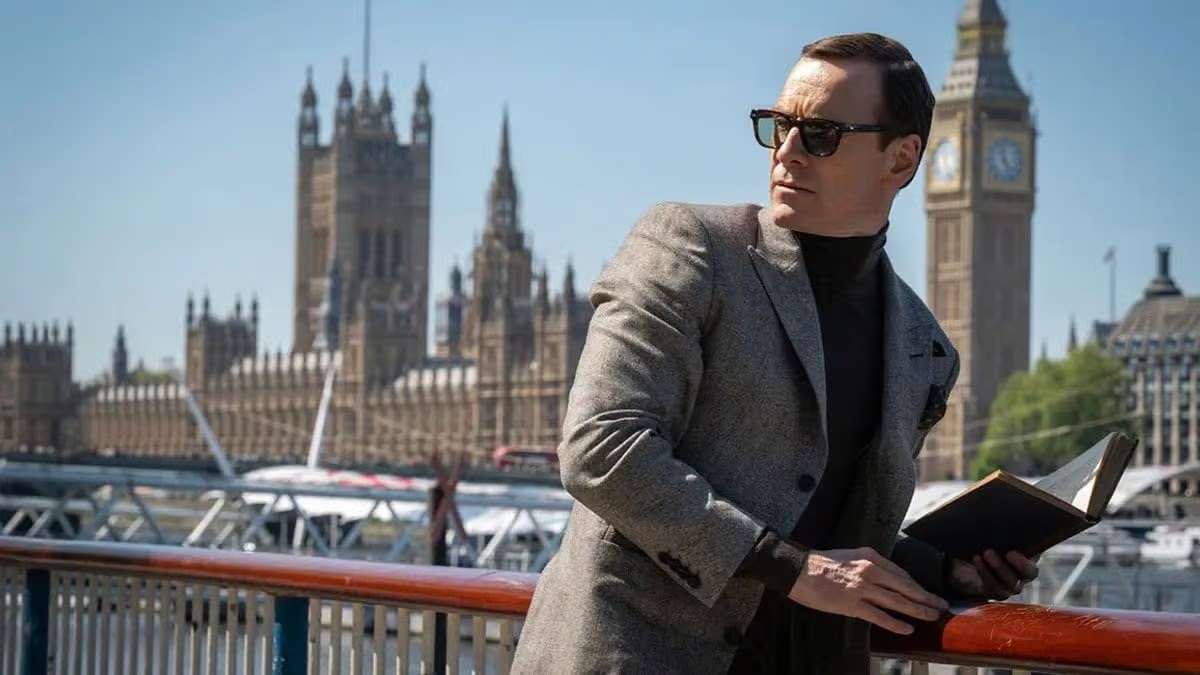
Director Steven Soderbergh's Black Bag uses the threatened meltdown of a nuclear plant to add an element of global peril to a movie that, despite such ominous stakes, plays an intriguing game of small ball.
Rocky Mountain Movies & Denver Movie Review
FOR MOVIE LOVERS WHO AREN'T EASILY SWEPT AWAY
Wednesday, March 12, 2025
'Black Bag': a tense tale about trust
Director Steven Soderbergh's Black Bag uses the threatened meltdown of a nuclear plant to add an element of global peril to a movie that, despite such ominous stakes, plays an intriguing game of small ball.
Thursday, November 3, 2016
A revealing search for identity
To understand Chiron, the main character in director Barry Jenkins's Moonlight, it might be helpful to understand what this young man -- shown at three different stages of his life and played by three different actors -- doesn't have.
No father guides Chiron; his crack-addicted, single mom offers no real parental support; no group of friends provides companionship; and no protector helps keep the neighborhood bullies at bay.
Such observations make Chiron sound like a sociological statistic, a black kid suffering the deprivations of an impoverished life in Miami's ironically named Liberty City. Although Chiron's deprivations constitute a valid and appropriate description, they don't go far enough.
The most important thing that Chiron lacks is a voice. What makes Jenkins's movie impressive are the ways in which he has coaxed the actors who play Chiron to be expressive without articulating the myriad contradictory feelings that whirl inside the character's head. Chiron seldom speaks.
You can (and probably should) spend time unpacking the various complex meanings in Jenkins's movie: the drug dealer who becomes a genuine father figure in Chiron's life but who, because he sells drugs to Chiron's mother, is pained by his own hypocrisy; Chiron's discovery of his gayness; or the multiplicity of causes leading to the violent explosion that criminalizes Chiron and redirects his life.
All of those things are worth discussing, but Chiron's voicelessness underlies everything worth thinking about in Moonlight.
And by voice, I don't mean only the act of speaking. I mean Chiron's ability to define an identity that's unshackled from environment and circumstance.
In the movie's first section, we meet the youngest version of Chiron, as played by Alex Hibbert. A slight kid who has been issued the nickname "Little," Chiron clearly is an outsider.
In this section, Chiron encounters Juan (a terrific Mahershala Ali), a drug dealer who takes the boy under wing.
Born in Cuba, Juan sincerely cares about Chiron. Scenes in which he teaches Chiron to swim give Jenkins an opportunity to display a tender, lovely touch.
Not surprisingly, Juan's concerns land him in a territorial fight with Chiron's mother, a walking fury of woman portrayed by Naomie Harris.
When Chiron reaches his teen years, Ashton Sanders takes over the role. Of the three actors who portray Chiron, Sanders has the least physical resemblance to the others, but his acting leaves no doubt about the adolescent Chiron's connection to his boyhood self: his watchfulness, his ability to ask penetrating questions, his loneliness.
In this period, Chiron has his first sexual experience, and again tries to escape bullies. He hides from his tormentors until an irrepressible anger breaks through his muted surface.
Trevante Rhodes takes over the role when Chiron becomes an adult. By this time, Chiron has survived a stint in juvenile prison; he has bulked up, perhaps to armor himself against the world and against his own feelings. He's also living a life that mirrors the life lived by Juan.
I don't know if it's acting or physical resemblance or a combination of the two, but as this segment evolves, Rhodes reveals more and more traces of the Chiron we knew as a child.
Eventually, Chiron reconnects with a friend from childhood (Andre Holland), a reunion that leads to the movie's conclusion -- which feels like a well-earned respite from all the previous tensions, if not a triumphant moment of self-realization.
Whether you see Moonlight as a perfect movie or not, it's difficult to imagine that you won't be moved by the way Jenkins interprets and reimagines Tarell Alvin McCraney's play, In Moonlight Black Boys Look Blue.
It's not easy to make a movie in which the main character is less actor than one who's acted upon, less talker than one who is talked at, but Jenkins creates a richly realized world and moves us through it with insight and small moments of grace.
Tuesday, December 24, 2013
Elba towers as Nelson Mandela
British actor Idris Elba doesn't really look like Nelson Mandela -- at least not the Mandela we knew from his years as president of South Africa and his reign as a kind of national and even global elder. But the actor's mastery of Mandela's voice and mannerisms give Mandela: Long Walk to Freedom a solid center.
It's difficult to say whether the 24/7 news-cycle immersion that accompanied Mandela's recent death will boost interest in this generally successful bio-pic or detract from it. We've certainly had plenty of biographical information about Mandela in the last month, and those who have read past the headlines know that not everything about the much-admired leader was universally praised.
As directed by Justin Chadwick -- working from William Nicholson's adaptation of Mandela's massive autobiography -- Mandela: Long Walk to Freedom is a mostly laudatory big-screen biography that only occasionally crosses the line into hagiography.
The sprawling, stylistically agitated movie traces Mandela's development from a radical young lawyer in Johannesburg to his 27 year imprisonment on Robben Island and, finally, to his emergence as a symbol of South African reconciliation.
The rest is pretty much secondary:
Naomie Harris portrays Mandela's second wife, Winnie Mandela, in a performance that matches Elba's, but the screenplay only sketchily outlines the rift between Winnie and her husband: Mrs. Mandela favored violent retribution against those deemed "collaborators" with the government that perpetuated apartheid.
Early parts of this two-hour and 21-minute movie suffer from the hasty way in which Chadwick bounces through events that attempt to humanize Mandela by making brief references to early womanizing. We also learn a little about Mandela's first wife (Evelyn Mase).
At times, it almost feels as if Mandela was rushed to completion, but it's more likely that the filmmakers were hard pressed to find a workable structure for such a towering life.
If you're looking for more than a guide to Mandela and to the struggle against apartheid, you'll have to supplement your viewing with some reading. Even with a two-hour plus running time, it's impossible to do more than skim Mandela's significant and much revered life.
This puts a tremendous burden on Elba, who -- thankfully -- proves himself more than equal to a task that had be as daunting as it was difficult.
Thursday, November 8, 2012
For James Bond, life gets harder
As an iconic movie hero, James Bond has died many deaths, only to be reborn in new guises for new times. Once known for his impeccable style and unquestionable taste in martinis and women, Bond recently has settled into a recessionary mode -- at least as far as his erstwhile playboy image is concerned.
In Skyfall -- his third Bond movie -- Daniel Craig has become an even blunter, more stoic Bond. In a time when drones target terrorists, when small units of highly trained Navy SEALs can seem more effective than entire armies and when shadowy villains seem more interested in lethal disruption than in global conquest, the single-handed bravado of Bond might seem as out-dated as the preposterously ambitious villains of 007's big-screen formative years.
Skyfall continues Bond's march into the future -- and more. It entertains, chastens and finds its own distinctive voice.
In keeping with this new spirit, Skyfall features an amusingly sly villain, a former MI6 agent played with wily, seductive ease by Javier Bardem, who adds to the gallery of classic villains he began creating with Anton Chigurh in No Country For Old Men.Despite his casually expressed cruelty and the threat he poses to British intelligence, Bardem's Silva isn't the only enemy Bond must face. Bond also must do battle with time. He's forced toward introspection as he wonders whether he's truly up to the task of combating the evil Silva and preserving the integrity of MI6. The devious Silva threatens to expose a raft of agents on the Internet. He must be stopped from executing a cyberterrorist assault on secrecy.
But even here, the Bond series faces adaptive pressures. Is Silva out to conquer the world as a result of a maniacal lust for power? Not really. He's more disgruntled employee than global threat. And as we eventually learn, he has good reason to be upset.
To fulfill its mission of creating a more human Bond, the series has brought on a director whose reputation hardly hinges on action. Sam Mendes (best known for American Beauty, Road to Perdition and Revolutionary Road) doesn't skimp on action set pieces, but he brings a welcome sense of dramatic grounding and psychological heft to the proceedings.
The trick, one supposes, is to balance innovation with tradition. There are beautiful women (Naomie Harris and Berenice Marlohe), an appearance by Bond's Aston Martin DB5 and a prologue that has Bond toppling onto a speeding train, as well as a bit in which the world's most famous spy races a motorcycle across rooftops in Istanbul. But Skyfall remains as much about propelling Bond into the 21st century as it is about delivering the winking thrills of yesteryear.
Maybe that's why Skyfall's most weirdly flirtatious scene takes place when the blond, soft-spoken Silva captures Bond and taunts him with homoerotic advances. For his part, 007 remains unfazed.
Even the movie's climax feels a bit shrunken. The action eventually shifts to Bond's boyhood home in Scotland, where an old mentor (Albert Finney) is enlisted to help beat back Silva and his minions, who put the house (not fondly remembered by Bond) under severe assault. You get the idea: The scale of the picture exceeds the grandeur of its themes.
This being the 50th anniversary of the indestructible Bond franchise, it's fair to say -- as I already too much have -- that Skyfall is committed to entertaining while perpetuating the series. It continues the exciting, often intriguing and clever retooling of the Bond mythology, but what's really at stake isn't the continued existence of a weary, threatened world, but the future of Bond himself.
Physically powerful and much less prone to puckish humor than any of his predecessors, Craig may just carry Bond into the future with will, muscle and a severely knotted brow. Bond, as you'll notice, accepts each new assignment "with pleasure.'' It's to Craig's credit that we feel as if there also will be equal amounts of pain.


