Showing posts with label Marisa Abela. Show all posts

Wednesday, March 12, 2025

'Black Bag': a tense tale about trust


   Director Steven Soderbergh's Black Bag uses the threatened meltdown of a nuclear plant to add an element of global peril to a movie that, despite such ominous stakes, plays an intriguing game of small ball. 
  Collaborating with screenwriter David Koepp, Soderbergh focuses on the increasingly tense relationships between a group of British intelligence agents, one of whom plans to sell the meltdown malware that could trigger mass casualties and which the British have deemed too dangerous to employ.
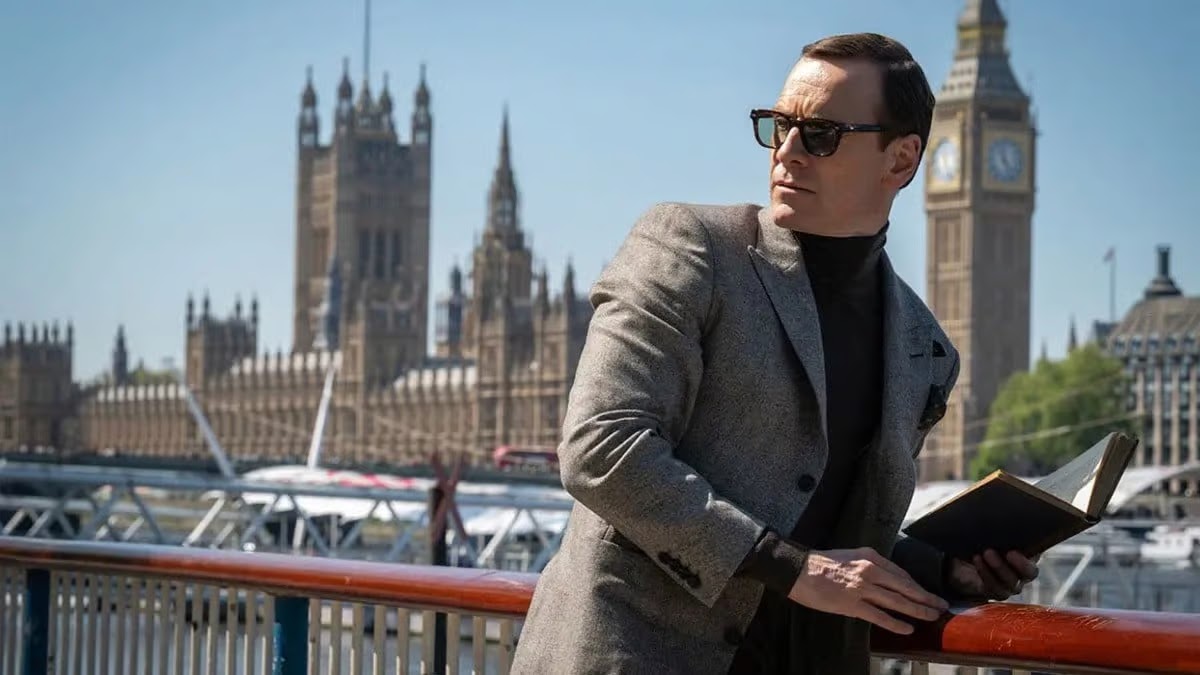
  Playing married spies, Michael Fassbender and Cate Blanchett lead a strong cast that keeps the movie percolating. Everyone's behavior becomes suspect.
   The set-up immediately raises the personal stakes for Fassbender's George. Early on, George learns that his wife's name has appeared on a list of five agents who might be traitors. If she's the culprit, he's going to have to kill her. Will George be more loyal to his wife than to his job? We're not sure. Maybe he's not sure either.
    Blanchett's Katherine seems cagey and intelligent, and it's clear that she and George have carefully worked out the calculus that allows their marriage to continue, even though they sometimes have to reply to each other’s questions by saying "black bag." That means the answer is too secret to divulge.
     Fassbender makes George into a tightly wound professional who keeps us off balance.  To begin his investigation, George stages a dinner party at which the suspected agents (Regé-Jean Page, Tom Burke, and Marisa Abela) and a member of the agency's psych team (Naomie Harris) wind up spilling tea on one another. They reveal enough to bring out festering animosities, but not enough to allow George to identify the culprit. 
    Pierce Brosnan has a nice turn as the head of the agency. He and the rest of the cast embody a drama that bristles with small and large betrayals.
   At times, the movie's many intricate turns get ahead of the audience, but it's not necessary to follow the characters into every cranny Soderbergh explores. A smart screenplay encourages confidence that a satisfying conclusion will be reached. 
    Black Bag includes a skillfully edited polygraph scene that reminds us that truth is difficult to come by in an environment where nearly every one lies. How can they not? It's part of the job.
   

Wednesday, May 15, 2024

Amy Winehouse's brief, wild life


   Amy Winehouse may not have lived long enough for her considerable talent to mature. She was 27 when she died from alcohol poisoning in 2011. Her early demise makes Winehouse a problematic subject for a biographical movie. 
   Fair to say, Winehouse's life had only one act -- albeit a wild one.
   In some respects, Winehouse revivified a rock n’ roll cliche — lacing her stardom with an unholy triumvirate: sex, drugs, and alcohol. Her inspirations derived from sources as diverse as rapper Lauryn Hill and singer Sarah Vaughan. She didn’t want to be pinned to anyone's genre bulletin board.
   Defined by uncompromising independence and a powerful voice, Winehouse blazed bright; she was nominated for eight Grammys and won six of them. 
   Back to Black tells Winehouse’s story, serving it in jagged chunks that seem appropriate for a singer/songwriter whose Rehab can be read as an anthem of spirited defiance. 
   “They tried to make me go to rehab but I said, ‘No. No. No.’”
  The movie’s title — taken from Winehouse’s 2006 album of the same name — suggests dark currents. Winehouse’s journey toward oblivion centers on a startling and dynamic performance from Marisa Abela, who sings the movie’s musical numbers. No lip-synching here. 
   In this telling, Winehouse draws inspiration and affection from her grandmother, Nan Cynthia (Lesley Manville), a nightclub singer who functions as a mentor to Winehouse, a Jewish girl from North London who's often shown wearing a conspicuously displayed Star of David.
   Winehouse also receives support from her dad (Eddie Marsan), a dedicated father who tries to keep Winehouse on track, no easy job considering Winehouse went to great lengths to prove she was no Spice Girl pop star.  As is frequently the case with headstrong rebels, Winehouse clashed with those who wanted to shape her career.
  Much of the movie centers on Winehouse’s heated but disastrous relationship with Blake Fielder-Civil (Jack O’Connell). Blake charts his own course through the world of drugs.
   Credit O’Connell with generating the bad-boy charm that Winehouse found irresistible. Put it this way: Their relationship wasn’t the stuff of rom-coms.
     I can’t say “no no no” to Back to Black, probably because I’m too much of a sucker for courageously immersive performances, and Abela certainly gives one. But director Sam Taylor-Johnson, working from an episodic screenplay by Matt Greenhalgh, creates a movie that often feels so scattershot and confrontational you may want to push it away.
     By the end, that's what I found myself doing.