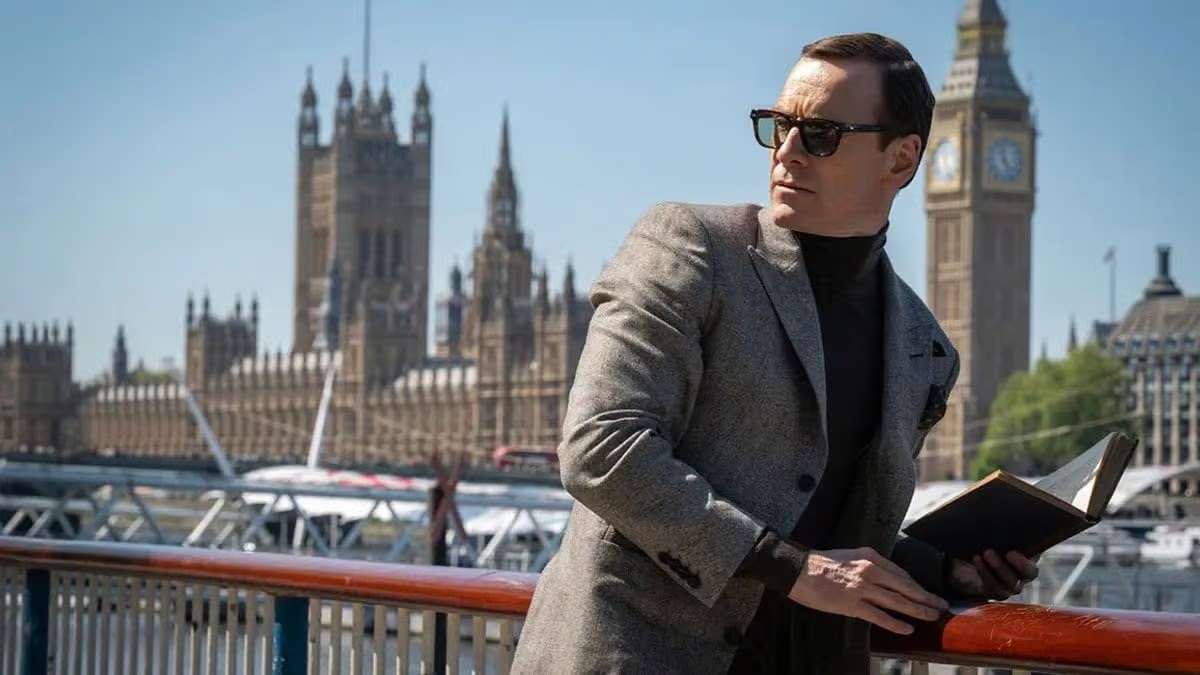
Director Steven Soderbergh's Black Bag uses the threatened meltdown of a nuclear plant to add an element of global peril to a movie that, despite such ominous stakes, plays an intriguing game of small ball.
Rocky Mountain Movies & Denver Movie Review
FOR MOVIE LOVERS WHO AREN'T EASILY SWEPT AWAY
Wednesday, March 12, 2025
'Black Bag': a tense tale about trust
Director Steven Soderbergh's Black Bag uses the threatened meltdown of a nuclear plant to add an element of global peril to a movie that, despite such ominous stakes, plays an intriguing game of small ball.
Wednesday, December 9, 2020
Three friends on an uneasy crossing
Sunday, October 20, 2019
A look at the great financial shell game
Director Steven Soderbergh aims at the absurdities of a wealth-obsessed world in The Laundromat, a Netflix movie that feels like a collection of skits revolving around the Panama Papers scandal of 2016.
That financial mess involved a massive leak of files showing how the very rich (or at least some of them) could use shell corporations to shield themselves from a variety of troublesome intrusions, matters such as income tax or various liabilities.
The Laundromat, which begs for comparison with 2015's livelier The Big Short, uses a variety of techniques to create a farrago of sketches, many presented with the kind of gimmickry that defies cinematic convention, everything from breaking the fourth wall to chapter headings such as The Meek Are Screwed.
The movie is held together by two figures played by Gary Oldman and Antonio Banderas. They are, respectively, Oldman's Jurgen Mossack and Banderas's Ramon Fonesca, characters who might have popped out of a Pinter play. They often address the audience, acting as guides to the financial maneuvering at movie's core.
Speaking in a comic German accent, Oldman seems the more pragmatic of the duo. If there's romanticism in financial chicanery, Banderas finds it.
Ramon and Jurgen are lawyers who run a firm that specializes in creating shell companies. No questions asked. Secrecy respected. If these corporations lack substance ... well ... shouldn't wealthy people be allowed to park their cash somewhere without agents from the IRS crawling all over it?
Working from a screenplay by Scott Z. Burns, Soderbergh tries to show how the damage caused by all this subterfuge can impact those whose financial calculations extend no further than trying to balance a checkbook.
Meryl Streep portrays Ellen Martin, a woman who loses her husband (James Cromwell) in a boating accident on Lake George, NY. Ellen believes that she will collect an insurance settlement from the boating company.
Ellen soon learns that the company had been duped by someone who sold it insurance from a company that wended its way toward the portfolio of an outfit that existed only on paper. Ellen turns up at various points in the story to remind us that all this high-flying finagling can actually connect to ordinary folks.
This portion of the movie introduces us to a character played by Jeffrey Wright, an accountant who lives in Nevis, a West Indian island off the beaten tourist track. Ellen shows up there to track down the company that owns the insurance company that was supposed to compensate her for her loss.
None of this is to say that The Laundromat has a great deal of bite. It's mostly bark presented by Soderbergh with the winking buoyancy of a caper movie.
As Soderbergh works his way through the story, the movie makes a long stop at the palatial home of a wealthy man (Nonso Anozie) who's dallying with his daughter's college roommate. Anozie's Charles' approach to problem-solving: Award any aggrieved party with bearer shares that he claims are worth mega-millions.
Later, we meet a slick wheeler-dealer (Mathias Schoenaerts) who tries to exert his power over a Chinese woman (Rosalind Chao) who isn't going to fall so easily.
Put all this together and you have an airy concoction that amuses even if it doesn't pack the clout we might expect. By the end, I half wondered whether Soderbergh wasn't saying that any society that allows its economy to create financial instruments (i.e., paper) that have the appearance of worth without any reality to support them deserves what it gets — in the end, a handful of nothing.
Thursday, March 22, 2018
A victim or is she really insane?
Filmed with iPhones by director Steven Soderbergh and built around a powerhouse performance by Claire Foy, Unsane offers moments that shock, unsettle and work on your nerves. And in playing a woman who's put through a physical and emotional wringer, Foy wipes out all memories of the dignity and composure she projected as Queen Elizabeth in The Crown.
Unsane also boasts a bit of head-spinning substance: The movie makes us wonder how we might go about defending our sanity if we suddenly were institutionalized, having mistakenly -- or so we believed -- been identified as a danger to ourselves and others.
Foy plays Sawyer Valentini, a banking analyst who's trying to establish herself in a new city. As the story develops, Sawyer is tested at the deepest levels. Unsane hardly qualifies as a small classic, but the movie wouldn't work at all if Foy had failed to communicate a sense of vulnerability and, just as important, a potential for violence.
After a disturbing incident with a man she picks up at a bar, Sawyer decides to see a counselor. She's fearful of being followed by a stalker. Why someone as capable as Sawyer would seek psychological help at an institution rather than in a more traditional setting -- the privacy of a psychiatrist’s office, for example -- never is made clear, one of several tests of the story's credibility.
An intake officer decides that because Sawyer has thought — albeit tenuously — about suicide, she should be admitted on a 24-hour-hold. Sawyer signs a few papers thinking that she’s signing up for counseling. Without realizing what she's done, she ascents to her own commitment.
The more Sawyer aggressively protests, the more the attendants believe she really needs help. After a few violent outbursts, Sawyer's 24-hour hold is extended to seven days. Her mother (Amy Irving) is sympathetic, but can't obtain Sawyer's release.
Unsane functions on at least two levels. The first involves a social dimension: Is this institution committing people against their will in order to collect insurance money? When such monies run out, the supposedly insane suddenly become sane again. Mental health care becomes a profit-oriented scam.
On a second level, the movie pushes Sawyer to wonder whether she really might be insane. If all the people around you seem to be insane — why else would you find yourself in their company?
Working from a screenplay by Jonathan Bernstein and James Greer, Soderbergh effectively keeps us wondering about Sawyer for quite some time.
The story takes a turn toward horror when a new attendant (Joshua Leonard) shows up at the hospital. Sawyer accuses the attendant of being the man who stalked her in Boston, forcing her to move to Pennsylvania to escape his reach.
No one believes Sawyer, who finds only one ally inside the institution. Nate (Jay Pharoah), a man who has been committed for opiate addiction, has managed to smuggle in a cell phone which he shares with Sawyer.
Initially, Soderbergh’s use of iPhones gives the movie’s images an off-kilter feel that creates a mood of disconnection from the ordinary. Overall, though, I’m not sure there was a great deal of gain in making the movie this way — unless it was to keep costs to a minimum.
Despite some plot leaps that are difficult to swallow and a reveal that arrives too early, there’s enough in Unsane to keep it watchable, providing you don’t mind a surrender to horror-movie ploys before Soderbergh calls it quits.
I don't imagine that Unsane will be a major box-office performer, but it serves as a clear announcement that Foy is more than a regal presence. As Sawyer, she’s vulnerable, frightening and assertive. Her performance goes a long way toward saving a movie that isn’t always able to resist its less imaginative impulses.
Thursday, August 17, 2017
A caper movie, country style
It's a bit of a stretch to think that anyone has been eagerly waiting to see Daniel Craig, the current James Bond, play a hillbilly safecracker from West Virginia. But Craig does just that in Steven Soderbergh's Logan Lucky, a caper movie in which a group of West Virginia rednecks stage a robbery at the Charlotte Motor Speedway during the Coca-Cola 600, a NASCAR race held on Memorial Day weekend.
Those who try to mine veins of importance from Logan Lucky, which was written by Rebecca Blunt, may find themselves straining. Logan Lucky stands as an enjoyable -- if slight -- caper comedy build around odd ball casting that creates much of the movie's appeal -- that and Soderbergh's understanding of how to freshen a formula.
An unlikely duo of Channing Tatum and Adam Driver play brothers. Tatum's Jimmy Logan is a beleaguered construction worker who loses his job for not reporting a pre-existing health condition; he has a limp. Jimmy's brother Clyde (Driver) works as a bartender despite having a prosthetic lower left arm, a souvenir from his military service in Iraq.
Jimmy would like to spend more time with his daughter after his divorce from Bobbie Jo (Katie Holmes). But Bobbie Joe and her husband (David Denman) plan to move to a swankier town, leaving Jimmy with a great need for money if he wants to maintain a relationship with his daughter (Farrah Mackenzie), a child who participates in beauty pageants.
With no legitimate prospects in sight, Jimmy uses the code word that his brother knows signals trouble. "Cauliflower."
The rest of the movie follows a pleasingly predictable pattern in which Jimmy assembles the crew he needs to pull off the heist. One of Jimmy's primary partners in crime is Joey Bang (Craig), a felon whose participation presents Jimmy with an obstacle. Joey's in jail. Jimmy contrives a scheme to get Joey out of the slammer so that he can put his larcenous plan in motion.
Jimmy's sister (Riley Keough) plays a role in pulling off a robbery that allows Soderbergh to revel in West Virginia color, sometimes in ways that seem a trifle self-conscious.
To further complicate matters, Joey insists that his participation is contingent on Jimmy involving Joey's two brothers (Jack Quaid and Brian Gleeson), a couple of guys who probably never will be mistaken for MENSA candidates.
Two additional performances are worth mention. Seth MacFarlane shows up as Max Chilblain, a British race car impresario, and Hilary Swank makes a late-picture appearance as a cop who's trying to nab the thieves.
Like many heist movies, Logan Lucky requires a healthy suspension of disbelief, and it's tough to avoid not thinking of the movie as a kind of knockoff of Soderbergh's Ocean's series, only with dirt under its fingernails.
I enjoyed Logan Lucky, even though I was seldom unaware that I was watching actors tapping into their inner rednecks. As it stands, the cast seems to be having the kind of good time that transfers to an audience.
A couple of clicks toward even more weirdness and Logan Lucky might have landed Soderbergh in Coen Brothers territory. Now that really would have been something to behold.
Thursday, February 7, 2013
'Side Effects,' an intriguing thriller
Director Steven Soderbergh has said that the thriller Side Effects will be his last big-screen venture. The 50-year-old, Academy Award-winning director recently told New York Magazine that he plans to spend much of his time painting. Soderbergh didn't rule out theater or a television series, but said that he wouldn't continue as a filmmaker while he felt as if he were "running in place."
In place or not, Soderbergh certainly has been running; he has made 26 features since rocking and transforming the independent film world with 1989's Sex, Lies, and Videotape. As it progressed, Soderbergh's career seemed to divide between star-driven mainstream movies and more idiosyncratic fare. He has had franchise success (the Oceans Eleven movies), won a best-director Oscar for Traffic (2000), and challenged commercial wisdom with Che (2008), a four-hour, two part look at the revolutionary life of Che Gueverra. Most recently, he scored a box-office victory with Magic Mike, an upbeat look at the world of male strippers.
Intriguing and deftly made, Side Effects doesn't always tell the most believable of stories, but it's easy to overlook plausibility issues, right up until the movie's unfortunate and less-than-credible last act.
It may be stretching the point, but Side Effects struck me as a middle-ground helping of Soderbergh, a movie lodged somewhere between the director's mainstream and more specialized efforts. This time, Soderbergh roots his thriller in a culture that frequently over-uses or abuses prescription drugs. All of us are bombarded with drug advertising, and we've read about doctors who receive consultancy money from pharmaceutical companies looking to steer patients toward one drug or another.
At the outset, Side Effects looks as if it's going to be an expose -- perhaps even a heavy-handed one -- about the social and personal perils of America's drug obsession. But Soderbergh quietly shifts gears on us, moving his movie into more classical thriller terrain.
Early on, the story centers on Emily Taylor (Rooney Mara), a young woman whose husband (Channing Tatum) has just finished a four-year prison sentence for insider trading. Once a Wall Street golden boy, Tatum's Martin Taylor tries to rehabilitate his professional life, but soon realizes that he has other problems.
Emily seems severely depressed. She has trouble relating to others, and at one point, she drives her car into the wall of a parking garage. This apparent suicide attempt brings her into contact with a British psychiatrist (Jude Law), who lives in New York City with his wife (Vinessa Shaw) and young stepson.
Law's Dr. Jonathan Banks eventually puts Emily on a new antidepressant called Ablixa. The drug seems to work -- until it doesn't. The potentially dangerous side effects of Ablixa help put the thriller elements of screenwriter Scott Z. Burns's story into motion. Burns, by the way, wrote the screenplay for Contagion, also directed by Soderbergh.
It's impossible to tell more without tipping the movie's hand, so I'll simply say that Soderbergh increasingly concentrates on Law's character as the psychiatrist finds himself foundering in troubling ethical and legal waters.
It takes time to understand why Mara, last seen in the American version of Girl With a Dragon Tattoo, seems a bit drab. Stick with her. Law excels as an empathic psychiatrist who also needs money. He's taken a $50,000 consulting fee from the company that manufactures Ablixa.
At one point in the story, Dr. Banks meets with the psychiatrist who previously treated Emily, a crisply efficient Catherine Zeta-Jones. Zeta-Jones's character ultimately has more to do with propelling the plot than with creating insight into any of the ethical or psychological issues the movie raises.
If Side Effects really is Soderbergh's swan song, it stops short of qualifying as a totally triumphant conclusion. I don't think I'd rank it as one of the best movies in a career that frequently has balanced entertainment with social significance (Erin Brockovich and The Informant) and that has seen the director employ a dazzling variety of approaches in movies such as Kafka (1991), King of the Hill (1993), Schizopolis (1996) and Bubble (2005).
Obviously, it's not easy to fit Soderbergh into any pigeon hole, which is part the reason I hope he doesn't remain a retired filmmaker.
Soderbergh's Behind the Candelabra, the story of Liberace, will play on HBO later this year. But if Side Effects really does turn out to be Soderbergh's final theatrical release, I can understand why.
Directing can become an exhilarating but exhausting exercise in cunning and craft. And every movie presents all sorts of steep challenges -- funding and logistics, to name but two. On top of that, Soderbergh often serves as his own cameraman.
No wonder he's tempted to seek the nourishing solitude of an artist's studio, where he can tend to his creativity in ways that keep it from -- in his words -- "running in place."
Thursday, June 28, 2012
The chaotic world of male strippers

When I read that director Steven Soderbergh was making a movie about male strippers, I scratched my head, but figured that Soderbergh -- who has had both commercial (Ocean's Eleven) and artistic successes (Bubble) -- deserved the full benefit any doubts I and others might have about Magic Mike, a movie starring Channing Tatum.
I carried that accepting attitude into the movie's preview screening, but, sad to say, Magic Mike too often comes across as a lively hunk of junk cinema that does little more than titillate the demographic at which it seems to be aimed, the kind of women who consider watching male strippers a fun night out with the girls.
Not surprisingly, the talented Soderbergh sets the scene well, establishing the environment around a Tampa club called Xquisite, which is run by an oily impresario of beefcake who calls himself Dallas (Matthew McConaughey). McConaughey, who knows how to play sleazy, gives himself fully to the role of an ex-stripper who aspires to move his club from Tampa to Miami and who offers his strippers equity share in the business.
A variety of intentionally hockey strip numbers serve as showy highlights, although they tend become repetitive as the strippers play with male stereotypers -- from firemen to cowboys to cops to sailors.
A whisper of a story emerges when Mike takes a newcomer (Alex Pettyfer) under his wing. We see how Pettyfer's Adam -- a.k.a. The Kid -- learns to be an effective stripper and how he begins to enjoy a life that gives him money, women, notoriety and fun -- at least within the small, strip-club world.
It's probably a mistake to think of Magic Mike as episodic; it's really an immersive movie in which Soderbergh takes us into a world where the men are sex objects and, for the most part, seem to embrace the role.
Tatum, who at age 18 worked as a stripper, is credible as the kind of guy who has irons in many fires. Mike sees himself as a budding entrepreneur, and he hopes one day to start a custom furniture business. To date, he's gotten by on hustle, good looks and charm. He's one of those guys who seem to be dancing on air.
Adam's sister (Cody Horn) would like to see her 19-year-old brother on a more normal path and occasionally serves as the movie's scold, a role not even she takes all that seriously. Horn's Brooke is more concerned about her chaotic younger brother than about the propriety of stripping.
At about an hour into the movie's 110 minutes, I noticed two things. First, the air-conditioning in the theater where the preview screening was being held seemed to be flagging, not a good thing on a day when temperatures had reached 105 degrees. Even worse, the movie began to show its need for a stronger story.
The best Soderbergh can do is to introduce a secton in which Adam gets himself into trouble feeding ecstasy to a sorority girl. The incident further prompts Mike to wonder whether his life isn't a tad empty. Mike'a attempts to make a genuine connection with a woman he seems to see regularly (Olivia Munn) go nowhere. She sees him only as a sexual diversion.
Soderbergh opts for a naturalistic acting style that allows for plenty of hemming and hawing. The cast seems comfortable enough, although some of the strippers (Adam Rodriguez and Joe Manganiello) receive little attention, aside from Manganiello who is seen using a pump to ... er ... enhance his on-stage appeal.
Soderbergh doesn't judge anything that happens, suggesting only that young men outgrow this sort of thing (Mike) or turn it into a marginal form of show business (Dallas) or go along for the ride as long as it lasts (Adam).
There's no point moralizing when a substantial part of the audience will be attending for the beefcake alone, but Soderbergh could have said something a little more trenchant than what we find here.
The world of the male stripping ultimately isn't all that interesting, and this is a case in which what could have made for a lively and unusual backdrop basically becomes the entire movie.
Thursday, January 19, 2012
She kicks butt -- and means it
The other night I was looking at Angelina Jolie's body, not an uncommon activity for male moviegoers, but my motivations had nothing to do with prurient fantasy. Watching Jolie at the 69th Golden Globes, I couldn't help thinking to myself, "God, that woman is thin."
I mention this because Jolie has appeared in a variety of movies -- notably the Lara Croft series -- that emphasize her physical prowess. Seeing the elegantly dressed Jolie at the The Golden Globes, I had a difficult time believing in her action-hero chops.
But Gina Carano, the star of director Steven Soderbergh's new thriller Haywire? She's a whole other story.
According to a fan site, Carno's a 145-pound kickboxer. Carano not only looks as if she can deliver a punch, she actually does deliver many of them, often in rapid, punishing succession.
I probably never would have heard of Carano had Soderbergh not cast her in a thriller that's notable for ... well ... Carano, as well as for some protracted, bruising action, much of it cleverly conceived.
Of course, it doesn't hurt that Carano happens to be attractive or that she's able to hold the center of an action-oriented thriller. So, if you want to see a woman who fights -- and means it, Haywire definitely fills the bill.
But beware, the plot of the movie can go as haywire as the title, and, as a colleague suggested after a preview screening, you run the risk of wearing yourself out if you try to follow it too closely.
Carano plays Mallory Kane, a woman who works for a private espionage agency. In Soderbergh's globe-hopping story, Mallory is pursued by a variety of foes, some of whom pounce on her with sudden fury.
For those who want to know a little more, I'll take a shot: Someone wants Mallory dead. Displeasure with Mallory has something to do with a Barcelona-based job in which she was hired to rescue a Chinese journalist (Anthony Brandon Wong).
Upon returning from Barcelona, Mallory is given another assignment by her boss (Ewan McGregor). He tells her that he has a really easy job for her. Reluctantly, she travels to Dublin to hook up with a British agent (Michael Fassbender). There, Mallory discovers that she's the target of an elaborate assassination plot.
Fassbender, who played a sex addict in Shame, again finds himself between a woman's legs - only this time he's subjected to strangulating punishment during a fight in a hotel room that does more damage than six drunken rock bands.
To carry out his cinematic mission, Soderbergh has hired a large and impressive cast that includes Michael Douglas, Antonio Banderas, Channing Tatum and Bill Paxton. Don't get to worked up, though, most of these actors appear in what amount to extended cameos.
Soderbergh also gets tricky with the movie's structure. He has Carano tell the early part of the story to a befuddled young man (Michael Angarano) whose car she commandeers. Her tale is told in a series of flashbacks that feature chases on foot, excruciating brawls, and rooftop scrambles. All of this concludes with a car chase in the woods that's both novel and harrowing.
When Mallory has finished her story, the narrative shifts to the present, building toward a finale that's both pointed and a little confounding. I know that sounds impossible, but that's how it is.
Part of me wants to say that Soderbergh and screenwriter Lem Dobbs have steeped the movie in needless complication and purposeless confusion. Sure, Haywire shows off Soderbergh's ability to handle action, but when set pieces become a movie's main attraction, you have to wonder why a little more care wasn't spent on storytelling.
"But wait," the Soderbergh fan in me says. Maybe there's another way to look at it. Maybe Soderbergh is offering a wry commentary on the way most Hollywood action movies are packaged and sold. Couldn't almost every action movie be called Haywire? Aren't they all wild collections of set pieces thrown around plots that make little sense? And was my colleague right? Maybe it's wrongheaded of me to want to know what motivates any of these characters.
Oh well, Whatever Soderbergh had in mind, he's found the right woman for the job. Put another way, you come away from the movie believing that Carano easily could kick Jolie's butt -- and maybe even take on her share of punks with names like Bruce, Arnold and Sylvester.
Besides, there's one thing I know for sure: McGregor has the worst hair cut I've seen in a movie in a long time, especially for someone who's not playing a death-row prisoner who's about to be fried.


