Showing posts with label Tom Burke. Show all posts

Wednesday, March 12, 2025

'Black Bag': a tense tale about trust


   Director Steven Soderbergh's Black Bag uses the threatened meltdown of a nuclear plant to add an element of global peril to a movie that, despite such ominous stakes, plays an intriguing game of small ball. 
  Collaborating with screenwriter David Koepp, Soderbergh focuses on the increasingly tense relationships between a group of British intelligence agents, one of whom plans to sell the meltdown malware that could trigger mass casualties and which the British have deemed too dangerous to employ.
  Playing married spies, Michael Fassbender and Cate Blanchett lead a strong cast that keeps the movie percolating. Everyone's behavior becomes suspect.
   The set-up immediately raises the personal stakes for Fassbender's George. Early on, George learns that his wife's name has appeared on a list of five agents who might be traitors. If she's the culprit, he's going to have to kill her. Will George be more loyal to his wife than to his job? We're not sure. Maybe he's not sure either.
    Blanchett's Katherine seems cagey and intelligent, and it's clear that she and George have carefully worked out the calculus that allows their marriage to continue, even though they sometimes have to reply to each other’s questions by saying "black bag." That means the answer is too secret to divulge.
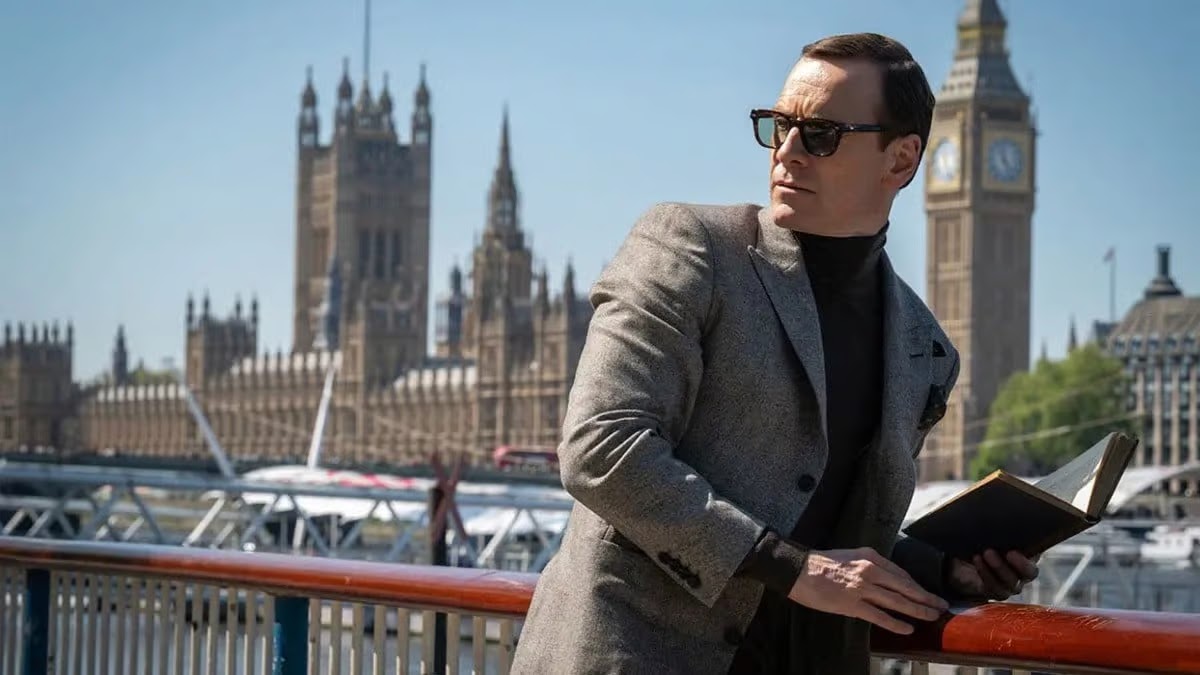
     Fassbender makes George into a tightly wound professional who keeps us off balance.  To begin his investigation, George stages a dinner party at which the suspected agents (Regé-Jean Page, Tom Burke, and Marisa Abela) and a member of the agency's psych team (Naomie Harris) wind up spilling tea on one another. They reveal enough to bring out festering animosities, but not enough to allow George to identify the culprit. 
    Pierce Brosnan has a nice turn as the head of the agency. He and the rest of the cast embody a drama that bristles with small and large betrayals.
   At times, the movie's many intricate turns get ahead of the audience, but it's not necessary to follow the characters into every cranny Soderbergh explores. A smart screenplay encourages confidence that a satisfying conclusion will be reached. 
    Black Bag includes a skillfully edited polygraph scene that reminds us that truth is difficult to come by in an environment where nearly every one lies. How can they not? It's part of the job.
   

Wednesday, May 22, 2024

The origin of a post-apocalyptic warrior


 If this review were a trial, we'd begin with stipulations, agreements that we can accept (or should) without argument.
  1. Few, if any, filmmakers are as skilled at creating propulsive action as George Miller, who offers some of the best bone-crushing, metal-bending sequences ever brought to the big screen.
  2. Not many filmmakers are as committed to harsh truths as Miller. When it comes to post-apocalyptic life, brutality reigns.
  3. In catastrophically depleted environments,  competition for resources feeds cruel compulsions to dominate.
   I begin this way because Miller has created four Mad Max movies that have offered sustained thrills while helping to redefine post-apocalyptic cinema.
   You can bet that Furiosa: A Mad Max Saga, Miller's latest and a prequel to the widely acclaimed Mad Max Road Fury, will deliver the goods as Miller  plunges into a forbidding hellscape where sentiment is as scarce as good grooming.
    Amid the rubble and mayhem, Miller also has insisted that his movies offer the kind of hyper fun that results from wowed appreciation of chases, crashes, fights, and collisions delivered at breakneck speeds.
   So where am I going with all this? What's my verdict on Furiosa: A Mad Max Saga, the story of a girl who matures into the teenager who'll become the warrior woman played by Charlize Theron in Fury Road?
   I saw Furiosa in IMAX at an evening screening after having awakened in Virginia at 5 a.m. EDT for a return flight to Denver. I was tired and jet-lagged, but my eyelids never drooped. A thudding persistent score, the ominous sound of a truck horn, and the roar of motorcycle engines enliven the forbidding  landscapes Miller creates so well. 
   And yet, I'd be remiss if I didn't say that some of the thrill is gone. Ditto for the exhilarating sense of discovery that Road Warrior initially brought. Don't take this as a pan, I said "some" of the thrill -- not all of it. 
    Furiosa begins with Alyla Browne playing Furiosa as a child who is taken from one of the last remaining flourishing spots on Earth, an Edenic green spot. After marauders capture Furiosa, her mother mother (Charlee Fraser) rides a horse and then a motorcycle to the rescue. Mom's efforts go awry -- but not without giving the movie a gripping prologue.
   When the story begins in earnest, Furiosa has been taken prisoner by Dementus (Chris Hemsworth), a ruthless warlord who lost his family and, as a consequence, decided that nothing but merciless violence will conquer his grief. Hemsworth seems to have fun with an outsized role, tempering Dementus's casually expressed sadism with humor.
   The movie eventually focuses on Furiosa's development. She starts as a crafty child devoted to keeping her green homeland free and hidden from those who would exploit it. She evolves into a warrior determined to avenge the early-film death of her mother at the hands of Dementus.
   As part of her development, Furiosa -- now played by Anya Taylor-Joy -- also becomes the pupil of a skilled driver who serves as a mentor (Tom Burke). The two might have made a great team for an entire movie instead of enriching one episode among many.
    Furiosa's story takes place against the backdrop of a brewing war between the forces of Dementus and those of Immortan Joe (Lachy Hulme). 
   Immortan Joe, you'll recall from the previous movie, presides over the Citadel, a fortress built into a cliff. The Citadel dispenses water to the rude and scoffing multitudes, the various tribes that roam this diminished world. 
    Taylor-Joy may not be as physically imposing as Theron, but she brings intensity to a role in which she speaks little, at times posing as a wily young man to escape the fate of young women destined to be held in a harem Immortan Joe uses for breeding purposes.
    No point recounting all the action, except to note that a highlight includes an attack on a speeding silver semi-truck by parachute-wearing warriors. Dementus rides in a chariot drawn by three motorcycles. A variety of  jerry-rigged vehicles revive the junkyard chic that has been a Mad Max staple.
    Some of the character names clue you into the nature of those who populate Miller's expansive desert environment: The People Eater, Organic Mechanic, Rictus Erectus, and Vulture. I had to consult the credits to catch all of these names, but it doesn't matter; it's their fierce looks that count.
   I wish my enthusiasm for Furiosa: A Mad Max Saga weren't tempered by the sense that the movie -- which includes chapter headings -- didn't always display the brisk ingenuity that audiences discovered in Mad Max 2: The Road Warrior (1981) back when Mel Gibson, the original Mad Max, had yet to become a divisive figure. 
   But if Furiosa has fallen off a bit, it hasn't broken into shards. Miller's skill and vision keep familiarity from breeding contempt -- even if we don't always invest in the fate of this teeming screenful of characters, desperate souls for whom good will isn't even a vague memory.
   Most of Furiosa takes place on arid terrain its characters call the Wasteland. For them, the name fits. For Miller, it's territory he still rules.


Wednesday, January 18, 2023

Bill Nighy's memorable turn in 'Living'


   If a doctor, heaven forbid, were to tell Bill Nighy that his demise was imminent, we’d expect a clever retort or a subtle response that resisted turning the moment into high-stakes drama. Nighy has become an actor we feel we know.
   Of course, I have no idea how Nighy might respond to such devastating news, but in Living, Nighy plays a dying character whose emotions are expressed in ways that are bravely undemonstrative. 
   Nighy plays Mr. Williams, a bureaucrat in London’s Public Works Department. He’s a widowed commuter whose life, as he says at one point, has avoided either happiness or misery.
   Mr. Williams lives in the suburbs with his son (Barney Fishwick) and daughter in-law (Patsy Ferran) and governs his life with structured routine. If it’s “picture day,” Mr. Williams goes to the movies. 
   As the supervisor of a small group of paper pushers, Mr. Williams focuses on the stack of paperwork before him, reacting unemotionally to the bureaucratic buck passing that unfolds when his agency is asked to approve construction of a small playground. 
   The movie begins by introducing us to Peter Wakeling (Alex Sharp),  the newest member of the Public Works team.  Unbent by years of service, Wakeling questions what the others long have accepted — the absurd workings of a procedure-crazed government agency.
    Aimee Lou Wood portrays Margaret Harris, a young woman who, unlike her colleagues, seems not have lost touch with the rhythms of life. Not surprisingly, she has accepted a job at a restaurant, where she hopes to ascend into management.
   An English-language remake of Ikira Kurosawa’s Ikiru (1952), Living benefits from the stiff constraints that, in this movie, define  London life during the 1950s, the period when the story takes place. 
   The story's development hinges on what only can be described as Mr. William’s quiet rebellion.
   Once told that he’s dying, Mr. Williams stops going to work. He  travels to a beach town where he encounters a footloose fellow (Tom Burke) who tries to introduce him to the local pleasures.
   Mr. Williams doesn’t return to work, but a chance encounter in London with Miss Harris leads him to an attempt at capturing a bit of life before it’s too late. And, no, we’re not talking about a misguided sexual encounter.
    Working from a screenplay by Kazuo Ishiguro, director Oliver Hermanus can’t blot out every trace of sentimentality, but Nighy’s restraint makes it clear that Mr. Williams is not the sort of fellow ever to gush and his performance serves to characterize the movie. When Mr. Williams lets down his hair, it’s strictly one strand at a time. 
   Nighy creates a memorable portrait of a decent man who has lived a dreary life but who comes to understand that small gains must be savored, perhaps because for him (as for most of us) that might be all there is.

Thursday, November 19, 2020

How a great movie was written


     In 1940, screenwriter Herman Mankiewicz found himself sequestered in Victorville, California. He’d been sent to a remote ranch by Orson Welles to write the screenplay that turned out to be Citizen Kane. 
     Director David Fincher has taken on the task of telling Mankiewicz’s story, a look at a caustically cynical wit who could be amused by Hollywood's emptiness while still knowing how to navigate its treacheries.
     Beautifully filmed in black-and-white by cinematographer Erik Messerschmidt, Mank peers into the corrupted soul of  Hollywood of the early 1940s, a time when the movie industry tried to establish its right-wing bona fides in California even as Hitler rose to power across the Atlantic and the country had yet to recover from the Great Depression.

     Built around an intriguing performance by Gary Oldman as Mankiewicz, the movie sometimes feels like a breezy collection of bold-faced names from yesteryear -- from Ben Hecht to George S. Kaufman to S.J. Perelman. 

    The story eventually draws its energy from tension resulting from Mankiewicz's real-life inspiration for the character of John Foster Kane, none other than media titan William Randolph Hearst, played with surprising subtlety by Charles Dance. 

    Mankiewicz knew Hearst and was a frequent guest at Hearst’s San Simeon retreat, a lavish pleasure palace where Hearst entertained friends and where he and his mistress, Marion Davies (a terrific Amanda Seyfried), dwelled in isolated splendor. Hearst seldom found himself in agreement with Mankiewicz but thought him amusing.

     Working from a script by his late father Jack Fincher, the director includes plenty of famous Mankiewicz bon mots.  After a display of drunken vomiting at a dinner party,  Mankiewicz supposedly excused himself by saying that at least the white wine had come up with the fish. Not quite enough for redemption, but bad, either.

      A quick Google search will show that Mankiewicz looked nothing like Oldman, which may distract aficionados or provide further proof of Oldman’s versatility. Credit Oldman with fashioning a character who tried to balance a need for success and money with an underlying desire to ridicule and dismiss the powerful barons who held the purse strings. 

      Mank will be of particular interest to those familiar with the controversy about who deserves credit for writing Citizen Kane. Officially, Welles and Mankiewicz shared credit, as well as an Academy Award for best screenplay. 

     But in 1971, New Yorker film critic Pauline Kael wrote  a provocative two-part story that awarded the lion’s share of credit to Mankiewicz. Kael’s conclusions have been disputed by others and I have no interest in stepping into waters that have been roiled by deep research and critical partisanship.

     If you care, the movie seems to favor the idea that joint credit for the Kane screenplay was undeserved.

     Notice needs to be taken of the many supporting roles that enliven Mank: Arliss Howard turns up as a doltish Louis B. Mayer, head of MGM; Toby Leonard Moore portrays David O. Selznick, and Ferdinand Kingsley offers his version of Irving Thalberg.

      If you don't know who any of these folks are, Mank may require you to spend some time with Google, which means it's a bit of a film buff's night out.

     What about Welles, you ask? He’s played by Tom Burke, but you won’t see much of him until near the movie’s end when Welles and Mankiewicz fight about who’ll receive credit for the Kane screenplay, which everyone acknowledges to be brilliant.

      Others in the cast deserve at least cursory mention.  Lily Collins portrays Rita Alexander, the British secretary  hired to type the pages Mankiewicz — bed-ridden with a broken leg — dictated. Tuppence Middleton plays Sara Mankiewicz, the writer’s wife, a woman who abided Mank's alcoholism, gambling, and womanizing. Tom Pelphrey appears as Herman’s bother, Joseph — who went on to write and direct any number of memorable movies himself, All About Eve among them.

     Sam Troughton takes a turn as producer John Houseman, who Welles occasionally dispatched to Victorville to check on Mankiewicz’s progress and to monitor his drinking. 

     Perhaps inspired by Kane’s complex structure, Fincher moves his story out of Mankiewicz’s Victorville retreat by flashing back to better and worse times. He highlights Mankiewicz’s relationship with Marion Davies, supposedly the model for the woman Charles Foster Kane embarrassingly attempted to turn into an opera diva in Citizen Kane.

     I’m not sure if Fincher was trying to give the movie topical zing but he spends a fair amount of time on the California 1934 gubernatorial race in which Hollywood's upper echelon rallied to defeat author Upton Sinclair,  the Democratic candidate who was smeared as anti-American and a communist. 

       The screenplay suggests that the race may have marked the  beginning of manufacturing news to seduce a gullible public.

      By making a movie about the making of a movie, Fincher has taken on a gargantuan task  — not to mention that he's dealing with what might be the greatest American movie of them all. Don’t fret. Kane is a far better movie than the movie about Kane and Fincher's effort occasionally goes slack. 

      Citizen Kane remains a great movie even if you know nothing about Hearst or any of the other so-called models for its  characters. Kane may have been of its moment, but it's too damn good to stay there.

       Still, don't sell  Mank short. Fincher takes us back to a time when smart, literary types invaded Hollywood, collected some big paydays, and, in some cases, wrote fine movies. I'm not sure whether to view it as a footnote to a masterwork or an entertainment in its own right, but Fincher's Mank proves a dense, gossipy pleasure.