Showing posts with label Kenneth Branagh. Show all posts

Wednesday, September 2, 2026

Fleeing Russia during the Cold War


In Mayday, Ryan Reynolds plays a Navy pilot shot down while flying a spy mission at the height of the Cold War. In Russia, Reynolds’ Troy is saved by Nikolai Ustinov (Kenneth Branagh), a former KGB agent living as a backwood recluse in the Russian wilds. Ustinov regrets his KGB past, obsessively watches Top Gun, and wouldn’t mind moving to the US. After an opening full of swaggering top-gun bravado, the movie begins to temper its view of US-Soviet relations, adding a bit of nuance. All-American Troy seems shocked to learn that ordinary Russians are capable of kindness (big reveal, no?). Mayday quickly moves into hybrid territory: part action movie, part buddy comedy, and part road movie as Troy and Ustinov try to escape the Soviet Union. A KGB official (Marvin Dorocinski) doggedly follows in close pursuit, but  Nikolai is no pushover. His KGB fighting chops haven't entirely eroded. Maria Bakalova signs on as Nikolai's  daughter, and David Morse has a small role as Troy’s ailing father. Writer/directors John Francis Daley and Jonathan Goldstein (Dungeons & Dragons: Honor Among Thieves) give Mayday the kind of big-budget look we expect from such thrillers. Still, the mix of humor and action doesn’t quite click, and Troy’s penchant for wise-cracking hardly budges the needle on the wit meter. The story picks up for a big finish, having set itself apart by leaning on what looks like novelty casting. Branagh doesn’t seem the most likely choice for kick-ass action, but there he is, trying to inject a touch of Russian melancholy into Ustinov's dialogue. In sum: I won’t give this one a resounding “Nyet,” but I can’t give it an unqualified  “Dah!” either.


Thursday, September 14, 2023

Kenneth Branagh takes Poirot to Venice


 Kenneth Branagh continues his Agatha Christie preoccupation with A Haunting in Venice, his third in a series of films based on Christie novels. As is the case with much of Christie's work, Haunting  delays its big revelation until the end, allowing ace detective Hercule Poirot finally to disclose whodunit. 
  I won't do that with this review. Here's my take: Haunting is an adequate -- though hardly exhilarating -- thriller seasoned by supernatural suggestion that goes against the ultra-rational Poitrot grain.
  As a director, Branagh, who also plays Poirot, takes advantage of otherworldly possibilities, trying for a few jolts and a large helping of eeriness. But the film doesn't register as a superior slice of horror, if that's what Branagh had in mind.
    Christie purists will note that Branagh has based his film on the author's novel, Hallowe'en Party, and shifted its location from England to Italy. By confining most of the tale to the creepy confines of an old  palazzo, Branagh misses an opportunity. The labyrinthian alleys and byways of Venice could have augmented the movie's mystery and terror.
    The story begins in 1947 when Ariadne Oliver, a mystery writer played by Tina Fey, invites Poirot to a Halloween party. She wants the great sleuth to expose a psychic (Michelle Yeoh) who claims to communicate with the dead, one of whom happened to be the daughter of the palazzo's owner (Kelly Reilly). The girl, we learn, entered the realm of the departed after committing suicide.
    Not surprisingly, the mystery doesn't end when Poirot discover that the psychic is a fraud. The plot contrives to allow Poirot to do what he always does: hunt a killer. 
    The visual atmosphere ranges from dim to dark and Branagh also employs a charged angle about the palazzo's past. At one time, the place housed orphans who were abandoned to die. Their ghosts are said to have haunted the place ever since. 
    The supporting cast of characters -- or more precisely suspects  -- includes a visiting American (Kyle Allen), a psychologically damaged physician (Jamie Dornan), his precocious son (Jude Hill) and others who expand the list of red herrings.
     We're meant to wonder whether a stream of mysterious occurrences will shatter Poirot's commitment to reason, causing him to rethink his rejection of otherworldly claims. Let's just say that Poirot's skepticism, forged by many murder investigations, has deep roots.
      Earlier in this review, I called Haunting adequate,  hardly a ringing endorsement for a whodunit that generates too little concern about who  committed the dastardly deed.
     It's not so much that we figure things out early on; it's that we're not given enough reason to immerse in the gloomy game Poirot must play.


Friday, July 21, 2023

Oppenheimer: The story of man and his times


    In Oppenheimer, the story of the scientist known as "the father of the atomic bomb," director Christopher Nolan takes a deep look at a complicated man who found himself poised at a pivotal moment of history.
    A theoretical physicist, Oppenheimer led the bomb-making effort in the Los Alamos, New Mexico. Deemed an unlikely choice for the Manhattan Project, Oppenheimer was supported by Leslie Groves, an Army officer charged with overseeing the project, which employed  some of the world’s most gifted physicists.
    Oppenheimer might be less stylistically self-conscious than such Nolan movies as Inception, but that doesn't mean the movie lacks style. Nolan presents his story in sharply edited narrative bursts that brim with detail and suggestive power.
   Working from American Prometheus, The Triumph and Tragedy of J. Robert Oppenheimer, a 2005 biography by Kai Bird and Martin J. Sherwin, Nolan builds the story around a politically loaded 1954 closed-door hearing at which Oppenheimer’s security clearance was challenged.
   At three hours in length, Oppenheimer is comprehensive enough to be a compelling account of the invention of the atomic bomb and a character study about a man riven with contradiction. Simultaneously proud of his achievement and aware of the horrific destruction he helped unleash, Oppenheimer was cursed with irresolvable conflict.
    Cillian Murphy brilliantly portrays Oppenheimer from his student youth through his appearance at a closed-door hearing which pitted him against Lewis Strauss. As head of The Atomic Energy Commission, Strauss had it in for Oppenheimer.
     Subtle, reticent and wily, Murphy’s Oppenheimer belongs to a rare group of scientists devoted to pursuits about which most of us remain only sketchily aware. In Oppenheimer's case, quantum mechanics.
    Oppenheimer wasn’t immune from the intellectual arrogance such endeavors can breed. He often held his cards close to the vest, minimizing his liberal/left leanings when necessary. Nonchalant about his association with friends who were members of the Communist party, he ultimately got caught in the backwash that swept the country during the McCarthy era.
     As intriguing as Murphy can be, he receives support from one of the strongest casts to populate a movie in some time. 
    Made-up to the point where he almost disappears, Robert Downey Jr. portrays Strauss, a figure whose presence grows as the film progresses. Downey creates an indelible portrait of a man cast into a world in which he's almost always out of his depth.
      Matt Damon does solid work as Groves. Other performers find featured moments, including Benny Safdie as physicist Edward Teller. 
      The movie's all-star group of scientists and theoreticians includes Kenneth Branagh as Neils Bohr and Josh Hartnett as Ernest Lawrence, inventor of the cyclotron and participant in the Manhattan Project.
      Nolan dips into Oppenheimer’s tangled personal life with performances by Florence Pugh as a politically consumed woman and Oppenheimer paramour and Emily Blunt as Kitty Harrison, Oppenheimer’s wife. The harried mother of his children and a hard drinker, Harrison emerges as a woman who refuses to be bowed by her husband's interrogators.
     The test of the atomic bomb precedes the movie’s third act, which tends to make the remainder of the story feel slightly anti-climactic. 
      Still, scenes at the hearing (in black-and-white) allow for a burgeoning conflict to emerge: Oppenheimer came to oppose the development of the hydrogen bomb, a position that put him at odds with Teller and a defense establishment increasingly mired in Cold War frenzy.
       There are genius strokes: Focusing on Oppenheimer’s face when bombs explode in Hiroshima and Nagasaki, for example. Nolan spares us the sight of nuclear devastation. We know that Oppenheimer knows what he's wrought.
       Nolan also displays a keen understanding of how an academic environment that sheltered so many gifted scientists merged into the country’s war-time agenda. He captures the fervor of men who found themselves moving from the world of theory to the world of practice.
         With help from composer Ludwig Goransson, Nolan masterfully infuses a surfeit of expository scenes with tension and urgency, leaving it to us to debate some of the ethical considerations that probably are more evident today than they might have been during the heat of war.
        A movie about a momentous subject that’s branded as one of the year’s most important releases carries a major burden. Time will tell whether Nolan has lived up to it.
       Meanwhile, Oppenheimer deftly illuminates the allure and dangers of being caught in the sweep of history.
       It's a movie about Oppenheimer, yes, but you remember him in the well-developed context of the movie's cascading scenes and shorthand revelations, a man fully and sometimes dangerously situated at a historical turning point whose implications still reverberate.

Thursday, February 10, 2022

Floating along with 'Death on the Nile'


   No, Kenneth Branagh, you didn't murder Death on the Nile, but you didn't bring it to scintillating life, either Yes, you have improved over your last venture into Agatha Christie territory, the lamentable 2017 adaptation of Murder on the Orient Express. But 
in neither case have you attained the sizzle to which I assume your aspired.
    Enough with the second-rate Poirot imitation.
    I had hoped that Death on the Nile would provide the tonic that the big-screen needs at this doom-struck moment. Hardly awful but lacking in distinguishing spark, Death on the Nile turns out to be a middle-grade effort.
   As was the case with Murder on the Orient Express, Branagh plays Hercule Poirot, the Belgian detective who has been solving crimes since Christie first introduced him in 1920.
   Branagh's performance — headlined by a freight train of a Belgian accent — functions somewhat in the same way as paint splattered on a carefully composed canvas. Branagh makes sure that we know Poirot is an oddball, a sharp-eyed detective with a taste for fancy pastries.
  None of this is to say that Death on the Nile lacks highlights, among them: Haris Zambarloukos's cinematography, Jim Clay's production design, and the costume design by Paco Delgado and Jobanjit Singh.
    But such accouterments have a downside, as well. I'm not sure that Emma Mackey, as the passionate, insanely jealous Jacqueline de Bellefort, isn't upstaged by her dress (think neo-Cleopatra) at a key point in the movie.
   Other highlights include Sophie Okonedo as an American jazz singer armed with a quick wit.  She's accompanied by her niece (Letitia Wright), a young woman who manages the singer’s business affairs. 
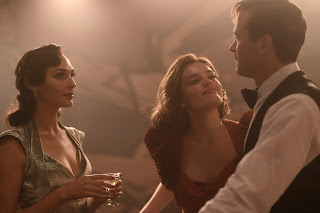
    Christie stories typically confine a large number characters in a single location, in this case, a yacht that embarks from Karnak for the honeymoon celebration of Linnet Ridgeway (Gal Gadot), a wealthy beauty who has married Simon Doyle (Armie Hammer).
    Before the story arrives in Egypt, we get London-based cabaret scenes in which Doyle seems to be totally consumed with passion for Mackey's Jacqueline de Bellefort. Passion or not, Doyle doesn't hesitate to drop de Bellefort for Ridgeway, thus setting off the jealousy that drives the plot. 
    De Bellefort hates being aced out by her best friend but she's far from the movie's only suspect.
    The passenger manifest includes the British comedy team of Dawn French and Jenifer Saunders. Annette Bening plays mother to Bouc (Tom Bateman), Poirot's pal and a generally carefree fellow. 
    I could go on, but only at risk of turning this review into a roster.
    Rather, I'll say that screenwriter Michael Green begins with a World War I flashback in which we learn Poirot's backstory, which includes lost love and an explanation of why he wears a mustache that qualifies as a special effect.
     For a finale, all the movie's suspects gather in a single location so that Poirot can pick them apart, preying on their weaknesses, until he finally reveals whodunit. 
    No harm will come to those who see Death on the Nile and some may enjoy its throwback pleasures. But I was looking to be buoyed by watching these folks, many without virtue, bob wickedly on the Nile. 
    Instead, I found myself merely floating along.


Thursday, November 11, 2021

A boy's life during "The Troubles"


   In 1969, Protestants and Catholics were at one another's throats in the streets of Belfast, Northern Ireland. Bombs ripped through urban neighborhoods, people were beaten, and an atmosphere of fear and rage prevailed. 
   Despite the turmoil, normal life never entirely disappeared. Kids played on their blocks, and not every Belfast Protestant spewed hatred for Catholics who wanted Northern Ireland to sever ties with Great Britain.
    Kenneth Branagh wrote and directed Belfast, a movie that captures a slice of life during the terrible times when Branagh was a kid. Branagh, who also wrote the screenplay, shows us Belfast through the eyes of nine-year-old Buddy (Jude Hill), a boy whose dad (Jamie Dornan) commutes to construction jobs in England. Buddy's mom (Caitriona Balfe) holds things together in Belfast, the city the family regards as home.
   Grandma (Judi Dench) and Grandpa (Ciaran Hinds) are close at hand and Buddy movies easily between both households. His older brother (Lewis McAskie) isn't seen quite as much. 
    Branagh makes some interesting stylistic decisions, the most important being to film mostly in black-and-white, interrupting with color for scenes in which the family attends movies. 
    In the theater, a world of color opens for the family as they watch films such as Chitty Chitty Bang Bang and One Million Years BC, not exactly high art but welcome escapes from daily tensions. 
    High Noon plays on TV, a moral drama that mirrors some of the struggles faced by Dornan's Pa.
    Van Morrison, who hails from Northern Ireland, provides a score that fits the proceedings and, although the movie doesn't shrink from violence, it often adopts the dreamy tone of events seen through a filter of memory and longing. 
   Street violence juxtaposes with the tenderness of family life and Buddy’s youthful innocence. He has a crush on a fellow student, for example, presenting her with flowers, a touching gesture of unashamed love.
    It's not surprising that Buddy has no idea how to react to the events around him. When rioters crash into a local supermarket, he grabs a box of detergent and takes it home to his mother. 
    As someone who regards Protestants and Catholics as equals, Dornan's Pa faces pressure from local toughs who want him to join a neighborhood gang that's taking up arms against Catholics. Pa knows that it won't be long before the violent Protestant partisans take revenge on him for refusing to fight.
     He’s involved in a tug of war with his wife, who’s reluctant to leave the only home she has known. 
    The episodic nature of the movie wears a bit thin, but overall, Belfast paints a telling picture of a family forced to decide whether to endure devastating turmoil or pull up roots.
     In a better world, they never would have had to make such a choice.


Tuesday, September 1, 2020

Great action in a muddled ‘Tenet’

    Tenet involves an ingenious conceit: the idea that time can be manipulated to flow forward and backward simultaneously. This means that a car chase could be proceeding at breakneck speeds while the same cars move in opposite directions — or something like that.
    Graspable more in outline than in detail, Tenet creates an often frustrating mixture of consternation and thrills. 
    Director Christopher Nolan brings Inception-like complexity to a story that probably will have fans filling chat rooms and Zoom calls with speculation, insights, and connections to whatever they perceive as the movie’s meaning.
    Then there’s me.
    First off, I saw Tenet at a screening in which a handful of critics were spatially distanced in a large IMAX theater. 
    I’m not sure what awaits moviegoers when they venture into newly re-opened theaters but I admit to feeling a bit of guilt at having seen Tenet under what surely must be the safest possible conditions. I hope you’ll be able to do the same.
     The movie tosses four principal characters into a mind-bending Cuisinart built around the concept of inversion, a state in which effect can precede cause.
     John David Washington (BlacKkKlansman) plays a character described in the credits only as The Protagonist, a secret agent who must save the world from dreams of annihilation by Andrei (Kenneth Branagh), a crazed Russian oligarch.        
     Andrei's art appraiser wife Kat (Elizabeth Debicki) develops a flirtatious relationship with The Protagonist, but her main concern involves rescuing her young son from the clutches of his evil and monumentally abusive father.
     As his mission unfolds, Washington’s character acquires a sidekick, the devilishly stylish Neil (Robert Pattinson).
    Not much else needs to be known about the cast. Michael Caine makes a brief appearance as a British spy and Indian actress Dimple Kapadia plays a sophisticated woman who traffics in arms.
     For all its theories, talk of algorithms and such, Tenet plays like almost every other summer movie, by which I mean it alternates exposition (a lot of it) with imaginatively conceived action set pieces.
      I half wondered whether Tenet might be a movie that’s best enjoyed by throwing out the bathwater (the story) and keeping the baby (the action).
      A chase involving speeding trucks is particularly exciting and Nolan excels at making the movie's theoretical conceits visible: bullets fly backward into guns and demolished buildings reassemble, for example. 
    Did I mention that birds can be seen flying backward?
    Because the characters need to wear oxygen masks when they are "inverting," some of the burdens of performance have been lifted. But these days, not seeing everyone's face all the time seems depressingly familiar.
    Of the performances, Debicki stands out. Her Kat is sexy, calculating, and possessed of worldly intelligence.  Pattinson brings casual charm to his portrayal and Washington gives a forceful, straight-ahead performance that provides the movie with its continuity.
    Speaking with a Russian accent, Branagh alternates understatement and outbursts, giving the movie a full quota of human menace.
    I presume that Nolan and company collected major frequent flyer miles as they location-hopped to places as far-flung as Italy's Amalfi Coast, Mumbai, Estonia, Denmark, Norway, and London.
    All this is accompanied by a score (credit Swiss composer Ludwig Goransson) that pulses and pulses -- and then pulses some more.
    After a well-staged opening which seems to have been inspired by a real-life 2002 terrorist attack on a Moscow theater, the movie quickly leaps from what many will see as Bondian terrain to one involving alternate realities. 
    With Nolan, the reality in which we all reside never seems complex and baffling enough. His worst enemy: the chronological order that marks the way most of us experience the passing of time.
      I leave it to you to determine whether it's important to catch every line of dialogue. I know I missed a lot.
     And that seems to sum up the Tenet conundrum; you’re often left wondering whether you’ve lost your place or whether the story simply has gone on without you. The result, at least for me: Increasing indifference.
    It’s obviously up to you to decide whether you want to see Tenet, which only can be viewed in theaters. Exhibitors, studios, and other representatives of what might be described as the motion-picture industrial complex certainly hope you do.
    I  have mixed feelings about the reopening of theaters and I’m eager to hear from those who go. I’m less interested in what you think of Tenet than in whether you felt safe in a theater where masks could be lowered to consume snacks.
    In the end, how safely theaters can operate during a pandemic (it may take time to tell) strikes me as a far more important question than any I could raise about Nolan's latest spectacle.


Thursday, May 23, 2019

Shakespeare finds no peace at home

Kenneth Branagh's All is True speculates about the life of The Bard.
After a fire destroyed the Globe Theater during a 1613 production of Henry VIII, William Shakespeare decided to leave London's glare, put down his quill and spend the rest of his days in the company of his family. Sounds good, no? Of course, not.

In the hands of director Kenneth Branagh, who also plays the aging Shakespeare, The Bard's years in retirement are anything but trouble-free. He's deeply aggrieved over the death of a son he mostly neglected. His wife (Judi Dench) is older than he and treats him with what might be called warm tolerance. His daughter Judith (Kathryn Wilder) misses no opportunity to express her anger at him and another daughter (Lydia Wilson) has married a doctor (Hadley Fraser) whose uptight Puritanism gets on Will's nerves.

In short, the Shakespeare home is anything but peaceful in this speculative bit of fiction about the waning days of the greatest writer ever to put pen to paper.

Under such unruly circumstances, what's a bard to do?

Well, he must ward off potential scandals, manage his finances and deal with a wife who knows that his highly regarded love sonnets probably were not written for her.

All of this sounds intriguing, but Branagh's All Is True winds up sounding as if Ben Elton's screenplay was heavily influenced by modern sensibilities that resulted in dialogue that might have made Shakespeare wince.

The film's title derives from a scene in which an impatient Shakespeare, evidently fed up with being asked the same questions again and again, tells a would-be writer that if he explores the depths of his imagination and produces a work that reflects such depth, it will be true -- and that, in the world of fiction, anything that emanates from such a place must be true.

Is this Shakespeare or self-help?

This is not the only instance of uncharacteristically blunt speech in which Shakespeare and his squabbling family engage. Some of Judith's verbal assaults on a father who cherished his son but gave his daughter short shrift also have a contemporary ring.

With a receding hairline and an artificially extended nose, Branagh gives us a beleaguered Shakespeare who is much criticized by his family for having spent his time in London, ignoring his kin and wrapping himself in his career as a poet and dramatist.

I would have thought that Branagh, no stranger to Shakespeare, might have done better, and I would normally say that All Is True proves marginal or at least that viewing might easily be delayed until the movie is available through one streaming service or another.

But there's one scene that burns itself into memory.

Shakespeare meets with Henry Wriothesley, a.k.a, the 3rd Earl of Southhampton. Wriothesley, thought by many to be the Fair Youth of Shakespeare's sonnets, tries to convince Shakespeare that, as the greatest writer who has ever lived, he might be a touch less concerned about what his neighbors think about him.

Ian McKellen portrays the aging Wriothesley, a man no longer fair or youthful. McKellen adds something that has been missing throughout, a sense of sorrow, grandeur and Olympian intelligence delivered by an aristocrat who can see the finish line and who knows precisely where he's been. The Earl's biography resides in every shaded corridor of McKellen's face and in every inflection of his voice.

This is not to fault Branagh or the other actors, but to note that despite the revelation of family secrets and the march toward a big scene in which Shakespeare must face a truth that undermines his reality, it's McKellen who gives the movie its moment of pure transcendence.


Thursday, November 9, 2017

Kenneth Branagh rides the Orient Express

Branagh directs and stars in Murder on the Orient Express, but his version of the 1934 Agatha Christie novel seldom clicks.

I'd be lying if I told you that I recall every detail of director Sidney Lumet's 1974 hit Murder on the Orient Express, but I do remember that the movie was fun. Albert Finney appeared as the great Belgian detective, Hercule Poirot, heading an all-star cast that included Lauren Bacall, Ingrid Bergman, John Gielgud and Sean Connery.

The trouble with Kenneth Branagh's new version, which stars Branagh as Poirot, is that the movie can't wring enough enjoyment out of the journey from Istanbul to Calais -- not for the train's passengers and, more importantly, for us.

Murder on the Orient Express mostly serves to showcase Branagh's turn as Poirot in his version of Agatha Christie's classic 1934 mystery, and, no, Branagh isn’t as good as Finney.

Before the preview screening of Orient Express, I wondered why Branagh had bothered to remake it. After the movie concluded, I could find no special reason for him to have taken another go at material that also has yielded a 2001 TV movie in which Alfred Molina portrayed Poirot.

In this latest outing, Branagh upstages a hefty cast, which includes Michelle Pfeiffer, Josh Gad, Willem Dafoe, Penelope Cruz, Derek Jacoby, Judi Dench, Daisy Ridley and Leslie Odom Jr. Johnny Depp signs on, as well.

Branagh tries to provide visual bang for the buck with exterior shots of the mountains across which the train speeds, an avalanche that derails the engine, and even a few scenes outside of the train. The drama’s resolution takes place in a tunnel where the suspects are lined up at a long table as if they were about to stage a news conference.

I tired of Branagh's Poirot, particularly given the movie’s monotonous structure: Poirot interviews suspects (i.e., the supporting cast) one after another, each appearing in perfunctory fashion as if Branagh is following a time table rather than a script.

Nothing, of course, is as it seems, but Branagh doesn't optimize the participation of a strong cast. Only Pfeiffer comes close to receiving her own small showcase. Mostly, the supporting characters fail to generate keen interest.

For those who haven't read Christie's novel or seen the 1974 movie, there's no point spoiling the mystery, although it's worth noting that lots of attention seems to have gone into the movie's production design, creating the illusion that we're on a most opulent journey.

When Poirot finally solves the mystery, the movie hits its stride, but much of Orient Express proves a snooze-worthy ride in the company of a morally insistent detective who so values balance that he only eats eggs of precisely the same size.

If the light from your mobile device weren't likely to disrupt the experience of others, I'd suggest that this is one journey on which you might consider bringing a book -- perhaps something by Agatha Christie.

Thursday, July 20, 2017

'Dunkirk' makes fear feel real

Trapped on a beach, British soldiers scramble to survive in the early days of World War II..

In 1940, some 400,000 British troops (along with French, Canadian and Belgian soldiers) were stranded on a beach in France. The soldiers were backed into a military cul-de-sac by German forces that rapidly were moving westward. The troops had little support from the air or the sea. On this lonely stretch of beach in northern France, they were strafed by German planes. Their only way out was to be transported back across the English Channel.

That's the backdrop for Dunkirk, the latest, and perhaps most masterful, film from director Christopher Nolan (Interstellar, The Dark Night Rises and Inception).
Watching Dunkirk, I kept recalling a long ago conversation I had with a World War II veteran who worked at the Rocky Mountain News. We were having coffee in a room behind what was called "the backshop," the place where the printers worked when newspapers still employed printers. I was telling him about some war movie I'd seen.

"You know what war is?'' he asked.

"What?" I responded, readily conceding that his knowledge of the subject was far greater than mine since he had served with Patton's Third Army in France and Germany. For him, war wasn't a movie.

"Fear. Nothing else," he replied.

It's too early to determine whether Dunkirk is a great war movie, but I believe Nolan got one thing right. He conveys the fear of men who, minus air support or ships to transport them off the beach, became targets. The term "sitting ducks" seldom has been more appropriately employed.

Nolan uses all of his considerable cinematic skills to make us feel the explosive force of bombs, the startling eruption of bullets or the vulnerability of the few British pilots who made their way to Dunkirk in planes that, by today's standards, seem like little more than flying crates.

Nolan divides his story into several related parts. In the first, a British soldier (Fionn Whitehead) escapes German gunfire that wipes out all his fellow soldiers on the streets of Dunkirk. He arrives on the beach, where thousands of British soldiers have assembled.

He and another soldier (Aneurin Barnard) carry a wounded soldier to a Red Cross rescue ship. They race through masses of soldiers carrying a stretcher toward the pier where the boat has docked. Their motives have a double edge. They want to board the ship themselves.

The officers on the beach are played by Kenneth Branagh (Navy) and James D'Arcy (Army). The soldiers await help, but Branagh's character knows that the British command wants to preserve its destroyers for later battles. Prospects for rescue are dim.

Another story focuses on a British civilian (Mark Rylance) who decides to sail his private boat to Dunkirk to help rescue the stranded soldiers. He's accompanied by his son (Tom Glynn-Carney) and a local teenager (Barry Keoghan).

On their way to Dunkirk, this civilian crew saves a stranded soldier (Cillian Murphy) whose ship was sunk by a German torpedo. Cillian's shell shocked soldier wants Rylance's character to turn his boat around. He doesn't want to return to the nightmare he just left.

If you see the film in an IMAX theater with the sound cranked, you'll feel every shock and rumble -- many of them enhanced by Hans Zimmer's score, a pounding affair that rises like an adrenalized pulse. It's the musical equivalent of writing in all capital letters: DREAD. FEAR. PANIC.

Nolan's third story deals with the air war. Tom Hardy files a RAF Spitfire. Hardy's character -- his face mostly obscured by the mask that supplies him with oxygen -- engages in dogfights with German planes. These dizzying air battles rank among the best ever filmed. (Nolan shot his film with IMAX cameras on 65 mm film; he puts us in the cockpit with Hardy in ways that are disorienting and, of course, frightening.)

It's difficult to imagine that cinematographer Hoyte van Hoytema won't win an Oscar for his stunning work here.

Nolan shifts between all these stories in an effort to provide an encompassing view of Dunkirk. Individual stories are subordinated to the creation of an overall feeling of war chaos.

We can assume things about the characters from their behavior -- Rylance's steadfastness, Branagh's leadership, Whitehead's "ordinary-Joe" qualities, but Nolan leaves most of that work to us.

In some respects, the movie's heroism belongs mainly to its civilians. As it turns out, a small armada of private boats traveled to Dunkirk to rescue the stranded soldiers. It was a stirring moment of British unity that defined the pluck and spirit of a united people facing terrible duress. To portray it, Nolan mostly dispenses with dialogue.

If I have a beef with Dunkirk, it's this: Nolan's movie consists almost entirely of climaxes, the kind of scenes that other war movies build toward. And once, the chaos subsides, Nolan doesn't seem to know what to do. Scale overwhelms everything in ways that make sense if you acknowledge that Nolan's aim is to make us feel as if we, too, are on that beach.

That's part of the point, I think, to make us understand that once the fighting starts, thoughts about patriotism tend to give way to the urge simply to survive.

Nolan has made a movie full of fear and frenzy. It's impressive for sure but sensation-oriented films tend to fade once the sensation stops.

Judging by the inescapable sadness in the eyes of the veteran I mentioned earlier, that's not the case for those whose wars weren't fought at the movies.

Thursday, March 12, 2015

Familiar tale proves entertaining

Cinderella returns, this time with special effects and Cate Blanchett
Taking a break from Shakespeare, director Kenneth Branagh manages a neat trick: He serves up a visually witty and passably entertaining version of a story so familiar, we hardly can believe anyone wants to tell it again.

Lily James (of Downton Abbey) appears as Cinderella, a preternaturally understanding young woman who does her best to adjust to the substantial misfortunes fate deals her -- the early-picture death of her mother (Hayley Atwell) and the later demise of her doting father (Ben Chaplin).

It seems Dad made only one major mistake in his life: After being widowed, he married the conniving Lady Tremaine (Cate Blanchett) and brought his new wife and two daughters (Sophie McShera and Holliday Grainger) into his stately home.

You don't need to know much more because you already get the drift.

The pleasures of this Disney-produced edition of Cinderella have less to do with discovery than with its visual extravagance, created in part by cinematographer Haris Zambarloukos.

Branagh's use of computer generated imagery serves to suggest a connection with Disney's fanciful animated version, a 1950 release that's regarded as a classic. Technological advances allow Branagh to offer novel views of wonders such as lizards turning into footmen for a pumpkin that has been transformed into a carriage.

Did I mention the movie's lovable mice?

An able supporting cast helps bring Chris Weitz's screenplay to life, as well.

Richard Madden plays the prince in this version, never a great role. The prince's father (Derek Jacoby) presses his son to get married, but pushes for the young man to wed a royal.

We also meet a devious Grand Duke portrayed by Stellan Skarsgard, who's ultimately saddled with the task of bringing additional intrigue to the story.

In this telling, Lady Tremaine -- a.k.a. The Wicked Stepmother -- tries to cook up a conspiracy with the Grand Duke that will prevent Cinderella from fulfilling her romantic destiny.

I suppose we shouldn't be surprised that the gifted Blanchett makes the role her own, avoiding the temptation to create a sneering caricature.

The fairy godmother is played by Helena Bonham Carter, an actress who attempts to wring every bit of amusement out of her role.

This Cinderella isn't delivered with a heavy hand, and the result is an entertainment that boasts a wide range of secondary pleasures.

Examples: Dante Ferretti sets are suitably impressive. Sandy Powell's costumes provide their own amusement, particular those of Drisella and Anastasia, the two impossibly snooty stepsisters. Evil Stepmom boasts a preposterously expressive collection of hats.

Given the scale and color of the production, it's hardly surprising that Cinderella functions like a musical in almost every respect, except for the fact that it has no musical numbers. I can't say I missed them.

The primary audience -- girls and tweens -- probably will enjoy the movie, and the parents who accompany them won't suffer. To ask for anything more from another telling of the Cinderella story might be to demand the impossible.

Thursday, January 16, 2014

Jack Ryan lives -- again

Chris Pine tries to breathe new life into an old franchise.
I wish I had $5 for every improbable plot twist in Jack Ryan: Shadow Recruit, a new thriller starring Chris Pine as author Tom Clancy's famed CIA agent. I might not be rich, but I'd sure as hell be eating at more upscale restaurants.

Still, it's January, and you take your movie pleasures where you find them.

Credit Pine for bringing welcome emotional vulnerability to the role of Ryan in an action-oriented movie directed by Kenneth Branagh, who also plays the movies arch villain, a misguided Russian patriot named Victor Cherevin.

Trying to reboot a Cold War series for present-day action spawns a plot that pays too little attention to veracity, stranding the movie somewhere between hard-core realism and James Bond fantasy -- with a little Mission Impossible tossed in for good measure.

No surprise there. David Koepp, who co-wrote the screenplay with Adam Cozad, also wrote the 1996 version of Mission Impossible and has a variety of additional action movies under his belt, including Spider-Man and Jurassic Park.

Shadow Recruit begins by explaining how Ryan becomes a CIA operative. A student at the London School of Economics when 9/11 hits, Ryan immediately joins the Marines. After being gravely injured in Afghanistan, he returns to the U.S. to recuperate and to be recruited by the CIA's Thomas Harper, Kevin Costner in full stolid mode.

Unlike other spies, Ryan is no womanizer. During his painful rehab, he falls for his physical therapist (Keira Knightley), a woman who soon becomes a doctor and who moves with Ryan to New York, where he works undercover as a financial analyst for a big Wall Street firm.

There's no sense trying to summarize all of the intricacies of a plot that advances both a terrorist threat and a Russian scheme to undermine the U.S. dollar.

Branagh's Victor Cherevin masterminds the plan. Ryan is sent to Moscow to thwart it. Perhaps to add more menace, the screenplay finds Knightley's Cathy following Ryan to Moscow to surprise him with her presence.

Of course, she doesn't know that he's in the CIA, and her impromptu visit complicates his mission. Not only must Ryan save the Western world, he must keep his girlfriend alive, as well.

Thankfully, the script doesn't turn Knightley's Cathy into a total cipher; it's clear that she's capable of thinking for herself. She even plays a real role in advancing the plot.

Branagh does a serviceable job with the movie's action, which takes an unsuspecting Ryan by surprise. While in Moscow, he's learning the ropes of being a CIA operative, a far more dangerous job than he initially expected.

Fortunately, Ryan's a remarkably quick learner. One minute he's fretting about not knowing his way around Moscow; the next, he's driving a car at breakneck speeds through the city's streets. The script doesn't allow much time for Ryan to make the transition from brainy analyst to lethal operative, but Pine does his best to make the leap as convincing as possible.

The same can't be said for the movie's wrap-up, which finds Ryan, Cathy and a CIA team flying to back to the U.S. and figuring out the rest of the plot at astonishing speeds. Oh well, what's the point of logic when the fate of the world's at stake?

Pine makes a better Ryan than his predecessors, which include Alec Baldwin, Harrison Ford and Ben Affleck. If the series continues, he'll be able to put another franchise on his resume, already having landed the role as Captain Kirk in the revived Star Trek series.

Shadow Recruit mostly holds its own, but it could have been a lot better. No one asked me, but next time out, I hope the filmmakers opt for a plot that allows Ryan to ply his trade in more credible fashion.


Wednesday, November 23, 2011

Maybe a week with Marilyn wasn't enough

Michelle Williams does nice work in My Week With Marilyn, but the movie comes up short.


The main reason you might want to see My Week With Marilyn -- which is a bit of an anecdote passing as a feature-length movie -- centers on the work of Michelle Williams. Williams offers a mixture of fully realized performance and unrestrained glamor as Marilyn Monroe, capturing the Hollywood sex goddess during days in England when she was filming The Prince and the Showgirl under the direction of the esteemed Laurence Olivier (Kenneth Branagh).


Here's how we know what went on: An avid film enthusiast named Colin Clark (a real person) worked as a third assistant director (read lackey) on the production. Clark evidently developed a week-long relationship with Monroe in which she both relied on him and toyed with his affections. Clark, who went on to become a documentary filmmaker, wrote a couple of books about his experiences tagging after Monroe.


If Williams makes a convincing Monroe, the same can't be said for Branagh, who suggests Olivier (the cast of the mouth, the delivery of lines), but obviously can't manage to look like him. And, yes, it bothered me because the movie's make-up people went to great lengths to turn Williams into a Monroe look-alike.


Director Simon Curtis, working from a script by Adrian Hodges, brings too little interpretive savvy to the proceedings, and Eddie Redmayne (through no fault of his own) can't make a memorable character out of a star-struck young man who's in love with the movies. On screen, Clark comes off as a bit of a cliche, a wide-eyed kid who has run away to join the show-business circus.


Some of the supporting performances are good. The always impressive Judi Dench gives a nicely shaded performance as the kindly Dame Sybil Thorndike, and it's nice to see Emma Watson (of Harry Potter fame) given a chance to do something other than react to special effects. She has a small role as a young woman working in wardrobe. Watson's Lucy clearly would make a more suitable companion for Clark than Monroe, who at the time was married to playwright Arthur Miller, played here by Dougray Scott.


And I particularly enjoyed Zoe Wanamaker as Paula Strasberg, Monroe's Method-oriented acting coach who contributed mightily to Olivier's massive frustration. Olivier didn't want to Monroe to plumb the depths of her character; he simply wanted her to get on with it.


A film about Monroe -- a complicated and often troubled woman who may have been both oppressed and nourished by her status as a sex symbol -- would have been most welcome, and the gifted Williams clearly was up to the task.


But My Week With Marilyn sums up what's interesting about itself in one very incisive line of dialogue: Monroe was a star who wanted to be taken seriously as an actor; and Olivier (who also starred in Prince and the Showgirl) was a revered actor who wanted to be a star. They couldn't help but clash.


That's a revealing observation, but insufficient to sustain an entire movie. My Week With Marilyn simply isn't big enough to accommodate a star of Monroe's magnitude