Showing posts with label Tilda Swinton. Show all posts

Monday, December 30, 2024

When second thoughts nag


   I've been having an argument with myself, and I'm inviting you to listen in. I don't second-guess a lot of things, but I make an exception when it comes to my work.
  Let me clarify: I've been thinking about director Pedro Almodovar -- not the person whom I've never met and have only seen once in person when both he and I were much younger and Almodovar was making his first big wave on the festival circuit with 1988's Women on the Verge of a Nervous Breakdown.
   In the early 1980s, Almodovar, now 75, gained bad-boy notoriety for the gay tilt of his movies, which could seem shocking even as his native Spain shed the oppressive strictures of Franco rigidity. But Almodovar always has been too talented to be pushed into one more genre ghetto.
    Visually robust and thematically provocative, Almodovar has established himself as a significant  presence in the “art film” world. The auteur theory isn't talked about much anymore, but Almodovar qualifies as a bona fide auteur.
  I mention this because I just finished writing a negative review of Almodovar’s The Room Next Door, an adaptation of a 2020 novel by Ingrid Nunez. I’ve read Nunez, but not What Are You Going Through, the novel on which The Room Next Door is based and which I’ve learned is more discursive than Almodovar’s film. 
   Sadly, I found The Room Next Door surprisingly uninvolving. I seldom felt as if I were encountering a film in which style and story merged in vivifying ways. Offering only trace elements of the director's capacious talent, The Room Next Door isn't a typical Almodovar film. 
     The Room Next Door is also Almodovar's first English-language feature, but I didn’t dwell on the impact that might have had on the movie. Lingual landscape is also cultural landscape, but thoughts about something else have been nagging at me: how to think about potential shifts in an artist's approach.
     Almodovar tells the story of a terminally ill war correspondent (Tilda Swinton) who asks an old friend (Julianne Moore) to share a rented house in upstate New York. There, she plans to end her life by taking a pill she obtained on the dark web. 
     Why didn't a foray into such emotionally charged territory seem more grounded in the messy business of dying? 
     I’ve seen too many people die of cancer. None of them looked as well-kempt as Swinton for their date with the reaper. They may have been brave and composed on their deathbeds, but their bodies were being destroyed. It's difficult fully to understand the word “ravaged” until you’ve seen a body under malignant siege.
       So, there was that. At the same time, I wondered if I weren't being too rigid. Why must every Almodovar movie conform to my idea of what an Almodovar movie should be? At the same time, I saw no reason Almodovar couldn’t deal squarely with death while keeping his voice at full throttle. (For examples, see Almodovar's Volver (2006) and Pain and Glory (2019), movies in which death plays a role.)
        Questions and more questions kept tugging at my sleeve. Could Almodovar's decision to make a film in English have signaled his need to take a break from being the Almodovar of expectation? Should an artist be admired for trying to expand his or her range? Is it possible for a filmmaker to exhaust a particular style or, at minimum, need a refresh? Shouldn't such transformative efforts be supported? Or perhaps, I wondered, was the style of The Room Next Door not transformative enough?
       I haven't resolved these questions, nor do I want to recant my review. To check myself, I watched The Room Next Door twice and concluded that it might represent a mismatch between Almodovar and the movie's source material. Still, when serious filmmakers don't seem to be working at peak levels, they deserve more consideration than might be given to less ambitious efforts.
     To take another recent example, director Robert Eggers (The Witch, The Northman, and The Lighthouse) brings distinctive atmospheric artistry to horror. I don’t think Nosferatu, Eggers' latest, totally succeeded, but as a work of undeniable aspiration, it shouldn't be casually dismissed.
      Francis Ford Coppola couldn't have wanted to spend his life making Godfather movies. He’s always insisted on going his own way. But Megalopolis? In Coppola's case and in the case of some other filmmakers, one isn't just reviewing a single film but trying to understand where that film fits (or doesn't) into a career based on vision, acuity, and the ability to get under the skin and stay there.
      In his way, Almodovar may have been advocating for everyone being able to choose death if faced with an incurable illness that promises nothing but pain. I’ve known people, who, facing such illnesses, proceeded bravely and with resolve. Enough, as the saying goes, is enough.
        And, so, too, with this essay. Enough.
       Maybe I've misread Almodovar's movie, or perhaps the director has landed in the midst of a transition period, the kind of artistic purgatory where one keeps working while waiting for the heavenly call of renewal to sound. That’s what artists do. They work.
      As I said at the outset, I'm arguing with myself, turning my thoughts this way and that while living with the unavoidable prospect of never sticking a perfect landing. 


Friday, December 27, 2024

A woman opens death's door


     The Room Next Door, Pedro Almodovar's adaptation of author Sigrid Nunez’s 2020 novel, What Are You Going Through, marks the Spanish director’s first English-language feature. Almodovar,  best known for his long career in Spanish film,  previously made two short films in English. 
      Language aside, I’ve generally counted on Almodovar to refresh my eye. I don't consider this a small matter in the age of Marvel, CGI, and mega-make-up. Almodovar’s bold use of colors, his ability to build stories around distinctive faces, and his skill at spicing his movies with tension, eroticism, and melodrama have made him an internationally known auteur.
     Serious and emotionally measured, The Room Next Door comes across as an anemic helping of  Almodovar, a modest drama about death that flirts with a major idea about climate disaster as it searches for a human approach to the doom that awaits every individual.
  Tilda Swinton, who has worked with Almodovar before, plays Martha, a well-known war correspondent who has witnessed her share of battlefield death. Julianne Moore portrays Ingrid, a prominent author who early on learns that Martha has been hospitalized with terminal cancer. Once close, the two haven't seen each other in years.
    Ingrid visits Martha in the hospital, and their friendship renews -- albeit under extreme circumstances. Whatever relationship the two develop must end with grief.
    Whispers of plot emerge when an experimental treatment fails to halt the advance of Martha’s stage three cervical cancer. After exploring the dark web, Martha obtains a pill that will end her life. She's done with suffering.
     Martha asks Ingrid to join her in a sleek modern home in upstate New York where she’ll spend her remaining days. She doesn’t want Ingrid by her side when she dies, but she wants someone nearby, a person who’ll know that she's gone. 
      The screenplay leans on exposition to explain how Ingrid will escape criminal liability for Martha’s death. She faces exposure because New York has not yet legalized assisted death. Ingrid will also bring news of Martha's death to the daughter from whom the dying journalist has become estranged.
       The Room Next Door may be less stylish than other Almodovar films, but don't get the impression that Almodovar drains it of all color. The characters wear vividly colored clothes, and Almodovar doesn't neglect the film's interiors. Martha's design-oriented hospital room looks impervious to the smell of antiseptic, and Almodovar seldom meets a wall from which a painting can't be hung.
     But these touches don’t feel nearly as pleasurable as they have in previous Almodovar work; they're like footprints, reminders of the director’s presence rather than a fully realized expression of it.
       Mostly, The Room Next Door involves conversations between Martha and Ingrid, although at one point, a flashback reveals a memorable experience Martha had while covering the war in Iraq. Another scene, possibly the movie's most vivid, explains what happened to the father of Martha’s daughter, a Vietnam veteran who suffered from PTSD. 
       And, then, there's the film's thematic reach — or possibly its overreach. While looking after Martha, Ingrid meets with a writer (John Turturro) who lectures on the inevitability of climate-related catastrophe. Both Martha and Ingrid once had affairs with Turturro's character, who has become annoyingly stern. 
       Turturro’s appearance may be meant to highlight the gap between the prospect of global doom and the solitary death of one woman, but the horrors of climate change seem tacked on to an intimately told story about two women who share a profound experience.
      Appearing gaunt and pallid, Swinton makes Martha's death feel a bit abstract. Not her fault. Almodovar focuses on a woman who’s managing the messiness out of her death -- and perhaps out of the movie, as well. Moore makes Ingrid's openness apparent; she's uncertain about Martha's decision to end her life, but she's devoted to her friend.
     A thriller-like score by Alberto Iglesias vibrates beneath the movie's surface, but the music feels misplaced. I took that as a clue. Maybe this is a case of a mismatch between director and material. The Room Next Door didn't seem to give Almodovar or the story he tells enough room to breathe.


Friday, March 1, 2024

Another film occupies its own world


   No one is likely to accuse Julio Torres, the writer/director of Problemista, of lacking ambition. 
   In his mischievous debut film, the former SNL writer and creator of the sitcom Los Espookys, tackles the maddening complexities of emigrating to the US, the insular hypocrisies of the art world, and the coming-of-age problems of one young man.
   That's a lot and Torres’s movie can't handle it all, even with humor and bold, if often silly, displays of creativity. The movie can feel like a scrapbook of ideas set aside for another day.
   Like many immigrants, Alejandro, played by Torres, has a dream. He aspires to design toys for Hasbro, a career that might be an overreach. Consider the duplicitous Barbie-like doll with fingers crossed behind her back, for example. Or how about the truck with the flat tire, intended to teach kids a cautionary lesson?
  To support himself, Alejandro works at a company that freezes corpses for future unthawing. He soon meets Elizabeth (Tilda Swinton), a former art critic whose late husband's body resides at the facility from which Alejandro is in the process of being fired.
   Sporting an unruly crop of red hair and a badly curdled temperament, Elizabeth obsessively works to establish the reputation of her recently departed husband (RZA), an artist who specialized in paintings of eggs nestled in billowy folds of fabric.
   Thanks to Swinton's embrace of her character's fury, Elizabeth blows through the movie with tornadic force.  A sharply offensive woman, she cuts no one any slack. As a character, Alejandro can't compete with her.
   Now and again, Alejandro communicates with the doting mom (Catalina Saavedra) he left in his home country of El Salvador. She believes she can solve any problem her son might encounter, a conviction that has diminished Alejandro's capacity for self-assertion.
   Lacking much by way of ordinary reality to play against, Torres's whimsical approach swamps the movie.  And at times, the movie goes self-consciously bonkers, notably in its depiction of a character called Craigslist (Larry Owens), a surreal embodiment of the website devoted to classified advertising.
   Despite Elizabeth's scourge-like presence, the film's overall tone is only mildly satiric, a movie that too often feels as if it has taken its own idiosyncrasies as its subject.
  Torres treats the film like a playhouse for his imagination. For me, the movie’s ideas, though sometimes clever, didn't always translate into enough laughs: The net result: Problemista left me wishing Torres better luck next time.


Thursday, October 26, 2023

David Fincher's brutal, efficient thriller


     It's not easy to make a movie about a man whose survival depends on anonymity and obsessive attention to detail, so much so that he's constantly replaying a manual of instructions in his head. "Stick to the plan. Anticipate, don't improvise." 
      That's the profile of the nameless character who occupies the center of David Fincher's The Killer, a plunge into the life of a high-paid assassin who plies his lethal trade with exactitude and indifference to anyone else's causes or concerns.
      A major irony triggers Fincher's movie. 
      After a tense and artfully shot opening scene in which the killer (a trim Michael Fassbender) waits for his prey, he misses. Having botched the job, the killer flees the empty Parisian office he'd been occupying as he prepared to shoot someone in the apartment across the street.
      Once he misses his mark and the movie finishes some wily flirtation with Rear Window voyeurism, the killer embarks on a globe-hopping trip spurred by the story's core mystery.
      Fincher has made terrific real life crime movies (Zodiac) and movies that rely on a mixture of fantasy and bristling cynicism (Se7en and Fight Club). He's never made a movie that wasn't steeped in style and directorial competence. 
      Put another way, Fincher knows what he's doing and we feel his confidence.
       Post his assassination attempt, the killer heads to a retreat he keeps in the Dominican Republic. When he arrives home -- a very nice place, by the way -- he learns that his lover (Sophie Charlotte) has been a badly beaten. 
       Then it's off again, this time to get to the bottom of what  brought his lover to the brink of death. He travels to Chicago, New Orleans, Illinois, and Beacon, New York.
        Fincher introduces the movie's chapters with title cards based on the characters the killer tracks: The Brute and The Expert, for example.  Sala Baker plays The Brute; Tilda Swinton appears as The Expert.
       Fassbender has been given some amusing dialogue and his character uses a string of fake credit cards issued in the name of TV characters, Archibald Bunker to cite one example.
       It's as if Fincher is inviting us to play a cinematic game that's willing to wink at us from time-to-time.
       But when it comes to the killer's MO, Fincher pulls no punches when the killer confronts the go-between separating clients from killer (Charles Parnell) or his frightened secretary (Kerry O'Malley).
       The performances are crisp but I wouldn't regard The Killer as an actors' showcase; it's a director's movie -- with help from  cinematographer Erik Messerschmidt, an edgy score from Trent Reznor and Atticus Ross, and tunes from the synth-heavy group, The Smiths.
        Based on a French graphic novel, The Killer slides through a world without either God-given or human morality. But this isn't Dostoevsky, it's a thriller that keeps us in a state of agitation as Fincher displays efficiency void of judgment.
        Oh, and for good measure, he adds a brutally extended fight scene that includes an encounter with a pit bull.
        The Killer may not be Fincher's best work but, within its narrow constraints, it nails its moves.

Thursday, December 8, 2022

'Pinocchio' told in a darker register


   If you appreciate stop-motion animation, you'll no doubt be enthralled by Guillermo del Toro's Pinocchio, an animated work co-directed by del Toro and Mark Gustafson. 
   I've read that del Toro has better served the familiar story's source material, a tale first told in 1883 by Carlo Collodi. Never having read the original, I'll take the word of others, notably because del Toro has made a darker version than we might expect, considering the story 's Disneyfied past.
   Note, however, that del Toro includes a lengthy World War II segment, which, if memory serves, never made it into Collodi's 19th-century work. Neither did Benito Mussolini, the pompous dictator who shows up here.
   Ostensibly a musical, the movie is more notable for its often gloomy tones than for any soaring musical work. 
   Ever obsessed with the horrors of fascism and the dread of death, Del Toro (Pan’s Labyrinth and more recently Nightmare Alley) works his favorite themes into this overlong movie while also acknowledging religion, albeit in somewhat ambiguous fashion. 
   Early on, Pinocchio's dad (David Bradley 's Geppetto) is seen restoring an altarpiece of Jesus on the cross. In this version, Gepetto isn't a Santa's workshop kind of craftsman. 
   The outline of the familiar story remains. When Geppetto's beloved son (Gregory Mann as both the real-life son and Pinocchio) is killed by a bomb, Geppetto drowns his sorrows in alcohol. Once a noble craftsman and loving father, Geppetto becomes an inconsolable drunk. 
   A Wood Sprite (Tilda Swinton) brings the wooden Pinocchio to life. Although death is very much on the movie's mind, Pinocchio himself has more lives than a cat. He can be killed and brought back to life. In one adventure after another, he tries to win his father's love.
   Ewan McGregor gives voice to Sebastian Cricket, who also serves as the movie's narrator. Christoph Waltz turns up as the voice of Count Volpe, the exploitative entrepreneur who tries to turn Pinocchio into a sideshow attraction. 
   Del Toro has done his best to keep Pinocchio from looking like a lovable puppet, making no attempt to conceal Pinocchio's wooden origins. He's not exactly kindling but he's no cute make-believe boy, either.
   I'm not sure how kids will respond to this version of Pinocchio. I wouldn't want to deny the creativity and care of del Toro's filmmaking but too often I found the movie more impressive than enjoyable. 

Monday, December 5, 2022

A mother/daughter relationship explored


Tilda Swinton plays dual roles of daughter and mother in The Eternal Daughter, director Joanna Hogg’s intensely focused examination of the complexities and nuances of a mother/daughter relationship. Swinton’s Julie has brought her mother Rosalind to a Welsh hotel to celebrate her mother’s birthday. Julie, a filmmaker, plans to begin a screenplay based on her mother’s life. Hogg fills the soundtrack with eerie suggestions, cluing us to the idea that there’s more here than meets the eye. It’s no surprise that Swinton, with modest help from make-up, meticulously details the tics and behaviors of both Julie and Rosalind. The movie quietly (very) builds toward a big reveal, which will make you want to replay much of the story in your mind before you reach a verdict about Hogg’s achievement. Hogg (The Souvenir, The Souvenir: Part II) works at her own pace, resisting the temptation to be hurried, which  means that the movie can feel a trifle dull at times. Still, the affections and tensions of a mother/daughter relationship prove intriguing and Hogg winds up with a carefully realized exploration of a psychologically rich subject made more vivid by Swinton's capable work. I don’t want to give away more, but Hogg leaves us with a provocative question: Are ghosts real, and if so, what are they made of?


Thursday, August 25, 2022

A genie fails to conjure enough magic

   
  Australian director George Miller (The Road Warrior movies) travels to Istanbul to tell a story loosely based on an A.S. Byatt collection of short stories, The Djinn in the Nightingale's Eye.  Miller and his team put a lot of effort into creating a look that's designed to amuse, enchant, and sweep us away.
   Despite an intriguing theme about the role of storytelling in our lives, Three Thousand Years of Longing turns out to be one of those movies whose parts don't add up to a satisfying whole — and not all the parts are captivating, either.
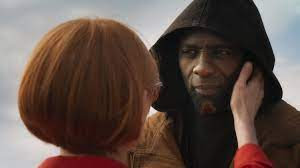
     Miller teams two fine actors in a tale about an academic (Tilda Swinton) and a Djinn (Idris Elba) who encounter one another after Swinton's Alithea Bonnie purchases a small bottle during a visit to Istanbul's Grand Bizarre.  
     Alithea returns to her hotel room, tries to clean up the bottle, and, lo, a genie emerges. The skeptical academic, who studies the role of narrative in mythic literature, is granted three wishes. She's reluctant to use them.
      While waiting for Alithea to make up her mind, the Djinn tells Althea stories, some of which Miller beautifully realizes while others falter. The imaginary Arabian backdrops often are more interesting than the stories that unfold in front of them. 
       A variety of characters emerge as the Djinn tells Alithea about his previous attempts to free himself from his bottle: If he grants three wishes, he'll be free. One tale involves a ravenous and infantile sultan who surrounds himself with portly women.
       Miller is a talented and important director who has veered off the Mad Max track before -- notably with Babe: Pig in the City (1998) and Lorenzo's Oil (1992). He previously tried his hand at fantasy with 1987's The Witches of Eastwick. 
      After his triumph with Mad Max: Fury Road (2015) and with another Road Warrior movie looming, it's easy to understand why Miller wanted a change of pace with a story that's meant to be savored rather energized by speed, the difference say between sipping a glass of wine and downing it with one mighty swig.  
     Put another way: I was rooting for Three Thousand Years of Longing but had difficulty sustaining interest as scenes between Swinton and Elba (shown in various sizes and often with smoke rising from his body) bogged down.
     At once majestic and knowing, Elba creates a memorable Djinn but Swinton's Alithea proves a bit dull, an academic who longs for love and companionship.
      Miller is too talented not to find some masterful moments but the movie suffers from a lack of drive, and when Alithea and the Djinn return to London, the screenplay expands to include a romantic dimension in which the fantastical and the mundane try to merge.
     Generous viewers may give Miller a pass. I'd have no quarrel with those who are so inclined but, for me, this story about the transcendent importance of stories seldom made it feel as the stakes were vital.
     Besides, the best way to celebrate stories is to tell a great one. Three Thousand Years of Longing falls short in that regard.

Thursday, October 21, 2021

Wes Anderson's insular ‘Dispatch’


     Wes Anderson is an artful filmmaker and master miniaturist, a director who knows how to situate his films in the rich stream of cinema history. He's idiosyncratic and hardly ever seems to make a film in which his main objective is to soothe an audience. These are admirable traits and also the reasons why I always scold myself when I can't fully get behind an Anderson film.
   That's the case with The French Dispatch, a movie  apparently intended as a tribute to great magazine journalism. 
   Bill Murray plays the editor of the French Dispatch. Headquartered in the city of Ennui along the Blasé river, the Dispatch has built its reputation on the power of the written word and the idiosyncratic journalistic eye.
    Murray articulates two rules for those who work for the Dispatch. Don't cry and write in a way that makes it seem as if you did it on purpose.
   The plan: When Murray's Arthur Howitzer Jr. dies, the paper dies with him -- perhaps Anderson's way of acknowledging the disappearance of Great Editors; i.e., editorial titans who knew how to work with "difficult" writers -- and had never heard of focus groups, much less consulted one.
    An anthology divided into three parts with a prologue, the movie focuses on the Dispatch, a New Yorker-like publication complete with a table of contents and drawings. The meat of the movie involves three Dispatch feature pieces presented in black-and-white, color, and mixtures of the two.
    First among them, The Concrete Masterpiece, a story in which an art maven (Tilda Swinton) talks about a brilliant rebel painter named Moses Rosenthaler (Benicio Del Toro). 
   Imprisoned for murder, Rosenthaler uses a prison guard (Lea Seydoux) as a model. Adrien Brody enters the story as an art dealer who wants to exploit Moses's work -- and is, therefore, outraged when Rosenthaler produces frescos on the prison's walls. How the hell can those be sold?
   The best and most genuinely bizarre of the three pieces, The Concrete Masterpiece features Del Toro as a genius who seems to have separated himself from the constraints of ordinary morality. 
   Next up, Revisions to a Manifesto featuring Timothee Chalamet and Frances McDormand. McDormand plays a writer caught up in what looks like the student rebellion of 1968. She develops a relationship  -- as a kind of mentor and sexual partner -- for Chalamet's character, leader of a student revolt. She also crosses  an ethical line, helping Chalamet's character write a manifesto. 
   By the time of the second movie, I found myself asking just how much quirkiness and intricate detailing I could tolerate. 
   OK, part three, The Private Dining Room of the Police Commissioner. Jeffrey Wright portrays a writer who's working on a profile of a chef. Listening to Wright's delivery of the segment’s abundant dialogue has its rewards. But Private Dining Room, which also makes room for animation and crime, seems crowded to the point of indulgence.
   Almost every Anderson movie has a finely etched quality as well as a whimsical sense of humor and French Dispatch is not without those qualities. Still ....
   I wouldn’t say that Anderson has chiseled the life out of his movie; it's more that the chiseling almost becomes the life of an intricate inward-looking movie that carves out a place for itself — but not always for an audience. 
   Is it possible for a movie to talk to itself?

Thursday, August 27, 2020

Dickens with buoyancy and bounce

     Be of good cheer. Director Armando Iannucci (In the Loop, Veep, and The Death of Stalin) has taken a crack at Charles Dickens' David Copperfield. You say you've had your fill of Dickens. Not to worry. Iannucci and a first-rate cast very likely will change your mind.
     Lively and engaging, The Personal History of David Copperfield reflects Iannucci’s understanding that the enduring appeal of Dickens has as much to do with the humor that derives from sharply drawn characters as with the ripe melodrama that often punctuates his stories.
     Adopting an infectiously playful spirit, Iannucci and his co-writer Simon Blackwell insist that the Copperfield story can be fun, which may explain why Personal History  plays with the energy of a musical -- only without
anyone doing anything as silly as bursting into song.
     Perhaps inspired by Hamilton, Iannucci creates a multi-cultural, multi-ethnic Copperfield. The casting works to give the story a universalist spin without becoming preachy or self-conscious. 
     Dickens, of course, was interested in the social issues of his time, many of which (class distinctions and maltreatment of the poor) show up in Copperfield and remain relevant in our moment of widespread distress.
     But Iannucci grabs hold of something to get us and his hero through his wrenching trials. David Copperfield remains a beacon of determination and, as played by Dev Patel, a hero who shows amusing flashes of self-awareness and pluck. 
     If the acting in Personal History were a meal, it would be a feast of tasty comic supporting performances.
     Peter Capaldi's    Mr. Micawber is a charming rogue of a fellow who shamelessly compiles debts. With a brood of a family to support, Micawber constantly courts the possibility of being thrown into debtor's prison. 
     Tilda Swinton, at her imperious best, plays Copperfield's aunt,  a woman who shares her estate with the addled Mr. Dick (Hugh Laurie), a man who has convinced himself that a beheaded king of yesteryear; i.e., Charles I, somehow has managed to transfer all of his thoughts into Mr. Dick's head. 
     A terrific Morfydd Clark tackles two roles. She appears as Copperfield's mother and later returns as Dora, the lovable but clueless beauty who captures Copperfield's heart.
     The movie begins with Copperfield on a stage, telling his story to an audience. In this theatrical setting, Iannucci launches Copperfield's journey down a road that leads to his exploitation, his strange schooling, and his associations with the always tipsy Mr. Wickfield (Benedict Wong) and his down-to-earth daughter (Rosalind Eleazar). 
     Darren Boyd portrays Murdstone, a villainous creep who -- at one point -- becomes Copperfield's stepfather and tormenter, banishing the boy to misery in a bottle factory.
     No Copperfield would be complete without a Uriah Heep and Ben Whishaw more than does him justice, creating a character of such transparent unctuousness that he practically oozes off the screen.
     At one hour and 59 minutes, Copperfield might be a trifle long but Iannucci moves briskly, often dispensing with such matters as exposition or transitions. 
     He creates the illusion of an episodic story told as if it is unfolding -- with embellishments, of course -- from Copperfield's memory: The result proves as generously entertaining as anything you might see in this strange and often dispiriting season.

Thursday, June 13, 2019

Jim Jarmusch makes his zombie movie

Every now and again, I come across a movie that I watch without being able to form much of a connection. That certainly was the case with The Dead Don't Die, director Jim Jarmusch's belated entry into the world of zombie movies. Employing a cast led by Bill Murray, Adam Driver, and Chloe Sevigny -- all of whom play small-town cops — Jarmusch deadpans his way through a dreary foray to a small town where the dead are popping up from their graves. There's little point making this kind of movie without taking aim at a decaying world. To that end, Steve Buscemi portrays a racist farmer who wears a "Keep America White Again" hat, a take on ... well ... you know. Strange things begin to happen in the tiny fictional town of Centerville and it doesn't take long for the dead to begin chewing on the living. Murray and Driver display little emotion as the movie progresses. Tilda Swinton adds to the weirdness quotient. She shows up as the town's mortician, a woman who also happens to wield a mean samurai sword. At one point, Jarmusch shatters convention. Driver's Ronnie justifies his gloomy outlook by telling Murray's character that he knows things will end badly because he’s read the script. Jim, he says, showed it to him. Oh, I forgot to mention that Tom Waits portrays a hermit who wanders through the woods outside of town and that Danny Glover appears as the owner of the town's hardware store. The idea of riffing on zombie movies, a deadened American culture, global warming, and small-town insularity isn't exactly new. Because The Dead Don't Die was selected as the opening offering of the Cannes Film Festival, I expected a more robust movie -- even if that movie kept faith with Jarmusch's low-key style. The Dead May Not Die, but this movie sometimes feels as if it's in need of life support. Oh well, maybe it’s me. I’ve admired some of Jarmusch’s movies and been unimpressed by others. For me, this one staggered its way onto the negative side of the ledger.

Tuesday, June 27, 2017

'Okja:' A very big pig movie


Once you know that Okja is a pig the size of a hippopotamus, you'll understand that the movie named after her isn't going to be a typical affair. It's also worth knowing that Korean director Bong Joon-ho (Snowpiercer and The Host) isn't trying to turn Okja into an updated version of Babe, the endearing Australian charmer from 1995.

Ever ready to expose greed and deception, Bong has made a movie about the ways in which a callous corporation exploits both the pig and the pig's keeper, a quietly determined Korean girl named Mija (An Seo-hyun).

Early on, we learn that the Mirando company has created enormous genetically modified pigs. Wanting to keep the pigs under wraps for a decade, the company sends each animal to a far-flung keeper. The keepers are responsible for raising the pigs. Mija is one of those keepers.

It soon becomes clear that Mija, who lives in the mountains with her grandfather, has developed a strong Bond with Okja. Okja servs as Mija's constant and loyal companion. The two play together, and Mija believes that her grandfather plans to purchase the pig so that Okja can continue her idyllic life in Korea.

But even grandpa can't be trusted: He has no intention of keeping Okja from becoming someone's dinner -- or in the case of this pig, dinner for a multitude of consumers.

The company is represented by its CEO Lucy Mirando (Tilda Swinton); a fading TV celebrity (Jake Gyllenhaal); and the company's smooth-talking flak (Giancarlo Esposito).

It doesn't take much italicizing by Bong for us to know that this trio -- coupled with Lucy's twin sister (also Swinton) -- represents the soulless evil of contemporary life.

An animal rights group led by the super-sincere but still conniving Jay (Paul Dano) also joins the fray, a group with its own agenda.

I can't say that the giant animated pig looks exactly like an inflated version of the real thing, but it quickly becomes apparent that Okja has a heroic, self-sacrificial streak that makes her even more of a pal to Mija. Only the motives of animal and girl show anything close to unalloyed purity.

A simple plot finds company reps traveling to Korea to bring Okja to New York for a competition to determine which of the company's many genetically modified pigs qualifies as best of the breed, a major PR stunt.

The rest of the movie follows Mija's efforts to reunite with Okja and return to the uncorrupted simplicity of mountain life.

The grown-up, non-pig performances tend toward exaggeration bordering on caricature. Gyllenhaal, for example, speaks in a distractingly odd voice. Always clad in shorts, his character looks like a demented kid who has gone off the rails at summer camp.

Don't mistake Okja for a kids' movie, though. Among other dark moments, Bong includes a harrowing trip to a slaughterhouse where Okja is supposed to meet her terrible fate.

Fat with thematic intentions, Bong's movie never quite scores a bullseye. It should be seen as a kind of irresistible oddity that hammers home its message (or messages) without much finesse but is made watchable by the bond between a girl and a pig that only the cruelest carnivore ever would want to eat.

The point: In a world dominated by commerce and self-interest, the real pigs are all walking on two legs.
Okja bows on Netflix and is available in limited theatrical settings.

Monday, November 7, 2016

An amusing appointment with 'Doctor Strange'

Like many of you, I've grown weary of movies derived from Marvel Comics. So when a choice presented itself last week -- see Dr. Strange, another movie from the Marvel machine, or Moonlight, a much-praised movie that lit up the fall festival circuit -- I chose Moonlight. I was, however, pleasantly surprised when, on a weekend catch-up mission, I saw Doctor Strange. Sporting an American accent, Benedict Cumberbatch plays the title character, an ultra-rational neurosurgeon who learns to submerge his ego by mastering the mystical ways of the East -- or least Marvel's idea of what such ways might be. Initially, Strange heads eastward in hopes of restoring damage done to his precious hands in a devastating automobile accident. In Kathmandu, Tilda Swinton's Ancient One gradually initiates Strange into the mysteries of her universe -- with help from her sidekick Chiwetel Ejiofor's Mordo. Cumberbatch nails Strange's arrogance and makes the doctor's transition to a superhero credible. An appealing Rachel McAdams signs on as a former colleague and love interest of Dr. Strange, and Mads Mikkelsen plays Kaecilius, the villain of the piece. The plot is mushy Marvel pap, but the fun of director Scott Derrickson's movie has less to do with story than with the special-effects show that Derrickson puts on: Inception-like inward collapses of buildings, odd intersections of reality and alternate realities, and Dr. Strange's cape, which seems to have a mind of its own. Just as important, the movie has a sense of playfulness that makes Dr. Strange feel reasonably fresh -- at least until the obligatory epilogue that comes at the conclusion of the end credits. So three cheers for Derrickson and his crew. They've defeated a ton of preposterous dialogue and a plot that could have encouraged indifference to create an enjoyable comic book movie.

Thursday, February 4, 2016

The Coens take on '50s Hollywood

Great cast, but Hail, Caesar! is enjoyable only in bits and pieces. Fortunately, some of those bits are inspired.

Despite the exclamation point in its title, the new Coen brothers film, Hail, Caesar!, isn't the sharpest or most emphatic of their many amazing efforts. A collection of sketches that both satirize and celebrate Hollywood of the 1950s, Hail, Caesar! lands the Coens in what for them is strange terrain: They've come up with a middle-ground addition to their idiosyncratic oeuvre with -- and this deserves underlining -- touches of entertaining brilliance.

There's a whisper of a story here: Fictional Capitol Studios finds itself in the midst of a major production. The movie is called Hail, Caesar!, and it carries the same heavily freighted subtitle as Ben-Hur, A Tale of the Christ. The plot, which offers echoes of The Robe focuses on a hardened Roman officer who eventually sees the light, rapturously submitting to a new faith when he encounters Christ on the cross.

Capitol's mega-buck epic stars Baird Whitlock (George Clooney), a slightly dissolute movie star who is also slightly dim.

During the filming of a scene, Whitlock is drugged and spirited away by extras who demand a $100,000 ransom. As it turns out, they are rebels with a cause, leftist screenwriters enamored of the Soviet Union who meet regularly to be lectured by Professor Marcuse (John Bluthal), an unveiled reference to Herbert Marcuse, a hero of the New Left during the 1960s.

It falls to Eddie Mannix (Josh Brolin), the studio's tough but perpetually burdened mogul, to return Whitlock to the set so that his mega-production can wrap. Eddie's part businessman and part fixer, a guy who's accustomed to covering the tracks of the studio's frequently wayward stars.

Eddie Mannix is modeled on a real-life MGM studio fixer of the same name. Here, Mannix is treated as decent but beleaguered man who's trying to keep the studio from running aground -- not an easy task when its stars have a penchant for landing themselves in embarrassing positions.

As Eddie puts out one Hollywood fire after another, he also entertains an offer from Lockheed, which wants to give him a high paying job that would allow for a more regular and presumably respectable life.

Now, very little about the plot matters. What makes the movie palatable are several winningly ludicrous snippets from Capitol's movies. Think of them as footnotes that are more interesting than the main body of the work.

One of the best involves a bone-headed decision to turn the studio's acrobatic cowboy star into a romantic lead, jamming him into comedy in which characters dress to the nines and speak in the kind of faux British -- or British-ish -- accents that were popular in some movies during the '30s and '40s.

Director Laurence Laurentz (Ralph Fiennes) is stuck with this egregious piece of miscasting. The scene in which Laurentz tries to prepare cowboy Hobie Doyle (Alden Ehrenreich) for sophisticated patter might be enough to justify the price of admission.

The same goes for brief appearances by Tilda Swinton, who plays two roles -- gossip pedaling, twin columnists Thora and Thessaly Thacker. Listen to the way Swinton says Eddie's name, giving it a twist that evokes the pleasures of a whole era of studio filmmaking.

And if you don't smile during a production number featuring Channing Tatum as a tap-dancing sailor who, along with his shipmates, contemplates life at sea without "dames," you're in an even worse mood than I usually find myself in.

And then there's a broadly comic bit involving Frances McDormand as C.C. Calhoun, a chain-smoking film editor.

For me, those were highpoint to be savored, along with numerous small touches.

Alas (to be as stilted as some of the dialogue in Capitol Studio's productions), not all of the sketches work so well. Though beautifully produced, an Esther Williams' style swimming number featuring Scarlett Johannson might have been included just to show that the Coens could do it.

Johansson plays DeeAnna Moran, a pregnant movie star who forces the studio to find ways to cover the fact that she's not married. Her story eventually leads to Jonah Hill, whose role amounts to little more than a forgettable cameo. Hill plays Joseph Silverman, a man who specializes in "personhood," a joke that's not really worth the trouble of explaining.

In A Serious Man, the Coens took on religion; their attempts to do the same here aren't nearly as rich. The movie opens with Mannix in a confessional booth where he establishes himself as a serious Catholic who's addicted to confession. Mannix feels guilty because he lies to his wife about having quit smoking, but his real guilt comes from working so hard to support a morally dubious and often lunatic enterprise.

Stretches of Hail, Caesar! proves only mildly amusing and some of the humor built around the Hail, Caesar epic struck me as more obvious than we expect from the Coens who've taken swipes at Hollywood before, notably in the feverishly brilliant Barton Fink.

Hail Caesar! may not rank at the top of Coen's impressive list, but it should do nothing to sour anyone on their work. My advice: Treat the movie as a smorgasbord. Pick what you like; forget the rest.

Thursday, July 16, 2015

Amy Schumer's semi-nasty rom-com

In Trainwreck, the spotlight is on a sexually aggressive woman.

Is there anything Tilda Swinton can't do?

In the new Amy Schumer comedy Trainwreck, a nearly unrecognizable Swinton plays the crisply aggressive British editor of S'nuff, a trendy New York-based magazine that explores such ludicrous topics as the best ways for men to masturbate at work.

"Pitch me. Pitch Me,'' she goads her staff, looking for topics to satisfy her perverse journalistic appetites.

Swinton's role is parodic, but it leaves you wondering whether she might have added even more sharpness to a movie such as The Devil Wears Prada.

But wait. I already hear the groaning. Why am I talking about an actress who has a tasty supporting role in a comedy starring Schumer, the off-color, feminist-oriented comic who's garnering big-time attention at the moment.

The best answer, I suppose, is that I'm easing into what's going to be a review that resists falling too far on either side of the Schumer fence.

In Trainwreck, Schumer earns a center-stage spot on the big screen, but her movie hits flat spots even as it finds major comic flourishes. Besides, Trainwreck isn't nearly as creative as Schumer's Comedy Central show, Inside Amy Schumer.

In Trainwreck, Schumer plays Amy Townsend, a talented magazine writer who defends herself against emotional involvement by sleeping with just about every man who crosses her path.

Amy has rules about her profligacy. She never spends the night with one of her bedmates. She consumes lovers, and quickly moves on.

That's an interesting (and novel) enough premise for a comedy, and it probably should have carried Trainwreck further than it does.

After all, movies seldom portray women as aggressors in the sexual arena. Amy doesn't make love: She notches conquests.

This approach allows Schumer, who wrote the screenplay, to play to her strengths. In the war-of-the-sexes, her character takes no prisoners.

The movie, which was directed by Judd Apatow, has fun putting Amy in charge of its sometimes scalding narrative.

The most notable of Schumer's early picture assaults revolves around Amy's relationship with a muscle-bound hunk (John Cena) who's too dim to acknowledge his homoerotic impulses. He also can't believe that Amy's interest in him doesn't extend beyond the sack, where his idea of erotic talk has to do with filling her with protein. He makes love to her as if she were an exercise machine.

Amy's life, which also includes excessive alcohol consumption, makes room for encounters with her sister Kim (Brie Larson), a younger woman who's married and who has a stepson, a brainy child who rubs Amy the wrong way. Kim qualifies as the anti-Amy, but the sisters are close.

If there's any psychology here, it revolves around Amy's father (Colin Quinn): He's a bigoted Mets fan who left his wife because he couldn't stand the bondage of monogamy.

A demonstrably rotten father and a worse husband, Quinn's Gordon presumably served as Amy's role model when it comes to men. His philandering evidently paved the way for Amy's lack of trust.

Still, Dad's the person to whom Amy feels closest. When illness forces him to move into an assisted living facility, Amy dotes on him.

So where's all this going? The train wreck that passes for Amy's life eventually takes a predictable turn. In the course of researching a story, she meets a well-regarded sports doctor (Bill Hader).

A bit awkward around women, Hader's character falls for Amy. She falls for him, too, but to make the relationship work, Amy must lower her guard and overcome her indifference to all matters concerning sports.

The movie's love story accomplishes two things: It allows Trainwreck to spend too much of its indulgent 125-minute length chugging into conventional rom-com territory (girl meets boy, girl screws up relationship, girl learns lesson), and it introduces cameos from two basketball players LeBron James (funny) and Amar'e Stoudemire (not so much).

The movie, by the way, is set in New York during a time when Stoudemire was still a Knick. Last I checked, he plays for the Miami Heat.

Much of the humor revolves around sex and reflects Schumer's non-stop attack on feminine cliches and the male ego. And, yes, her humor can be laced with acid.

For the most part, Hader's playing straight man as the movie's romantic lead, a good guy whose patience qualifies as preternatural.

Here's the pivotal point, though. You may find yourself wondering why Hader's Aaron doesn't give up on a woman who seems intent on destroying relationships. Amy can be amusing, but she's not always likable. She's often a pain in the butt.

Apatow (This Is 40, Funny People, Knocked up, and The 40-Year-Old Virgin) doesn't always strike the right balance between the movie's comedy and its occasional serious moments, but directorial style doesn't much matter here. This is Schumer's showcase.

A footnote: It's refreshing to see James poke fun at the grim-faced intensity he shows on the basketball court. Those of us who follow the NBA seldom see LeBron James exercise his smile the way he does here.

Maybe in her next film, Schumer and James can go one-on-one. The result might make for good, competitive fun.

Thursday, September 25, 2014

On the mad road to meaninglessness

Terry Gilliam's latest abounds with creativity -- and chaos.
Let's call Terry Gilliam's The Zero Theorem a wildly ambitious and sometimes invigorating mess.

Only an imagination as fertile as Gilliam's could create a movie that playfully poses the biggest of questions: Is the entire universe heading for oblivion, thus rendering all human activity meaningless?

To aid in this out-sized inquiry, Gilliam concocts a dystopian world in which a man named Qohen (Christoph Waltz) receives an assignment from a character called Management (Matt Damon).

Qohen's job: to find a mathematical equation that proves that all life adds up to nothing -- or something like that.

Not surprisingly, the assignment drives poor Qohen batty as he encounters a variety of strangely colorful characters: his supervisor (David Thewlis), a woman (Melanie Thierry) sent by Management to arouse Qohen sexually, and a whip-smart teen-ager (Lucas Hedges), who happens to be Management's son.

At one point, the distressed Qohen engages in a form of therapy with a virtual therapist played by Tilda Swinton, unrecognizable in the recent Snowpiercer and almost as unrecognizable here.

Near the beginning, Qohen -- who refers to himself either as "we" or "us" -- requests permission to work at home: It seems he once received a phone call from someone purporting to explain the meaning of life, but the connection was lost. He's hoping the mystery caller will get back to him.

Ridiculous? Of course, but with Gilliam, it's not so much the story he tells that matters, but the world he creates.

Working from a screenplay by Pat Rushin, Gilliam drops characters into the middle of a tipsy world to see how they'll react.

This time, Gilliam creates a funky reality that mixes high tech gadgetry and low-tech grunge. Qohen lives in an abandoned, rotting church (think metaphorically), where he plies his trade in front of a large screen.

It's possible to see The Zero Theorem as an extension of Gilliam's work in the much-admired Brazil, although devotees of that movie may not find this one quite as appealing.

The Zero Theorem overflows with boundary-pushing visual invention: a crucifix in which the head of Jesus has been replaced by a security camera, for example.

Moreover, the actors are game for anything Gilliam throws at them, including some of the year's most preposterously amusing costumes from designer Carlo Poggioli.

The lack of a compelling story eventually takes its toll, but Zero Theorem is the kind of visual feast that Gilliam fans will tolerate better than those who haven't joined the club.

For those fans, even a Gilliam failure may be better than someone else's run-of-the-mill "success."

Wednesday, July 2, 2014

All aboard for a compelling ride

A wild, weird dystopian journey that demands to be seen.
Lately, I've been wondering why we can't seem to get enough of dystopia? I don't need to recount all the ways in which the world's a mess, but it's intriguing that just about every tentpole movie (from Edge of Tomorrow to Transformers: Age of Extinction to The Hunger Games) mires itself in the gloomiest possible vision of a future we once saw as endlessly bright -- or at least that's the story we tell ourselves about the past.

TV, of course, has joined the vigorous march toward doom. This week, I watched the opening episode of HBO's The Leftovers, which (happily) is not another cooking show. The jury may be out on the show's merits, but it brings dystopian flavor to a present in which a third of the population has vanished -- for no apparent reason. The great disappearance seems to have resulted in a thorough demoralization of those who remain, the leftovers of the title.

That shows airs at the same time as The Last Ship, a TNT production about the lone surviving naval ship in a world vanquished by a plague-like virus.

As a culture, we seem to be wallowing in mass depression -- and even if the box office has flagged a bit -- we seem to be enjoying our gloom immensely.

Me? I've grown weary of the dystopian thinking that has burdened the artistic imagination. But maybe even that attitude reflects the general malaise. What the hell's wrong with me? I'm having trouble enjoying mass destruction.

Now comes Snowpiercer, an international hybrid of a movie from Korean director Bong Joon-ho (The Host), and it may help restore my faith in hopelessness.

Perhaps because its director is Korean and perhaps because Bong bases his movie on a French graphic novel called Le Transperceneige, Snowpiercer has become an art-house offering.

Don't be misled. Snowpiercer is an action movie wrapped in an iron-clad vision of a society in which survival depends on brutally enforced class divisions that may have resulted from an intense competition for limited resources.

Bong's refreshingly preposterous movie takes place on a train that circles the globe. The lives of those on board are maintained, but the train goes nowhere. The whole idea of destinations seem to have vanished.

How did this happen? Global warming was heating the planet to intolerable levels. Someone figured out how to cool the planet, but the solution went too far, turning the entire Earth into a snow-covered wasteland. The only survivors are on the train to nowhere, lurching endlessly through sub-zero temperatures.

As can happen when a group is totally suppressed, the lower classes who occupy the rear of the train are becoming restless. Curtis (Chris Evans) and his friend Edgar (Jamie Bell) decide it's time for a revolt.

This means organizing their fellow sufferers and fighting their way to the front of the train, where people haven't been reduced to living in squalor and eating nothing but protein bars that look as if they're made from a combination of recycled rubber and Gummy Bears. They're not.

A mysterious figure we don't see until the film's final act presides over the train and its regimented inhabitants.

Bong creates plenty of excitement as the rebels attempt to traverse the train's length, exposing the train's social structure as they go, and pouring on plenty of revolutionary violence.

Bong obtains fine performances from a cast that includes Octavia Spencer as the mother of a boy who's taken to the front of the train for unknown reasons, and John Hurt, as a sagacious old man who became a peon when he was banished from the front of the train.

We also meet Mason (an unrecognizable Tilda Swinton), a bureaucrat who travels the length of the train making announcements for the purportedly revered leader and doling out punishments to those who express dissatisfaction.

Alison Pill has a wonderfully exuberant turn as a school teacher who instructs young people and who also leads them in insanely cheerful devotions to the unseen leader.

Korean actors Kang-ho Song and Ah-sung Ko, play a father/daughter team of drug addicts who join the fray.

Intricately realized and totally unhinged, Snowpierecer can't be watched without feeling a bit of trepidation, probably because much depends on what happens when our revolutionaries finally reach the front of the train, where actor Ed Harris becomes a presence.

It pains me to say that the finale is a bit of a letdown. How could it not be? Harris doles out a bits of expositional and philosophical dialogue that don't quite deliver the hoped-for payoff.

But don't let that stop you from seeing one of the most creative, strange and propulsive movie's of the year. Flaws and all, Snowpiercer -- like its perpetually moving train -- takes us on one hell of a trip.

Thursday, May 1, 2014

Jarmusch joins the vampire jamboree

Jim Jarmusch -- a director who has marched to his own tune since his 1984 breakthrough with Stranger Than Paradise -- is a late attendee at the vampire party that's been sinking its teeth into popular culture for the past several years.

Perhaps that's why Jarmusch's Only Lovers Left Alive feels burdened by fatigue, as well as by a pervasive sense of futility. Make that futility with a capital "F."

That may be part of the point. Jarmusch seems to be commenting on the generally woeful state of human affairs.

Within the movie's confined and airless world, only vampires truly appreciate the best of human achievement in the arts and sciences. Vampires dismiss the rest of humanity, which they seem to regard as a biological lost cause.

It's a risky approach because Jarmusch's movie sometimes becomes an example of the statement it's making, an entertainment that can feel more like it has been embalmed than edited.

And yet ....

There's something to be discovered amid the resignation and ruin, a feeling that the movie's vampires -- played by Tilda Swinton and Tom Hiddleston -- are remnants of a dying breed, symbolic holdovers from the last days of a reeling counterculture.

Hiddleston's Adam lives in a deserted part of Detroit in a house full of electronic equipment that supports his musical habits. Adam spends most of his time recording all the parts of various tunes in his junk yard of a home.

Adam also nourishes himself with blood he buys from Dr. Watson (Jeffrey Wright), a doctor who runs a blood bank in a nearby hospital. Adam always arrives unannounced, sporting a flimsy doctor's disguise.

When he drinks blood out of a wine glass, Adam -- like movie's other vampires -- swoons like a heroin addict experiencing the relief of a first rush.

Swinton's Eve lives in Tangier: She reads compulsively, and obtains her blood supply from Elizabethan playwright Christopher Marlowe (John Hurt), a vampire who's clearly devoted to Eve.

Adam. Eve. Marlowe.

Restrained as the tone can be, Jarmusch's movie virtually screams out for metaphoric or ironic interpretation: Adam and Eve, for example, seem more like the last couple than the first.

And immortality -- or as close as former humans can get to it -- has its burdens. Suffering from spiritual exhaustion, Adam contemplates suicide, a wooden bullet to the heart.

Concerned about him, Eve -- his long-time lover -- decides it's time for a visit. She flies to Detroit to elevate Adam's spirits. When Eve travels, she carries a couple of suitcases containing nothing but books.

Adam's also concerned about what humans -- he regards most of humanity as the walking dead and calls them "zombies'' -- have done to the planet, contaminating the blood supply and despoiling the very Earth upon which they walk.

That's the rub, though. No matter how contemptuous vampires are of humans, they can't live without them. The lumpen masses feed the vampiric elite.

Not a lot happens. An eager-to-please human named Ian (Adam Yelchin) drops in on Adam from time to time, bringing a sampling of guitars and other paraphernalia to satisfy Adam's musical cravings.

Late in the movie, Eve's sister Ava (Mia Wasikowska) arrives for a visit: Ava's boisterous, undisciplined and liable to sink her fangs into a human, an activity that Adam and Eve disdain as barbaric.

Is it disparaging to say that Swinton was born to play a vampire? Could there be an actress more suited to pallor?

Hiddleston -- known for his work in The Avengers and Thor movies -- shows a different side of himself, and it's always a pleasure to see Hurt, who seems to be decaying before our eyes.

Jarmusch is now 61, and it's tempting to view Only Lovers Left Alive as a kind of dirge for a lost cultural moment that he cherished. Is Jarmusch wondering whether even vampires have the energy for one more bite?

I don't know, but Only Lovers Left Alive feels less like an artistic summation than a last gasp.

Thursday, March 13, 2014

Wes Anderson checks into a grand hotel

Evoking a bygone era -- or a director's carefully realized vision of it.
Watching Wes Anderson's The Grand Budapest Hotel, I wondered whether the Marx Brothers wouldn't have fit right into the visual intricacies and loopy grandeur of Anderson's impressive production.

It's not that Anderson's nostalgic comedy has an antic spirit or that it's full of rapid-fire word play, it's more that Anderson has concocted a fantasy that embodies the feeling of European culture at a certain moment, perhaps the interval between two world wars.

Anderson creates a time full of aristocratic pretension, ornate elegance and formal manners. The Marx brothers probably would have trashed this world, created by Anderson in the fictional Eastern European country of Zubrowka.

Anderson may not embrace everything about this bygone environment, but he establishes it with astonishing precision. At times, it almost seems as if the entire production belongs inside a snow globe.

Anderson's great strengths center on production design, color and visual wit. Even a young woman's face can't be presented without adornment. Saoirse Ronan's Agatha, for example, has a swooping red birthmark on the right side of her face. A young lobby boy at the once stately Budapest Hotel draws a pencil thin mustache under his nose.

Considerable pleasures can be found in Anderson's mixture of artifice and art: Anderson creates a charmed atmosphere in which the principal characters are introduced along with the main story line, a tale told by Zero Mustafa (F. Murray Abraham ) to a writer (Jude Law) who's visiting the Grand Budapest.

Mustafa explains how he came to own the Grand Budapest, which -- at this point in the tale -- is in a near-fatal state of decline.

Thus begins a flashback. As a young lobby boy, Mustafa found a mentor in Gustave H. (Ralph Fiennes). Gustave becomes the movie's most memorable character, a concierge so well-schooled in the arts of service that he has sexual liaisons with many of the hotel's elderly women guests. They adore him, even though Gustave may have been a homosexual.

What ever his sexual preference, Gustave embodies all the surface qualities necessary to create the illusion of taste and distinction so vital to a certain segment of European civilization.

By the time, the movie is over, Anderson deepens his definition of what it means to be civilized, particularly when one realizes that life is short, brutish and subject to violent intrusions by war and other catastrophes.

Anderson's complicated, story-within-stories plot eventually comes to revolve around a supposedly priceless painting called "A Boy with Apple." The painting is left to Gustave by Madame D. (an unrecognizable Tilda Swinton), one of his aging fans.

Madame D's son Dimitri (Adrien Brody) wants the painting back. A tangle of betrayals and murders ensue. At times, the plot -- which includes a prison break -- has the over-stuffed feel of excess baggage.

That bothered me a bit, but with this kind of movie, the icing tends to be far more important than the cake, a fitting comparison because elaborately decorated pastries play a key role in advancing the plot.

Although Grand Budapest Hotel is small and highly polished, it boasts a large cast that includes Jeff Goldblum, Harvey Keitel, Bill Murray, Willem Dafoe, Mathieu Amalric, Tom Wilkinson, Edward Norton and, in passing, Owen Wilson.

The heart of the story belongs to Fiennes and newcomer Rivolori. The two create a relationship in which Gustave -- a man known for his "liberal" use of perfume -- develops a genuine fondness for his young charge. If there's a love story here, it's between Gustave and Mustafa.

The movie ends with a title card that pays homage to Stefan Zweig, an Austrian writer credited with inspiring the script and who seems connected to some of the sensibilities that seem to interest Anderson. Overwhelmed by a rising barbarity in the world, Zweig committed suicide in 1942.

In a way, The Grand Budapest Hotel is a movie about sensibility. Gustave's refinements of speech (broken by the occasional epithet) contrast with Demitri's bluntness: Brody sounds as if he arrived in Zubrowka after a stop in one of New York's outer boroughs.

I can't say that Grand Budapest proceeds without sometimes losing steam. But there are enough rare sights to make the journey worthwhile: An elevator with a shocking red interior, the pink grandeur of the hotel's facade, and the changing aspect ratios that Anderson uses to evoke times past.

Moreover, the overplayed gentility of the characters remains quietly amusing throughout.

But there's a problem in all this: Anderson's sensibilities are so refined that he sometimes seems to lose sight of the audience. I enjoyed The Grand Budapest Hotel enough, but also sometimes saw it as a kind of art object, something too far removed from recognizable experience to encourage connection.

By now, though, most audiences have come to regard Anderson (Moonrise Kingdom, The Darjeeling Limited, The Life Aquatic with Steve Zissou and Rushmore) as an acquired taste.

The taste here? Call it bittersweet.


Thursday, March 29, 2012

A powerful look inside a mother's torment

We Need to Talk About Kevin isn't for everyone, but this look at a reluctant mother is provocative and haunting.

Director Lynne Ramsey’s We Need to Talk About Kevin had a run on last fall’s film festival circuit, opened commercially in New York and Los Angeles in December of 2011, but only now is beginning to circulate around the country. In conjunction with November's Starz Denver Film Festival, Ramsey and screenwriter Rory Kinnear visited Denver to talk about a movie that involves a killing rampage at a high school. Gifted and unapologetic about her choices, Ramsey made it clear that she understood that some people might reject her movie on its face.

It’s important to take note of the words “on its face” because We Need to Talk About Kevin is not really about a young man who kills fellow students at his high school, although that horrific event does reverberate throughout the story, giving it an extremely disturbing edge.

Unsettling, yes, but I can't agree with a woman who at a festival screening of the movie said We Need to Talk About Kevin never should have been made. There are very few "shoulds" when it comes to art. Many artists like to explore the extremes of human behavior because they know that such extremes often push toward difficult truths. If nothing else, We Need to Talk About Kevin is a movie of extremes.

Based on a novel by Lionel Shriver, We Need to Talk About Kevin has no interest in explaining school murders, which may be unexplainable anyway. What distinguishes both the novel and Ramsey’s movie is a willingness to take a highly subjective look at the main character Eva (Tilda Swinton in the film), a mother who can’t accept her son. Eva probably never wanted to be a wife and mother, and she's forced to re-evaluate her life after her son (Ezra Miller) commits a horrible crime.

Courageously, Ramsey has done what few filmmakers who adapt novels for the screen are willing to do: She has taken only what most intrigued her about Shriver’s dense fiction and discarded the rest. This approach probably was essential because Shriver told the story through a series of letters written by Eva. What remains is a riveting account in which past and present mingle as the movie works its way toward the climax we know is coming.

Ramsey and cinematographer Seamus McGarvey create powerful imagery -- and if you pay attention -- you’ll soon become aware that you are not receiving a rounded, clear-eyed portrait of a troubled family: You’re getting the view from inside of Eva’s head -- and it’s not a pleasant one.

Swinton makes a perfect Eva, a woman who has stepped into a life in which she feels like a stranger. Eva gave up a career as a travel agent to become a wife and mother, but We Need to Talk About Kevin is not a feminist tract that decries Eva’s loss of independence; it’s a mesmerizing, intimate examination Eva’s life as a mother who deals with a child who (for reasons that movie never fully explains) is a handful from day one.

Roll a ball to little Kevin, and he refuses to return it. He just sits there. Long after most kids are toilet trained, Kevin continues to poop in his pants, an act of willful disobedience.

On some level, Kevin knows that he is not a wanted child. He perceives his mother’s rejection and misses no opportunity to punish her for it. Like many a misguided child, Kevin's also smart enough to see through the facade of suburban life that’s supposed to shield people from their demons.

Only Kevin and his mother share this twisted intimacy. Kevin’s dad Franklin (John C. Reilly) takes a boys-will-be-boys attitude toward Kevin, insisting (even when the evidence is overwhelming) that things are OK. Eva and Franklin’s second child (Ursula Parker) somehow seems to have escaped from the family’s loop of rage, denial, frustration and lack of fulfillment: It’s as if she’s been dropped into this nightmare from a more much more pleasant dream.

Swinton’s masterful performance turns Eva into a witness as much as a participant in her life. Eva’s encountering an awful truth, so it’s not surprising that Swinton often looks stunned and shattered. Try as she may, Eva can’t change what seems to be an indestructible part of her nature, a resistance to being Kevin’s mother.


Ramsey’s casting is spot-on: Reilly’s perfect as a deluded dad. The actors who play Kevin as a boy (Rock Duer and Jasper Newell) are equally good, as is Miller, who takes over when Kevin becomes an adolescent.

Ramsey, whose last movie was the equally difficult Morvern Collar (2002), is alert to the satirical possibilities in even the darkest material. She doesn't approach her characters with soggy sympathy but with a cool - even cruel -- eye.

Ramsey made We Need To Talk About Kevin for very little money. She and her crew had to work fast. I think the haste served the material, which also boasts provocatively fragmented storytelling, remarkable sound design and a haunting score by Jonny Greenwood.

In a community that lives with the memory of Columbine, some may wish to avoid the provocations and occasional horror of We Need To Talk About Kevin. I wouldn’t try to argue anyone out of such a position.

But those who see We Need to Talk About Kevin will find a fevered nightmare with humor nipping at its edges. For me, We Need To Talk About Kevin stands as a small masterpiece of subjective cinema; its febrile tremors infiltrate, challenge and ultimately haunt the mind. And know this: We Need to Talk About Kevin is not an exercise in social realism; it's an exercise in emotional realism: rampant, dark and unafraid.