Showing posts with label Idris Elba. Show all posts

Wednesday, October 8, 2025

An explosive 'House of Dynamite'

 
    Terse and chilling, director Kathryn Bigelow’s A House of Dynamite tackles a situation most of us would prefer not to contemplate: a nuclear attack on a major American city.
    Working from a screenplay by Noah Oppenheim, Bigelow divides her movie into three sections, each offering a different vantage point on the same brief time during which a missile hurtles toward the US.
    Few in the movie’s large ensemble of military and civilian characters are psychologically prepared for an event that probably will kill 10 million people in the initial blast. Scores of additional deaths from fallout are sure to follow. The missile's origins are unknown, but it's headed for Chicago.
     Those familiar with previous Bigelow hits such as Zero Dark Thirty (2012) and Hurt Locker (2008) know she’s skilled at sustaining tension, and A House of Dynamite  stands as confirmation of her ability to rivet attention. In keeping with an intensely concentrated approach, Bigelow shorthands character development, opting instead to put her characters to the test.
    How quickly can they accept that they’re not dealing with a routine exercise? How good are they at handling  fear? Can they react reasonably under intense pressure?
     A strong and well-selected cast includes Rebecca Ferguson as a White House Situation Room official, Gabriel Basso as a Deputy National Security Advisor, Jared Harris as the Secretary of Defense, and Idris Elba as the President of the United States. Tracy Letts portrays a folksy general who commands personnel who scan banks of monitors. A FEMA official (Moses Ingram) tries to prepare an evacuation response.
     House of Dynamite employs too many actors to name them all. Many roles are relegated more to function than revelation. Still, Ferguson, Harris, and Elba convey the emotions accompanying concern for those outside the security perimeter, seen in glimpses that remind us that most people are unaware of a pending Armageddon.
      Snippets of story detonate along the way. A Major General at a remote outpost (Anthony Ramos) falls into despair when his crew fails to intercept the missile. The Secretary of Defense grapples with the fact that his daughter lives in Chicago, the targeted city. An expert on North Korea (Greta Lee) watches a reenactment of the Battle of Gettysburg with her son when she's called for advice.  
       This contrast between two kinds of horrible warfare may be a bit on the nose for a movie that avoids extraneous observation, but A House of Dynamite mostly meets its subject head-on.
      Given current preoccupations — wars in Gaza and the Ukraine, National Guard troops in major cities, and a government shutdown — A House of Dynamite may seem a little out of sync with today's worries.
    Perhaps that’s the point. Bigelow’s movie serves as a sobering tap on the shoulder from someone intent on reminding us that other dangers lurk. Heaven forbid that one day a missile makes a mockery of the quotidian unfolding of what, for most of us, will begin as just another day. 
 

Thursday, August 25, 2022

A genie fails to conjure enough magic

   
  Australian director George Miller (The Road Warrior movies) travels to Istanbul to tell a story loosely based on an A.S. Byatt collection of short stories, The Djinn in the Nightingale's Eye.  Miller and his team put a lot of effort into creating a look that's designed to amuse, enchant, and sweep us away.
   Despite an intriguing theme about the role of storytelling in our lives, Three Thousand Years of Longing turns out to be one of those movies whose parts don't add up to a satisfying whole — and not all the parts are captivating, either.
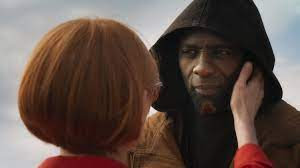
     Miller teams two fine actors in a tale about an academic (Tilda Swinton) and a Djinn (Idris Elba) who encounter one another after Swinton's Alithea Bonnie purchases a small bottle during a visit to Istanbul's Grand Bizarre.  
     Alithea returns to her hotel room, tries to clean up the bottle, and, lo, a genie emerges. The skeptical academic, who studies the role of narrative in mythic literature, is granted three wishes. She's reluctant to use them.
      While waiting for Alithea to make up her mind, the Djinn tells Althea stories, some of which Miller beautifully realizes while others falter. The imaginary Arabian backdrops often are more interesting than the stories that unfold in front of them. 
       A variety of characters emerge as the Djinn tells Alithea about his previous attempts to free himself from his bottle: If he grants three wishes, he'll be free. One tale involves a ravenous and infantile sultan who surrounds himself with portly women.
       Miller is a talented and important director who has veered off the Mad Max track before -- notably with Babe: Pig in the City (1998) and Lorenzo's Oil (1992). He previously tried his hand at fantasy with 1987's The Witches of Eastwick
      After his triumph with Mad Max: Fury Road (2015) and with another Road Warrior movie looming, it's easy to understand why Miller wanted a change of pace with a story that's meant to be savored rather energized by speed, the difference say between sipping a glass of wine and downing it with one mighty swig.  
     Put another way: I was rooting for Three Thousand Years of Longing but had difficulty sustaining interest as scenes between Swinton and Elba (shown in various sizes and often with smoke rising from his body) bogged down.
     At once majestic and knowing, Elba creates a memorable Djinn but Swinton's Alithea proves a bit dull, an academic who longs for love and companionship.
      Miller is too talented not to find some masterful moments but the movie suffers from a lack of drive, and when Alithea and the Djinn return to London, the screenplay expands to include a romantic dimension in which the fantastical and the mundane try to merge.
     Generous viewers may give Miller a pass. I'd have no quarrel with those who are so inclined but, for me, this story about the transcendent importance of stories seldom made it feel as the stakes were vital.
     Besides, the best way to celebrate stories is to tell a great one. Three Thousand Years of Longing falls short in that regard.

Thursday, August 18, 2022

'Beast'; Tension and not much else


Idris Elba provides Beast with a  major draw. But Elba's presence can't offset an improbably scripted thriller in which Elba's character and two daughters (Iyana Halley and Leah Jeffries) are threatened by a vengeful and highly motivated lion. A group of poacher's killed the beast's entire pride, turning the lion into a killer of humans. The movie begins to resemble a Cujo knockoff -- only set in a South African game park. Early on, Elba's Dr. Nate Samuels, guilty about not having seen early signs of his late wife's cancer, travels with his kids from the US to South Africa. He  hooks up with an old friend and wildlife protector (Sharlto Copley). Samuels hopes to strengthen his bond with his kids by visiting the country where his wife was raised. Icelandic director Baltasar Kormakur follows a predictable course, setting up scenes in which the lion (CGI) threatens to kill its human prey. A vague thematic connection arises: The lion failed to protect his charges and Dr. Samuels fears that he won't be able to keep his daughters alive. A couple of fuzzy dream sequences don't add much, but the movie whips up tension by adopting a horror movie tone. For  a time, the characters are confined inside a van as the lion stages one pounding assault after another. There's no faulting the cast but the screenplay isn't really fresh enough to create much cinematic roar. Oh well, Beast at least has the decency to confine itself to an economical 90-minute running time. 

Wednesday, November 3, 2021

A Western with contemporary kick


    The history of the Hollywood western has been a massively white affair, hardly a revelation to anyone who has spent more than a few years watching movies. Director Jeymes Samuel may have had that in mind while directing The Harder They Fall an almost entirely Black helping of genre tropes set in the Old West -- or Samuel's version of it.
   Samuel, who's British, has assembled a first-rate cast that includes Jonathan Majors, Idris Elba, Regina King, Zazie Beetz, Delroy Lindo, and LaKeith Stanfield.
  A revenge saga at heart, the movie wastes no time putting its brutal cards on the table. When he was only eight, Love watched Buck murder his mother and father. Buck then carved a small cross on Love's forehead.
   The movie takes place with the now-grown Love leading a gang of thieves who rob from other thieves. Nat also wants to avenge  the death of his parents. He's out for blood.
   Samuel embellishes the movie's genre ploys with rap music, jazz, and, most unusually, a modern dance interlude set in a saloon. Jay-Z and Kid Cudi's My Guns Go Bang turns up, not a tune you'd expect to find in a western -- and some of the more profane language obliterates the line between historical and contemporary talk.
    The melding of approaches is part of the point: The Harder They Fall is no throwback; it's intentionally styled to be of the moment; i.e., it’s fluent in the language of 21st Century cinema. 
    So, no, John Wayne couldn't ride into this movie and find a comfort zone.
   Although Majors's Love  is the main character, the movie has an ensemble feel and Samuel makes sure not to shortchange the female cast members. King portrays Trudy, a tough-talking, no-nonsense assistant to the soft-spoken but no less menacing Buck. 
   Beetz appears as Stagecoach Mary, an independent woman who provides Nat with a love interest -- but never plays second fiddle to him.
   Not only is the music anachronistic but so are some of the movie's gender variations. Danielle Deadwyler plays Cuffy, an outlaw of ambiguous gender identity. 
   The  story advances toward the all-Black town of Redwood City where Buck, newly sprung from prison by Trudy and cohorts, plans to establish his empire. The revenge-hungry Love has other plans.
   Samuel's over-reliance on looming close-ups can be annoying and the plot tends to trip over itself here and there. But the movie has a quality of the unexpected that fends off dullness and the actors all work at peak form, many operating in both comic and serious veins.
   The movie makes one brilliant satirical joke when Nat and his crew head to an all-white town to rob the local bank. The town  has been drained of color by a production team with a cutting sense of humor. 
   I don't know the history of the movie's characters who are based on real people, but it's clear that Samuel, who co-wrote the screenplay with Boaz Yakin, has taken great liberties in order to produce a no-holds-barred western that blazes across the screen, sometimes falling off its horse, but always creating a strong vibe -- presuming there was such thing as a "vibe" in the Old West.


Monday, August 9, 2021

'Suicide Squad' is better than you'd expect


     I'm late to The Suicide Squad party, which means that I already know the movie, after receiving generally good reviews, failed to overwhelm at the box office. The Hollywood Reporter wondered whether moviegoers stayed home because of the spread of the delta variant.
    But staying home didn't mean missing the movie because it's streaming on HBO Max, which is how I caught up with it.
    Director James Gunn (Guardians of the Galaxy) has created what looks like a nihilistic free-for-all built around a group of outcasts recruited by the head (Viola Davis) of a black ops outfit called Task Force X.
    The selected team is supposed to destroy a creature called Starfish, an alien that might vanquish the entire Earth and which has fallen into the hands of an evil dictator (Peter Capaldi) of the small island nation of Corto Maltese (fictional) off the coast of South America. 
   In addition to Margo Robbie’s Harley Quinn, there's John Cena's Peacemaker, Daniela Melchior's Ratcatcher 2, Idris Elba's Bloodsport, and Sylvester Stallone's Nanaue/King Shark. Stallone provides the voice for a shorts-wearing shark-like creature with arms and legs.
   If the site of legions of rats doesn't appeal, you might want to think twice about joining The Suicide Squad. Ratcatcher 2 turns out to be a perverse Pied Piper who can muster up armies of rats.
    And while we're on the subject of strange creatures, consider David Dastmalchian's Polka-Dot Man, a human covered with polka dots which he can removed be removed and hurled at a foe. Did I mention that Polka-Dot only strikes when he sees his mother’s face in an opponent.  
   My advice: Don't give this too much thought.
   I wasn't counting but Idris seems to get the most attention as a sharpshooter who joins group leader Colonel Rick Flag (Joel Kinnaman) in an adventure that begins strong, can't always sustain excitement but recovers for a finale that's cleverly mounted and funny in the way of such movies.
    I supposed it's fair to say that Gunn has provided a worthy redo (sort of) of the much-scorned 2016 Suicide Squad which was directed by David Ayer.
    Robbie seems to enjoy indulging Harley's crazy ways and the rest of the cast is up to snuff as a group that, unlike other superheroes, doesn't seem to stand for anything as lofty as truth, justice, and the American way. 
     They just wanna be part of the abundant action set pieces that Gunn serves up with abandon.
      Now, having said all that, a cautionary note:
      The Suicide Squad may be the cinematic equivalent of someone who proudly claims to care about nothing — but you know it’s a pose.
      Still, the movie's saving grace lies in its willingness to embrace the ridiculous and, in the process,  poke fun at the kind of movie it easily could have been; i.e., one that took itself more more seriously.
      One look at the starfish monster -- Starro by name -- tells you Gunn has made goofiness a virtue.


Thursday, April 1, 2021

A story about real urban cowboys


     These cowboys ride and tend horses. In the evening, they crack open a few beers, sit around campfires, and exchange stories. 
    Cliches, of course, but they assume new meaning when you realize that the cowboys in question maintain their lifestyle in the streets of North Philadelphia.
    In some respects, Concrete Cowboy can seem dismayingly familiar, mostly because the movie has been built around standard coming-of-age tropes. 
    The story: A frustrated mom sends her uncontrollable son (Caleb McLaughlin) to live with his tough-love father (Idris Elba) who happens to be an ex-con.
    Although director Ricky Staub's drama hardly can be considered groundbreaking, the movie derives freshness from its setting and from the inclusion of real-life members of Philadelphia's Fletcher Street stables.
    Elba, who also served as one of the movie's producers, creates a stoic but caring father, and McLaughlin embodies the confusion of a troubled kid with lots of anger.
     Once deposited with his father, McLaughlin's Cole takes up with a drug-dealing cousin (Jharrel Jerome), a character who sharpens the clash between street hustling and cowboy values.
     Much of the movie deals with Cole's indoctrination into horse culture, an initiation that includes mucking stalls and other dirty work. He also bonds with a difficult horse, becoming the only human the horse will tolerate.
     Before seeing Concrete Cowboy I knew nothing about these Philadelphia horse enthusiasts.  When the real cowboys are swapping stories or talking about the derivation of the word "cowboy," the movie most clearly shatters the formula that sometimes burdens it.*
*Concrete Cowboy is a Netflix film, viewable at www.netflix.com/ConcreteCowboy


Thursday, August 1, 2019

'Hobbs & Shaw': more preposterous action

Dwayne Johnson and Jason Statham star in an action spinoff that wears out its welcome.

Fast and Furious Presents: Hobbs & Shaw attempts to expand the reach of an amped-up series that began in 2001 with a Rob Cohen-directed movie about street racing. The original movie, modest by current standards, marked a surprising entry into that summer's big-screen sweepstakes, a refreshing blend of speed and grit.

The series, which long ago made the leap into franchise territory, now has spawned a slightly demented offspring, one that’s far enough afield from its cinematic parents that it feels obliged to proclaim its lineage. I’m cynical enough to view Hobbs & Shaw as a superfluous mutation, an attempt to squeeze more mileage out of a series that never seems to run out of road.

Fast & Furious Presents: Hobbs & Shaw teams Dwayne Johnson's genially muscular Hobbs with Jason Statham's sneering Shaw. The two characters have history, which is another way of saying they don't get along. Both, of course, have cropped up in previous Fast & Furious movies. This time, they’re the main event.

A largely irrelevant plot brings these bickering battlers together for a job that Hobbs immodestly refers to as "saving the world." In this case, saving the world involves preventing the spread of a bio-engineered virus that could wipe out most of humanity. The virus hardly matters because even the characters don't seem to take the plot all that seriously.

Idris Elba signs on as the movie's bad guy, which is how his character introduces himself. "I'm the bad guy," he says, cueing a laugh line by signaling the movie's wish to play a genre-mocking game -- some of the time, if it not entirely.

On the less jokey side of the ledger: An evil corporation has weaponized Elba's character, turning him into a human with robotic capabilities that approach super-heroism. He supposedly represents a new rung on the evolutionary ladder.

As it turns out, Shaw's character has a sister (Vanessa Kirby) who's also trying to save humanity, an occupation that's always in large demand in summer movies. In the movie's early scenes, Kirby's Hattie steals the virus by embedding the capsule that contains it in her palm.

The Fast and Furious franchise always has made room for bold women. Kirby's Hattie carries on the tradition; she's a genuine butt-kicker who needs little assistance from the affable Hobbs or the dyspeptic Shaw.

Remember the virus? We're told, it eventually will go ... well ... viral. The clock ticks away.

Director David Leitch and his team don't pay much attention to this or any other clock, allowing the movie to unfold over a distended two hours and 15 minutes.

Hobbs & Shaw works its way toward a finale on Samoa without making it seem as if anything vital is at stake, aside from the filmmakers' ability to engineer ridiculous chase sequences and other impossible feats. The action is outlandish but not all of it is thrilling.

If you're of a mind, you may want to view the movie's Samoan finale as a statement -- albeit one that's delivered with as much ham-fisted panache as the barbs traded by Hobbs & Shaw. Hobbs reunites with his estranged brother (Cliff Curtis). They use Samoan weapons to ward off high-tech baddies. Can simple humanity triumph?

The movie includes an appearance by Helen Mirren, as Shaw's imprisoned mother, superfluous aside from suggesting participation in future movies. There also are a couple of cameos from actors I won’t name lest I spoil the surprise.

Look, I have no need to believe anything that happens in this kind of entertainment, but I'd like, at a minimum, to feel a sense of sustained involvement. That's not easy when a movie’s action, though abundant, isn't necessarily about creating excitement but about impressing us with the filmmakers' ingenuity. A little of this sort of thing goes a long way, and Hobbs & Shaw offers more than a little -- way too much, in fact.

Sunday, December 24, 2017

Poker for big names and fat wallets

Aaron Sorkin makes his directorial debut with Molly's Game, a movie that features some winning hands from a somewhat limited subject.

When I was browsing the internet looking for information on the real Molly Bloom, I came across a review of Bloom's book, which serves as the basis for writer Aaron Sorkin's eagerly awaited directorial debut.

A website devoted to books about poker featured a headline that suggested that the book struggled to find both an audience and a point.

I'm not sure that Sorkin's adaptation of Bloom's book, Molly's Game, will have trouble finding an audience, but it does have a bit of difficulty finding a larger point. Bloom's journey took her from an Olympic caliber skier to a woman who made a ton of money running high-stakes poker games before running afoul of the law.

In real life, Bloom's LA-based game attracted players such as Ben Affleck and Tobey Maguire. She evidently operated legally until she began taking a cut of the biggest pots. Such "raking" is illegal and evidently changes friendly games (even when played for ridiculously large stakes) into crimes.

Don't get me wrong. Molly's Game can be entertaining, and it features an energized performance from Jessica Chastain as Bloom, a woman whose brother Jeremy Bloom became both an Olympian and an NFL player.

Molly Bloom was on a similar Olympic track until a freak accident derailed her career. At loose ends, she headed to LA where she eventually moved from a gofer at high-stakes card games to an impresario of such big-money affairs.

Perhaps taking a cue from Bloom's book, Sorkin has Molly narrate the movie, a dialogue-heavy plunge into her point of view that, at times, makes it feel as if Molly's reading us the movie.

As much as any writer, Sorkin has a way of making it seem as if he's in the know about whatever subject he tackles. He floods the screen with poker jargon and makes sure that every actor speaks with the kind of rapidity that marked the great screwball comedies of yesteryear. The result can be dizzying, skilled actors engaging in tricky verbal workouts.

Idris Elba adds weight as Molly's attorney. Watching Elba and Chastain bat words over the metaphorical net that separates their characters creates a pleasure all its own.

Bloom's story moves from Los Angeles to New York City, unfolding in episodic fashion, almost as if Sorkin drops little short stories into the larger mix. This approach highlights the work of a strong supporting cast.

Jeremy Strong portrays Molly's first LA boss, a character who makes no attempt to be anything less than obnoxious. Michael Cera does good work as an arrogant player with skills; Bill Camp does a terrific job as a skilled player who swan-dives into a terrible losing streak, and Chris O'Dowd impresses as a dim-witted drunk who works off a gambling debt by bringing some troubling folks into one of Molly's New York games, figures from the Russian mob.

Kevin Costner has one of the movie's best small roles. He plays Molly's authoritarian father, a philandering psychology professor who presides over a flock of high-achieving offspring.

Up to a point, Sorkin benefits from the lavish surroundings that Molly created for those who gambled at her table: drinks, fine food, fancy hotel rooms and beautiful women to wait on both winners and losers.

Earlier, I mentioned that the movie might have difficulty making a point. By the end, it seems as if Sorkin wants to hold Molly out as an example of female achievement. She used her wits to create a small empire and honorably refuses to supply the FBI with the names of those who sat at her table. Public exposure might have ruined lives and destroyed families.

Pretty noble for someone who knows she made a small fortune serving the gambling addictions and fantasies of men who were willing to throw money at her in the form of out-sized tips.

I was entertained by much of Molly's Game, which -- at 140 minutes in length -- probably runs 20 minutes longer than necessary: Sorkin turns cards over with enough flair and snap to keep his movie watchable, but, in its entirety, the movie doesn't make the case for why Bloom's story is more than a sketch in a bigger picture that remains unpainted.

Wednesday, October 4, 2017

Struggling to survive -- the movie, that is

Idris Elba and Kate Winslet are stranded in the mountains. In this case brrr is bad.

I've been searching what's left of my movie-saturated brain trying to find something (anything, really) positive to say about The Mountain Between Us, a survival adventure starring Kate Winslet and Idris Elba and directed by Hany Abu-Assad, the Dutch/Palestinian director who gave us two Oscar-nominated works, Paradise Now and Omar.

It's not an easy task, but I came up with two things, and I'll share them before I proceed to tell you that The Mountain Between Us qualifies as a major disappointment, a movie that shatters credibility before shifting gears and making an ill-advised turn from formulaic adventure to formulaic romance.

So about those positives: To begin with, it's a pleasure to see the gifted Elba in a lead role as an accomplished man, in this case, a neurosurgeon who's trying to get to reach a patient in need of his skills.

Another positive? Fair to say that Abu-Assad does a decent job with the plane crash that strands the movie's two principals near the film's beginning.

OK, I'm out of positives. Now for the negative side of the ledger:

Winslet plays Alex Martin, a photographer with war-time experience. When the movie opens, Alex is trying to reach Denver for her wedding, scheduled to take place the next day. She's frustrated when she learns that all flights have been canceled because of bad weather. She notices that another passenger -- Elba's Ben Bass -- faces the same problem and proposes that they join forces, hire a private plane and remain on schedule.

Having described the movie as a survivalist adventure, you already know that the plane goes down in the forbidding mountains of northern Utah. This, after the pilot (Beau Bridges) has a stroke while flying, never a good.

Alex, Ben and Walter's dog, an animal that Abu-Assan occasionally uses for inappropriately cute reaction shots, survive.

If you're going to get into this wilderness ordeal, you'll have to forgive some inconsistencies. At one point, Ben suddenly turns up with a nice pair of hiking boots. A small matter, but you can search for others on your own.

Initially, Ben and Alex argue about the best course of action. He's prone to logical thinking: She's more willing to follow her instincts. Should they stay with the plane or try to walk to safety, a difficult proposition because Alex's leg is broken and neither of them has a clue where they are or how far they might have to travel in to reach a point of survival?

Neither Winslet nor Elba need any selling when it comes to acting ability, but they're not well served by inane dialogue, an obviously stated moral (stronger together) and a late picture, eye-rolling conversion to romance that throws us into a whole other genre.

Adapting a novel by Charles Martin, screenwriters J. Mills Goodloe and Chris Weitz move through plot points like a hiker negotiating deep drifts without the benefit of snowshoes. As is the case with many movies, this one may have begun as someone's labor of love; it turned out to be ... well ... just laborious.

Thursday, August 3, 2017

Little illuminated in 'Dark Tower'

Inspired by eight Stephen King novels, this summer movie may do a quick fade.
One of America's most popular and prolific authors, Stephen King wrote eight novels in his Dark Tower series. Instead of picking one of them, director Nikolaj Arcel and his team, which included Arcel and three additional writers, decided to make a big-screen mash-up of King's opus, cherry picking what they must have seen as choice elements for a screenplay.

The resultant movie -- The Dark Tower -- can be taken as a pean to unabashed eclecticism, drawing on everything from spaghetti westerns to sci-fi ploys to Tolkien-like fantasy.
Early fears that the movie would veer toward incoherence can be set aside. The Dark Tower -- which alternates between a world called Mid-World and present day New York City -- can be followed, but before it's done a different question emerges: Followed to what end?

Neither bad enough to offer the guilty pleasures of pure trash or good enough to constitute enthralling summer fun, the movie -- which clocks in at a merciful 95 minutes -- features a cast that includes Idris Elba and Matthew McConaughey, each of whom plays a character representing a different moral polarity. Elba portrays The Gunslinger, a cowboy seeking revenge against the Man in Black (McConaughey).

This disreputable Man in Black, also known as Walter, killed The Gunslinger's father and has devoted himself to destroying the Dark Tower.

The tower, which looks like a giant stalagmite that has been painted black, can be found at the center of a circle that encompasses many universes. If the tower falls, demons will be unleashed. Horrors will ensue. The Man in Black will capitalize, reigning over the chaos.

To achieve his evil goal, the Man in Black appropriates the energy of specially gifted children to beam potent rays of destruction at the tower.

A Manhattan teenager named Jake (Tom Taylor) is the most powerful of these psychically gifted young people. The Man in Black wants to use Jake to destroy all the universes, which are connected by portals.

Nutty? To be sure, but most fantasies resist careful scrutiny, and -- in this case -- themes about sons who lose fathers barely resonate.

Add some creatures with skin that they wear (seams show) and a variety of other tricks that give birth to special effects that fall short of knockout levels, and you've got the idea.

Elba, a fine actor, looks great in a Clint Eastwood-style duster. Sporting an upwardly brushed hair style that might make Christopher Walken envious, McConaughey does his best to convey the eerie villainy of a character who refers to his various abilities in the plural, calling them "magics."

The Man in Black can work simply, as well, killing people by passing a hand over their faces and telling them to "stop breathing."

It seems cavalier to dismiss a movie inspired by eight novels with a short review, but I see no reason to belabor this one or to suggest that I returned from any of the movie's various universes with anything resembling great rewards. Despite lots of huffing and puffing on the part of the filmmakers, The Dark Tower seems far too easy to shrug off.


Thursday, July 21, 2016

A Star Trek that emphasizes speed

Director Justin Lin takes over the reins from J.J. Abrams and as Star Trek continues to explore the final frontier.

Toward the end of Star Trek Beyond, Captain James T. Kirk tells his principal adversary that change is a necessary component of life. It's difficult to say more without plunging into spoiler terrain, but it's worth pointing out that Kirk could have been directing his remark to the Star Trek faithful. Expect a few changes.

The biggest change in Star Trek Beyond involves the person at the helm. Justin Lin takes over from J.J. Abrams, who remains as a producer. It should surprise no one that Lin, best known for Fast & Furious movies, gravitates toward action. He loads (perhaps even overloads) Beyond with noise, flying debris, and over-edited battle sequences.

At the same time, Lin makes sure that the characters are well-served. Kirk (Chris Pine) begins the movie with a case of space fatigue. He's not sure he wants to continue as Captain of the Enterprise.

Spock (Zachary Quinto) also contemplates a life change. As a result, his relationship with Lieutenant Uhura (Zoe Saldana) has hit a snag.

The rest of the crew remains reliably familiar: Sulu (John Cho), Chekov (Anton Yelchin) and Scotty (Simon Pegg) all do their part.

You've probably read that this episode reveals that Sulu is gay with a husband and child, information Lin presents in an off-handed way that suggests we're in a version of the future in which sexual orientation has ceased being a talking point.

Lin wisely includes references to the original Mr. Spock, perhaps to acknowledge the actor who played him. Leonard Nimoy died last year.Star Trek Beyond, by the way, is dedicated to both Nimoy and Yelchin, who was killed in a freak auto accident earlier this year.

New additions also can be found. Besides the reptilian-looking Krall (Idris Elba) -- the villain of the piece -- we meet Jaylah (Sofia Boutella). She's an alien woman who joins the Star Trek team in its effort to prevent the destruction of Yorktown, a massive Federation space station that Lin explores with swooping, dizzying camera moves.

The screenplay by Pegg and Doug Jung seems based on something we might call "the speed principle." Move quickly and few will notice plot holes or fret about the fact that a rescue oriented story wears a bit thin.

But sci-fi precision never has never been Star Trek's strong suit. Ethical questions usually take precedence. Although such questions are raised, they now seem to peek out from behind the movie's many action set pieces.

Put another way, Beyond isn't the most contemplative version of Star Trek, although it has its compensations: A couple of moments involving old-fashioned rock music should bring a smile to most faces.

At a Wednesday night showing -- the movie began at 10 p.m. -- the crowd seemed especially to enjoy the interchanges between Spock and Bones (a scene-stealing Karl Urban). Such scenes wisely reiterate or poke fun at the recognizable traits that define Star Trek characters: Spock's deadpan commitment to logic or Bones' sniping humor, for example.

So back to the beginning. This edition attempts to reprise what's familiar about the series while also giving it new energy. Change, but not so much that we forget that we're watching a Star Trek movie.

I'm not a fanboy, so I don't know how Star Trek stalwarts will receive this new edition. In my estimation, Beyond whizzes by without damaging the franchise, while also providing a couple of inspired bits and firing retro rockets of nostalgia in ways that feel like true expressions of affection.

Lin even finds a way to work a motorcycle into the story, but don't fret Star Trek purists: Lin hasn't propelled Fast & Furious's Vin Diesel into the final frontier. Some things remain sacred.


Thursday, April 14, 2016

Disney scores with another 'Jungle Book'

CGI animals and a strong voice cast help director Jon Favreau sell a familiar tale.

Adaptations of Rudyard Kipling's The Jungle Book don't exactly make for fresh news. So when I first saw the title on a list of 2016 releases, I found it difficult to get excited about another jungle journey, even one equipped with a CGI menagerie.

As it turns out, Disney's Jungle Book, directed by Jon Favreau, is bright (even in 3D), appealing and in at least one inspired sequence, engagingly loopy.

The story focuses on Mowgli (Neel Sethi), a boy who was raised by wolves and suddenly finds himself targeted by a tiger named Shere Kahn (voiced by Idris Elba).

The story is narrated by Bagheera (Ben Kingsley), the sagacious panther who first brought young Mowgli to Raksha (Lupita Nyong'o), the wolf who becomes his surrogate mother and who tries to instill him with the lore of the pack.

Elba gives voice to a convincing villain, a somewhat battered tiger who's motivated by a desire to keep fire out of the jungle. Shere Khan thinks it's not enough to exile Mowgli from the jungle by returning him to his human tribe. He wants to kill the boy.

In the early going, I half wondered whether Mowgli's flight through the jungle hadn't given Disney an excuse to produce a kiddie version of The Revenant, another wilderness survival epic. But Favreau balances the movie's convincingly dangerous situations with enough comic moments to keep fright in check.

To insure the success of its effort, Disney has surrounded first-timer Sethi with a strong voice cast. In addition to Kinglsey and Elba, you'll recognize Bill Murray as the voice of the conniving but good-spirited Baloo, a bear with a honey jones.

The movie even breaks into song with a Murray-voiced rendition of The Bare Necessities, which was used in Disney's 1967 animated version of The Jungle Book. The song seems awkwardly inserted because this version of Jungle Book isn't really a musical, but once you get past its slightly jarring arrival, the song is sort of fun.

Even though we never see him, Christopher Walken does scene-stealing work as the voice of King Louie, a giant orangutan with evil on his mind.

Louie wants Mowglie -- referred to by the animals as a "man cub" -- to return to his own kind, capture fire and deliver it to the power-hungry king who lives in an impressively created temple that has been overrun by all manner of monkeys.

Walken, too, is given a musical number, I Wanna Be Like You.

Animal purists may find this entirely anthropomorphic endeavor to be a little prone to cuteness. Despite Favreau's amazingly skillful use of CGI, the movie's spirit often follows a cartoon template with creatures (wolf cubs, for example) that are petting-zoo cuddly.

Although the movie expresses deep reverence for elephants -- all creatures bow before them -- it also makes sure to find a way to put a baby elephant into danger, an incident that provides the movie with an opportunity to showcase the human ingenuity that Mowgli possesses.

But there are also strangely alluring creatures that aren't quite as kid friendly: Ka, a giant snake voiced by Scarlett Johansson, tries to tempt Mowgli with her hypnotically seductive voice.

Favreau paces the movie at a speed that tends to help push criticism aside. Panthers with British accents? Why is it that some of the animals talk and some don't? And, most importantly, concerns about whether some of the realistically presented animal fights are too vivid for the youngest viewers to handle. The movie has been rated PG.

Overall, though, The Jungle Book proves entertaining and likable without delivering too heavy-handed a message about the way humans, the masters of fire, tend to destroy jungle habitats.

Stay put for the end credits, which are entertaining in their own right.

Thursday, March 3, 2016

There's lots of fun in 'Zootopia'

Sometimes fun is the best ambition.

I have no idea whether Zootopia -- the latest animated fantasy from Disney -- will become a classic, but I do know that it scores high on the fun meter.

So three cheers for a story about Judy Hopps (voice by Ginnifer Goodwin), a bunny who aspires to become a cop in the city of Zootopia. Police work has been Judy's ambition since she was a child.

Primed for action and a do-gooder's career, Judy wants to leave the countryside and her family of underachieving carrot farmers.

When Judy arrives in the city, she becomes the first bunny on the Zootopia PD. An unimpressed chief Bogo (Idris Elba), arbitrarily decides that Judy's fit only for parking duty. He doesn't believe a bunny can hold her own on Zootopia's mean streets, hardly a surprising opinion from a water buffalo.

Zootopia is unique because the animals all get along. That's why it's called Zootopia. Predators and prey may not be the best of friends, but the former have learned to refrain from devouring the latter.

While handing out parking tickets, Judy meets Nick Wilde (Jason Bateman), a conniving con artist of a fox who eventually teams with Judy to help crack a case involving the disappearance of 15 mammals.

If Judy can solve the mystery, she'll get herself off parking duty, maintain a position on the force and climb out of Chief Bogo's (you'll pardon the expression) dog house.

Judy and Nick make an odd couple as they learn some shocking news: Some predators suddenly are turning on prey, thereby threatening Zootopia's peaceable social structure.

Disney loads up on animals and voices, but I particularly enjoyed an arctic shrew mobster who'll remind adults in the audience of Don Corleone. Mr. Big, as he's called, is brought to gravelly voiced life by Maurice LaMarche.
Appropriately, I suppose, the Zootopia's DMV is staffed by sloths, a joke that surely will appeal to every adult who's ever endured what seems like an interminable wait at any department of motor vehicles.

The story evolves into a light-hearted police procedural that winds up preaching a lesson about acceptance and free will -- if that's not too grandiose a term for the fact that the animal characters are forced to decide whether to be ruled by instinct or choice.

Directors Byron Howard, Rich Moore and Jared Bush do a fine job of keeping Zootopia amusing for kids and equally enjoyable for the adults who accompany them to theaters.

Disney's animators seem to have had a grand time creating Zootopia -- which consists of districts such as Tundratown, Little Rodentia and Bunnyburrow.

OK, that's a bit theme-parkish, but dividing Zootopia into distinct environments must have kept the animators from getting bored. It also gives Judy and Nick an opportunity to venture into Zootopia's bad neighborhoods.

At various times Judy must prove to herself and the world that she's no dumb bunny; the same goes for this frolic of a movie. The highest compliment I can pay Zootopia? It's no dumb bunny, either.

Thursday, October 15, 2015

The horrific life of a kiddie killer

Beasts of No Nation makes for harrowing viewing.

Watching director Cary Joji Fukunaga's Beasts of No Nation, I was reminded of the axiom that cautions us to be careful about what we wish for. Sure, many of us want (or say we want) movies that don't short-change real-life horrors.

But when such movies arrive, they aren't always pleasant to watch.

Starring Idris Elba and newcomer Abraham Attah and based on a novel by Uzodinma Iweala, Beasts of No Nation takes place during a civil war in a fictional West African nation. The story centers on the transformation of young Attah's character from a cheerfully mischievous boy into a brutal child warrior.

Attar's Agu is enjoying a happy childhood with his family when an invading government army throws his village into chaos. In the resultant panic, Agu's mother and baby sister are sent to the capital. Agu's father and older brother are brutally murdered.

Left alone, Agu flees marauding soldiers as he tries to make his way through the bush.

Tired and hungry, Agu eventually is captured by rebel forces led by a character known only as Commandant (a scary and convincing Elba). Wide-eyed and frightened, Agu learns the ways of the rebel forces and becomes a kiddie killer.

Boys, Commandant insists, aren't useless. Why? They can pull triggers.

Agu joins with boys who've gone through similar experiences and who now are subject to brutalization and molestation within the "family'' of warriors that Commandant has created.

Agu's experiences are nothing short of horrific, and the scene in which he makes his first kill hardly could be more harrowing. Ordered by Commandant to commit murder, Agu buries the blade of a machete in a cowering man's skull. He now belongs to the gang.

Commandant certainly is capable of monstrous behavior, but he's given a human dimension by Elba. It seems entirely plausible that a character as charismatic as Commandant could hold sway over his charges through a mixture of inspiration, fear and intimidation.

To the film's credit, we also learn that Commandant may be subject to betrayals by the political puppet masters who use his brutality but who may inevitably disown it -- and him.

The film benefits from an intermittent narration provided by Agu, who is well portrayed by Attah -- a 14-year-old non-professional from Ghana. Attah embodies Agu's increasing numbness to the violence that surrounds him and which he perpetuates.

Yet, Attah never loses touch with Agu's vulnerability. You can't look at him without realizing he's still a boy, and that makes Agu's violence all the more heartbreaking.

Fukunaga (Sin Nombre and episodes of the first season of HBO's True Detective) doesn't have to raise the emotional wattage for us to realize that we're watching a story of tragic proportions.

But as I said at the outset: We need movies such as this, but that doesn't mean they go down easily. They are (and should be) disturbing as hell.

Tuesday, December 24, 2013

Elba towers as Nelson Mandela

British actor gives Mandela: Long Walk to Freedom a solid core, but movie mostly touches highlights from a significant life.
British actor Idris Elba doesn't really look like Nelson Mandela -- at least not the Mandela we knew from his years as president of South Africa and his reign as a kind of national and even global elder. But the actor's mastery of Mandela's voice and mannerisms give Mandela: Long Walk to Freedom a solid center.

It's difficult to say whether the 24/7 news-cycle immersion that accompanied Mandela's recent death will boost interest in this generally successful bio-pic or detract from it. We've certainly had plenty of biographical information about Mandela in the last month, and those who have read past the headlines know that not everything about the much-admired leader was universally praised.

As directed by Justin Chadwick -- working from William Nicholson's adaptation of Mandela's massive autobiography -- Mandela: Long Walk to Freedom is a mostly laudatory big-screen biography that only occasionally crosses the line into hagiography.

The sprawling, stylistically agitated movie traces Mandela's development from a radical young lawyer in Johannesburg to his 27 year imprisonment on Robben Island and, finally, to his emergence as a symbol of South African reconciliation.

The rest is pretty much secondary:

Naomie Harris portrays Mandela's second wife, Winnie Mandela, in a performance that matches Elba's, but the screenplay only sketchily outlines the rift between Winnie and her husband: Mrs. Mandela favored violent retribution against those deemed "collaborators" with the government that perpetuated apartheid.

Early parts of this two-hour and 21-minute movie suffer from the hasty way in which Chadwick bounces through events that attempt to humanize Mandela by making brief references to early womanizing. We also learn a little about Mandela's first wife (Evelyn Mase).

At times, it almost feels as if Mandela was rushed to completion, but it's more likely that the filmmakers were hard pressed to find a workable structure for such a towering life.

If you're looking for more than a guide to Mandela and to the struggle against apartheid, you'll have to supplement your viewing with some reading. Even with a two-hour plus running time, it's impossible to do more than skim Mandela's significant and much revered life.

This puts a tremendous burden on Elba, who -- thankfully -- proves himself more than equal to a task that had be as daunting as it was difficult.

Thursday, July 11, 2013

More monsters from the deep

Giant robots, ugly sea monsters and a robust comic-book spirit stave off disaster for Pacific Rim.
In what has been a largely disappointing summer -- at least in the blockbuster department -- director Guillermo del Toro's Pacific Rim comes as a refreshing surprise -- at least for a while. Taking his cue from classic Japanese horror movies such as Godzilla, del Toro imagines a time when hideous sea monsters called Kaiju are terrorizing the planet.

For reasons that aren't entirely clear, humanity has decided to battle these monstrous creatures with giant robots called Jaegers (German for hunters). It's also not clear why these 25-story tall behemoths need to be operated by two humans who work inside the machines and who must coordinate their movements through a symbiotic mind melding technique called "drifting." Wouldn't batteries have been just as good? Hasn't anyone heard of remotes?

If you haven't gotten the idea by now, let me make it clearer: Pacific Rim isn't about real-world logic; it's about putting a big-money charge into monster-movie tropes that once were considered indispensable components of second-tier entertainments.

Del Toro's movie is also about actors delivering uninspired dialogue with a straight face, about the wanton proliferation of special effects (some very good) and about a fair amount of well-conceived dystopian set design.

Put another way: The impressively scaled world del Toro creates is probably more interesting than what takes place in it: At its best, Pacific Rim brims with the kind of comic-book monumentalism that the lingering adolescent in me still finds impressive, epic-proportioned battles staged in a virtually created vastness.

I don't think del Toro, who has directed Hollywood movies such as Hellboy and more idiosyncratic fare such as Pan's Labyrinth, would object to anyone saying that he has tried to play with every toy he can find in hopes of creating a movie that will boom and bash its way through a couple of hours of clangorous action, semi-interesting exposition and unadulterated genre kicks.

I saw Pacific Rim in IMAX and 3-D, and the experience was overwhelming, particularly in the noise department. There's enough metal-on-metal clanging to stock a couple of Transformer movies. Moreover, some of the action seemed repetitive, particularly as seen in cinematographer Guillermo Navarro's darkly hued images.

You won't find much by way of stand-out acting here, but Pacific Rim is the kind of movie that can get by on performances that are servicable. British actor Charlie Hunnam portrays Raleigh Beckett, an ace figther who -- along with his brother (Diego Klattenhoff) -- has earned a reputation as a premier Kaiju killer.

But when Raleigh's brother dies (in the movie's gripping prologue), a dispirited Raleigh quits fighting and takes a job building walls to keep out the sea monsters. You needn't have seen a ton of movies to know that the commander of the Jaeger force (Idris Elba) will summon Raleigh back for one last battle against the rapidly proliferating Kaiju.

This task acquires increased urgency because the Kaiju invasion is about to intensify and because the Jaeger force, which thus far hasn't succeeded, is about to be disbanded.

When Raleigh rejoins the Jaeger fighters in Hong Kong, it's clear that he's going to need a new partner with whom he can "drift." Enter Mako Mori (Rinko Kikuchi of Babel), a serious fighter who wants to battle monsters. Elba's character doesn't want Mako to fight for reasons that are revealed during a preparatory drifting exericse.

The screenplay by Travis Beacham raises and drops issues at speeds that rival the movie's action set pieces. It's not the most elegantly conceived piece of work, although it makes room for a few complications about the Kaiju and for a couple of dueling scientists (Charlie Day and Burn Gorman) who provide comic relief.

There's also a cameo from Hellboy stalwart Ron Perlman, who plays a character with the strangely evocative name of Hannibal Chau, a Hong Kong criminal who lives in a Blade Runner-like portion of the city, where he sells the body parts of slain Kaijus.

I wish I could say that the movie -- entertaining for roughly three quarters of its length -- hadn't worn out for me, but the combination of noise and action eventually took its toll on both my ear drums and nervous system.

That's not to say that Pacific Rim isn't fully loaded for summer. Del Toro knows how to make a comic book movie, and -- even when the material lets him down -- he does his best to keep the movie's dark world spinning as furiously as possible.