Viggo Mortensen directs and co-stars with Vicky Krieps in The Dead Don't Hurt, a Western that looks as if it's trying to follow in the footsteps of genre-busting exercises such as Marlon Brando's One-Eyed Jacks. Defined more by silence than dialogue, the acting in The Dead Don't Hurt, a bit like the movie itself, can border on self-consciousness. Approached with a hyper-awareness of period detail, the movie works its way through two hours and nine minutes, employing a structure that involves abruptly inserted flashbacks. The basic story: A Danish immigrant, played by Mortensen, and a French Canadian woman of independent spirit, portrayed by Krieps, meet in San Francisco and migrate to a frontier outpost in Nevada where Mortensen's Olsen owns a dilapidated cabin. Krieps's Vivienne tidies up, adding warmth to the bleak surroundings, but Vivienne resists domestication -- not that Olsen tries to force it on her. Immigrant soulmates, Olsen and Vivienne try to define new lives in the West. When Olsen joins the Union Army to fight against slavery, Vivienne -- now alone -- has a predictably violent encounter with Weston (Solly McLoud), the town's bully and part owner of the bar where Vivienne has landed a job. To further complicate matters, Weston's dad (Garret Dillahunt) is in the midst of a shady deal with the town's mayor (Danny Huston). Mortensen strains to defeat Western romanticism as The Dead Don't Hurt builds to the inevitable confrontation between Olsen and Weston. Mortensen only partially succeeds at subverting the genre's macho cliches by tossing a strong woman into a male-dominated pressure cooker. Delivering some of her lines in French, Krieps gives the movie's best performance, but The Dead Don't Hurt seems to be aiming for more than it delivers.
Rocky Mountain Movies & Denver Movie Review
FOR MOVIE LOVERS WHO AREN'T EASILY SWEPT AWAY
Thursday, June 6, 2024
Viggo Mortensen directs a Western
Viggo Mortensen directs and co-stars with Vicky Krieps in The Dead Don't Hurt, a Western that looks as if it's trying to follow in the footsteps of genre-busting exercises such as Marlon Brando's One-Eyed Jacks. Defined more by silence than dialogue, the acting in The Dead Don't Hurt, a bit like the movie itself, can border on self-consciousness. Approached with a hyper-awareness of period detail, the movie works its way through two hours and nine minutes, employing a structure that involves abruptly inserted flashbacks. The basic story: A Danish immigrant, played by Mortensen, and a French Canadian woman of independent spirit, portrayed by Krieps, meet in San Francisco and migrate to a frontier outpost in Nevada where Mortensen's Olsen owns a dilapidated cabin. Krieps's Vivienne tidies up, adding warmth to the bleak surroundings, but Vivienne resists domestication -- not that Olsen tries to force it on her. Immigrant soulmates, Olsen and Vivienne try to define new lives in the West. When Olsen joins the Union Army to fight against slavery, Vivienne -- now alone -- has a predictably violent encounter with Weston (Solly McLoud), the town's bully and part owner of the bar where Vivienne has landed a job. To further complicate matters, Weston's dad (Garret Dillahunt) is in the midst of a shady deal with the town's mayor (Danny Huston). Mortensen strains to defeat Western romanticism as The Dead Don't Hurt builds to the inevitable confrontation between Olsen and Weston. Mortensen only partially succeeds at subverting the genre's macho cliches by tossing a strong woman into a male-dominated pressure cooker. Delivering some of her lines in French, Krieps gives the movie's best performance, but The Dead Don't Hurt seems to be aiming for more than it delivers.
Wednesday, July 27, 2022
'Thirteen Lives' tells an amazing story
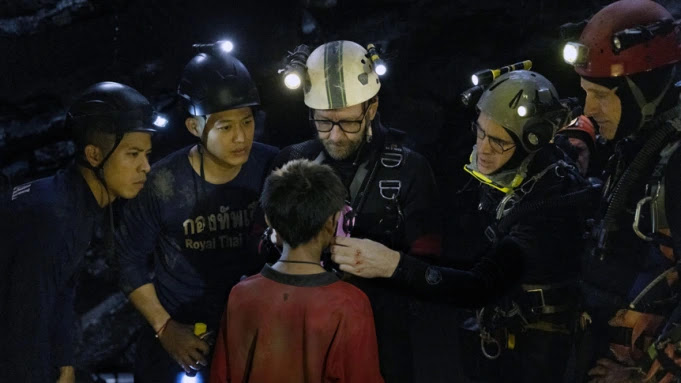
Ron Howard's Thirteen Lives can be regarded as a procedural; i.e., a straightforward account of a story in which 12 boys and their soccer coach were stranded in a flooded cave in Thailand.
Thursday, February 4, 2021
Viggo Mortensen makes his directorial debut
Falling, a serious, often disturbing film about a father/son relationship, marks the directorial debut of actor Viggo Mortensen.
Tuesday, November 20, 2018
An odd couple takes to the road
The temptation with movies such Green Book is to make too much of them. A movie about an unlikely friendship that develops between a cultured black man and an unenlightened white man too easily can be taken as a prescription for racial harmony. Better to view Green Book as an anecdotal tale which — no matter how amusing — doesn’t speak to complex racial issues that remain frustratingly unresolved in 2018.
Now that that’s off my chest, let me tell you about a crowd-pleasing odd-couple comedy directed by Peter Farrelly, who usually works with his brother Bobby on movies such as Shallow Hal, There's Something About Mary, and Dumb and Dumber To. Green Book stars Viggo Mortensen and Mahershala Ali in a story about a trip through the American South taken by Ali’s Dr. Don Shirley, an accomplished pianist, and Mortensen's Tony Vallelunga, a Bronx-based Italian-American with racial attitudes rooted in the 1950s.
The title derives from the book that black travelers used to learn locations of black-owned hotels, motels, and restaurants in the segregated world of Jim Crow or in other racially inhospitable parts of the country; i.e., most of the rest of the US. Oddly, the book gets short shrift as the movie unfolds.
As Vallelunga (a.k.a. Tony Lip) Mortensen gives his broadest performance yet, channeling his inner Joe Pesci to play a crude — albeit ultimately good-hearted — guy who loses his job as a bouncer at Manhattan's Copacabana nightclub and lands a gig driving for Shirley. The year: 1962.
The two men are polar opposites, which in movie language guarantees that they’ll eventually become friends.
Dr. Shirley is a decorous artist who, when he first meets Tony, appears in a flowing regal robe. Educated and cultured, Dr. Shirley initially is wary about Nick, but he knows that he needs a tough guy to guide him on his musical tour through a potentially hostile South.
Once Tony and Dr. Shirley hit the road, the movie becomes a two-hander in which an incredulous Nick reveals his stereotypical ideas about black people. What? A black man who's too fastidious to eat fried chicken or listen to R&B? Can Shirley be genuinely black if he doesn’t know the music of Aretha Franklin?
These bits typify the kind of odd-couple humor that Farrelly builds into the proceedings, playing them against Nick’s dawning realization that the Jim Crow South wasn’t a great place for a black man — much less a black man the movie shows as having gay inclinations.
Mortensen looks to have packed on the poundage for the role. A man of ravenous appetite, Nick eats -- while smoking, while driving, while anything. I half expected him to try to eat the '62 Cadillac in which this bickering pair travels. For Nick, a slice of pizza consists of an entire pie folded in half and jammed into his mouth.
Ali, who impressed as a drug-dealing father figure in Moonlight, creates a portrait of a lonely man whose talent and cultivation can’t insulate him from racism. At a recital at a country club, Shirley is fawned over as a performer but isn't permitted to eat in the dining room lest the club’s white members should be put off their feed.
The two main characters are meant to learn from each other: Tony tries to introduce Dr. Shirley to what he sees as the “real” world. Dr. Shirley gives Tony a few lessons in aesthetics and sensitivity, dictating the love letters Nick writes to his wife, nicely played by Linda Cardellini.
Based on a true story, Green Book was adapted from a book written by Vallelgona's son, Nick, and you're bound to hear the movie's many enthusiasts speak of it in glowing terms. Sure it’s encouraging to watch two men fight through their preconceptions about each other, and Farrelly's no slouch when it comes to comedy. But Green Book struck me as a movie more anxious to warm hearts than risk getting under anyone's skin.
Thursday, July 14, 2016
'Captain Fantastic' and the 'Wilderpeople'
In a way, Captain Fantastic is something of a throwback, a movie that hinges on a slightly dated conflict between a father's fierce countercultural commitments and widely recognized mainstream proprieties.
Forget the title, Captain Fantastic has nothing to do with comic book heroism; it's the story of an intelligent survivalist (Viggo Mortensen) and his six children. Mortensen's Ben believes that, as a parent, he's obligated to remove his children from the corrupting influences of a society driven mad by soul-destroying capitalism.
Ben is so committed to his views that he has substituted the celebration of Noam Chomsky's birthday for Christmas. Yes, it's OK to laugh, but Ben believes in the moral necessity of his choices.
The always intelligent Mortensen, adept at suggesting more than scripts often contain, imbues Ben with edgy smarts and stern conviction. He can be loving and a bit scary.
The movie opens with a bloody coming-of-age ritual involving a hunt, but it quickly becomes clear that Ben isn't neglecting the intellectual side of his kids' growth: They're home-schooled in literature, science and philosophy, and are encouraged to defend any position they take.
Ben also subjects his brood to physical challenges that he calls "training." These exercises can include dangerous rock climbing expeditions and exhausting uphill runs.
It shouldn't be surprising that Ben's kids have unconventional names: Bodevan (George MacKay) is the oldest, a teen-ager who's beginning to wonder if he's missing something. Encouraged by his mother, Bodevan secretly has applied to some of the nation's most elite colleges.
As for the rest of the brood, I could tell you the kids who play the family, but instead I'll give you a few of the character names: Nai, Zaja, Vestry, Kielyr and Relian, a countercultural roll call if ever there were one.
Simply hanging around the forest with a bunch of kids might not be particularly interesting. Something major must happen, and it does. Mom, who's off being treated for severe depression, commits suicide.
Mom's parents (Frank Langella and Ann Dowd) blame Ben for ruining their daughter's life. They ban him from the funeral, the Christian burial Langella's Jack insists on. Mom, we learn, wanted to be cremated.
Urged on by his kids, Ben loads everyone into the rundown bus the family uses for transportation and attends the funeral.
En route, the family stops at the home of an aunt and uncle (Kathryn Hahn and Steve Zahn) who are understandably concerned about the way in which Ben raises his children.
Credit writer/director Matt Ross with setting up some amusing situations, most notably one in which Bodevan meets a girl at a campsite and decides that his first kiss provides sufficient reason to propose marriage.
The point, of course, is that these kids have little idea about how to operate in socially oriented situations.
Not all of Ben's judgments seem particularly smart. During a celebration of Noam Chomsky Day, Ben gives his six-year-old daughter a copy of The Joy of Sex. Why burden the kid with unnecessary inhibitions?
While traveling, Dad and the kids stage an operation in which they steal food from a supermarket. Ben has taught them that they're entitled to free food from a system that's designed to exploit them.
Not surprisingly, the family runs into a conflict with Langella's Jack, who wants to take custody of the kids. Jack believes that some of Ben's child-rearing methods are abusive. If you think about it, he has a point, but the movie doesn't take that point seriously enough.
Captain Fantastic remains watchable because of Mortensen, who convinced me that Ben was an ideologue, a tyrant with his kids (for their own good, of course) but also a loving father who eventually must decide whether he has the right to make some of the choices he's forced on his children.
To the extent that the movie leaves you to ponder what's really best for Ben's kids, it's a worthwhile and somewhat offbeat addition of this year's movie run.
But it's also true that the most interesting character in the movie only appears on screen in Ben's daydreams. Mom evidently developed strong reservations about the family's search for self-sufficiency. Perhaps because of his stubborn commitment to what he viewed as his high ideals, Dad couldn't hear her.
To me, the most convincing thing about Captain Fantastic was Mom's depression, which may not be what Ross most wanted anyone to take away from his movie.
A BETTER MOVIE ABOUT A KID IN THE WOODS
Thursday, October 9, 2014
Another adaptation of a Highsmith novel
Thursday, December 29, 2011
A surprisingly safe "Dangerous" movie
In David Cronenberg’s A Dangerous Method – an adaptation of a Christopher Hampton play called The Talking Cure – Michael Fassbender plays Carl Jung, Viggo Mortensen portrays Sigmund Freud and Keira Knightley takes on the role of Sabina Spielrein.
Jung and Freud presumably need no introduction; Spielrein on the other hand, may not be familiar to most audiences. She was a patient of Jung’s who went on to become an analyst of some repute and who also was one of Jung’s mistresses – at least according to Cronenberg’s talky period piece.
Try as I might, I seldom got past the sense that all three actors were playing characters rather than deeply inhabiting them, an impression that’s reinforced by the fact that Jung, Freud and Spielrein eventually become advocates for different – if overlapping – views of human behavior.
The screenplay, which was written by Hampton and based on a book by John Kerr, revolves around an interesting conflict, although the movie tends to make its clash of ideas seem less than urgent. I’ll risk a bit of reductionism to put it this way: Freud insisted that sex was at the core of human behavior. Jung believed there was more to humanity than sex; he affirmed what he saw as humanity’s inherently religious impulses.
A Dangerous Method might be the least Cronenberg-like of recent Cronenberg movies, a stylistically straightforward piece that sprinkles conversations (some vaguely interesting) over a variety of Swiss and Austrian locations, many shot by cinematographer Peter Suschitzky with tasteful rigor.
The movie’s sense of caution comes as a bit of a surprise because sex (and its importance) lies at the heart of the drama, as well as at the core of a growing conflict between Jung and Freud, who – for a time – thought Jung would inherit his mantle as head of the psychoanalytic movement.
Cronenberg fans needn't totally dismay; the movie is not without a bit of kinky behavior. As it turns out, Knightley’s Spielrein achieves her greatest sexual kicks by being spanked, a pleasure Jung obligingly provides, although he seems determined to show that he’s not having a good time doing it.
Jung seems to be torn between a conformist commitment to his marriage (perhaps made easier by the fact that his wife was wealthy) and the unleashing of his more libidinous drives.
Although I had difficulty totally buying either Fassbender or Mortensen, neither has the annoying impact of Knightley, who enters the picture screaming as she’s being carried into Jung’s hospital in Zurich. In portraying Spielrein’s hysteria, Knightley juts out her jaw and contorts her facial muscles as if her body is being jolted by high-voltage shocks.
I don’t know if this is a “realistic’’ portrayal of severe hysteria, but I do know that in movie acting suggestion sometimes can be more powerful than demonstrative assertion. Put another way, Knightley’s performance may drive you a little crazy.
The story is not without political overlay: An increasingly concerned Freud fears that Jung’s interest in such matters as mysticism will undermine the scientific aura that's essential to the acceptance and growth of psychoanalysis.
These arguments too often make it seem as if the movie exists to articulate various points of view rather than to deeply probe the nature of its characters. At one point, though, Vincent Cassel shows up as Otto Gross, a brilliant psychoanalyst who believes all repression represents an unhealthy limitation of freedom. Cassel's welcome presence pushes the movie away from the neatly intellectualized debate between Freud and Jung.
Of the movie’s trio of principals, Mortensen probably provides the most interesting interpretation. His Freud has a deep and cagey sense of self-assurance – at least as it applies to the psychoanalytic domain over which he presides. A Dangerous Method, however, really has more to do with Jung than with Freud, who is absent from long stretches of the movie.
Maybe that’s why Mortensen’s performance wasn‘t enough to make me buy into A Dangerous Method, a movie that seems to unfold on a distant planet where talk about sex and dreams tends to become absurdly dispassionate. In the introduction to his book, Kerr talks about the ways in which Freud and Jung became the first thinkers to live with “that peculiarly intense burden of self-reflection that distinguishes the psychology of modern man.”
Maybe, but intense self-reflection isn’t necessarily the best place to begin a drama, and neither Cronenberg nor Hampton has been able entirely to liberate the material from the confines of the stage – other than by ensuring that the film’s conversations take place against a variety of elegant European backdrops.
In a time when the talking cure seems to have been supplanted by the dispensation of pills, the issues in A Dangerous Method don’t readily spring to life. They seem to swirl inside the embryonic and insular world of psychoanalysis, which – at least in this outing – provides no satisfying dramatic conclusion.