Thursday, September 1, 2022

Two short takes before a long weekend

 Honk for Jesus: Save Your Soul


Writer/director Adamma Ebo tackles the hypocrisies of a Black megachurch in Honk for Jesus. Save Your Soul, a muddled satire that seems unsure how hard it wants to hit. I have no idea what Ebo believes when it comes to religion but her movie can confound as it tries to blend comic and serious elements. Decked out in some of the year's most flamboyant costumes, a commanding Regina Hall plays the First Lady of the Atlanta megachurch where her husband (Sterling K. Brown) presides. Early on, we learn that Brown's pastor Lee-Curtis Childs has disgraced himself. He's busy warding off suits by former male congregants who have claimed sexual abuse. Hall's Trinitie Childs stands by her man, even though she knows he has foundered on the rocks of what the church regards as a forbidden temptation. Hall holds the movie together as Brown conveys the fallen pastor's attempts to regain his pulpit privileges, which include an immaculately groomed mansion, a sleek Bugatti, and celebrity status. A rival couple (Nicole Beharie and Conphidance) prepares to lure the Childs's disillusioned flock to a new venue. Hall and Beharie give the movie its backbone, even though its broadly comic gestures and moments of high drama can't compensate for an already depleted mock-doc approach. The movie, which includes Trinitie's donning of white face for a weirdly misguided roadside promotional effort, can't resolve what feels like uncertainty about how sharp a satiric knife to wield.

The Good Boss 


Javier Bardem's Julio Blanco runs a company that manufactures scales. Julio claims to care about his employees, insisting that they've become members of an extended family. That’s true if you happen to be part of a family that gives you a trinket and a hug as it pushes out the door. Alternately smarmy and exasperated, Julio deals with a cascading series of problems on the eve of a visit from a team of judges who will decide whether the company receives a coveted award for its achievements. Julio wants to win, but layoffs -- notably of a protesting former employee (Oscar de la Fuente), marital problems of an important manager (Manolo Solo), and Julio's dalliance with a slyly seductive intern (Almudena Amor) --  push him toward extremes. Otherwise, director Fernando Leon de Aranoa, who also wrote the screenplay, sketches in upbeat strokes that allow Bardem to build a wry performance around Julio's well-practiced duplicity. Thanks to Bardem and a fine complementary cast, The Good Boss amuses, even though it takes a darkly jolting turn as the 10-day period before the factory's inspection draws to a close. I wouldn't take The Good Boss as a definitive critique of capitalist hypocrisy. Still, as an enjoyable comedy and a showcase for Bardem, it can be as diverting as it needs to be.

Friday, August 26, 2022

Stallone takes on a superhero role


  If I ran a film festival, I'd assemble a tribute to Sylvester Stallone. And, no, I'm not kidding.
  I'd invite the star and include five of his movies in my festival schedule: The Lords of Flatbush (1974 ), Rocky (1976 ), First Blood (1982 ), Cop Land (1997), and Creed (2015). 
  I'd love to hear Stallone discuss a career that has spanned more than 50 years and has included wildly popular movies, as well as movies that most critics have disparaged, 1983's Cobra, for example. 
   All of which brings me to Samaritan, a movie that wouldn't come close to making my greatest-Stallone-hits list but one that allows the actor to flex some superhero muscle -- and pretty much get away with it.
   Happily, Samaritan does not spring from the pages of either Marvel or DC Comics. It originates from a series of graphic novels by Bragi F. Shut, who also wrote the movie's screenplay.
   In a way, it's a relief to see a comic-book movie that doesn't feel as if it's aspiring to be summer's biggest "event." Credit Samaritan with knowing its place in the cinematic universe.
    A low-rent helping of grunge and action, Samaritan unfolds on the mean streets of Granite City, the urban dystopia where teenage Sam (Javon Walton) is bent on finding Samaritan, a superhero who has been presumed dead for more than 20 years. 
   Sam believes that Samaritan is very much alive and living incognito as Joe Smith (Stallone) in the same low-income neighborhood where Sam and his single mom (Dascha Polanco) reside.
   A lively Walton proves convincing as a street kid who develops a relationship with the gruff but caring Joe. Joe's occupation: garbage man, work that allows him to find and repair discarded objects, say a radio that has seen better days.
   Pilou Asbaek portrays the villainous Cyrus, a criminal who wants to revive the spirit of Samaritan's dead twin brother, the evil Nemesis. Epic enemies, the brothers didn't get along.
   Oh hell, forget the details. The plot makes some sort of sense -- if that's not too strong a word -- when you're watching the movie.
   It takes a while for Stallone to curl his upper lip into a snarl but the actor fulfills the screenplay's demands with old-pro ease while allowing signs of age to add some creak to his step.
   Director Julius Avery keeps things moving toward a third-act surprise as Samaritan traverses its dreary cityscape, an over-worked cliche of urban decay.
    Enough. If you're amenable to stepping outside the normal boundaries of what you might consider a good or bad movie, Samaritan -- showing on Amazon Prime -- might keep you involved for much of its economical 99-minute running time. 
    And don't forget to attend my Stallone tribute, providing my imaginary film festival ever takes place.
    

Thursday, August 25, 2022

Much is said in a mere 'Three Minutes'


   Put a camera in front of people and you're bound to elicit a variety of reactions. Some will pose and posture. Still others will feign indifference. Kids likely will be more demonstrative than adults. 
  You'll see all of those reactions in Three Minutes: A Lengthening, a film shot by a tourist in the Polish town of Nasielsk in 1938. The film was taken by David Kurtz, who traveled from the U.S. to his Polish hometown on what turned out to be the eve of the German invasion and the Holocaust.
   Not a skilled photographer, Kurtz's footage operates on strictly amateur levels, but the movie's poignance evolves from the knowledge we bring to the film. Simply put: We know a good deal more than the people who are being photographed — and what we know is horrific.
    More than the sadness of watching ordinary people long gone, Three Minutes conveys the eerie sorrow that comes from our awareness:  The people we're watching didn't die of disease and old age. Their lives never ran the expected course. Most were murdered in German death camps. The movie becomes a historical time bomb.
   The footage was discovered in 2009 by Kurtz's grandson Glenn, who gave it to the U.S. Holocaust Museum in Washington D.C. Director Bianca Stigter fashioned the footage into an artful reminder of the lives of folks who had no idea about the fate that awaited them.
   We see kids in the street. People gather in front of the town grocery or exit the town's synagogue. The boys wear caps. Some of them are boisterous, less so the girls. The ordinary humanity of Nasielsk's Jews makes Stigter's film unusually touching.
    Glenn Kurtz wrote a 2004 book titled Three Minutes in Poland and Stigter follows Kurtz's lead, talking about the difficulty of identifying these lost souls.
    A woman who saw the footage recognized her grandfather, Maurice Chandler, a man who survived the Holocaust. Chandler was 13 when the footage was shot. In interviews conducted recently,  Stigter offers guidance about the town and its residents.
   You'll learn something about attempts to restore the footage but the real power of the movie lies in searching the faces of people who were very much alive on a sunny and unexceptional day in a town most of us never would have heard of had it not been for three minutes of film.

A genie fails to conjure enough magic

   
  Australian director George Miller (The Road Warrior movies) travels to Istanbul to tell a story loosely based on an A.S. Byatt collection of short stories, The Djinn in the Nightingale's Eye.  Miller and his team put a lot of effort into creating a look that's designed to amuse, enchant, and sweep us away.
   Despite an intriguing theme about the role of storytelling in our lives, Three Thousand Years of Longing turns out to be one of those movies whose parts don't add up to a satisfying whole — and not all the parts are captivating, either.
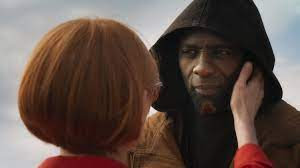
     Miller teams two fine actors in a tale about an academic (Tilda Swinton) and a Djinn (Idris Elba) who encounter one another after Swinton's Alithea Bonnie purchases a small bottle during a visit to Istanbul's Grand Bizarre.  
     Alithea returns to her hotel room, tries to clean up the bottle, and, lo, a genie emerges. The skeptical academic, who studies the role of narrative in mythic literature, is granted three wishes. She's reluctant to use them.
      While waiting for Alithea to make up her mind, the Djinn tells Althea stories, some of which Miller beautifully realizes while others falter. The imaginary Arabian backdrops often are more interesting than the stories that unfold in front of them. 
       A variety of characters emerge as the Djinn tells Alithea about his previous attempts to free himself from his bottle: If he grants three wishes, he'll be free. One tale involves a ravenous and infantile sultan who surrounds himself with portly women.
       Miller is a talented and important director who has veered off the Mad Max track before -- notably with Babe: Pig in the City (1998) and Lorenzo's Oil (1992). He previously tried his hand at fantasy with 1987's The Witches of Eastwick
      After his triumph with Mad Max: Fury Road (2015) and with another Road Warrior movie looming, it's easy to understand why Miller wanted a change of pace with a story that's meant to be savored rather energized by speed, the difference say between sipping a glass of wine and downing it with one mighty swig.  
     Put another way: I was rooting for Three Thousand Years of Longing but had difficulty sustaining interest as scenes between Swinton and Elba (shown in various sizes and often with smoke rising from his body) bogged down.
     At once majestic and knowing, Elba creates a memorable Djinn but Swinton's Alithea proves a bit dull, an academic who longs for love and companionship.
      Miller is too talented not to find some masterful moments but the movie suffers from a lack of drive, and when Alithea and the Djinn return to London, the screenplay expands to include a romantic dimension in which the fantastical and the mundane try to merge.
     Generous viewers may give Miller a pass. I'd have no quarrel with those who are so inclined but, for me, this story about the transcendent importance of stories seldom made it feel as the stakes were vital.
     Besides, the best way to celebrate stories is to tell a great one. Three Thousand Years of Longing falls short in that regard.

Wednesday, August 24, 2022

A hostage-taker with small demands


  Watching Michael K. Williams in Breaking serves as a forceful reminder of how much the late actor commanded every scene in which he appeared. Williams, who grew up in a tough Brooklyn world,  died of a drug overdose in September of 2021. He was 54.
   It's worth remembering Williams's great performances as Omar Little in The Wire and as Chalky White in Boardwalk Empire. Williams was a rare actor whose anger, ferocity, and intelligence made him unforgettable.
   That's an odd way to begin a review of a movie in which Williams plays a supporting role but I wanted to acknowledge an actor whose presence always seemed to burn through the screen.
   In Breaking, Williams plays Eli Bernard, a police negotiator who tries to persuade the movie's main character (John Boyega) to release two employees (Nicole Beharie and Rosa Diaz) he's holding hostage at a small bank.
   Based on a true story, Breaking stands as an indictment of the VA. A botched VA payment of a paltry $892 triggered a breakdown by Boyega's Brian Brown-Easley. 
   A former marine, Easley teetered on the line separating an earnest young man from someone who had slipped into paranoid fantasy. 
   A terrific Boyega makes it clear that Easley didn't want to hurt anyone, even though he threatened to detonate a bomb if the VA didn't meet his ludicrously modest demand. 
    An absurd media frenzy enriched the premiere hostage movie -- Dog Day Afternoon. Director Abi Damaris Corbin  also charts Easley's attempts to attract media coverage. Easley eventually establishes contact with a producer (Connie Britton) at a local TV station. But the media isn't a target here.
     Corbin maintains a seriously committed point of view throughout: After serving in the Persian Gulf, Easley was discarded by a bureaucratic system that rendered him invisible.
    Breaking isn't a perfect movie. Contrasts and connections between Easley and Bernard, both former marines, are provided in sketchy fashion, and Bernard's clash with unsympathetic white officers in the Georgia town where the story is set are shortchanged. Tension comes and goes.
      But a strong cast is anchored by Boyega's memorable performance as a who young man who asked for very little -- and couldn't even get that. 

More Neo-noir, fewer thrills


Writer/director Neil LaBute came out of the gate fast, wowing Sundance audiences with the severely caustic In the Company of Men (1997).  LaBute has been working steadily since, plying his trade in movies, theater, and TV. Few writers can turn a line of dialogue into a punch to the face better than LaBute and his movies usually are worth an argument or two. So, it was with modest expectations that I approached Out of the Blue, LaBute's latest entry into the Neo-noir sweepstakes. Ray Nicholson plays Conor, the potential sap in a drama in which his character -- an ex-con working as a librarian -- falls for a supposedly irresistible seductress (Diane Kruger).  Hank Azaria makes intermittent appearances as Conor's parole officer, Gia Crovatin signs on as one of Conor's library co-workers, and Chase Sui Wonders portrays the stepdaughter of Kruger's character. Nicholson and Kruger fail to generate the requisite heat, Azaria's character seems out of place, and most audiences easily will guess which way LaBute wants the noir winds to blow. Those expecting end-of-picture twists will find them but Out of the Blue neither sings nor stings. Insertion of titles between segments (perhaps intended as humorous) slows things down as LaBute works his way through a kickless tale of murder, gullibility, and deceit.

Thursday, August 18, 2022

'Beast'; Tension and not much else


Idris Elba provides Beast with a  major draw. But Elba's presence can't offset an improbably scripted thriller in which Elba's character and two daughters (Iyana Halley and Leah Jeffries) are threatened by a vengeful and highly motivated lion. A group of poacher's killed the beast's entire pride, turning the lion into a killer of humans. The movie begins to resemble a Cujo knockoff -- only set in a South African game park. Early on, Elba's Dr. Nate Samuels, guilty about not having seen early signs of his late wife's cancer, travels with his kids from the US to South Africa. He  hooks up with an old friend and wildlife protector (Sharlto Copley). Samuels hopes to strengthen his bond with his kids by visiting the country where his wife was raised. Icelandic director Baltasar Kormakur follows a predictable course, setting up scenes in which the lion (CGI) threatens to kill its human prey. A vague thematic connection arises: The lion failed to protect his charges and Dr. Samuels fears that he won't be able to keep his daughters alive. A couple of fuzzy dream sequences don't add much, but the movie whips up tension by adopting a horror movie tone. For  a time, the characters are confined inside a van as the lion stages one pounding assault after another. There's no faulting the cast but the screenplay isn't really fresh enough to create much cinematic roar. Oh well, Beast at least has the decency to confine itself to an economical 90-minute running time. 

Genres collide in ‘Spin Me Round’


As the manager of an Italian restaurant that's part of a ubiquitous chain, Alison Brie's Amber thinks she's had a stroke of luck. Dutiful and loyal, Amber learns that she's been selected to attend a corporate retreat in Tuscany. Amber is supposed to stay at a villa owned by the head of the Tuscan Grove chain (Alessandro Nivola) that employs her. As it turns out, Amber and a variety of other managers are housed in a bare-bones hotel near the boss's extravagant villa. Their supposed immersion in Italian culture proves superficial and it soon becomes clear that Spin Me Round wants to shade its comedy with thriller elements. Hidden "romantic" agendas arise, particularly after Nivola's Nick invites Amber to join him on his beautiful yacht. Among the cast. Molly Shannon stands out as a woman with anger-management problems. Aubrey Plaza, always intriguing, plays Nick's no-nonsense assistant, a woman with a libidinous plan of her own. Zach Woods portrays Dana, a guy who buys into the chain's propaganda, at least for a while. Director Jeff Baena, who wrote the screenplay with Brie, tries to blend rom-com and thriller flavors, but the story's mystery seems clear to everyone except the folks in the movie. After generating a few laughs and threatening to ride a pleasant Tuscan vibe, Spin Me Around sounds vaguely ominous notes that don't swell into anything rich or exciting. And, oh yeah, the comedy doesn't always spark, either.

Thursday, August 11, 2022

‘Fall’ scales thrill-ride heights


  We go to some movies because of who’s in them. Other movies attract us because we’re fascinated by the stories they tell. Sometimes we're bored or just willing to take a chance. At other times, a favorite director draws attention.
   Then there are movies that, despite deficiencies, are built around an ingredient so compelling, they're difficult to to resist. I’d put Fall in this latter category. It’s a movie in which dumb behavior by two characters leads to sequences as riveting as anything you’ll see this summer. 
   It’s necessary at this point to say that those made uneasy by heights may find Fall excruciating — in a good way, I suppose.
   Here’s the deal: Distraught over her husband’s death in a climbing accident,  Becky (Grace Caroline Currey) tries to drown her grief with alcohol. 
   A year passes before Becky's climbing pal Hunter (Virginia Gardner) turns up. Hunter insists that if Becky doesn't climb again, she'll always be dominated by fear.
     Hunter proposes that the two tackle a decaying 2,000-foot TV tower that looks entirely misplaced in the middle of the California desert, a relic of another time. 
     Initially reluctant, Becky agrees to make the climb. When the ladder used in the ascent collapses, Becky and Hunter are stranded on top of the tower with no way down.
     The climbers try to use their ingenuity to figure out how they might summon help as the screenplay reveals a source of tension between the two women and adds splashes of backstory.
     Director Scott Mann and cinematographer MacGregor do the rest, creating one harrowing bit after another, all of them stomach-churning if heights aren’t your thing — and they’re definitely not mine.
     The two actresses are well cast. Currey conveys the fear that has stunted Becky's climbing career -- and her life, as well. Gardner imbues Hunter with a sense of bravado that pushes her toward extreme physical feats that she treats as fodder for her on-line presence.
     The movie concludes a bit summarily but the ending came as a relief — not because Fall disappoints but because I was happy to leave that damn tower to the vultures that sometimes circle it.