-- A blind date in a trendy restaurant hardly seems odd, until you realize the restaurant sits in the middle of a cemetery.
Rocky Mountain Movies & Denver Movie Review
FOR MOVIE LOVERS WHO AREN'T EASILY SWEPT AWAY
Wednesday, April 16, 2025
Cronenberg tackles grief -- in his way
-- A blind date in a trendy restaurant hardly seems odd, until you realize the restaurant sits in the middle of a cemetery.
Wednesday, August 24, 2022
More Neo-noir, fewer thrills
Writer/director Neil LaBute came out of the gate fast, wowing Sundance audiences with the severely caustic In the Company of Men (1997). LaBute has been working steadily since, plying his trade in movies, theater, and TV. Few writers can turn a line of dialogue into a punch to the face better than LaBute and his movies usually are worth an argument or two. So, it was with modest expectations that I approached Out of the Blue, LaBute's latest entry into the Neo-noir sweepstakes. Ray Nicholson plays Conor, the potential sap in a drama in which his character -- an ex-con working as a librarian -- falls for a supposedly irresistible seductress (Diane Kruger). Hank Azaria makes intermittent appearances as Conor's parole officer, Gia Crovatin signs on as one of Conor's library co-workers, and Chase Sui Wonders portrays the stepdaughter of Kruger's character. Nicholson and Kruger fail to generate the requisite heat, Azaria's character seems out of place, and most audiences easily will guess which way LaBute wants the noir winds to blow. Those expecting end-of-picture twists will find them but Out of the Blue neither sings nor stings. Insertion of titles between segments (perhaps intended as humorous) slows things down as LaBute works his way through a kickless tale of murder, gullibility, and deceit.
Friday, January 7, 2022
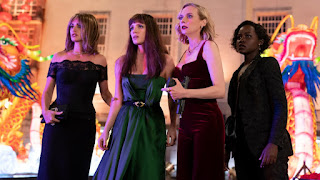
They can save world. What about the movie?
Thursday, December 20, 2018
A shattered man's world of dolls
Director Robert Zemeckis has devoted a substantial portion of his career to films that play with cinematic convention. We’re talking about movies ranging from Who Framed Roger Rabbit to The Polar Express to Beowulf to A Christmas Carol. In Welcome to Marwen, Zemeckis continues his fascination with artificial worlds. Throughout the movie, he shifts from "normal" big screen reality to a world full of dolls that resemble characters in the movie's real-world story.
Welcome to Marwen is based on the life of Mark Hogancamp, a photographer whose work consists mostly of taking photos in and around Marwencol, a fictional miniature Belgian town he built in his backyard and populated with dolls and other toys.
If that sounds familiar, it could be for two reasons: Hogancamp’s photographs have been featured in several New York galleries and Hogancamp’s life was the subject of a fascinating 2010 documentary by Jeff Malmberg.
Those who’ve seen Malmberg's documentary already know Hogancamp’s backstory. In 2000, he was severely beaten outside a bar in upstate New York by five thugs who objected to him talking about the enjoyment he got from wearing women’s shoes. Hogancamp was in a coma for 40 days, lost all memory of his personal life prior to the assault and then began to channel his anxieties and rage into World War II tableaus in Marwencol. He had a particular fascination with battling against Nazis and his fantasies took on a pulpy, comic-book quality.
So what was left to say after the documentary? As it turns out, not much.
In Welcome to Marwen, the stories that take place inside of Marwen (all enacted with dolls that resemble characters from Hogancamp's life and voiced by actors) aren't all that interesting and the overall story vacillates between being creepy and heart-warming, never quite making up its mind which map to follow.
Using his terrible beating as an explanation, Carell portrays Hogancamp as a shattered man who long ago lost the ability to read social signals. He's briefly enamored with a new neighbor (Leslie Mann), mistaking her kindness for romantic interest.
Meritt Wever plays the owner of the local hobby shop Hogancamp frequents and Diane Kruger provides the voice of Deja Thoris, a witch-like figure who haunts Hogancamp and his Marwen alter-ego figure, Cap'n Hogie.
Working from a screenplay he co-wrote with Caroline Thompson, Zemeckis takes a stab at illuminating serious issues involving hate crimes, personal freedom (symbolized by Hogancamp's preference for wearing women's high-heeled shoes) and tolerance.
Alan Silvestri's score might have been better suited to a magical fantasy; here, it seems at odds with Hogancamp's story.
I wondered if Tim Burton, a director more willing to lean into weird material, might have been a better choice for this story. Zemeckis largely remains outside of Hogancamp's world, turning us into observers.
Welcome to Marwen offers some clever visual touches but never makes it clear what we're supposed to feel about Hogancamp: Is he a crackpot? An emotionally crippled victim? An artist? The movie didn't need to answer all (or any) of those questions, but unlike the documentary, I left without wanting to give them much further thought.
Tuesday, July 12, 2016
Penetrating the cocaine cartel
Set during the 1980s, The Infiltrator tells the story of an undercover US Customs agent who helps crack a vast money-laundering scheme connected to Pablo Escobar and the Medellin drug cartel.
The life of an undercover agent consists of dodges and duplicity. He or she must establish real connections with criminals before turning the tables on them.
That's not a new story, but with Bryan Cranston (Breaking Bad) playing undercover cop Robert Mazur, The Infiltrator has a strong center.
Mazur won the trust of major cocaine dealers by posing as Bob Musella, a businessman with money-laundering expertise and ties to the New York mob. Musella made money for big-time drug czars, but also recorded their conversations with equipment hidden inside his expensive brief case.
Watching this kind of movie affords a double pleasure. On one level, The Infiltrator relates a story about a cop who's trying to bring down bad guys. Ably directed by Brad Furman (The Lincoln Lawyer) -- the movie benefits from constant tension because, at any moment, Mazur could be exposed.
On another level, there's voyeuristic kick to be found in the milieu that Mazur penetrates. It's a world in which the top guys no longer get their hands dirty, but which also is populated by lots of scary people who do.
According to the movie, which is based on a true story, Musella convinces kingpins with obscene amounts of cocaine cash that he'll invest their loot in small companies that are entirely legitimate. He also involves one the world's biggest banks in his operations.
The movie brings up some of the same issues as Donnie Brasco; i.e., the pain that's felt when undercover cops finally complete their work. They're putting people behind bars who trusted them, some of whom they've even grown to like.
It's also challenging to go deep undercover, and still be a devoted father and husband.
While dining in a restaurant with his real wife (Juliet Aubrey), Mazur's undercover world intrudes: An underworld associate unexpectedly shows up. To preserve his cover, Mazur humiliates an unsuspecting waiter. His behavior shocks both his wife and us, and serves as a sobering reminder of the problems faced by those who live two lives.
Furman surrounds Cranston with a terrific supporting cast. John Leguizamo gives another live-wire performance as a savvy informant. Benjamin Bratt, in his best big-screen work yet, plays Roberto Alcaino, an all-business Escobar henchman with charm to burn, culinary talent and an ability to savor the pleasures of the moment. He's cocaine royalty.
The DEA even gives Mazur a fake fiancee (Diane Kruger), a woman who's on her first undercover assignment and who turns out to be surprisingly good at her work.
And when Musella and his faux fiancee socialize with Alcaino and his wife, you get a feeling for the combination of loyalty and largesse that seduces people into the drug business.
A whispering mobster in a white suit (Yul Vazquez) becomes one of the movie's scarier characters, a man of variable sexual appetites who likes to be regarded as too dangerous to be trifled with.
Amy Ryan shows up now and again as Mazur's boss, a tough woman who seems to have been deprived of the gene for empathy.
At 60, Cranston may be a trifle old for the part, but he's especially adept at showing the discomfort Mazur feels in playing a role in which missteps can be fatal.
Mazur, whose work actually took five years to complete, probably should already have given up the chase when the movie begins. He knows that he should be home with his wife and kids, but he wants to catch bad guys. Still, he's not crazy enough to be immune to fear.
In all, the movie does a fine job of showing the perils of undercover work. The closer one gets to the quarry, the more likely the chances for success and the greater the letdown when the ruse finally must be abandoned and fake alliances are betrayed. So goes the complex plight of the undercover cop: He's the hero who can feel like a heel -- and Cranston never lets us forget it.
Thursday, May 5, 2016
This 'Sky' falls and fails
Thursday, April 24, 2014
Seeking paradise in the Galapagos
Directors Dayna Goldfine and Daniel Geller began their efforts after finding black-and-white footage of Friedrich Ritter and Dore Strauch, the original settlers on the unpopulated island of Floreana in the southern Pacific.
According to the movie's web site, the footage was shot during expeditions by Captain Alan Hancock to the Galapagos Islands, a desolate spot that seems better suited to lizards and giant tortoises than to human beings.
Ritter, a physician who fancied himself a philosopher, was aggrieved when a few other intrepid souls followed him to Floreana, including a purported baroness who seemed to become sexually involved with most of the men on the island.
Life on Floreana wasn't easy, and much of the footage shows Strauch and Ritter working to sustain life by cultivating crops to support their vegetarianism.
Ritter's goal was to forsake the individuality-crushing confines of civilization and community. Naturally, the arrival of other people only fueled Ritter's belief that contact with others meant conflict.
The newbies on Floreana included another German couple and the aforementioned baroness -- one Eloise von Wagner Bosquet -- who brought a couple of lovers with her. The baroness planned to build a hotel on the island.
The story, which includes a possible murder and assorted other mysteries, is carefully assembled with a variety of name actors reading from correspondence by all the participants.
Voices are provided by Cate Blanchett (Strauch), Diane Kruger (as the female member of the second couple) and Connie Nielsen (as the baroness). Thomas Kretschmann reads the words of Ritter.
Interviews with some of the offspring of the handful of people who lived on the Galapagos Islands add a bit of contemporary spin to the proceedings.
The German newspapers wrote about Ritter and Strauch as a new Adam and Eve. It doesn't take much by way of imagination to know that a paradise never found can't be lost.
The Galapagos Affair is an interesting and bizarre story about the way in which noble dreams so often lead to folly.
Thursday, August 16, 2012
An urgent look at the fall of Versailles
Director Benoît Jacquot fills the screen with tension, finds an interesting way to tell the story (from the perspective of a young woman who serves as the queen's reader) and even manages a surprising conclusion to a historical tale in which the outcome is well-known and inevitable.
Shot at Versailles and beautifully appointed, Farewell, My Queen centers on Sidonie Laborde (Léa Seydoux), a young woman who has been working at Versailles for four years when the movie begins. Farewell, My Queen opens with Sidonie being awakened from a sound sleep; the moment sets the tone for everything that follows. The whole court is awakening -- albeit reluctantly -- to the fact that it's about to topple.
Jacquot, -- along with Gilles Taurand -- co-adapted a novel by Chantal Thomas; the screenplay wisely doesn't tell us much about Sidonie's background. She's a young woman who evidently found her identity at Versailles, and is entirely devoted to the queen. There's an avidity about Sidonie; she works hard to stay abreast of gossip about events unfolding in and around the court. She knows literature -- she's a reader after all -- and, as played, by Seydoux, she has an alarming alertness about her. She's no pushover.
The rest of the performances keep pace. As Marie Antoinette, Diane Kruger -- a German actress playing the Austrian who found herself on the French throne -- is beautiful, pampered and capricious. Kruger brings welcome complexity to her performance. Her Marie Atoinette is no cartoon of cruelty, although she's plenty vain. The queen, who spends most of her time in her bedroom, has been carrying on an affair with Gabrielle de Polignac, a young duchess played by Virginie Ledoyen.Jacquot daringly lowers the volume on Bruno Coulais's agitated score, giving it the feel of a pulse that's beating wildly. A restless camera beautifully captures the sense of mounting confusion faced by both the nobility and those who serve it. An old order is falling, but Jacquot understands that for those who lived it, the experience was immediate, shocking and, in many cases, terrifying.
Quick but telling touches abound. At one point, the king (Xavier Beauvois) appears. The courtiers -- in full plummage -- sucrry toward him, frightened people hoping for answers. None are forthcoming. Imagine peacocks awakening to the roar of a lion, and you'll have a feeling for the mood at court. Such an attitude of fearful surprise might well have characterized those who cloistered themselves in the opulence of Versailles, and knew little of life beyond court with its boundless intrigues and ludicrous finery.
In covering four days before the French Revolution, Jacquot avoids scenes that scream out about their historical importance. He's interested in what it felt like to be at Versailles as the wheel of history turned.
We know the outcome, but not all of these characters know their fates: It's that sense of terrified confusion that gives Farewell, My Queen so much remarkable and instructive urgency.
Thursday, February 17, 2011
Another thriller with tension and plot holes
Walking out of a preview screening of Unknown – a new thriller starring Liam Neeson – I turned to my wife and said, “If that hadn’t been based on a true story, I don’t think I would have believed a minute of it.”
I was being facetious, of course. Unknown is not based on a true story, and it’s not particularly believable, although much of the time I’m not sure its credibility really matters.
More to the point: If Unknown had had half a brain, it might have been an exceptional thriller. But wait. It does have half a brain – the half that can concoct an intriguing premise, create real tension and spice things up with decently mounted action sequences.
The other half? The half that knows how to bring a thriller to a satisfying conclusion? That half never seems to have developed.
Still, Unknown keeps you involved, in no small part because its story takes place Berlin during a chilly November weekend; the movie has enough frosty atmosphere to slide past some of its rough spots.
Neeson plays Martin Harris, a botanist who flies to Berlin with his wife (January Jones) for a biotech convention. When he arrives at his hotel, Harris realizes that he’s left his briefcase at the airport. He grabs a cab, and races back to the airport. En route, the cab gets into a horrific accident. Harris winds up in a four-day coma.
When he awakens and tries to resume his life, he’s greeted with alarming news. His wife no longer recognizes him. Worse yet, another man is claiming to be Martin Harris. This impostor seems to be living Harris’ life.
This leads to the obvious questions: Has Harris gone crazy? Is there a scandalous plot afoot? For reasons neither Harris nor we know, is someone trying to push the real Harris aside? It’s either the world’s greatest case of identity theft or Harris has fallen prey to paranoid delusions, a distinct possibility because he hit his head during the vividly presented crash.
Director Jaume Collet-Serra (Orphan) has skills. He knows how to create suspense, put an action sequence in motion and keep us wondering just when Unknown’s going to get around to making sense of a plot that’s better in the build-up than in its resolution.
Neeson (Clash of the Titans and Taken) seems to be making a habit of finding scripts that emphasize action, although this one does on occasion flirt with intelligence. Look, I like Neeson's work, but worry that his most interesting recent role took the form of a near-cameo in Paul Haggis’ forgettable The Next Three Days. He played an expert on jailbreaks.
The rest of the cast proves variable. Jones, best known for her work in Mad Men, seems a one-dimensional actress in a role that required at least two. Veteran German actor Bruno Ganz may be looking a bit decrepit, but still can steal a scene. Ganz plays a private investigator and former Stasi officer who tries to help Martin figure out what’s happening to him.
And Diane Kruger (of Inglourious Basterds) does a decent enough job as an illegal Bosnian immigrant who drives the cab that plunges Martin into a river. Kruger’s Gina may be able to help Martin straighten out the mess in which he finds himself.
The movie never really untangles all of its own messes, but it has some thrills and tension. In the end, you don’t need to believe its story to get something out of it. I hate to keep repeating this February mantra, but: Lower your expectations and proceed accordingly.