Thursday, July 28, 2022

A trip to Texas that’s not afraid of detours

      
      Send a self-centered New Yorker to Texas and he's bound to arrive with baggage, say a suitcase full of inflated superiority.
     That's Ben Manalowitz, a New Yorker writer who thinks that every story must point to themes large enough to justify his decision to write about it.
     Ben's always looking for definitive statements, an ambition that blinds him to the people who are right in front of him.
     Fortunately, BJ Novak, who wrote and directed Vengeance, the story of Ben's Texas trip, doesn't share the same limitation. Novak has made an entertaining culture-clash comedy full of characters who are more than they seem. 
     Ben (Novak) also writes for a podcast produced by an editor (Issa Rae) who encourages him to dig deeply into a Texas story he discovers when he's drawn into a mystery involving Abby, a woman that he casually hooked up with in Manhattan.
     As it happens, soon after Abby returned to her small Texas backwater home, she turned up dead.
     Abby's family believes that Ben and Abby were more than a one-night fling. That's why her brother Ty (Boyd Holbrook) insists that Ben attend Abby's funeral, where he’s even asked to speak. 
      Ty believes that his sister was murdered. No way she died of an opiate overdose, says Ty, who doesn't accept the coroner's report. Tye wants Ben to help him find the murderer and avenge Abby's death.
    Isn’t that what any significant other would do? And why doesn't Ben just take up residence with Abby's hospitable family while the vengeance plot brews?
     As the movie progresses, Ben's inquiries lead him to Quentin Sellers (a terrific Ashton Kutcher). A music producer who worked with the dead girl, Sellers quickly upends Ben's expectations by delivering a surprisingly astute monologue. 
       Novak creates a main character who isn't instantly likable. Ben thinks he knows more than he does. He can't see beyond the story he thinks he’s telling. Maybe it's just a story he's telling himself
       Vengeance may strike you as talk heavy. It is, but some of the conversations are pointed and the so-called rube characters prove more perceptive than Ben initially suspects. 
       Without straining for effect, Novak toys with red-state cliches -- not only for blue-state Ben's edification but for ours. Don't panic, though; he's not singing Kumbaya, either.
        I won't reveal the movie's ending but honesty forces me to tell you that I'm still trying to come to grips with it. 
        But, hey, I also need to say that Vengeance wisely sidesteps being the kind of movie its suggestive title implies. 
       One last thing: Don’t be surprised if the movie leaves you hungry for a Whataburger.
       

'Not Okay' turns out to be okay


   Not Okay takes aim at the ravenous need some young people have for on-line fame. It's not exactly fresh territory. We already know that hollow on-line ambition inspires shameless searches for notoriety. Besides, the selfie joke pile pretty much had been exhausted.
    But director Quinn Shepherd, with help from a cast headlined by Zoey Deutsch, gets something out of an obvious premise by flooding the screen with upbeat style and maximizing her lead actress's ability to balance glibness with hints of genuine emotion.
   Deutch’s Danni is an aspiring writer who works for a Manhattan-based website named Depravity.  Using rudimentary computer skills, Danni fakes a trip to Paris so that she can claim to have attended a prestigious writers' workshop. She wants to impress her boss (Negin Farsad) and maybe become a full-time writer.
   Danni's timing turns out to be rotten. She posts a fake picture of herself in front of the Eiffel Tower shortly before a terrorist bombing rocks Paris. Danni now has a problem. She either must confess to never having left New York or concoct a story about the difficulties of dealing with a traumatic brush with death. 
   She chooses the latter course and becomes an on-line celebrity as well as leader of a movement that encourage people to admit that they've been ravaged by trauma.
   Enter Rowan (Mia Isaac), a young woman who lost her sister in a school shooting and who since has become a highly recognizable  anti-gun voice. Rowan and Danni meet at a support group.
   Recently seen in Don’t Make Me Go, Isaac again proves a standout. As a character who's personable but burdened by badly frayed nerves and grief, Isaac rescues the movie from its own clever striving. 
    Of course, Danni's bubble must burst and when it does, Shepherd  tempers the movie's playful tone. 
    As a movie about shallow people, Not Okay sometimes seems shallow itself. I could have done without chapter headings and other self-consciously playful ploys. And somewhere in the back of my mind, I wondered whether a comedy involving deadly terrorism might not be at odds the movie's mostly bouncy beat.
   By the end, though, Shepherd leaves us with a slightly sour taste. She's right to do so. Danni's fraudulent ways teach her a lesson but, to the movie's credit, her shallow appetites are not without consequence. 

‘Paradise Highway’ wastes two great actors


A movie that features Juliette Binoche and Morgan Freeman in prominent roles is bound to tempt viewers who otherwise might not care about a pulpy story in which a long-distance truck driver (Binoche) tries to rescue a girl (Hala Finley) from a ring of sex-traffickers. Freeman plays a former lawman who steps out of retirement to aid in the search for Binoche's Sally and the girl, who take to the road in Sally’s semi. The cast also includes Frank Grillo as Sally's imprisoned brother. On the eve of his release, he asks Sally to transport some illicit cargo so that he can square himself with a gang that's threatening his life. Shocked and unsettled, Sally learns that the cargo is a girl who’s bound for sex slavery. Reluctantly, Sally opts to save the girl. I'll say no more except to note that I found it painful to watch two terrific actors saddled with lame dialogue. Moreover, Binoche is miscast as a foul-mouthed, tough-minded long haul driver, a role deprives of her of the ambiguous allure that has drawn us closer in so many movies. Too often, Freeman is stuck bantering with his younger partner (Cameron Monaghan) as they try to save the girl. I think you can guess the girl’s fate but neither Binoche nor Freeman can save the movie.

Wednesday, July 27, 2022

Strong cast but the movie self-destructs


   What happens when a director assembles a strong cast and has clear command over a movie's imagery but still can't cross the finish line unscathed.
  The answer can be found in director Andrew Semans's Resurrection, a psychological thriller that's big on creating ambiguity.
 About the cast: Rebecca Hall plays Margaret, a single mom and businesswoman living in New York State. Confident in the business world, Margaret harbors a deep, unsettling secret.
  Margaret's seemingly solid world begins to crumble when she sees a man (Tim Roth) from her past at a biotech conference. The appearance of Roth's David shakes Margaret to the core.
 The performances given by Hall and Roth blend perfectly with the uneasy mood that Semans creates. 
  We're mean to wonder whether Margaret is really in danger from Roth's character or whether we're being immersed in her paranoia.
  Roth wisely underplays the menace that David represents, only  occasionally flashing a toothy grin that borders on the demonic.
 Semans makes good use of Wyatt Garfield's cinematography, which implies a populated world while at the same time pushing us deeper into Margaret's isolating point of view. 
  Margaret operates like a woman possessed. We often see her  running. She runs hard and even seems to be working during the sexual interludes she shares with a married co-worker (Michael Esper). 
   Margaret isn't running toward anything; she's running from a part of her past she wants to suppress. The effort leaves her drenched with sweat.
 Overprotective of her teenage daughter (Grace Kaufman) and eager to play mentor to an intern at work (Angela Wong Carbone), Margaret is one more character burdened by her personal history.
  All of this builds toward a violent finale and a conclusion that, on a literal level, makes no sense and which presumably Semans wants to fill with metaphoric charge. 
  Still, the movie's conclusion struck me as an unearned volley of gore and mystery that made me regard Margaret's crazed journey with more skepticism than I might initially have had.
  

'Thirteen Lives' tells an amazing story


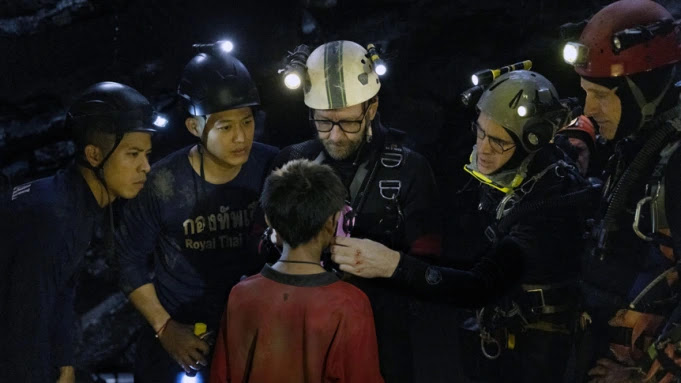
   Ron Howard's Thirteen Lives can be regarded as a procedural; i.e.,  a straightforward account of a story in which 12 boys and their soccer coach were stranded in a flooded cave in Thailand. 
   The event -- which happened in 2018 -- captured the world's attention as a team of divers combatted monsoon rains while trying to locate the boys and figure out how to extricate them from the cave.
   So, a procedural, yes, but one that tells an incredible story about a team of international divers and Thai Navy Seals who, after 18 days guided the boys to safety. 
   Difficult to begin with, the task became nearly impossible because the boys had to be equipped with diving gear that would enable them to breathe as the divers navigated treacherous waters and narrow passageways. 
   Howard introduces five divers played by Colin Farrell, Viggo Mortensen, Joel Edgerton, Tom Bateman, and Paul Gleeson
 Mortensen and Farrell receive the most attention as divers who don't always agree. The story also deals with tensions between Thai authorities, the Thai military, and the foreigners who arrived to help. 
  The Thai characters aren't especially well-developed but neither are the principal divers, who are given sketchy backgrounds. 
    The characters spend little time interacting with one another in ways unrelated to the rescue mission, so it's up to the actors to suggest deeper character traits. Credit Mortensen, Farrell, and Edgerton with doing as much as they can in this regard.
    Howard and cinematographer Sayombhu Mukdeeprom up the dramatic ante with rescue sequences that involve a decision that's best discovered in a theater, presuming you don't already know it. 
   The movie's underwater scenes must have been difficult to film but they tend to become slightly repetitive as divers make multiple trips through tunnels of the cave to save the boys.
    I expected an emotionally richer film from Howard whose filmography includes the gripping Apollo 13. He's working with a subject that seems firmly located in his wheelhouse but Thirteen Lives proves more resolute than inspiring.
   I don't think it's a spoiler to say that we know the outcome of such a well-known story from the outset. Aside from becoming international news, the rainy season rescue also is the subject of Rescue, a well-regarded 2021 documentary. But whatever its limitations, Thirteen Lives still has an amazing story to tell.

Thursday, July 21, 2022

Two strong documentaries: 'Fire of Love' and 'Hallelujah'

 Fire of Love 

You say you've been on some crazy dates? You may want to rethink that when you watch Fire of Love, director Sara Dosa's documentary about Maurice and Katia Krafft, a husband and wife who spend their lives traveling the world so that they can watch volcanoes erupt. Maurice and Katia died during a 1991 eruption on an island off the Japanese coast, but they left lots of footage of their adventures. They photographed their work (partly to support themselves) and partly to share some of nature's more amazing sights with the rest of us. They were either lucky or focused enough to define their lives by the obsession they shared for volcanoes and each other. Knowing what they wanted their lives to be, they decided never to have children, a wise choice for folks who, though well-prepared, regularly risked their lives. At one point in Dosa's documentary, Maurice paddles a small boat across a lake full of sulfuric acid. You'll learn volcanoes are divided into two broad categories -- red and gray. It's the gray volcanoes that kill and that this intrepid couple spent their later years pursuing -- until their preoccupations finally did them in. 


Hallelujah: Leonard Cohen, A Journey, A Song

If you haven't heard Leonard Cohen's Hallelujah, you must have spent the last several years living under a rock. The song has been sung by many artists and has become a staple of moments meant for inspiration, grieving, or triumph. The story of this ubiquitous song is the occasion for director Daniel Geller and Dayna Goldfine's documentary, Hallelujah: Leonard Cohen,  A Journey, A Song. The movie also serves as a sketchy biography of Cohen, the poet/singer who died in 2016. Cohen worked on Hallelujah for years, pushing its lyrics through many permutations, 180 versions by some accounts. Mostly avoiding Cohen's non-musical life, the movie focuses on Cohen's strange, halting career. Music writer Larry Sloman offers insights into the man and his music, noting that Cohen's life had been devoted mostly to "holiness and horniness." A Montreal-born Jew, Cohen spent five years in a Zen monastery. The film leaves you with the impression that Cohen -- who appears throughout -- never captured what he was reaching for or even totally figured out what it was that drove him. Whatever else he accomplished -- and he left a fair number of memorable songs -- Cohen created a song that's now ingrained in our culture and is likely to remain there.

'Nope': A big-screen letdown toys with ideas


   Director Jordan Peele’s third movie, Nope, should spark heated discussions among Peele’s legion of fans. Some will find the movie daring and provocative. Others may experience more consternation than they'd like. Still others will see the movie as a highly variable exploration of multiple ideas that proceeds without offering enough by way of thematic punch.
  I find myself in the latter group.
  It’s difficult to write about Nope without spoilers, so I’ll offer only a sketchy plot summary. 
   A rancher (Daniel Kaluuya) trains horses and works as a handler of those horses on movie sets. Kaluuya's OJ is joined on his failing ranch by his sister Emerald (Keke Palmer), a lively young woman whose personality contrasts with the cowboy stoicism OJ struggles to maintain.
   The major development: A UFO — often barely visible — hovers above OJ's ranch, causing fluctuations in power and wreaking more dangerous forms of havoc. 
    With visions of fame and fortune dancing in their heads, OJ and Emerald visit a local electronics store and arrange for a techie (Brandon Perea) to install cameras at their ranch. They want to capture this amazing alien arrival and enrich themselves in the bargain.
    They're looking for what they call "the Oprah shot," exposure on a validating scale.
     The alien visitor isn’t looking to make friends. Like a vacuum, the ship (it looks like a flying white pancake) sucks up objects, livestock, and people, most of them from a nearby attraction, a ranch-like theme park run by Ricky "Jupe" Park (Steven Yeun). As a kid, the grandiose Park was part of a sitcom built around a chimpanzee named Gordy. More on that sitcom within the movie later.
  Peele, whose movies always invite a plunge beneath the surface, seems to have many things on his mind: a look at the way artificial effects are squeezing the life out of movies, a mildly parodic take on classic sic-fi, a sustained serving of dread, and a variety of other possibilities that audiences can uncover for themselves.
   For me, the problem  with Nope isn’t that it’s weird. It may not be weird enough. Peele puts a toe in Lynchian waters but doesn’t dive headlong into the pool. 
   Instead, Nope becomes a movie of hints and suggestions. Early on, Peele deals with the way Blacks played a pivotal but unacknowledged role in creating the movies. 
    Edweard Muybridge, a 19th Century English photographer,  is credited with having made the first moving picture, a man on a galloping horse. Nope tells us the rider was Black, one of OJ and Emerald's ancestors. 
   Now, the specialty business built by OJ's father (a briefly seen Keith David) is being supplanted by computer-generated horses that never bolt. 
   Perhaps we're meant to conclude that movies aren't evolving; they're betraying their origins.
   That idea -- the uncontainable often brutal nature of life -- echoes through a vividly presented episode from Park's sitcom day, an episode that’s dropped into the movie like a footnote.
   I wouldn’t call Nope an actors’ movie.  Kaluuya keeps things closes to the vest; Palmer juices the proceedings with verve; and Perea makes a credible techie who’s gradually pushed beyond his skill set.
   Michael Wincott shows up late in the movie as an assertive  cinematographer whom OJ — it stands for Otis Jr. — invites to film the UFO. OJ hopes that professional footage, as opposed to the original idea of using surveillance cameras, will enable him to save the ranch and taste some glory.
   There’s nothing wrong with a film that wants to play around with different ideas and tropes. But unlike Peele’s other two movies (Get Out and Us), Nope too often seems stuck in a creepy groove as Peele dishes out grinding sounds from the alien ship and numerous visual jokes, at least one of them qualifying as zany and inspired. Consider it a whopping goof on every spectacular sci-fi ending.
   Looking back on it, I wondered whether Nope wasn't its best when it was being playful, light on its feet and even silly.
    Given the expectations for Nope, I’d call the movie a letdown. Nope made me long for the moment when the film would find itself, and I, in turn, would find it. 
   For me, though, the movie's pleasures -- and there were some -- arrived only in piecemeal fashion. 

Wednesday, July 20, 2022

Life on an embattled Israeli kibbutz


    In 1948, not long after the state of Israel declared independence, fighting began between Israelis and their incensed Arab neighbors. One of those battles took place in southern Israel at Kibbutz Nitzanim. 
   The story of that battle and the people who fought it unfolds in Image of Victory, reported to be the the most expensive Israeli film ever made. 
   The movie begins with Egypt and Israel signing a peace agreement in 1979. An Egyptian journalist (Amir Khoury) who covered the events of 1948 wonders how the world could have changed so much. Did the Egyptians who died in those early days of war sacrifice their lives for nothing?
    Khoury's Hassanin remembers the fighting at Nitzanim as he recalls the face of a smiling Israeli woman who, after all had been lost at Nitzanim, faced the Egyptians with only a pistol in her hand.  Mira Ben Ari (Joy Rieger) a young mother, fought to protect the kibbutz when she could have fled with other evacuees.
   Director Avi Nesher situates the story in a frontier outpost in a lawless bit of land where the kibbutz residents are mostly left to their own devices, trying to survive, worrying about hostile neighbors, and sometimes squabbling among themselves. 
   The father of Mira's child (Elisha Banai) wants a more traditional relationship than Mira is willing to accept. Avraham (Ladin Gellman) tries to lead a small group of untrained soldiers (some ex-convicts) while clinging to a sense of military discipline.   
    Presented in flashback from its opening scenes in 1979, the story tells us that Hassanin was supposed to be making a propaganda film, photographing the victorious Egyptian army. He didn't always show the Egyptian efforts in the best light and found himself at odds with Egyptian officials and with Lieutenant Half (Alaa Dakka), a soldier who had no use for even a small film crew. 
   Overall, the Israelis beat the Egyptian and Arab forces but Egypt's King Faruk, hungry for at least one victory, dispatched a large force against the kibbutz, where a handful of desperate fighters remained after the collective farm had been evacuated. 
    Based on real events, Image of Victory doesn't totally embrace both sides of the conflict but Nesher creates what feels like a realistic portrait of newly arrived Jews living in a struggling young country.  
   Outnumbered and outgunned, the Israelis who remained at Nitzanim ultimately surrendered but the movie's strength derives from its suggestion that both Israelis and Egyptians were caught in an impossible situation.

Thursday, July 14, 2022

A dress, a dream — and few surprises


   Mike Leigh veteran Lesley Manville plays a seamstress who longs to own an original Christian Dior dress in Mrs. Harris Goes to Paris. I can't quite say that I wish Mrs. Harris hadn't gone anywhere, but this adaptation of a 1958 Paul Gallico novel adds little seasoning to its comfort-food approach to cinema.
   Motivated by a beautiful dress she sees in the closet of a woman for whom she cleans house, the widow Harris comes into some money, heads for Paris, attends an exclusives private showing of Dior originals, and tries to purchase one. 
   Mrs. Harris's objective pushes the story into class-distinction territory. No one at the house of Dior -- especially gatekeeper Mme. Colbert (a stern Isabelle Huppert) — believes that the low-born Mrs. Harris deserves to be in the same room with so much elegance.
   Mrs. Harris finds a champion in the widowed Marquis de Chassagne (Lambert Wilson), an aristocrat who insists that she be allowed to watch the showing and buy whatever she chooses. 
   Manville has no trouble carrying the movie as an increasingly assertive woman who will not be denied, but director Anthony Fabian seldom pushes against the movie's predictable stitching.
   A subplot centers on a top Dior model (Alba Baptista) who entices Dior's accountant (Andre Lucas Bravo). She reads Sartre's Being and Nothingness and insists she'd rather be studying philosophy than working as a high-class clothes horse. 
   Cliche? Of course. And, by the way, it’s doubtful that she could keep herself in make-up based on a philosophy student’s income.
   Formula (though gently applied) doesn't stop there. Mrs. Harris not only wants a dress but becomes a feisty advocate for the working stiffs who produce Dior's fabulous clothes.
   Manville works hard but the movie -- never credible to begin with -- becomes increasingly difficult to swallow as it labors to wrap things up.
   Oh well, one thing remains true: It's nearly impossible to weave a first-class movie out of material that may not be threadbare but shows an awful lot of wear.