Showing posts with label Lupita Nyong'o. Show all posts

Wednesday, July 15, 2026

Tracking Christopher Nolan's 'Odyssey'


   You've already seen The Odyssey. You've probably seen it many times.  I'm not talking about filmed versions, one in 1954 and another in 1997. I'm talking about movies that -- knowingly or not -- have retold the Odyssey story, if not literally, then by mimicking its structure. 
    You know the drill. A valiant hero is separated from all that's familiar to him. He must overcome many obstacles to achieve a goal that resonates in movies as diverse as The Wizard of Oz and E.T. The hero wants to go home, home representing everything good, stable, and familiar. 
    Put another way, The Odyssey may date to the late 8th century BC, but it created one of the templates for storytellers that endures to this day. 
    Unless you've been living in isolation, you know that director Christopher Nolan has made his version of The Odyssey, opting to avoid literary flourishes that might have struck contemporary ears as unrecognizably florid. At one point, Telemachus, son of Odysseus, calls his mother "mom." I did a double take when I heard Odysseus referred to as "daddy."
    A bit strange, yes, but the heart of the movie involves an episodic account of the perils Odysseus faces on his return trip to Ithaca after the Trojan War.
    As you can guess, there isn't much smooth sailing in The Odyssey. Seas roil and blood is shed. Odysseus' adventures may remind younger viewers of horrors they've encountered in Marvel movies. In Nolan's hands, they serve as tests of Odysseus' character and cunning, with cunning sometimes trumping issues of character.  
     Looking grizzled and battle-worn, Matt Damon, as Odysseus, highlights Odysseus' internal conflicts. How many men must be sacrificed to save most of the loyal soldiers who accompany Odysseus on his journey home? Put another way, Odysseus  — the ultimate pragmatist — constantly wrestles with his conscience. 
    Odysseus’ journey pauses when he washes up on the shores of a secret island inhabited by Calypso (Charlize Theron), an immortal beauty who offers Odysseus a chance to live with her forever. 
     No, says Odysseus; he’d rather be mortal and return to his wife Penelope (Anne Hathaway). Embittered and lonely, Penelope has spent the last 20 years warding off freeloading suitors who have invaded Odysseus' home, notably the sly Antinous (a terrific Robert Pattinson).
    Nolan also adds many of the side characters that bring color to the epic story. Eumaeus (John Leguizamo), a blind swineherd, remains loyal to Odysseus throughout his long absence, demonstrating that virtue isn't necessarily confined to those of noble birth.
      All of this plays against a counter story. Telemachus (Tom Holland) leaves home to find the father he doesn't know, although his trip isn't quite as fraught as his father's.
     Nolan presents a narratively complex story in segments, some of which merge easily and others which can make the movie seem a bit discombobulated, particularly at the outset.
   Sometimes, Nolan hurls us into some of the movie's  episodes without build-up, but he brings the story's bits and pieces together in the movie's finale, arguably the best and most commanding part of this gargantuan effort.
    In one of the movie's more engaging episodes, Odysseus encounters Circe (a compelling Samantha Morton), a witch who can turn men into animals, thus exposing what she regards as their essential natures.
     Then there's Menelaus (a strong Jon Bernthal) and his wife Helen (Lupita Nyong'o), both of whom Telemachus visits in hopes of learning his father’s whereabouts. Zendaya turns up as Athena, the goddess who appears to Odysseus, sometimes as a reminder of the pain he has inflicted on others.
       As he customarily does, Nolan minimizes the use of special effects. I’ve read that the fearsome Cyclops was created with a mixture of puppetry, animatronics, and a performance by Bill Irwin. An enormous Trojan horse was built to lay the groundwork for one of the movie's most powerful scenes. A chastened Odysseus witnesses the carnage wrought when he deceived the Trojans, entered Troy, and conquered the city. 
    With victory comes horror and remorse, a twist that might be dubbed "the agony of victory." 
      The Odyssey is worth seeing, but I wasn't swept away by a film that seems targeted for greatness, an A-list production in front of and behind the camera.
     Cinematographer Hoyte van Hoytema keeps early scenes dark, simulating the look of candlelit interiors. He often presses his camera close to faces, presumably to bring intimacy to the proceedings.
       Production designer Ruth De Jong opts for naturalism rather than period-piece cliche, and Ludwig Goransson's score pumps adrenaline into clangorous depictions of battle, perhaps trying to replicate the thudding rhythms with which Homer’s poetry originally was delivered. 
        A masterwork with ample amounts of blood and gore, the story retains much of its power, even if some of its monsters seem more related to the era of Ray Harryhausen’s artifice (1963's Jason and the Argonauts) than contemporary visual pyrotechnics. 
     Nolan sustains a clear vision, coaxes out several memorable performances, and hits home when it counts, but I was expecting something more encompassing; I wanted a movie in which I could get lost, and got a movie that I tracked with interest.
   Ah, the cyclops. Ah, the whirlpool. Yes, there's Odysseus tied to a ship's past because he insists on hearing the irresistible siren song that could cause him to leap overboard and face certain death.
   The movie seemed best when it didn't feel like a checklist of Odyssey high points bolstered by a strong cast and a commitment to imagery. The Odyssey was filmed with 70mm IMAX cameras that beautifully capture the sandy expanse of beaches and the imposing emptiness of seas at sunset. The Odyssey may not be consistently compelling, but in the stillness of those moments, Nolan writes poetry of his own.

Wednesday, November 9, 2022

A mostly satisfying 'Black Panther' sequel


  Black Panther: Wakanda Forever makes  a mostly worthy addition to a series forced to compensate for the death of its star, Chadwick Boseman. After Boseman’s death in 2020, the filmmakers faced a monumental problem: How to keep the series going without T'Challa, its main character?
   Viewers will no doubt argue about how well director Ryan Coogler solves the problem, but Coolger —who directed the first installment —lays the groundwork for more Black Panther movies by giving this sequel a strong cast of women while maintaining a respectful tone for what has been lost. 
     Is Boseman missed? Of course.
     Wakanda Forever sometimes feels like a movie stocked with supporting players and no clear lead. As the Queen Mother, Angela Bassett receives a good deal of attention, as does Letitia Wright, who plays Shuri, T'Challa's  tech-savvy sister.
     Both Wright and Bassett embody the movie's major theme: coping with loss. At one point, Shuri asks how a threatened Wakanda will survive without Black Panther to protect it? Much of the story involves attempts by various characters to answer that question, a process that sometimes feels labored.
    Familiar faces help. When series' regulars turn up, we're happy to see them. Among them: Danai Gurira as the stern general Okoye. Lupita Nyong'o reprises her role as Anika, entering the picture about midway through.
       So what happens in this Marvel extravaganza? 
       Outside forces threaten Wakanda’s tranquility. The nations of the world want to obtain vibranium, the substance that has allowed powerful Wakanda to develop into a tech paradise.
      The CIA acquires a machine invented by an MIT student (Dominique Thorne) that can detect vibranium. The agency has begun using this scanner to survey oceans for vibranium, a manifestation of the imperialist greed that Wakanda loathes.
     But wait, there's more.
     The underwater kingdom of Talokan (yes, a whole other empire) thwarts the CIA efforts. Talokan also has a supply of vibranium, which helps its residents survive in the sea.
     Trouble looms. The soft-spoken leader of Talokan (Tenoch Huerta) wants to join forces with Wakanda to stop the devious plans of the "surface people," as he calls the nations who lust after vibranium. 
    Hoping to avoid global conflagration, Bassett’s Queen Romonda,  a character of pinpoint ferocity, declines, thus lighting the fuse of conflict. Talokan and Wakanda square off in the movie's climactic scene, a nifty sea battle featuring a giant ship and flying warriors.
     A two-hour and 41-minute running time proves excessive, and not everything soars. A less-than-thrilling tangent involves  Martin Freeman and Julia Louise Dreyfus  as CIA agents.
     What I missed most about this edition of Black Panther was the elevating aura of Afro-centric nobility and discovery that permeated the first installment. The sense of ennobling fantasy dwindles as Wakanda Forever spins through its various plot threads and expositional chores.
      The first Black Panther felt like an entertaining superhero movie and a cultural game changer. This one feels more like a step in the Marvel franchise staircase. But considering the heavy burden that Coogler carried, the movie qualifies as a success -- even if we grumble a little.
       Wakanda Forever wraps things up with an appropriate expression of sadness for the loss of Boseman and T'Challa, and perhaps, most importantly, with a clear commitment not to cheapen the experience that captivated so many the first time around.
       That counts for a lot.


Friday, January 7, 2022

They can save world. What about the movie?

 
  Who says movies can't be educational? 
  The 355, a Bond-like thriller starring Jessica Chastain, derives its title from Agent 355, a real-life woman who spied for the rebel colonists during the Revolutionary War. 
  Yes, that was news to me, too.
  Oh well, the movie's title hints at the only revolutionary thing about it. The 355 quickly establishes itself as a formula job that tries so hard to attain franchise status, it might as well have been called The 355, Chapter 1. 
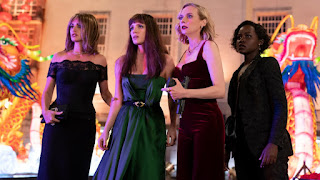
  Directed by Simon Kinberg (X-Men: Dark Phoenix) from a screenplay he wrote with Theresa Rebeck and Bek Smith, The 355 pits five women -- Chastain, Lupita Nyong'o, Diane Kruger, Penelope Cruz, and, late in the movie, Fan Bingbing -- against an evil genius who's trying to snare a device that can cripple the world's computer networks.
    Much of the time, it seems as if The 355 has been concocted to demonstrate the obvious: Women can make butt-kicking movies, too. 
    Of the women, though, only Kruger seems adept at projecting a killer vibe. Nyong'o plays a computer whiz who's trying to break with her MI6 past. Cruz? I'll get to her later.
   Chastain's Mace (short for Mason) and Kruger's Marie, a German agent, begin the movie as antagonists, squaring off in a chase sequence set in the Paris Metro. 
    Mostly, though, these women don't travel by subway. Instead, they globe hop from Paris to Marrakesh to Shanghai as the story contrives to unite them against a common foe.
   Absent a compelling story, we're left to wonder whether someone thought A-list pizzaz could elevate the movie's collection of undistinguished action, predictable plot points, personal betrayals, and slick packaging. 
   The 355 does feature one unusual job: Cruz plays a shrink with a narrow specialty. Her Graciela counsels Colombian secret agents and enters the picture to provide therapy for a rogue agent played by Edgar Ramirez. 
   Sebastian Stan portrays one of Mace's fellow CIA agents as well as a sort of minor (very) love interest.
   If by some miracle, there's a second helping of this uninspired brew, a title already awaits. How about The 356?

Wednesday, February 14, 2018

'Black Panther' elevates the comic-book genre

Chadwick Boseman stars in a fine Marvel Comics movie with a feel all its own.
Director Ryan Coogler begins Black Panther, his Marvel Comics adventure, in Oakland in 1992. Although we’re looking at the streets of a city where kids play basketball on decaying courts, the ensuing sequence adds a whole other dimension. It starts with a knock on the door of a small apartment adjoining the basketball courts. One of the men in the apartment checks the peephole and says that a couple of "Grace Jones-looking chicks" are knocking.

I won’t reveal more except to say that in this Oakland-based prologue, we meet a king, two of his female soldiers and the king’s treacherous brother -- all from the mythical African kingdom of Wakanda.

That’s a lot of information for a movie that hasn’t really even started. But it’s telling because Coogler (Fruitvale Station and Creed) wastes no time linking the lives of those kids on an Oakland playground to an ennobling mythos that draws on African tradition. The movie involves a fair measure of fantastic developments, but they feel solidly grounded.

Whatever meanings you read into Black Panther, you’ll find a movie that’s filled with the kind of commanding characters who do as much to create the movie’s world as the CGI razzle-dazzle Coogler also employs.

The story centers on T’Challa (Chadwick Boseman), prince and soon-to-be-king of Wakanda. Wakanda allows the world to believe that it's impoverished and irrelevant. The country appears bereft but hides its true face from the world. In Wakanda, tradition and advanced technology mingle without strain; tribal culture is maintained while amazing technical feats routinely are accomplished.

Coogler, who wrote the screenplay with Joe Robert Cole, deftly balances action, exposition and a large cast of characters that includes T’Challa’s love interest (Lupita Nyong’o), a woman with her own agenda. Nyong'o's Nakia feels duty bound to use Wakandan knowledge to help an ailing world, so much so that she puts civic obligation before love.

We also meet a variety of other characters, the most important of them a ruthless refugee from Oakland named Erik Killmonger (Michael B. Jordan). Killmonger, a man with a giant chip on his shoulder and a plan to arm the world's non-white populations, eventually challenges T’Challa, a.k.a, the Black Panther, for his throne.

Perhaps because of the way Coogler creates the appealing landscapes and urban environments of Wakanda -- almost an African Shangrila -- and perhaps because the movie seldom feels less than mythic and elevated, Black Panther differentiates itself from every other movie ripped from the pages of Marvel Comics.

It's also encouraging to discover that the women in Black Panther boldly claim their turf. In addition to Nakia, there’s General Okoye (Danai Gurira), a warrior who wields a mean spear and who's ferociously loyal to Wakanda. T’Challa’s sister Shuri (Letitia Wright adds brashness as the young woman who invents and controls most of Wakanda’s miraculous high-tech inventions. Her obvious counterpart, Q in the James Bond movies — only with a devilish streak.

The women in the cast are in fine form, and so are the men, especially Jordan who's scary good as a man at war with the world. Unassuming and unburdened by an overload of machismo, Boseman’s Black Panther makes an appealing superhero. Better yet, he shares the movie with every other actor without ever getting lost in the action, plot mechanics, and comic-book jargon.

Black Panther probably will give Boseman his widest exposure yet, but he’s already proven that he’s a terrific actor in earlier work. (He should at least have been nominated for an Oscar for his stunning portrayal of James Brown in the underrated Get On Up.)
Black Panther more or less divides into two parts. In the first, Ulysses Klaue (Andy Serkis), an arms dealer, steals an African artifact from a British museum. We quickly learn that the artifact is made of Vibranium, the mysterious substance on which Wakandan civilization and the Panther's powers have been built. Klaue thinks he’s gotten hold of something that will make him rich, but his meanness is no match for those with bigger dreams.

At this point, we also meet Everett K. Ross (Martin Freeman), a CIA agent who gets swept up in Wakanda's affairs. I haven't even mentioned Daniel Kaluuya (Get Out), who plays one of T'Challa's allies.

And, yes, there’s abundant action, most of it decently handled by Coogler — from car chases in the cramped streets of Seoul, South Korea, where the movie takes up early residence to a final battle in Wakanda involving clashing warriors and charging giant rhinos.

Coogler and his team deserve credit for creating a great-looking and distinctive entertainment. But this is one helping of popular culture in which effects don't dominate every scene and characters have room to breathe. That’s good news for Marvel and even better news for those in the audience who think they’ve already had enough comic-book movies to last a lifetime.

Thursday, September 29, 2016

A teen-age queen of the chess board

Director Mira Nair tells the unlikely true story of chess champion from Kampala.
 Set in the slums of Uganda, Queen of Katwe tells the story of Phiona Mutesi (Madina Nalwanga), a teen-ager who becomes a junior chess champion.

Director Mira Nair (Monsoon Wedding and Salaam Bombay!) has made a formulaic, against-all-odds story but manages to freshen it by focusing on a game not often associated with sports movies and by her commitment to showing life among the impoverished folks struggling to survive outside of the capital city of Kampala.

Nair supplements the work of a young and appealing cast with work from two seasoned performers. Lupita Nyong'o portrays Naku Harriet, a widowed mother whose energies are devoted mostly to eking out a living. Whatever doesn't fall under that heading can seem superfluous to Harriet, and that includes her daughter's chess abilities.

Wyong'o is joined by David Oyelowo, as an earnest fellow who runs the church-oriented youth center where Phiona learns to play chess. Oyelowo's character eventually must decide whether his job as a youth counselor is temporary or represents a true calling.

Oyelowo's Robert Katende becomes Phiona's mentor, and begins to act as liaison between Phiona and the mother who -- at least initially -- can't understand how chess will help her daughter endure the rigors of a hardscrabble life.

Phiona and her chess-playing cohorts from the neighborhood become the movie's underdogs. And we root for them when Robert bucks the odds by enrolling his charges in a chess tournament usually reserved for well-off kids who attend a private school.

Watching Nalwanga's confidence grow as she embraces her gift for developing complex strategies at the chess board might be reward enough for any movie, but Queen of Katwe not only has us pulling for a kid with a great gift, but for everything she represents to the people who surround her.

Like most good sports movies, it's undergirded by hope.

Thursday, April 14, 2016

Disney scores with another 'Jungle Book'

CGI animals and a strong voice cast help director Jon Favreau sell a familiar tale.

Adaptations of Rudyard Kipling's The Jungle Book don't exactly make for fresh news. So when I first saw the title on a list of 2016 releases, I found it difficult to get excited about another jungle journey, even one equipped with a CGI menagerie.

As it turns out, Disney's Jungle Book, directed by Jon Favreau, is bright (even in 3D), appealing and in at least one inspired sequence, engagingly loopy.

The story focuses on Mowgli (Neel Sethi), a boy who was raised by wolves and suddenly finds himself targeted by a tiger named Shere Kahn (voiced by Idris Elba).

The story is narrated by Bagheera (Ben Kingsley), the sagacious panther who first brought young Mowgli to Raksha (Lupita Nyong'o), the wolf who becomes his surrogate mother and who tries to instill him with the lore of the pack.

Elba gives voice to a convincing villain, a somewhat battered tiger who's motivated by a desire to keep fire out of the jungle. Shere Khan thinks it's not enough to exile Mowgli from the jungle by returning him to his human tribe. He wants to kill the boy.

In the early going, I half wondered whether Mowgli's flight through the jungle hadn't given Disney an excuse to produce a kiddie version of The Revenant, another wilderness survival epic. But Favreau balances the movie's convincingly dangerous situations with enough comic moments to keep fright in check.

To insure the success of its effort, Disney has surrounded first-timer Sethi with a strong voice cast. In addition to Kinglsey and Elba, you'll recognize Bill Murray as the voice of the conniving but good-spirited Baloo, a bear with a honey jones.

The movie even breaks into song with a Murray-voiced rendition of The Bare Necessities, which was used in Disney's 1967 animated version of The Jungle Book. The song seems awkwardly inserted because this version of Jungle Book isn't really a musical, but once you get past its slightly jarring arrival, the song is sort of fun.

Even though we never see him, Christopher Walken does scene-stealing work as the voice of King Louie, a giant orangutan with evil on his mind.

Louie wants Mowglie -- referred to by the animals as a "man cub" -- to return to his own kind, capture fire and deliver it to the power-hungry king who lives in an impressively created temple that has been overrun by all manner of monkeys.

Walken, too, is given a musical number, I Wanna Be Like You.

Animal purists may find this entirely anthropomorphic endeavor to be a little prone to cuteness. Despite Favreau's amazingly skillful use of CGI, the movie's spirit often follows a cartoon template with creatures (wolf cubs, for example) that are petting-zoo cuddly.

Although the movie expresses deep reverence for elephants -- all creatures bow before them -- it also makes sure to find a way to put a baby elephant into danger, an incident that provides the movie with an opportunity to showcase the human ingenuity that Mowgli possesses.

But there are also strangely alluring creatures that aren't quite as kid friendly: Ka, a giant snake voiced by Scarlett Johansson, tries to tempt Mowgli with her hypnotically seductive voice.

Favreau paces the movie at a speed that tends to help push criticism aside. Panthers with British accents? Why is it that some of the animals talk and some don't? And, most importantly, concerns about whether some of the realistically presented animal fights are too vivid for the youngest viewers to handle. The movie has been rated PG.

Overall, though, The Jungle Book proves entertaining and likable without delivering too heavy-handed a message about the way humans, the masters of fire, tend to destroy jungle habitats.

Stay put for the end credits, which are entertaining in their own right.

Thursday, February 27, 2014

'Non-stop' trades action for sense

Liam Neeson reunites with director Jaume Collet-Serra (The Unknown) for Non-Stop, a thriller set almost entirely on a jetliner that's facing a terrorist threat.

In addition to exploiting current fears about flying, Non-Stop proves laughably improbable and only moderately suspenseful.

With action-oriented movies such as Taken and to a lesser extent The Grey, Neeson seems to be on the verge of turning himself into a cliche.

Here, he's playing another depressed hero: He's Bill Marks, a Federal Air Marshal who's mired in guilt and prone to heavy drinking. We can guess from the outset that Marks is stricken by a terrible event from his past, probably something involving a daughter.

Despite his personal baggage, Bill gets a better deal than the audience. He's riding comfortably in business class on a flight to London. Once on board, he finds himself seated next to a friendly passenger (Julianne Moore) who also likes to tipple.

The plot arrives almost before the passengers can fasten their seat belts: Bill begins receiving text messages over a secure network. It seems that one of the passengers is a terrorist who plans to kill one passenger every 20 minutes unless $150 million is deposited in an off-shore bank account.

To add a further level of complication, TSA folks on the ground believe that Bill is the hijacker, a rogue agent out for a big pay day.

Bill must find the real hijacker even as he argues with authorities about his right to do so. Like most heroes, he's on his own.

Joining Moore in supporting roles are Michelle Dockery and best supporting actress nominee Lupita Nyong'o (as flight attendants).

Nyong'o is entirely wasted, which may be just as well because this rising star hasn't much to gain from a mediocre thriller that throws around red herrings before we learn what's motivating the hidden terrorist.

Let's just say the explanation left me groaning in disbelief. It's brazen, contrived and about as likely as finding an empty middle seat in the center aisle of a trans-Atlantic flight.

Collet-Serra stages an explosive finale which I won't reveal here, but which probably should be avoided by travelers who tend toward white-knuckle flying.

Look, Neeson has plenty of presence, and he's become particularly adept at adding gravitas to these kinds of roles, but I look forward to the day when he finds a bigger challenge -- for him and for us.


Thursday, October 31, 2013

The abject cruelty of U.S. slavery

12 Years a Slave is a powerful and necessary look at enslavement
When I was a kid, we learned that the Civil War was fought over slavery -- sort of. Though acknowledged as a cause of the war, the subject of slavery always seemed muted by more generalized issues: The industrial North vs. the agrarian South and states' rights vs. centralized federal concerns.

Fair to say that slavery didn't come alive as a shocking horror. We read little or nothing about the torments of the Middle Passage, about the cruelties of a system in which people were bought and sold without regard for family connections or about how much of the southern economy was built on the backs of people who were forced to endure humiliation and toil without either rest or recompense.

Movies haven't done much to clarify the picture. From Gone With the Wind to the recent Django Unchained, we've not had a story dedicated fully to describing what the world was like during the time of slavery -- and doing it from the point of view of someone who had been enslaved.

Now comes director Steve McQueen's 12 Years a Slave, written by John Ridley from a book by Solomon Northrup, a free black man who in 1841 was kidnapped in Washington, D.C. and sold into slavery.

Although McQueen has altered some of Northrup's narrative, Northrup's source material gives 12 Years a Slave an authenticity few other historical movies can claim.

This first-person account of America's "peculiar institution" maintains the formality of Northrup's language, but McQueen's images spring to life with troubling urgency.

Built around a solid and moving performance by Chiwetel Ejiofor (as Northrup), 12 Years a Slave hinges on a hideous deception. An accomplished fiddler, Northrup was tricked by a couple of charlatans into traveling with them as a violinist for a circus with which they supposedly were connected.

Once Northrup left his wife and children in Saratoga, N.Y., his fate was sealed. He was drugged and held in a "slave pen" in Washington a few blocks from the Capitol. In order to survive, Northrup gradually learned to hide his literacy (he was an educated man) and to answer to the name a slave trader arbitrarily gave him. He was called "Platt."

Obviously, we're a long way from the devoted slaves of southern fantasy. Mothers and children are viciously separated; brutal whippings are common, as is the sexual abuse of black women. At one point, Northrup is lynched.

His tormentors are driven off, but he's left to hang from a tree, his toes barely touching the ground, a man dancing over his own grave until his then owner (Benedict Cumberbatch) arrives to end his ordeal.

Northrup's life was threatened when he found himself subjected to an overseer's wrath. The overseer (Paul Dano) couldn't abide Northrup's intelligence. Northrup had figured out a way to get his owner's lumber more easily to market. Dano's character -- a man called Tibeats -- deeply resented any initiative on the part of a black man.

After this horrific episode, financial difficulties forced Cumberbatch's character to sell Northrup to Edwin Epps (Michael Fassbender), a malicious slave owner who delights in abuse and who is involved in a sexual triangle with his wife (Sarah Paulson) and a slave (Lupita Nyong'o), who also happens to be the best cotton picker on the plantation.

For all of Epps' obvious evils, we probably learn more about southern society from the parts of the movie involving Cumberbatch's "kindly" Mr. Ford. Ford treats his slaves reasonably well, but he obviously accepts the institution of slavery and has profited from it. He's troubled by cruelty, but not enough to reject the system that allows it to flourish.

At times, McQueen presents us with tableaus that might have been inspired by old photographs, perhaps as a way of establishing tension between what we regard as "history" and the urgency of a drama that appears to be taking place before our eyes. A scene in which Northrup encounters a group of Indians might be the film's most mysterious, groups of outcasts who don't know quite what to make of each other.

In 1853, Northrup finally was rescued and restored to his former life. He was able to write a book about his experiences, and evidently helped slaves escape the South via the underground railroad.

As moving as Northrup's reunion with his family is, it can't (and shouldn't) entirely be enjoyed. The story of slavery isn't really about one man's journey back to his home and family; it's about all those who died as slaves, unconsoled by a loved one's touch, distant from the mothers who bore them and regarded as property in an economy built on acceptance of people as chattel.

McQueen, who previously directed Hunger and Shame, allows room for such thoughts. It's also telling (and more than a little sad) that 150 years after Lincoln issued the Emancipation Proclamation, a movie such as 12 Years a Slave still qualifies as a rarity.