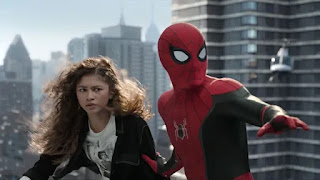
As far as Spider-Man is concerned, the world has amnesia. Still heralded as a crime fighter, Spider-Man has become a loner. Even his closest friends have forgotten that he’s also Peter Parker, a nice guy from Queens.
Rocky Mountain Movies & Denver Movie Review
FOR MOVIE LOVERS WHO AREN'T EASILY SWEPT AWAY
Tuesday, July 28, 2026
'Spider-Man' can still spin some fun
As far as Spider-Man is concerned, the world has amnesia. Still heralded as a crime fighter, Spider-Man has become a loner. Even his closest friends have forgotten that he’s also Peter Parker, a nice guy from Queens.
Wednesday, July 15, 2026
Tracking Christopher Nolan's 'Odyssey'
You've already seen The Odyssey. You've probably seen it many times. I'm not talking about filmed versions, one in 1954 and another in 1997. I'm talking about movies that -- knowingly or not -- have retold the Odyssey story, if not literally, then by mimicking its structure.
Wednesday, December 15, 2021
'Spider-Man' takes a big step forward
Thursday, March 11, 2021
War-time trauma and drug addicition
In Cherry, the Russo brothers (Anthony and Joseph) make a major departure from their last movie, Avengers: Endgame. You won't find any superheroes in Cherry, a hard-core adaptation of an autobiographical novel by Nico Walker.
Wednesday, March 3, 2021
'Chaos Walking:' A run might have been better
First, a quick look at the world of Chaos Walking, a futuristic story about warring deep-space colonists that trips over one of its central conceits. In Chaos Walking, men can hear each other's thoughts, a power achieved upon arrival on this distant planet.
Tuesday, September 15, 2020
Maybe the devil made them do it
Judging by the characters in The Devil All the Time, some of the folks in West Virginia and parts of southern Ohio are mighty weird, screwed-up in ways once taken for common coin in Southern Gothic literary circles.
These are just a couple of the more lurid examples from director Antonio Campos’ cinematic take on a novel by Donald Ray Pollock, who narrates a taxing two-and-a-half hour Appalachian journey that sometimes feels like a near-parodic take on one of Flannery O’Connor’s novels.
Campos doesn’t skimp on the number of characters who populate his movie, some arriving and disappearing before the story settles on Arvin (Tom Holland), a young man struggling to find his place in this strange, violent world.
The death of his mother and the resultant suicide of his father put young Arvin in the care of his grandmother (Kristin Griffin). As Arvin grows into manhood, the story also tracks the twisted progress of a serial killer (Jason Clarke) and his wife (Riley Keough).
Their MO: He takes photos of his victims having sex with his wife before slaughtering them. She goes along with his twisted plans, although she eventually tires of their murderous travels.
A frighteningly intense Harry Melling plays the preacher who believes the Lord will help him resurrect the dead. Mia Wasikowska portrays his hapless wife.
Arvin's grandmother adopts Leonora, the daughter of this less-than-happy couple. Eliza Scanlen plays Leonora as an adolescent.
To further complicate matters, Keough’s character is the sister of a corrupt local sheriff (Sebastian Stan).
I haven’t read Pollock’s novel, but in his review in The New York Times, Josh Ritter wrote, “Pollock’s prose is as sickly beautiful as it is hard-boiled.”
I can’t say the same for the filmmaking here; sans Pollock’s prose, the movie strips the characters to their bare-bones lunacy and becomes a bit of an endurance test, making us wonder just how much of this ruthlessly unpleasant crowd we can take.
Thursday, October 24, 2019
Titans battle over who'll rule the electric grid
The Current War: Director's Cut is a difficult movie for me to review. Before it was described as "the director's cut," the movie premiered at the 2017 Toronto International Film Festival. It was slated to be released by the Weinstein Company, but Harvey Weinstein's #MeToo exposure intervened.
Two years later, the movie found a home with 101 Studios. Director Alfonso Gomez-Rejon reportedly did some re-editing, added scenes and reduced the film's running time. Is it better than the version that played Toronto? I didn't see the movie then, so I can’t say.
I wondered, though, whether Gomez-Rejon (Me and Earl and the Dying Girl) didn't insist on a director's cut so that the movie -- which received a lukewarm reception in Toronto -- could be seen with fresh eyes.
Whatever the case, the movie that now arrives on the nation’s screens is a bit of an oddity.
Gomez-Rejon has tried (boy, has he tried) to make a visionary movie about visionaries, a choice that puts the movie in an odd position: It’s competing with its characters.
The story centers on the battle between Thomas Edison (Benedict Cumberbatch) and Geroge Westinghouse (Michael Shannon), two great names of American invention and commerce. A third revolutionary, Nikola Tesla (Nicholas Hoult) works his way into the story, first as an employee of Edison and later as an ally of Westinghouse.
The great competition concerns a question: Should direct or alternating current be adopted as the US standard. Edison champions direct current; Westinghouse hoists the banner for alternating current. You already know the outcome, so it's difficult to say The Current War generates a great deal of suspense. In the US, alternating current rules.
To the extent that there's more at stake than money and, of course, power, it's worth noting that Edison represents invention in its purest form. Westinghouse takes a more commercially oriented view. Because alternating current was cheaper and could carry over longer distances than direct current, Westinghouse deemed it the better bet.
This is not to say that Edison becomes the movie's hero. He's arrogant and not especially friendly. Instead of making him admirable, his commitment to principle makes him a pain in the butt. And Westinghouse -- though capable of underhanded behavior -- seems genuinely interested in making the world a better place.
It takes an actor as good as Shannon to convey the complexities of Westinghouse's personality and I half wished that the movie had been more about Westinghouse than Edison.
Safe to say that the 19th century battle about the future of electricity isn't easy to dramatize. But it’s Gomez-Rejon's unrelenting commitment to an arty style that makes the movie difficult to embrace: He uses endlessly shifting camera angles, dark lighting, and other self-conscious cinematic gestures in ways that sometimes wall off us off from the story he's trying to tell.
And yet ...
The Current War also creates an atmosphere that is intriguing and strange -- incredibly detailed and yet somehow weirdly unfamiliar.
There isn't much by way of memorable work from the movie's supporting cast.
Tom Holland portrays Samuel Insull, Edison's loyal assistant. Matthew Macfadyen plays J.P. Morgan, a titan of finance who Edison snubs. Tuppence Middleton portrays Edison's wife and Katherine Waterston appears as Marguerite Westinghouse, by far the more interesting of the two spouses.
Gomez-Rajon hints at the dark side of technological advance by introducing the invention of the electric chair, which was supposed to take the cruelty out of capital punishment but which might have made things worse. Both Edison and Westinghouse were compromised by their positions on the use of the chair.
All of this builds toward a competition over who will land the contract to light The Chicago Exposition of 1893, a major coup for whoever wins the day -- or, better put, the night.
Gomez-Rejon whips up some excellent imagery and the story generates interest. And yet ... as I've said ... The Current War isn't so much a failure as a puzzlement, a movie that, in my view, creates too many impediments to its fullest appreciation.
Monday, July 1, 2019
Spider-Man takes a European vacation
Whatever emotional kick you’ll find in Spider-Man: Far From Home comes from Robert Downey Jr.’s Iron Man. Don't get me wrong. Downey’s character isn't present. But Iron Man’s absence adds poignancy to a story in which 16-year-old Peter Parker wonders whether he’s capable of filling Iron Man’s shoes.
Riding the emotional wave that Marvel set off in Avengers: End Game, Spider-Man: Far From Home turns out to be a serviceable entry into the Marvel repertoire: a collection of less-than-impressively realized action, a surfeit of good-natured humor, and an appealing young cast headed by stand-out Tom Holland as Spider-Man.
This edition takes Spider-Man abroad. Peter Parker (Holland) joins his high-school class on a trip to Europe. Stops include Venice, Prague, and London as the story hop-scotches across cities that are threatened with destruction by creatures called Elementals: i.e., earth, water, and fire monsters that wreak havoc. Can any Marvel movie be considered complete without reducing some part of a major city to rubble?
In this edition, Spider-Man's classmates graduate to slightly larger roles. Zendaya portrays MJ, the girl who has stolen Peter Parker’s heart. Jacob Batalon plays Ned, Peter's best friend, a nerdy kid who this times winds up with a girlfriend (Angourie Rice).
Marisa Tomei returns as Aunt May; Jon Favreau appears as Happy, Tony Stark's former bodyguard and chauffeur; and Samuel L. Jackson, looking less than enthusiastic, reprises his role as Nick Fury, the head of the outfit that runs the Avengers.
Added to the mix is Mysterio, a superhero portrayed by Jake Gyllenhaal. Mysterio wears a helmet that looks like a some dropped a fishbowl on his head; he also has an alter ego. Out of uniform, he's Quentin Beck.
Super-sensitive about spoilers, Columbia Pictures has encouraged critics not to ruin the movie’s surprises. I won’t say more, except to note that not all of them have the hoped-for kick.
Holland works hard to be the energetic and conflicted, the not entirely mature Spider-Man that we’ve come to expect, and, yes, his naïveté and sincerity prove engaging.
All in all, this edition of Spider-Man is not only far from home, but it’s also far from being a disaster. Far From Home unfolds without giving offense or ascending into the upper ranks of Marvel's unending list of movies. Put another way: Far From Home passes muster.
But, know this, as well, Far From Home hardly lays a glove on the much more imaginative, Oscar-winning Spider-Man: Into the Spider-Verse, 2019’s Oscar winner for best-animated feature.
Thursday, July 6, 2017
'Spider-Man' again. Surprise: It's OK
In Spider-Man: The Homecoming, Marvel pushes the reset button for Spider-Man, adding Tom Holland as the new kid from Queens, the superhero who can weave webs that snare bad guys.
Although not an origins story, Spider-Man: The Homecoming has the feel of one, mostly because Holland's Peter Parker spends much of the movie trying to figure out the parameters that govern the behavior of a super hero. He's aided in this endeavor by Robert Downey Jr.'s Tony Stark -- a.k.a. Iron Man -- who occasionally drops in to mentor young Parker in the fine art of super-heroism.
The movie treats Spider-Man as a typically insecure teenager -- albeit one who aspires to join the Avengers, a group that needs no introductions. If it does, you can stop reading now.
This Spider-Man movie is one of the entries in the Marvel Comics universe that didn't find a home at Disney. A Sony release, The Homecoming makes an amiable addition to a series that was rebooted once before.
So is Holland a better Spider-Man than screen Spider-Man, Tobey Maguire?
Let's say Holland falls somewhere in the middle. Overdoing Spidey's youthful exuberance and naivety, Holland sometimes teetered on the edge of getting on my nerves.
Fortunately, director Jon Watts allows other characters to carry some of the movie's weight. A schoolmate, nicely played by Jacob Batalon, thinks Parker should use his burgeoning superhero status to win over female classmates who might otherwise view him as a nerd.
An underused Marisa Tomei joins the cast as Parker's Aunt May. Tomei has one of the movie's best moments in a final scene.
Think of the undeveloped potential in Tomei's character. A widowed aunt takes care of a teenage boy in a cramped and probably over-priced Queens apartment. This particular widow still has her looks and easily could be living an entirely different life. She might even feel ripples of resentment about having to spend so much time coping with a high-school kid.
OK. I know. That's another movie.
Parker's high school woes include his fumbling attempts to endear himself to the girl of his dreams (Laura Harrier). The Homecoming spends enough time in high school to earn a well-deserved teen-movie diploma.
A nicely timed piece of comic business arrives when Tony Stark's personal assistant (Jon Favreau) tries to talk to Parker in a high school bathroom.
Of course, you'll find the usual number of action set pieces, the strongest of which takes place when Parker's Academic Decathlon team visits the Washington Monument. A battle on the Staten Island Ferry isn't bad, either.
Otherwise, the screenplay -- credited to six writers -- proves an episodic affair with a minimal through line. While working on a scavenging operation, contractor Adrian Toomes (Michael Keaton) purloins a powerful substance left on Earth by extra-terrestrials. The discovery becomes the basis for an illicit weapons business run by Toomes, who also has a comic-book identity. He's The Vulture.
At times, Toomes dons large, ominous-looking metal wings that allow him to defy gravity and fly about.
Ably played by Keaton, Vulture is a working-class guy whose life turns evil when the government robs him of a salvage contract he fairly won. Thus scorned, Toomes decides to take revenge on society's elites. He feels entitled to be a villain, and Keaton knows how to make him convincingly mean.
Spidey also has been given an internal conflict: Will he become a nationally renowned celebrity superhero or will he remain a hometown Queens boy, a neighborhood version of a superhero? The question gives the movie a bit of unexpected edge. Does Spidey have the self-assurance to shun the limelight?
A surprising twist adds flavor to the final act, which makes room for the multiple climaxes that Marvel movies can't seem to live without.
Given our justifiable fatigue with comic-book movies, Spider-Man: Homecoming fares better than we have any right to expect. It may not always soar, but it doesn't crash-and-burn either. Be thankful.
Thursday, April 20, 2017
When a search becomes a destiny
These days, the movies give us lots of synthetic adventure, including gargantuan comic-book creations for a generation of couch potatoes. It's been a while since anyone tried to serve up any real adventure. Credit director James Gray with doing just that in The Lost City of Z, the amazing story of a 20th Century explorer who journeyed deep into the Amazon jungle in search of an ancient city he dubbed "Z" and which others called El Dorado.
Percy Fawcett (Charlie Hunnam) was a British army officer who was sent to Latin America to help chart the border between Brazil and Peru. During his mapping expedition, Fawcett became convinced that he had found archeological evidence of a lost civilization that was far more advanced than anyone believed possible. European prejudice against Latin America's non-white indigenous populations preferred to see savages, not innovators.
Basing his movie on David Grann's 2009 non-fiction bestseller, Gray tells a story that shifts between England and the Amazon -- with a brief stop for some compelling war footage. Fawcett served as an officer in World War I; he was wounded during a vicious trench battle.
Populated with stuffed-shirt Brits, Amazonian tribesman, and Fawcett's loyal crew, the movie proves a stirring adventure that opts for credible realism rather than over-inflated drama.
Joining Hunnam -- quietly fierce in his commitment to finding the lost city -- is a nearly unrecognizable Robert Pattinson, who plays Henry Costin, one of Fawcett's crew. On his last expedition to the jungle, Fawcett also was accompanied by his son Jack (Tom Holland). A fine Sienna Miller portrays Fawcett's wife, a woman who wanted to participate in an Amazonian mission but wound up staying home. She cared for the couple's three children and endured a life of committed loneliness. She supported her husband's dreams.
At one point, tension erupts between Fawcett and arctic explorer James Murray (Angus Macfadyen), a man who initially supports the search for the lost city but who becomes a liability when he faces the jungle's heat and hardships.
Gray (We Own the Night, Two Lovers and The Immigrant) never before has worked on such a large scale. With support from cinematographer Darius Khondji, Gray gives the jungle sequences vigor and excitement that surpasses the scenes in England, a location to which the movie periodically returns.
I have to admit, though, at times I found myself yearning for a more rapturous approach to the movie's imagery. Maybe that's more my problem than the movie's. The British interludes tend to disrupt the adventure but that may be the point. We share Fawcett's impatience about returning to the jungle.
When Fawcett encounters an opera company in the middle of the jungle, viewers may be reminded of Werner Herzog's Fitzcarraldo, another Amazon-based movie about doomed obsession.
But Hunnam (Pacific Rim and Crimson Peak) makes an interesting choice: His Fawcett is not a man of febrile passions; he's a man of mettle, and he approaches adventure as a kind of solemn duty. It's his reason for being.
Fawcett eventually loses his heart to the jungle. The jungle, however, isn't the most accommodating of lovers, a reality that underlies the movie's best sequences: Arrows of tribesman raining down on the explorers' raft, an encounter with head hunters and the crew caught in torrents of onrushing water.
At one point, Miller delivers the line that underscores Fawcett's ambition and perhaps the movie's, as well. She cites Robert Browning's poem, Andrea del Sarto, "Ah, but a man's reach should exceed his grasp or what's a heaven for?"
Despite references to Britain's imperial racism and slavery, I'm not sure that Gray attains the thematic heights that a film such as this could have reached. But his grasp proves strong: As the story of a man who consistently risked his life in search of a city only he believes existed, Lost City serves up more genuine excitement than most of its artificially inflated competitors.
Thursday, May 5, 2016
'Captain America' takes sides
I'm not sure what it means, but one of the best scenes in Captain America: Civil War doesn't involve Captain America. It occurs when Robert Downey Jr -- in Tony Stark mode -- visits Peter Parker (a.k.a. Spider Man) in the young man's Queens, NY apartment.
Downey and Tom Holland (the new Spider Man) play a comic duet in which the older more experienced Stark -- or Iron Man -- asks for help from a skittish teen-ager who'd rather finish his homework than join a major battle.
That's not to say that Captain America: Civil War shortchanges action, including a pitched battle at the Berlin airport between opposing Avenger factions -- the civil war of the title.
But even when its fighting, the movie often makes room for one-liners that serve as wry commentary on the preposterously swollen nature of what we're watching.
Following an Avengers movie isn't always an easy task for those who remain uninitiated in the mysteries of Marvel Comics.
Every character has a given name -- as in Natasha Romanoff -- and a superhero name. Romanoff, for example, is Black Widow. And then there's the task of remembering which actor is playing which Avenger. For the record, Scarlett Johansson portrays Black Widow.
Directors Anthony Russo and Joe Russo seem to assume we know all these characters, so he barrels ahead with a movie that mimics some of the concerns raised in the recent -- but much less enjoyable -- Batman v Superman.
As in that movie, we find superheroes struggling with consciences that have been piqued by growing awareness of the collateral damage they've wrought. Taking out bad guys creates much debris, some of it lethal to bystanders.
At one point, an increasingly tormented Iron Man is confronted by a mother (Alfre Woodard) who lost her son during one of Iron Man's escapades. Iron Man feels really bad, and Woodard -- in small appearance -- unloads on him with startling conviction.
The suggestion that people actually die and that others are left to grieve is welcome, but unlike the insistently dismal Batman v. Superman, a touch of seriousness doesn't undermine Civil War's comic-book instincts. Captain America takes a grim turn or two, but it's still fun.
Here's the gist: Upset by all the damage that the Avengers have caused, the US Secretary of State (William Hurt) decides to rein them in. The Avengers are asked to submit to the rule of a UN panel. Exactly why anyone thinks this will work remains a mystery.
Some Avengers agree to the new rules; others rebel against what they view as crippling restraints.
Among those who refuse to accept the new reality are Captain America (Chris Evans) and Falcon (Anthony Mackie). They want to remain independent fighters for ... well ... whatever it is they fight for.
Wanda (Elizabeth Olsen) reluctantly goes along with the new order, as does Iron Man.
Meanwhile, the villainous Zemo (Daniel Bruhl) wreaks havoc, and Winter Soldier (Sebastian Stans) tries to renounce violence.
The Russos move the story with reasonable alacrity, and try to add emotional kick by straining old friendships and dredging up a haunting incident from Iron Man's past.
You've probably noticed that I haven't said much about Evans; maybe that's because there's not a whole lot to say about this straightforward guy who plies his trade with all-American efficiency. The movie is named for Captain America, but it belongs to the other Avengers, as well.
If you want to be cynical, you could say that the introduction of Spider Man and Chadwick Boseman's Black Panther are commercial ploys intended to revivify or expand Marvel's big-screen universe, but Civil War, finally, stands as its own entertainment.
Besides, fans may greet each introduction of a character from the Avengers' roster with satisfying smiles of recognition. Yes, that's War Machine (Don Cheadle). And look, it's Jeremy Renner's Hawkeye. Paul Rudd's Ant-Man? Yes, he's there, too.
It's hardly surprising that the Avengers civil war drags on too long or that it assaults us with noisy action and nerve-rattling clangor. But for all that, the big winner in this civil war may be the audience.
Captain America isn't exactly mindless, but it doesn't let a thought or two stand in the way of anyone's fun.
Thursday, December 10, 2015
'Heart of the Sea' quickly sinks
Director Ron Howard's big whale movie slaps its enormous tail fins against a rising sea of Christmas entertainment, but produces only a dull thud.
Spread the blame: Lame dialogue, overly familiar characters and an unforgivably bland central performance are among the prime factors keeping the movie from attaining epic status.
One expected better because In the Heart of the Sea tells the story of the Essex, a Nantucket whaling ship that was destroyed by a huge whale in 1820. The crew of the Essex was stranded for months after their ship was wrecked in the southern Pacific.
If all this sounds vaguely familiar, it could be for two reasons: The story of the Essex reportedly inspired (at least in part) Herman Melville's masterwork, Moby-Dick.
Or perhaps you're aware of Nathaniel Philbrick's award winning nonfiction account of the Essex's tragic fate, also called In the Heart of the Sea and the principal source for Charles Levitt's soggy, cliched screenplay.
Howard frames his story with a visit by Melville (Ben Whishaw) to Tom Nickerson (Brendan Gleeson), the last remaining Essex survivor. With some prodding from his wife, a reluctant Nickerson begins to recount what happened to him and his shipmates some 30 years earlier.
At the time of the Essex's voyage, Nickerson was a cabin boy. Tom Holland portrays Nickerson in the movie's flashback scenes.
Howard makes a point of reminding us that in the early part of the 19th century, whale oil was the elixir that kept society's lamps burning, a bulwark of the economy and, therefore, a very big deal.
The movie's principal human conflict arrives early on. George Pollard (Benjamin Walker) lands his position as captain of the Essex because of family connections. He takes the job that had been promised to Owen Chase (Chris Hemsworth), an able first mate.
Our sympathies are meant to lean toward Chase, clearly the more competent and manly of this pair of antagonists. Besides, who wants to root for a legacy case who lands a job he hasn't really earned.
Cillian Murphy signs on as the Essex's second mate, but doesn't have enough to do, especially considering that Hemsworth's performance seems to consist mostly of looking ruggedly handsome.
Howard devotes considerable attention to the brutality and sometimes repellant demands of whaling. At one point, Nickerson is ordered to climb into a dead whale's blowhole so that he can retrieve buckets of oil, a job that's difficult to accomplish without losing one's lunch.
When the Essex finally encounters the heavyweight champion of whales -- the product of a team of CGI wizards -- the Essex and the movie are ready to capsize. A behemoth of a creature, the whale has a speckled gray body that's bigger than the Essex, but it's no Moby-Dick.
Once relegated to small boats, crew members struggle to survive, even resorting to cannibalism, the principal cause of the terrible guilt that burdens Nickerson in his intermittently presented conversations with Melville.
Melville took this story and made something towering, great and classic of it: Too bad he wasn't around to help with the script for Heart of the Sea, which leaves only intimations of what might have been in its otherwise forgettable wake.