The Legend of Ochi struck me as a small film straining to be a much bigger one. The movie focuses on the relationship between a teenage girl and a mythical creature that lives on the fictional island of Carpathia. Director Isaiah Saxon builds his story around the clash between the island's residents and the Ochi, creatures that have fierce teeth but look a bit like other movie creations, something of a cross between monkeys and a squirrel with Yoda-like ears and winsome eyes. An undernourished story centers on the developing relationship between Yuri (Helena Zengel) and a baby Ochi who's separated from its mother during a hunt conducted by Yuri's vengeful father (Willem Dafoe). Dafoe's Maxim recruits young men from his village to hunt the Ochi, a species he blames for killing humans and animals. Yuri rescues a baby Ochi and begins a relationship that turns the movie into a display of well-realized puppetry and CGI. Emily Watson appears as Yuri's mom, the woman who left Maxim for a solitary mountain existence.Yuri and Ochi search for connections with their mothers, who represent home, the preferred destination of many fantasy movies. Yuri learns she can communicate with Ochi and the story (accompanied by an aggressive use of David Longworth's score) boils down to familiar movie tropes. Saxon celebrates the mystery of the landscapes but the storytelling can seem hurried. You may admire Dafoe for pushing his portrayal of Maxim over the top or you may wonder (as I did) what attracted him to this role in the first place. Parents should be aware that from opening scenes of hunting to various shots featuring gore and a darkly forbidding tone, Legend of Ochi might be too much for younger kids but not enough for adults.
Rocky Mountain Movies & Denver Movie Review
FOR MOVIE LOVERS WHO AREN'T EASILY SWEPT AWAY
Wednesday, April 23, 2025
A familiar tale in an exotic setting
The Legend of Ochi struck me as a small film straining to be a much bigger one. The movie focuses on the relationship between a teenage girl and a mythical creature that lives on the fictional island of Carpathia. Director Isaiah Saxon builds his story around the clash between the island's residents and the Ochi, creatures that have fierce teeth but look a bit like other movie creations, something of a cross between monkeys and a squirrel with Yoda-like ears and winsome eyes. An undernourished story centers on the developing relationship between Yuri (Helena Zengel) and a baby Ochi who's separated from its mother during a hunt conducted by Yuri's vengeful father (Willem Dafoe). Dafoe's Maxim recruits young men from his village to hunt the Ochi, a species he blames for killing humans and animals. Yuri rescues a baby Ochi and begins a relationship that turns the movie into a display of well-realized puppetry and CGI. Emily Watson appears as Yuri's mom, the woman who left Maxim for a solitary mountain existence.Yuri and Ochi search for connections with their mothers, who represent home, the preferred destination of many fantasy movies. Yuri learns she can communicate with Ochi and the story (accompanied by an aggressive use of David Longworth's score) boils down to familiar movie tropes. Saxon celebrates the mystery of the landscapes but the storytelling can seem hurried. You may admire Dafoe for pushing his portrayal of Maxim over the top or you may wonder (as I did) what attracted him to this role in the first place. Parents should be aware that from opening scenes of hunting to various shots featuring gore and a darkly forbidding tone, Legend of Ochi might be too much for younger kids but not enough for adults.
Tuesday, December 17, 2024
Beautifully dark 'Nosferatu' goes on too long
Nosferatu has acquired a considerable amount of baggage since F.W. Murnau’s creepy classic debuted in 1922, establishing its bona fides as a German Expressionist take on a vampire tale that evoked memories of Bram Stoker's Dracula (1897). In 1979, Werner Herzog took a bite out of the vampire apple with a much-admired remake of Murnau’s movie, Nosferatu the Vampyre.
Wednesday, October 9, 2024
An uneven look at SNL’s first show
Who among us doesn't know what the letters SNL stand for? OK, it's Saturday Night Live, the show that recently celebrated its 50th anniversary. That's half a century of sketches, new comic faces, weekend updates, and cold opens. The show has hooked successive generations of younger viewers and created long-time loyalists.
Wednesday, September 4, 2024
After a long rest, Beetlejuice returns
It’s easy to see why Beetlejuice Beetlejuice, director Tim Burton’s follow-up to the 1988 classic, opened the 2024 Venice Film Festival. By the end of its high-spirited one hour and 32 minutes, the film has established itself as a celebration of the original.
Tuesday, June 25, 2024
A triptych from Yorgos Lanthimos
I had an oddly mixed response to Yorgos Lanthimos's Kinds of Kindness, the director's follow-up to the well-received Poor Things, which won a best-actress Oscar for Emma Stone.
Wednesday, December 6, 2023
'Poor Things:' Strange and lavishly creative
What the hell is director Yorgos Lanthimos's Poor Things about? If you know Lanthimos's work (Dogtooth, The Lobster, The Killing of the Sacred Deer, and The Favourite), you know the question is relevant because Lanthimos's movies tend to be odd, alluring and unsettling.
Thursday, December 16, 2021
A slow and overlong 'Nightmare Alley'
It’s no surprise that director Guillermo del Toro has remade Nightmare Alley, a 1947 noir movie starring Tyrone Power in a role intended to challenge the actor's glamor-boy image.
Wednesday, December 15, 2021
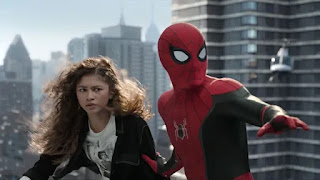
'Spider-Man' takes a big step forward
Sunday, June 7, 2020
Willem Dafoe portrays a film director
With Tommaso, director Abel Ferrara has made a film that I've seen described as semi-autobiographical. I don't know how close to the reality of his life Ferrara has gotten. Judging by the ways in which its main character puts himself in the middle of an unraveling patchwork of a life, I hope not too close.
An independent-minded director, Ferrara has been charting his own course since the early 1970s. During his prolific career, Ferrara, who'll be 69 next month, has divided audiences and critics with movies such as The King of New York (1990) and Bad Lieutenant (1994).
In Tommaso , Ferrara strikes notes that rely almost entirely on his main actor, Willem Dafoe, who has worked with the director on several other movies. Here, Dafoe plays Tommaso, a director who has been living in Rome for several years with a much younger Eastern European wife (Cristina Chiriac) and the couple's three-year-old daughter.
Tommaso is trying hard to put a turbulent past behind him; he has renounced the drugs and alcohol that wrecked his stateside life and he seems intent on constructing some kind of family life in Rome, perhaps as a form of contrition for too much previous bad behavior.
Dafoe moves Tommaso through a variety of scenes that suggest the cobbled-together life of an ex-patriot. He runs an acting school where the focus seems to be on uninhibited movement. He takes care of his daughter and cooks meals when his wife won't. He also attends meetings with fellow addicts and tries to overcome the increasing disdain of a wife who seems eager to spend as little time with him as possible.
When he's stressed, Tommaso meditates or practices yoga. Occasionally, he can be seen working on a screenplay. He's taken up Buddhism.
Dafoe rarely disappoints. He gives Ferrara everything he can, never shying away from the fact that Tommaso can be a real pain in the butt.
It's unlikely anyone will confuse Tommaso with an exercise in rigorously disciplined filmmaking, and there are images (Tommaso meeting a naked woman at a coffee shop) that aren't easily explained. Scenes set in Tommaso's 12-step group feel repetitive and Ferrara can't resist adding an explosive bit of violence toward the end.
No faulting Dafoe, who's game for anything, even allowing Ferrara to refer to the actor's appearance in The Passion of the Christ. You’ll have to get to the film's end to find out how this happens.
Many flaws can be tolerated when a filmmaker works close to the bone, but for me, the movie’s indulgences, its insularity, its fantasies and confessions left little room for any characters other than Tommaso, which, in turn, made me wonder whether Ferrara hadn’t made a film that’s talking mostly to itself.
Thursday, October 31, 2019
A private detective with Tourette syndrome
There’s nothing inherently wrong with long movies. Problems arise, though, when the content and momentum of a particular movie don't match its length. And that’s what happens with Edward Norton’s two-hour and 20-minute adaptation of Jonathan Lethem’s 1999 novel, Motherless Brooklyn.
In adapting Letham’s novel for the screen, Norton (who wrote the screenplay, directed and stars in the movie) uses Lethem’s story about a detective with Tourette syndrome as a launchpad for a conspiratorial tale about the ways in which a powerful figure built the bridges and highways that shaped New York City, destroying neighborhoods in the bargain.
It doesn’t take too much imagination to understand that the movie, set during the 1950s, can be taken as a riff on the career of New York power broker Robert Moses -- and perhaps on all wheeler/dealers who accumulate power without applying any ethical constraints.
A complicated story weaves through the various scenes that push Norton’s character deeper into the dens of power. He’s trying to negotiate his way through a labyrinth he doesn’t fully understand and which, frankly, may baffle audiences, as well — at least in the early going.
Moviegoers with memories probably won’t be able to resist comparisons to Chinatown (1974). But that movie became a classic of contemporary noir. Motherless Brooklyn, I’m afraid, is a wannabe by comparison. I’m talking about the movie's characters, its mood and the lack of chemistry between Norton and the movie’s female lead, portrayed by Gu Gu Mbatha Raw.
No point dwelling on the plot, but a word or two about the secondary characters. Bruce Willis appears briefly as the mentor and employer of Norton's Lionel Essrog. Willis' Frank Minna, a private eye with his own agency, rescued Lionel from an orphanage and schooled him in the ways of the street.
Bobby Cannavale portrays the slickest member of Frank's detective agency. Alec Baldwin appears as Moses Randolph, the movie's power broker, a man who doesn't care how many lives he wrecks. Baldwin is fine, although, in crucial moments, his dialogue is too on-the-nose. Willem Dafoe delivers an angry, agonized performance as a compromised idealist.
Safe to say that none of these characters is all that memorable. The same goes for a community organizer (Cherry Jones), a woman who’s fighting for New York’s neighborhoods. Raw’s character is part of that team, an activist lawyer intent on fighting the powers-that-be.
Michael Kenneth Williams portrays a jazz trumpet player who plies his trade at a Harlem nightclub that figures in the movie’s plot. Always commanding, Williams appears at a moment when Norton allows the narrative to stall; it almost seems as if he values listening to the music on the soundtrack more than moving the plot.
Norton gives Lionel the tics and outbursts that define his brand of Tourette syndrome. In displays of uncontrollable agitation, Lionel tries to put sometimes unrelated things together, which may be a metaphor for how he's trying to deal with a broken society. But Motherless Brooklyn isn't really about a man living with Tourette syndrome; it's a plunge into a corrupted world and the movie eventually staggers under the weight of what appear to be ultra-serious aspirations.
A fine cast keeps Motherless Brooklyn watchable, but something odd happened when Norton changed the time period of Lethem's novel from the 1990s to the 1950s. It lost much of its urgency. Motherless Brooklyn ca be so retro, it feels as tired as some of the clothes you might find in a thrift store, almost worn out -- and maybe a trifle passe.
Thursday, June 6, 2019
A tribute to the imagination of a director
I've read that Willem Dafoe wore director Pier Paolo Pasolini's clothes and eyeglasses while acting in director Abel Ferrara's simply titled, Pasolini, an ode to the fallen Italian filmmaker.
Pasolini's story can be as intriguing as his movies. The director was found dead on a beach in 1975. Seventeen-year-old Giuseppe Pelosi confessed to the brutal murder, which Ferrara depicts as an extreme act of homophobic rage. Pelosi eventually retracted his confession, and Pasolini's death remains a source of speculation. He had plenty of enemies -- from censorious haters of the sexuality in his films to detractors who abhorred his politics.
Ferrara uses the days leading up to Pasolini's death as a springboard for exploring the imagination of a director who also was a novelist and poet. There was Pasolini's work and then there was the man. Pasolini became a champion of independent-minded art that refused to bow at the altar of social convention.
Ferrara also explores Pasolini's view that every bit of humanity was being wrung out of people by corporate and industrial forces and by their own acquisitiveness. There are no more humans, Pasolini tells an interviewer at one point. The interviewer says that he finds piercing moments of light in Pasolini's work doesn't fully understand them. You may find yourself saying the same about Ferrara's movie.
In ways that unbalance us, the movie includes snippets from a film that Pasolini proposed to make. Ferrara begins with a reference to Salo or the 120 Days of Sodom, Pasolini's last film, a work that was excoriated by some for its graphic, humiliating depictions of sexual exploitation.
Pasolini thoughtfully watches a scene from the film, his demeanor suggesting that he's far more interested in its political implications than in its explicitness.
We also learn that Pasolini lived with his mother (Adriana Asti) and a cousin (Giada Colagrande). His home life appears to be calm, even reflective. He also liked to prowl Rome's streets at night looking for sex, a pursuit that may have led to his demise.
Pasolini's films (from The Gospel According to St. Matthew to The Decameron to Arabian Nights) won him admiration from critics, cineastes and perhaps even from his fellow countrymen. People never have been shy about expressing pride in the renown of certain artists -- even if they don't always understand or approve of them.
Pasolini includes sex and violence but Ferrara (best known for movies such as King of New York, Bad Lieutenant and The Addiction) seems in a reflective mood himself.
Is Pasolini about an important Italian filmmaker, about the Ferrara views of the role of artists or about Pasolini's belief that humanity was poised on the edge of an especially dangerous moment? Perhaps all of the above.
It would be impossible and also unforgivable not to say more about Dafoe's performance. Dafoe not only wears Pasolini's clothes but internalizes his spirit. He even holds our attention when Ferrara shows Pasolini sitting at his typewriter, pounding away at a screenplay.
Think what you will about Pasolini, but know that Dafoe, who speaks in English here and who last played Van Gogh in Julian Schnabel's At Eternity's Gate, is a gift to every director who wants to push the medium's boundaries -- and cinema lovers, as well. Movies would be poorer, staider and less challenging without him.
Thursday, December 20, 2018
Silly fun -- but only for a while
For perhaps a quarter of its length, Aquaman proves enjoyably silly, but -- for me at least -- enjoyably silly eventually morphed into an impatient question: Would this display of CGI magic, preposterous plotting and accumulating episodes ever end?
Where that point is reached for you in a two-and-a-half hour movie -- or if it's reached at all -- depends on how much-sustained entertainment you find in this overstuffed water ballet.
The origins story for Aquaman has been placed in the hands of director James Wan (The Conjuring), who creates a DC Comics extravaganza that immerses us in an underwater sea world full of dazzling colors, improbable technologies and a battle over who will rule Atlantis, the sunken city of myth.
A reluctant Aquaman (Jason Momoa) becomes a contender for the throne; the son of a surface-dwelling earthling (Temuera Morrison) and an ocean queen (Nicole Kidman), Momoa's character is presented as a longshot for success.
Also vying for the top job: King Orm (Patrick Wilson), another son of Kidman's Atlanna. Put Orm in the arrogant jerk category. He believes he should be king because of his pure bloodlines. Atlanna married his father after leaving her surface-bound husband -- for good and noble reasons, of course.
Momoa's Aquaman boasts a strong physique and a nonchalance about his various battles with evil, which begin with an attack on a group of pirates led by a vicious character named Manta (Yahya Abdul-Mateen II).
I'm not going to try to elaborate on the undersea world because it requires blind acceptance about such matters as how beams of fiery light exist in the depths of the ocean, how residents of Atlantis breathe without gills and ... oh well ... why go on listing all that's silly in this cornucopia of silliness?
Lest Aquaman become lonely, he's accompanied on most of his adventures by Mera (Amber Heard), a redhead who initially regards him as a hopeless case, but who eventually and unsurprisingly accepts him as the rightful king of Atlantis.
The supporting cast finds Dolph Lundgren playing King Nereus, an underwater noble who must decide where to place his loyalties. Willem Dafoe does Yoda-like duty as Vulko, an Atlantis adviser who becomes Aquaman's mentor.
Characters are made to seem as if they're floating in the depths of the sea, their hair flowing upward. How anyone gets a haircut in Atlantis remains one of the movie's many mysteries.
If you're after action, Aquaman tries (boy does it ever) not to disappoint. Wan has included everything from martial-arts combat to battles with monsters to trident vs. trident mega-bouts.
Did I mention that Aquaman's quest sends him a search for a trident that only a true king can possess, a plot device that takes the movie to the Sahara Desert, as well as to a small coastal town in Sicily?
I also forgot to mention that Aquaman's given name is Arthur and that the great triumphant moment of the film centers on Arthur's emergence as Aquaman, trident raised over his sculpted torso in comic-book glory.
Watching the movie is like reading a variety of Aquaman comics in succession, with a little ecological concern tossed in for good measure. At some point, though, you may get bored and wish you could put the books down and reach for a copy of Batman.
There's plenty of visual invention on display, but the eye can't totally silence a question from the mind: How much underwater spectacle does an Aquaman movie need before we start to drown in it?
Tuesday, November 20, 2018
A feverish movie about van Gogh
No artist seems to have inspired more filmmakers than Vincent van Gogh, not only because van Gogh survives as a painter of obvious art-historical importance but because his life helped to create the classic portrait of the suffering artist, the unrecognized genius who searches for spiritual exultation but also crashes back to earth. In van Gogh's case that meant cutting off his left ear and serving time in a mental asylum.
Julian Schnabel, a well-known contemporary artist and filmmaker, now joins the van Gogh fray with At Eternity's Gate, a movie focusing mostly on van Gogh's life in Arles, which serves as a kind of preface to his untimely and still somewhat mysterious death. He was shot in the stomach but there's disagreement about whether van Gogh was murdered or killed himself. He was 37 when he died in 1890.
Schnabel uses van Gogh's letters to his brother Theo, invented dialogue and some of the actual locations where van Gogh painted to bolster what amounts to an interpretive plunge into van Gogh's alternately soaring, alternately troubled mind, conveyed with disturbing authenticity by actor Willem Dafoe.
Schnabel, who wrote the screenplay with Louise Kugelberg and Jean-Claude Carriere, presents a view of the artist as a visionary who saw through to the essence of reality in nature but, ironically, began to lose touch with reality in his own life, often failing to remember important events.
The movie's most impressive support comes from Oscar Isaac as Paul Gaugin, a far more self-assured artist than van Gogh whose lack of prominence during his lifetime continually caused him to question his own ability.
Rupert Friend portrays Theo, van Gogh's tender, accepting brother and patron. Mads Mikkelsen plays a priest who's assigned the task of judging van Gogh's mental state before he's released from an asylum and turned back into the world.
Mathieu Amalric, who appeared in Schnabel's The Diving Bell and the Butterfly, portrays Dr. Gachet, the physician who cared for van Gogh and became the subject of one his most famous portraits. Emmanuelle Seigner plays Marie Ginoux, another subject of a van Gogh portrait and owner of a cafe in Arles, the town where van Gogh drank -- often too much. French actor Niels Arestrup has a brief but compelling turn as a fellow patient at the asylum where van Gogh commits himself.
Schnabel spends time showing van Gogh developing his relationship with nature -- at first simply observing, then sketching and finally painting.
Van Gogh heads to Arles for sunlight but arrives at a moment when the land remains under the grip of winter's chill. A desolate image of a field of lifeless sunflowers suggests that moribund nature awaits van Gogh's reviving eye.
At one point, Gaugin tells van Gogh that he paints too fast and overpaints; i.e., he uses so much paint his art tends to look like sculpture, presumably a conversation that Schnabel imagined van Gogh and Gaugin might have had.
I had a roughly similar feeling about cinematographer Benoit Delhomme's hand-held work. At best, Delhomme uses his camera to simulate the rapid strokes of a palette knife or the darting of the painter's eyes. But an unsteady camera also proves disorienting. And some of the visual tricks of focus and non-focus push too hard to give us a view of what van Gogh might have seen during episodes in which he's losing his grip.
Then, there's the question of age. Dafoe is 63 years old. Amazingly, casting him as van Gogh in his 30s doesn't prove distracting because we're witnessing an intensely subjective account of van Gogh's final years. Think of Dafoe as the embodiment of van Gogh's old soul.
For the most part, Schnabel tries to keep his work contemporaneous with van Gogh's exploratory intellect. In an early picture episode, van Gogh approaches a young woman who's herding sheep.
"Look at me," he implores, saying he wants to sketch her.
Van Gogh yearned to be seen -- not as an act of an unsatisfied ego but as the fulfillment of what he saw as a calling. Van Gogh's desire to share his vision underlies nearly everything that happens as Schnabel moves from one part of the story to the next, allowing the screen to sink into blackness between each of the movie's vignettes.
Not one for creative timidity, Schnabel even begins the movie daringly. We see a darkened screen and hear van Gogh talking about his very simple desire for acceptance and comfort. There aren't many directors who'd begin a movie about one of the world's most famous artist with words rather than with an image.
At Eternity's Gate marks the second film Schnabel has made about a painter. His first feature -- 1996's Basquiat -- looked at another painter whose life ended early. Jean-Michel Basquiat was 28 when a heroin overdose cut his life short.
If you're interested in understanding the mood Schnabel creates in his second movie about someone who can be viewed as an art-world casualty, you might want to take a look at the painting for which the movie is named. That painting was made by van Gogh in 1890, the year of his death. It shows a balding man sitting on a wooden chair in front of a sketchily drawn fire. The man's elbows rest on his thighs. His head is buried in his clenched fists. Presumably, he's thinking about his death, which may be imminent.
Can van Gogh's subject find something redeeming in this moment of sorrowful apprehension? You may want to think about that question as you watch Dafoe become van Gogh in Schnabel's boldly conceived, if somewhat jagged, interpretation.*
My favorite movie about artist Vincent van Gogh remains director Paul Cox's Vincent, a documentary that made its way into theaters in 1987. To make his movie, Cox used van Gogh's paintings, the locations in which the painter worked and excerpts from letters van Gogh wrote to his brother Theo. The combination allowed Cox to capture van Gogh's search for transcendence, a spiritual journey anchored in the earthy realities of the landscapes that compelled him.
Thursday, November 9, 2017
Kenneth Branagh rides the Orient Express
I'd be lying if I told you that I recall every detail of director Sidney Lumet's 1974 hit Murder on the Orient Express, but I do remember that the movie was fun. Albert Finney appeared as the great Belgian detective, Hercule Poirot, heading an all-star cast that included Lauren Bacall, Ingrid Bergman, John Gielgud and Sean Connery.
The trouble with Kenneth Branagh's new version, which stars Branagh as Poirot, is that the movie can't wring enough enjoyment out of the journey from Istanbul to Calais -- not for the train's passengers and, more importantly, for us.
Murder on the Orient Express mostly serves to showcase Branagh's turn as Poirot in his version of Agatha Christie's classic 1934 mystery, and, no, Branagh isn’t as good as Finney.
Before the preview screening of Orient Express, I wondered why Branagh had bothered to remake it. After the movie concluded, I could find no special reason for him to have taken another go at material that also has yielded a 2001 TV movie in which Alfred Molina portrayed Poirot.
In this latest outing, Branagh upstages a hefty cast, which includes Michelle Pfeiffer, Josh Gad, Willem Dafoe, Penelope Cruz, Derek Jacoby, Judi Dench, Daisy Ridley and Leslie Odom Jr. Johnny Depp signs on, as well.
Branagh tries to provide visual bang for the buck with exterior shots of the mountains across which the train speeds, an avalanche that derails the engine, and even a few scenes outside of the train. The drama’s resolution takes place in a tunnel where the suspects are lined up at a long table as if they were about to stage a news conference.
I tired of Branagh's Poirot, particularly given the movie’s monotonous structure: Poirot interviews suspects (i.e., the supporting cast) one after another, each appearing in perfunctory fashion as if Branagh is following a time table rather than a script.
Nothing, of course, is as it seems, but Branagh doesn't optimize the participation of a strong cast. Only Pfeiffer comes close to receiving her own small showcase. Mostly, the supporting characters fail to generate keen interest.
For those who haven't read Christie's novel or seen the 1974 movie, there's no point spoiling the mystery, although it's worth noting that lots of attention seems to have gone into the movie's production design, creating the illusion that we're on a most opulent journey.
When Poirot finally solves the mystery, the movie hits its stride, but much of Orient Express proves a snooze-worthy ride in the company of a morally insistent detective who so values balance that he only eats eggs of precisely the same size.
If the light from your mobile device weren't likely to disrupt the experience of others, I'd suggest that this is one journey on which you might consider bringing a book -- perhaps something by Agatha Christie.
Thursday, October 19, 2017
A heartbreaking ode to childhood
Not coincidentally, the movie takes place near Disney World, an attraction dedicated to an entirely different view of childhood and family than the one the movie so keenly observes. Also not coincidentally -- but definitely ironically -- the motel in which much of the story takes place is called The Magic Castle. Nothing about The Magic Castle, a dump coated with purple paint, seems either magical or noble.
If you're interested in knowing how certain effects in movies are achieved, a bit of on-line research usually can lead you to answers. But I don't know if it's possible to explain how director Sean Baker (Tangerine) obtained the performances that make The Florida Project so convincing and special, particularly from the kids who populate his movie.
Six-year-old Moonee, rendered in an irrepressibly energetic performance by Brooklynn Prince, provides the movie with its centerpiece. Moonee seems to be enjoying a summer away from school with two friends: Scooty (Christopher Rivera) and Jancey (Valeria Cotto). Cotta's Jancey lives with her grandmother in the nearby and equally bereft Futureland Inn.
These are not kids who are sent to summer camps, chauffeured from one enriching activity to another or otherwise sheltered from the harsh realities of a junk-food life in a place where most of the residents have little chance for brighter futures.
It's not surprising that at one point, the kids badly damage an abandoned property or that each of them becomes vulnerable to dangers that Baker doesn't always follow to the most harrowing extremes. What would be the point? Things are bad enough for these kids without piling on.
Moonee lives with her mother (a terrific Bria Vinaite), a young woman who tries to cobble together a life. Vinaite's Halley perpetually runs out of money and we fear that she'll never get a grip on how to be a responsible adult, much less a mother. But -- and here's where the movie shines -- it's equally clear that no matter how unprepared for motherhood Halley is at 22, she loves Moonee. She can be a playmate and a friend to her daughter, but she can't be the adult in the room, probably because in one way or another her early life mirrored Moonee's.
A world-weary custodian named Bobby (an excellent Willem Dafoe) presides over the motel. Bobby collects rent, enforces rules and tries to maintain a semblance of order. Dafoe portrays a sympathetic man who has seen almost every manner of hardship befall the denizens of this shabby world, often more than once. When he tries to help, he knows that he's bucking a tide of bad luck and despair.
The achievement of cinematographer Alexis Zabe must be acknowledged; his images can be lustrous and beautiful without shortchanging the seedy environment in which Moonee and Halley spend their time, occasionally trying to get a taste of the good life. When Moonee has a chance her to eat a real meal, her face practically erupts with delight.
Sometimes, there's less need to rattle on about exceptional movies than when we deal those that are mediocre. That may be the case with The Florida Project, a movie that concludes with a scene catapults Moonee into a world of promise and fantasy.
I won't say anything more about the movie's final shot, but everything that precedes it tells us that Baker knows better. Rude awakenings loom in Moonee's world of dreams. And that's what accounts for the sadness beneath every moment of euphoria in The Florida Project: Fantasies may buoy our spirits, but they also can curdle into the most devastating of lies.
Thursday, February 16, 2017
This 'Wall' is far from great
Can a wall protect a country's capital from being overrun by hordes of lethal monsters?
No, we're not talking about a debate on the Senate floor, but about a large-scale movie that turns Matt Damon into a western warrior enlisted in a Chinese battle to preserve humanity.
Directed by Zhang Yimou and shot entirely in China, The Great Wall may not totally crumble, but it doesn't rise to epic standards, either.
And for cineasts, the movie hardly marks a milestone. Zhang made his entry on the international stage with Red Sorghum (1987). He continued with Ju Dou (1990), Raise the Red Lantern (1991) and Shanghai Triad (1995). He was regarded as a young master of what was known as the Fifth Generation of Chinese filmmakers, and his work was bolstered by the presence of the beautiful and talented Gong Li.
In later movies such as Hero (2002) and House of Flying Daggers (2004), Zhang began turning out highly stylized martial arts films. And in 2008, he directed the opening ceremony of the Beijing Olympics.
Now comes The Great Wall, a movie whose only virtues involve costumes, spectacle and CGI-enhanced action. It seems to derive less from Zhang's earlier work than from his spectacular Olympic contributions.
Burdened by stock characters, wooden dialogue (much of it in English), and lame attempts at humor, the movie offers a less-than-stirring rendition of a legend about creatures that storm China's Great Wall in an effort to reach the capital.
The movie's dragon-like creatures -- Tao Tie by name -- are connected to a finger-wagging theme. It seems the monsters emerge every 60 years, which evidently coincides with society having become too greedy for its own good.
The Great Wall feels overly calibrated for international success with lots of action, some of it impressive. The first assault on the Great Wall (here serving as a fortress protecting the capital) involves archers in red armor and women in blue armor who leap off towering platforms to spear the dragons. If color could kill, these warriors would have no equal.
There's a whisper of a story. Damon portrays William, a western mercenary who has traveled to China with his warrior pals in hopes of cornering the gunpowder market. After most of his comrades are killed in early-picture skirmishes, William and his pal Tovar (Pedro Pascal) become prisoners of the Nameless Order, the army that occupies the Wall, executing its various maneuvers to a variety of compelling drum beats.
There's spectacle, but much of it feels underlined to elicit oohs and aahs: a scene in which thousands of lanterns are borne skyward in tribute to a fallen general, for example.
Willem Dafoe signs on as a character who also came to China in search of gunpowder, but who has been kept inside the great Chinese redoubt for 25 years. He wants to help William and Tovar escape so that he, too, can make his way back to the western world with plenty of gunpowder in tow.
The Chinese display a variety of weapons, but William pretty much sticks to archery. His skill as an archer impresses his captors. Eventually, his prowess is recognized by Lin (Jing Tian), a woman commander. She leads the squads of blue-clad female warriors who leap off the side of the Great Wall, doing their lethal work before being hoisted back up.
There's a bit of a moral here -- albeit a hackneyed one. Will William cling to his mercenary values or will he fight for a higher ideal, as in helping to save the unsuspecting residents of the capital? The Chinese understand higher ideals: trust and sacrifice. The Westerns are decidedly more crass.
A lack of stand-out performances (Damon included) doesn't help to turn the movie into anything more than a display of visual extravagance. And there's virtually no suspense in wondering whether -- in the end -- Damon's William will do the right thing.
I won't say more about whether the Tao Ties eventually reach the capital. But I will say that our president might do well to watch this movie because it says something about the effectiveness (or lack thereof) of walls when it comes to defending the populace from invasion.
Thursday, October 23, 2014
Bullets fly in 'John Wick'
In the movies, hitmen seldom retire to lives of leisurely bliss.
So we're not especially surprised when John Wick -- an assassin and the newly widowed title character of a new movie starring Keanu Reeves -- is pushed back into action.
We are a bit surprised, though, when (and I include this spoiler for the benefit of pet lovers), the dog his late wife gave him to help with grieving is killed by the sadistic son (Alfie Allen) of a Russian crime czar (Michael Nyqvist).
You can do a lot to a guy, but kill his dog? That's a major no-no.
John Wick, which was directed by Chad Stahelski, is a movie aimed at piling up box-office receipts as fast as falling bodies -- and lots of bodies bite the dust in a frenzied helping of violence that harkens back to some of the Hong Kong bloodbaths of the '80s and '90s. Think John Woo, only without as much style and without Chow Yun-Fat.
Reeves has been surrounded by a supporting cast that knows how to sell this kind of brutal gruel. Nyqvist has fun as the apparently judicious father of a son who believes he owns the world, and Willem Dafoe shows up as another hitman.
Plentiful fight sequences are well-orchestrated by Stahelski, who knows how to fulfill genre obligations.
John Wick is the kind of guilty pleasure that takes us back to grindhouse days, and I have no problem with that.
A wish, though: I wish that Reeves could bring at least a hint of subtext to the role. His character may triumph in the end, but the actors playing the bad guys have Reeves beat by a mile.
Thursday, June 5, 2014
Love and cancer in a YA package
Before a preview screening of the new movie The Fault in Our Stars, I noticed that each of the two people seated directly in front of me held a full box of tissues. It turns out they were mother and son.
The young man -- evidently brave enough to venture beyond Fault's predominantly female demographic -- had read the novel on which the movie is based. His mother hadn't. She'd been prepped, though, and was ready for the disturbingly sad parts of a teen romance about two kids with cancer.
I'd read about John Green's mega-bestseller, but hadn't read the book, so I let mother and her son serve as a kind of early warning system for me: I don't know if they each used an entire box of tissues, but they were smart to be ready.
The Fault in Our Stars is what my late mother's generation used to call a three-handkerchief movie, a description that needs no further elaboration.
But -- and it's a big but -- The Fault in Our Stars deserves credit for something it isn't; i.e., dumb and condescending.
Yes, these cancer suffers -- played by Ansel Elgort and Shailene Woodley -- are physically attractive. Yes, they're bright. And, yes, they seem to have been glamorized by director Josh Boone, who makes sure the love story powers the sometimes melancholy proceedings.
But The Fault in Our Stars earns the lump it puts in your throat, and it preserves what appear to be the more ambitious aims of Green's novel: Wondering about what happens after death (possibly nothing), maintaining a healthy skepticism about confessional behavior in a support group, acknowledging that there's no way around feeling some kinds of pain and admitting that we'll all be lucky if one or two people remember us when we're gone.
Woodley gives the movie its soul. Her character -- 16-year-old Hazel Grace Lancaster -- narrates the story, thus preserving some of the novel's tone and voice.
Woodley, who also appeared in Fault screenwriters' Scott Neustadter and Michael H. Weber's The Spectacular Now, brings intellignce and wit to Hazel Grace, who's learned not to be swept away by anyone's hollow bromides.
Elgort, who appeared with Woodley in Divergent, tends toward hunkiness: His character is less complex than Hazel Grace. His Augustus Waters is a former high school basketball star whose cancer cost him a leg, but who can seem far too good-spirited to be true.
Most of what transpires keeps close to teen realities - except possibly for a trip to Amsterdam engineered by Elgort's Augustus. The point of the travel: to visit Peter Van Houton (Willem Dafoe), the author of An Imperial Affliction, Hazel Grace's favorite novel.
Hazel Grace wants to ask deep questions about the ending of Van Houton's novel, but the author turns out to be a bitter drunk, a character who exists mostly to raise a cautionary point for young readers: Best not to confuse wisdom on the page with the character of the author.
Dafoe doesn't hold back when it comes to portraying Van Houton's cruelty, but the trip to Amsterdam makes room for other developments, including an unfortunate visit to the Anne Frank home, accompanied by voice-over readings from Frank's famous diary.
Frank died in the Bergen-Belsen concentration camp in 1945. She was 15. Bringing up Frank's story -- perhaps to amplify a point about embracing life amid abundant suffering -- seems too hard a tug at the heart strings, a needless exclamation point in a story that has plenty of its own emotional juice.
The story belongs to Woodley and Elgort, but the supporting cast adds flavor. Nat Wolff has a nice turn as August's friend Isaac, a teen-ager who has lost one eye to cancer and is about to lose another.
Laura Dern and Sam Trammel don't have a lot to do as Hazel Grace's parents, but the movie doesn't make buffoons out of them: They can't control a situation that's devastating for them.
Look, these cancer patients probably look a little too good for sick people, but one mustn't forget that The Fault in Our Stars makes no bones about being a Hollywood movie, and it will be seen by many who would shun a more aggressively realistic film.
Did the extended ending constitute a form of emotional piling on? Probably. Did I cry? No.
But here's the thing: I respect the tears of those who did -- and that's saying something.
Thursday, December 5, 2013
Hard times in Pennsylvania
Almost every moment in Out of the Furnace -- a brooding working-class drama steeped in Rust Belt realism -- seems amplified in what feels like a strained search for meaning.
Boasting a terrific bad-ass performance by Woody Harrelson, the movie nonetheless seems an ultimately failed attempt to give pulpy material a socially significant boost. Director Scott Cooper (Crazy Heart) tries for thematic elevation by garnishing a revenge-oriented drama with woes created by diminished economic opportunity and the psychological suffering of Iraqi war veterans.
Cooper (Crazy Heart) builds his generally grim movie around an intense performance by Christian Bale, who plays Russell Baze, a Pennsylvania steel mill worker and the older brother of Rodney Baze (Casey Affleck), a troubled veteran of four tours in Iraq.
Credited to Brad Ingelsby and Cooper, the screenplay piles on plenty of complications.
Principal among these twists: Russell winds up in prison after a fatal car accident. He was drinking.
Meanwhile, Rodney pleads with a local bookmaker (Willem Dafoe) to arrange a big-money, bare-knuckle fight for him in New Jersey.
As it turns out, the Jersey bare-knuckle scene and a variety of other criminal activities are presided over by Harrelson's Harlan DeGroat, a character cast in the fires of unapologetic evil.
But wait ... there's more:
While he's in jail, Russell's former girlfriend Lena (Zoe Saldana) takes up with a new lover, a sheriff played by Forest Whitaker, who might just as well have found something else to do for all the impact the script allows his character to make.
We also meet Russell's uncle (Sam Shepard), a character who rounds out the cast of hard-working, salt-of-the-earth Pennsylvanians, guys who toed the line, drank their beer, prayed the rosary, asked for nothing and went deer hunting for recreation.
You can tell that a movie is going for high-voltage impact when Dafoe -- no stranger to tough-textured realism -- gives one of the film's more relaxed performances.
There's no reason to fault any of the acting, but Harrelson's frightening performance achieves stand-out prominence.
Harrelson's DeGroat makes his presence known in the movie's opening scene, a brutal encounter that takes place in a drive-in and which calls for DeGroat to ram a hotdog down his date's throat before mercilessly assaulting a good samaritan who tries to intervene in the poor woman's behalf. DeGroat's wearing shorts at the time, a sartorial choice that gives his violence an alarmingly informal air.
It's equally clear that Affleck's Rodney has veered out of control -- albeit in a completely different way. Rodney has no interest in working in a steel mill, has accumulated substantial gambling debts and simmers with rage over lost comrades and memories of war-time carnage.
Cooper and cinematographer Masanobu Takayanagi do their best to give the gritty Pennsylvania settings -- steel mills, bars, dreary row houses and abandoned factories -- the kind of polished decay that movies can bring to towns that have seen better days.
Bale's deep-immersion performance doesn't leave much on the table, but Out of the Furnace can't quite transcend revenge impulses that ultimately take over and cheapen a drama that seems to be trying for more.
And try it does. If it were possible to get a hernia from attempting something meaningful, everyone involved in Out of the Furnace would need abdominal surgery. In the end, though, I'm not sure that this isn't a case in which black-and-blue marks outnumber serious insights -- despite all the heavy lifting.
Thursday, May 17, 2012
The end of the world and other matters
What would you do if you knew that the world was going to end today? No loopholes. No escape clauses. You and the rest of humanity are about to become extinct. That's the question that director Abel Ferrara -- perhaps best known for the scabrous cop drama Bad Lieutenant -- asks in 4:44 Last Day on Earth. Judging by the movie's two main characters (Willem DaFoe and Shanyn Leigh) the answer goes something like this: You'd pretty much do what you always do -- only with a heightened consciousness that you were living your final hours. Leigh plays an artist who paints in the couple's New York loft; DaFoe portrays a reformed drug addict. So what happens? A delivery kid shows up with Chinese food. DaFoe calls his daughter from a previous relationship. The couple makes love, argues, meditates and prepares for the worst. Ferrara surrounds DaFoe and Leigh with TVs (always on), computers and smart phones, making us wonder whether even the end of the world can't be experienced without some form of electronic mediation. Those familiar with Ferrara's work will find a softer, less heated approach in a movie that's not nearly as pretentious as Lars von Trier's Melancholia, which also dealt with the end of the world. Although Buddhist lectures and an interview with the Dalai Lama sometimes play on TVs in the background, neither character in 4:44 Last Day on Earth seems to be asking big questions. The point, one supposes, is not to imagine the end of all humanity, but to encourage thought about what really should matter to us. The movie blames man-created holes in the ozone layer for the approaching doom. But let's face it: The difficult truth, the one we seldom choose to acknowledge, is that any day could be our last. DaFoe and Leigh sometimes seem to be improvising, which means there are awkwardly acted moments, but there's also an undeniable quality of exhausted resignation about 4:44 The Last Day on Earth, a feeling that stems from knowing that there will come a moment when the universe puts a period at the end of each of our meager sentences -- and from thinking that all of humanity could reach a point when there will no next generation to set things right.
A THIEF IS TOPPLED FROM HIS ARROGANT PERCH
The Norwegian film Headhunters begins as if it's going to be a crackling thriller about a corporate headhunter who, in his spare time, steals art. In this full-time executive and part-time thief, director Morten Tyldum has found an interesting character, and actor Aksel Hennie imbues him with the kind of arrogance that accrues to someone who thinks he's putting something over on the world, even if he's not sure his run of unearned luck can last. Hennie's Roger Brown has a beautiful wife (Synnøve Macody Lund), a stylishly modern home and lots of possibilities for new art thefts. He also has an accomplice (Elvind Sander), a worker at a security firm who (for a price) shuts off the alarms at the homes Roger burglarizes. Roger's life changes on the day that he's approached by a confident CEO type (Nikolaj Coster-Waldau), who's looking for a new job. The movie then turns into a kind of cat-and-mouse game revolving around a valuable painting that has come into the possession of Coster-Waldau's character. We suspect something particularly strange is up when Coster-Waldau's character begins to reveal his background. He's a former special forces guy who worked for a company that has invented all kinds of high-tech tracking devices. Tyldum eventually switches gears, turning the movie into a disturbing game of can-you-top-this with Roger falling into one terrible trap after another. I'll spare you the details, but the squeamish should exercise a bit of caution here. Tyldum has a refined taste for macabre visual sight gags, and it should tell you something that Headhunters already has been slated for an American remake, perhaps because Tyldum builds the story around imaginatively conceived and steadily escalating physical horrors and perhaps because the movie's view of corporate types is fashionably unflattering. Headhunters is involving to be sure, but I couldn't help thinking that it's also one more movie looking for outré ways to distinguish itself from the rest of the indie pack.