Showing posts with label Letitia Wright. Show all posts

Wednesday, November 9, 2022

A mostly satisfying 'Black Panther' sequel


  Black Panther: Wakanda Forever makes  a mostly worthy addition to a series forced to compensate for the death of its star, Chadwick Boseman. After Boseman’s death in 2020, the filmmakers faced a monumental problem: How to keep the series going without T'Challa, its main character?
   Viewers will no doubt argue about how well director Ryan Coogler solves the problem, but Coolger —who directed the first installment —lays the groundwork for more Black Panther movies by giving this sequel a strong cast of women while maintaining a respectful tone for what has been lost. 
     Is Boseman missed? Of course.
     Wakanda Forever sometimes feels like a movie stocked with supporting players and no clear lead. As the Queen Mother, Angela Bassett receives a good deal of attention, as does Letitia Wright, who plays Shuri, T'Challa's  tech-savvy sister.
     Both Wright and Bassett embody the movie's major theme: coping with loss. At one point, Shuri asks how a threatened Wakanda will survive without Black Panther to protect it? Much of the story involves attempts by various characters to answer that question, a process that sometimes feels labored.
    Familiar faces help. When series' regulars turn up, we're happy to see them. Among them: Danai Gurira as the stern general Okoye. Lupita Nyong'o reprises her role as Anika, entering the picture about midway through.
       So what happens in this Marvel extravaganza? 
       Outside forces threaten Wakanda’s tranquility. The nations of the world want to obtain vibranium, the substance that has allowed powerful Wakanda to develop into a tech paradise.
      The CIA acquires a machine invented by an MIT student (Dominique Thorne) that can detect vibranium. The agency has begun using this scanner to survey oceans for vibranium, a manifestation of the imperialist greed that Wakanda loathes.
     But wait, there's more.
     The underwater kingdom of Talokan (yes, a whole other empire) thwarts the CIA efforts. Talokan also has a supply of vibranium, which helps its residents survive in the sea.
     Trouble looms. The soft-spoken leader of Talokan (Tenoch Huerta) wants to join forces with Wakanda to stop the devious plans of the "surface people," as he calls the nations who lust after vibranium. 
    Hoping to avoid global conflagration, Bassett’s Queen Romonda,  a character of pinpoint ferocity, declines, thus lighting the fuse of conflict. Talokan and Wakanda square off in the movie's climactic scene, a nifty sea battle featuring a giant ship and flying warriors.
     A two-hour and 41-minute running time proves excessive, and not everything soars. A less-than-thrilling tangent involves  Martin Freeman and Julia Louise Dreyfus  as CIA agents.
     What I missed most about this edition of Black Panther was the elevating aura of Afro-centric nobility and discovery that permeated the first installment. The sense of ennobling fantasy dwindles as Wakanda Forever spins through its various plot threads and expositional chores.
      The first Black Panther felt like an entertaining superhero movie and a cultural game changer. This one feels more like a step in the Marvel franchise staircase. But considering the heavy burden that Coogler carried, the movie qualifies as a success -- even if we grumble a little.
       Wakanda Forever wraps things up with an appropriate expression of sadness for the loss of Boseman and T'Challa, and perhaps, most importantly, with a clear commitment not to cheapen the experience that captivated so many the first time around.
       That counts for a lot.


Thursday, February 10, 2022

Floating along with 'Death on the Nile'


   No, Kenneth Branagh, you didn't murder Death on the Nile, but you didn't bring it to scintillating life, either Yes, you have improved over your last venture into Agatha Christie territory, the lamentable 2017 adaptation of Murder on the Orient Express. But 
in neither case have you attained the sizzle to which I assume your aspired.
    Enough with the second-rate Poirot imitation.
    I had hoped that Death on the Nile would provide the tonic that the big-screen needs at this doom-struck moment. Hardly awful but lacking in distinguishing spark, Death on the Nile turns out to be a middle-grade effort.
   As was the case with Murder on the Orient Express, Branagh plays Hercule Poirot, the Belgian detective who has been solving crimes since Christie first introduced him in 1920.
   Branagh's performance — headlined by a freight train of a Belgian accent — functions somewhat in the same way as paint splattered on a carefully composed canvas. Branagh makes sure that we know Poirot is an oddball, a sharp-eyed detective with a taste for fancy pastries.
  None of this is to say that Death on the Nile lacks highlights, among them: Haris Zambarloukos's cinematography, Jim Clay's production design, and the costume design by Paco Delgado and Jobanjit Singh.
    But such accouterments have a downside, as well. I'm not sure that Emma Mackey, as the passionate, insanely jealous Jacqueline de Bellefort, isn't upstaged by her dress (think neo-Cleopatra) at a key point in the movie.
   Other highlights include Sophie Okonedo as an American jazz singer armed with a quick wit.  She's accompanied by her niece (Letitia Wright), a young woman who manages the singer’s business affairs. 
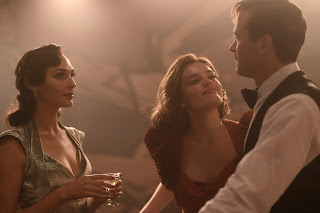
    Christie stories typically confine a large number characters in a single location, in this case, a yacht that embarks from Karnak for the honeymoon celebration of Linnet Ridgeway (Gal Gadot), a wealthy beauty who has married Simon Doyle (Armie Hammer).
    Before the story arrives in Egypt, we get London-based cabaret scenes in which Doyle seems to be totally consumed with passion for Mackey's Jacqueline de Bellefort. Passion or not, Doyle doesn't hesitate to drop de Bellefort for Ridgeway, thus setting off the jealousy that drives the plot. 
    De Bellefort hates being aced out by her best friend but she's far from the movie's only suspect.
    The passenger manifest includes the British comedy team of Dawn French and Jenifer Saunders. Annette Bening plays mother to Bouc (Tom Bateman), Poirot's pal and a generally carefree fellow. 
    I could go on, but only at risk of turning this review into a roster.
    Rather, I'll say that screenwriter Michael Green begins with a World War I flashback in which we learn Poirot's backstory, which includes lost love and an explanation of why he wears a mustache that qualifies as a special effect.
     For a finale, all the movie's suspects gather in a single location so that Poirot can pick them apart, preying on their weaknesses, until he finally reveals whodunit. 
    No harm will come to those who see Death on the Nile and some may enjoy its throwback pleasures. But I was looking to be buoyed by watching these folks, many without virtue, bob wickedly on the Nile. 
    Instead, I found myself merely floating along.