Showing posts with label Sophie Okonedo. Show all posts

Thursday, June 27, 2024

Dull movie about a rich subject


  Janet Planet explores the complex relationship between a single mother (Julianne Nicholson) and her young daughter (Zoe Ziegler).
  The subject brims with possibility. Visitors (some in romantic relationships with Mom) come and go, leaving Ziegler's 11-year-old Lacy to adjust to Mom's fluid living situation.
  Writer/director Annie Baker, a Pulitzer Prize-winning playwright, sets her film in a cabin-like home in rural Massachusetts, attuning the story to the viewpoint of a child who craves more of her mother's attention.
    Promising, yes, but the movie goes flat.
    Baker's directorial choices favor the ordinary over the dramatic, not necessarily a mistake but one that risks tedium. Made with an often static camera and indulging a preference for pauses that threaten to tip into emptiness, Janet Planet drifts into dullness. 
    Baker structures the movie around the instability with which Lacy lives, introducing various residents of the house occupied by Mom  -- Janet of the title -- and Lacy.
    Early on, Janet, a recently licensed acupuncturist, is seen living with Wayne (Will Patton), a brooding fellow who seems to regard conversation as a mortal sin. Baker introduces the “Wayne’’ scenes with a title card reading, "Wayne." When Wayne departs, another title card offers a terse, "End Wayne."
    The rest of the movie follows suit: Additional chapter headings introduce Regina (Sophie Okonedo), a former friend who moves in for a while.
    A bearded visitor named Avi (Elias Koteas) follows Regina into the house. He offers short talks on big subjects, notably the origin of the universe. Avi  doesn't converse, so much as lecture, a role he may have adopted as leader of a cult to which Regina once belonged.
   I wondered whether Baker found these characters more interesting than I did.
   Baker doesn't do much to vary the movie's tone. Lucy leaves home for a piano Lesson. She and another girl run around a local mall. Lacy sets up a small stage in her bedroom and populates it with figurines.  Mother and daughter walk into the woods to view a show given by a roving theater company in which performers don large puppet costumes.
    The performances have a tamped down quality. A quirky Ziegler convey's Lacy's distress As played by Nicholson, Janet fumbles her way through relationships and agonizes about whether she's capable of finding fulfillment. She makes bad choices in men.
    Dry flashes of humor can be found. The movie opens with Lacy calling her mother and asking to be picked up from summer camp. Her suitcase is ready.
    "I'm going to kill myself if you don't come get me,'' she says, ridiculously raising the stakes of her request.
    Janet Planet  felt edgeless to me, a movie that was  reluctant to sharpen anything that might have added dramatic seasoning. 
    When Lacy practices piano on a folding keyboard, it's clear that she's no budding Paderewsky. If that's meant to be humorous, it works for a second, but the joke quickly deflates.
    Baker has rich dramatic soil to till but nothing much grows from it. Janet Planet seldom opens up emotionally. For me, it became a slog.
    

Thursday, February 10, 2022

Floating along with 'Death on the Nile'


   No, Kenneth Branagh, you didn't murder Death on the Nile, but you didn't bring it to scintillating life, either Yes, you have improved over your last venture into Agatha Christie territory, the lamentable 2017 adaptation of Murder on the Orient Express. But 
in neither case have you attained the sizzle to which I assume your aspired.
    Enough with the second-rate Poirot imitation.
    I had hoped that Death on the Nile would provide the tonic that the big-screen needs at this doom-struck moment. Hardly awful but lacking in distinguishing spark, Death on the Nile turns out to be a middle-grade effort.
   As was the case with Murder on the Orient Express, Branagh plays Hercule Poirot, the Belgian detective who has been solving crimes since Christie first introduced him in 1920.
   Branagh's performance — headlined by a freight train of a Belgian accent — functions somewhat in the same way as paint splattered on a carefully composed canvas. Branagh makes sure that we know Poirot is an oddball, a sharp-eyed detective with a taste for fancy pastries.
  None of this is to say that Death on the Nile lacks highlights, among them: Haris Zambarloukos's cinematography, Jim Clay's production design, and the costume design by Paco Delgado and Jobanjit Singh.
    But such accouterments have a downside, as well. I'm not sure that Emma Mackey, as the passionate, insanely jealous Jacqueline de Bellefort, isn't upstaged by her dress (think neo-Cleopatra) at a key point in the movie.
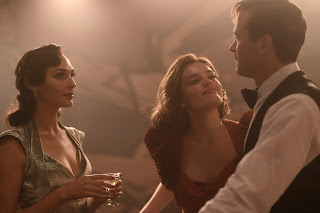
   Other highlights include Sophie Okonedo as an American jazz singer armed with a quick wit.  She's accompanied by her niece (Letitia Wright), a young woman who manages the singer’s business affairs. 
    Christie stories typically confine a large number characters in a single location, in this case, a yacht that embarks from Karnak for the honeymoon celebration of Linnet Ridgeway (Gal Gadot), a wealthy beauty who has married Simon Doyle (Armie Hammer).
    Before the story arrives in Egypt, we get London-based cabaret scenes in which Doyle seems to be totally consumed with passion for Mackey's Jacqueline de Bellefort. Passion or not, Doyle doesn't hesitate to drop de Bellefort for Ridgeway, thus setting off the jealousy that drives the plot. 
    De Bellefort hates being aced out by her best friend but she's far from the movie's only suspect.
    The passenger manifest includes the British comedy team of Dawn French and Jenifer Saunders. Annette Bening plays mother to Bouc (Tom Bateman), Poirot's pal and a generally carefree fellow. 
    I could go on, but only at risk of turning this review into a roster.
    Rather, I'll say that screenwriter Michael Green begins with a World War I flashback in which we learn Poirot's backstory, which includes lost love and an explanation of why he wears a mustache that qualifies as a special effect.
     For a finale, all the movie's suspects gather in a single location so that Poirot can pick them apart, preying on their weaknesses, until he finally reveals whodunit. 
    No harm will come to those who see Death on the Nile and some may enjoy its throwback pleasures. But I was looking to be buoyed by watching these folks, many without virtue, bob wickedly on the Nile. 
    Instead, I found myself merely floating along.


Thursday, July 4, 2019

Bob's Cinema Diary: 7/5/19 -- Toni Morrison: The Pieces I Am and Wild Rose

A documentary about author Toni Morrison and a raucous feature about an aspiring country singer from Glasgow, Scotland, don't have much in common -- unless you want to see each (in its own way) as a story about a driven, powerful woman.


Toni Morrison: The Pieces I Am

Director Timothy Greenfield-Sanders offers a well-rounded picture of the life of author Toni Morrison in Toni Morrison: The Pieces I Am. Morrison, 88, provides the movie's star power. In a variety of interviews given over many years, Morrison emerges as a formidable presence -- and one who's not afraid to laugh at herself when she deems it necessary. Much of Morrison's early life was spent in Lorain, Ohio, which she describes as a multi-racial, multi-ethnic town with a low level of ethnic and racial tension. But her life seemed to open up when she arrived as an undergraduate at Howard University. What followed her college experience was a career in publishing (she was a successful editor) and, finally, her emergence as a novelist of recognized power. Interviews with author Fran Lebowitz, editor Robert Gottlieb, poet Sonia Sanchez , and activist Angela Davis provide a laudatory environment in which to consider Morrison’s accomplishment. The only references to negative criticism of Morrison's work are presented in brief (and probably over-stated) bits from negative reviews. The movie builds toward a movement by a group of writers who protest the lack of significant prizes (Pulitzers and Nobels) for Morrison's work, an oversight that later was remedied. Morrison won the Pulitzer for her novel, Beloved, in 1988. The Nobel Prize in Literature followed in 1993. What emerges is a portrait of a woman who has spent her life delighting in language and ensuring that she used it without the inhibiting limitations of what she calls "the white gaze." I could have done without Oprah Winfrey's effusions but little in The Pieces I Am detracts from the appeal of Morrison's expansive and profoundly compelling personality. Put another way, it's difficult to imagine that anyone could watch this well-assembled documentary and not want to hang out with the woman at its center.

Wild Rose

The irresistibly raucous Wild Rose begins when its main character is released from prison. Having completed her time in jail,, Rose-Lynn begins pursuing her major aspiration: She wants to be a country singer, an ambition that acquires an air of eccentricity because Rose-Lynn does not have what we might regard as a typical “country” profile. How could she? She lives in Glasgow, Scotland. And maybe that’s part of the movie’s point — at least in an inadvertent way. Musical talent sometimes shatters stereotypical expectations. Early on, few share Rose-Lynn's dream. Her skeptical mother (Julie Walters) wishes Rose-Lynn, who was busted on a drug charge, would settle down and take care of her two children. Rose-Lynn has other ideas. The story unfolds in a somewhat predictable fashion as Rose-Lynn (portrayed by a dynamic Jessie Buckley) marches through the rest of the movie in headstrong fashion, singing and living a rough-edged life. When Rose-Lynn obtains a job as a domestic, her affluent employer (Sophie Okonedo) offers to help propel her career by raising money to finance a dream trip to Nashville. Like many others, Rose-Lynn hopes to be discovered when she arrives in the world’s country music capital. Buckley's performance makes us believe that this is a reasonable ambition for a woman whose credo has been tattooed on her arm: "Three chords and the truth." Buckley's drive keeps the movie hurtling toward a conclusion in which director Tom Harper, working from a screenplay by Nicole Taylor, upsets (at least mildly) the genre cliches that we've come to expect from movies about raw talents on the make and voices that won’t be silenced.

Thursday, May 30, 2013

Two Smiths, one lifeless movie

A dull and derivative After Earth teams Will and Jaden Smith.

In After Earth, Will Smith spends a lot of time trying to remain conscious. He has good reason. His character -- a prime commander in a futuristic army -- suffers two broken legs when an astroid storm causes his spacecraft to crash.

Unfortunately, I, too, had to struggle to stay awake during After Earth, and for equally good reasons. This latest project from M. Night Shyamalan -- a director whose success with The Sixth Sense gave him an elite status that his subsequent work seldom justifies -- is dull, derivative and doomed by a script that displays little by way of inspired imagination when it comes to envisioning a dystopian future. Yes, that again.

For a movie that teams Smith with his son, Jaden, After Death finds surprisingly little emotion in the father/son relationship at the movie's core. Blame here doesn't necessarily fall on the actors' shoulders: Smith worked well with his son in The Pursuit of Happiness (2006), and Jaden has had successes of his own, notably the 2010 remake of The Karate Kid.

One of the movie's major miscalculations involves Will Smith's character, Cypher Raige. Cypher (could there be a worse name for a character?) is a spit-and-polish, no-nonsense general who treats his son more as an army recruit than a young person he loves. To play such a stern father, Smith reduces his performance to a monotonous display of stoicism and military bearing.

The duty-bound Raige has been a mostly absent father: He's been busy fighting aliens, leaving his son in the care of his mom (a badly underutilized Sophie Okonedo). A backstory about about Raige's older daughter (Zoe Isabella Kravitz), makes its way into awkwardly introduced flashbacks and into scenes in which Jaden's character hallucinates about her.

The action begins 1,000 years after people were forced to evacuate the Earth, a planet made uninhabitable by human stupidity and aggression. After the devastation, humans fled to the planet Nova Prime, where they constructed bland futuristic cities and battled hostile alien creatures who evidently didn't appreciate being colonized.

In an effort to create a stronger bond with his son, Kitai, Raige takes the kid on a mission that goes awry with the spaceship crash. Father and son are the only survivors.

The rest of the movie finds the injured Raige using what's left of the craft's equipment to monitor his son's journey through forbidding forests as he tries to retrieve a device that can beam a signal to rescuers. The ship's tail, where the last such functioning device was kept, broke off far from where the main body of the vessel hit ground.

The movie follows a classically mythic structure based on Kitai's maturation. He confronts obstacles, faces his fears, and, finally, must do battle with an alien monster.

No fair picking on Jaden, who's too young to endure any critical scorn, but I was puzzled by the fact that Smith -- who takes a story credit and who serves as one of the movie's producers -- decided that this turgid concoction would make for an exciting father/son vehicle.

The movie's action set pieces -- Kitai confronts a fierce mama eagle, snarling big cats, a group of ferocious monkeys and more -- hardly qualify as edge-of-the-seat entertainment, partly because they're so obviously the result of computer-generated artistry.

If you're a stickler for consistency and credibility in the creation of a sci-fi universe, bring a scorecard: You'll find plenty of missteps to keep you busy.

Smith's character speaks to his son in clipped, lifeless dialogue. He encourages Kitai to carry out certain tasks "ASP," and when the youngster is on the verge of being overcome by panic, dad tells him to "take a knee."

Upon hearing this advice, the youngster drops to one knee and tries to collect himself before moving on to the next uninspired and enervating adventure.

After Earth doesn't qualify as an epic catastrophe, but it's a long way from anyone's best work. In this summer's lineup, it may well wind up being little more than an afterthought.