Showing posts with label Armie Hammer. Show all posts

Thursday, February 10, 2022

Floating along with 'Death on the Nile'


   No, Kenneth Branagh, you didn't murder Death on the Nile, but you didn't bring it to scintillating life, either Yes, you have improved over your last venture into Agatha Christie territory, the lamentable 2017 adaptation of Murder on the Orient Express. But 
in neither case have you attained the sizzle to which I assume your aspired.
    Enough with the second-rate Poirot imitation.
    I had hoped that Death on the Nile would provide the tonic that the big-screen needs at this doom-struck moment. Hardly awful but lacking in distinguishing spark, Death on the Nile turns out to be a middle-grade effort.
   As was the case with Murder on the Orient Express, Branagh plays Hercule Poirot, the Belgian detective who has been solving crimes since Christie first introduced him in 1920.
   Branagh's performance — headlined by a freight train of a Belgian accent — functions somewhat in the same way as paint splattered on a carefully composed canvas. Branagh makes sure that we know Poirot is an oddball, a sharp-eyed detective with a taste for fancy pastries.
  None of this is to say that Death on the Nile lacks highlights, among them: Haris Zambarloukos's cinematography, Jim Clay's production design, and the costume design by Paco Delgado and Jobanjit Singh.
    But such accouterments have a downside, as well. I'm not sure that Emma Mackey, as the passionate, insanely jealous Jacqueline de Bellefort, isn't upstaged by her dress (think neo-Cleopatra) at a key point in the movie.
   Other highlights include Sophie Okonedo as an American jazz singer armed with a quick wit.  She's accompanied by her niece (Letitia Wright), a young woman who manages the singer’s business affairs. 
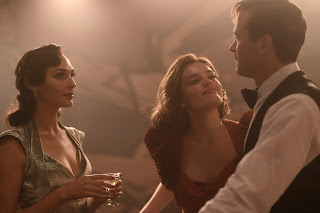
    Christie stories typically confine a large number characters in a single location, in this case, a yacht that embarks from Karnak for the honeymoon celebration of Linnet Ridgeway (Gal Gadot), a wealthy beauty who has married Simon Doyle (Armie Hammer).
    Before the story arrives in Egypt, we get London-based cabaret scenes in which Doyle seems to be totally consumed with passion for Mackey's Jacqueline de Bellefort. Passion or not, Doyle doesn't hesitate to drop de Bellefort for Ridgeway, thus setting off the jealousy that drives the plot. 
    De Bellefort hates being aced out by her best friend but she's far from the movie's only suspect.
    The passenger manifest includes the British comedy team of Dawn French and Jenifer Saunders. Annette Bening plays mother to Bouc (Tom Bateman), Poirot's pal and a generally carefree fellow. 
    I could go on, but only at risk of turning this review into a roster.
    Rather, I'll say that screenwriter Michael Green begins with a World War I flashback in which we learn Poirot's backstory, which includes lost love and an explanation of why he wears a mustache that qualifies as a special effect.
     For a finale, all the movie's suspects gather in a single location so that Poirot can pick them apart, preying on their weaknesses, until he finally reveals whodunit. 
    No harm will come to those who see Death on the Nile and some may enjoy its throwback pleasures. But I was looking to be buoyed by watching these folks, many without virtue, bob wickedly on the Nile. 
    Instead, I found myself merely floating along.


Wednesday, February 24, 2021

A multi-pronged look at the opioid crisis

     Director Nicholas Jarecki must have realized that opioid addiction is a multi-level problem that invades many corners of society. Perhaps that's why Jarecki's Crisis revolves around three stories, each moored in the culture that created one of the US's most severe drug problems.
     Crisis encompasses DEA undercover work, dubious university connections to drug companies, and a mom's search for the cause of her teenage son's death.
     Taking this kind of multi-pronged approach isn't without risks and Jarecki (Arbitrage) can't overcome them all, notably the way his movie loses momentum as it shifts from one story to another.
    The relationship between universities and those who fund research (in this case a major drug company) might not be the most dynamic of the movie's various plot threads but it's the most intriguing and, by itself, could have made for a provocative movie.
    It's equally true that trying to mount several stories, even if they're interrelated,  reduces the movie to a complex but nonetheless unsatisfying procedural.
     Armie Hammer portrays Jake Kelly, a DEA agent who's trying to infiltrate and expose a Canadian/Armenian Fentanyl-smuggling ring. A recovered addict, Clare (Evangeline Lilly) tries to learn how her squeaky-clean son could have died from an overdose, and Gary Oldman portrays Doctor Tyrone Brower, a scientist whose work has been funded by Big Pharma. 
    Now, one of his major donors wants Brower to corroborate its claim that the company has discovered a pain-killing drug that doesn't have the addictive powers of Oxycontin. This part of the movie revolves around Brower's crisis of conscience. He knows the drug isn't as advertised and agonizes about whether to  become a whistleblower.
    Hammer's portion of the movie seems most familiar, a thriller set in the morally ambiguous world of cops and drugs. Lilly's quest feels underdeveloped as she becomes something a cliche, the untrained civilian who decides to play sleuth.
    Goldman does his best to bring Dr. Brower's torment to life, but Crisis doesn't fuel much by way of outrage about the willingness of universities to corrupt themselves for money.
    I  wouldn't call Crisis a bad movie, but it does feel like a scattered and only intermittently powerful attempt to make a comprehensive statement about the culture that spawned an opioid epidemic. 


Thursday, March 28, 2019

'Hotel Mumbai' simulates a terrorist assault

In November 2008, terrorists attacked the Taj Mahal Palace & Tower Hotel in Mumbai, leaving 30 people dead before the invaders were gunned down. Hotel Mumbai tells that story in a vivid, gut-wrenching style, turning into a 2019 version of a disaster movie -- albeit one based on a real event. As the violence erupts, we meet a variety of people who are trying to save themselves and others, and, as is the case with such movies, we’re left to wonder who’s going to make it out of the besieged hotel alive. Nazanin Boniadi and Armie Hammer play a couple who has left their infant child in their room with a nanny (Tilda Cobham-Hervey) after heading to the hotel's lounge for a drink. Dev Patel portrays a Sikh waiter who almost gets dismissed for the day for wearing sandals instead of regulation footwear. Anumpam Kher appears as the head chef, a martinet in the kitchen but a man whose concern for the welfare of the hotel's guests takes on a new dimension as the movie progresses. Perhaps to further enhance the movie's international flavor, Jason Isaacs does duty as a Russian who regards the hotel as a sexual playground. Directed by Anthony Maras, Hotel Mumbai creates plenty of tension. The situation alone is enough to infuse the movie with a pulse-pounding drive. I'm certainly not the first to say this, but the comment seems unavoidable: Even a deftly made movie about a terror attack can leave you wondering exactly why you're putting yourself through what becomes a cinematic ordeal. Killing innocent people proves revolting, but do we need another helping of body-count cinema to remind us of that?

Monday, December 24, 2018

RBG, champion of gender equality

On the Basis of Sex can't match RBG, a widely seen documentary about Ruth Bader Ginsburg, perhaps because it opts to follow standard bio-pic moves.
If you want some insight into Ruth Bader Ginsburg, you'd do better to watch the recent documentary RBG than to immerse yourself in the dramatized account of Ginsburg's pre-Supreme Court life provided by On the Basis of Sex, a movie that makes no bones about lauding Ginsburg for being a groundbreaker against gender discrimination.

I'm not saying that Ginsburg doesn't deserve such accolades; I am saying that I wish the movie had delivered them in less routine ways.

Still, the value of On the Basis of Sex lies in its overall thrust; the movie reminds us that it wasn't all that long ago that even the most accomplished women had difficulty advancing within the legal establishment -- not to mention the society at large.

And, yes, I know that despite progress, gender equality remains an on-going battle.

Can we buy Felicity Jones as Ginsburg? I guess, but the documentary RBG proved that Ginsburg made a better Ginsburg than Jones, and as directed by Mimi Leder, the movie quickly becomes a catalog of the insulting ways professional women were treated during the late 50s and early '60s.

Working from a script by Daniel Stiepleman, Leder begins the story when Ginsburg enters Harvard Law School, an institution that in 1956 still harbored gender bias: The dean of the law school (Sam Waterston) believes a coveted place at prestigious Harvard Law could be better utilized by a bread-winning man.

At Harvard, Ginsburg received unwavering support from her husband, Martin Ginsburg (Armie Hammer), a genial man who also was enrolled in Harvard Law and who never underestimated his wife's brilliance.

Ginsburg quickly emerges as a super-woman who can take care of a newborn, tend to her ailing husband when he's diagnosed with testicular cancer and excel as a student -- not only in her classes but when filling in for the recovering Martin.

Ginsburg ultimately transferred to Columbia University's law school because Martin landed a job in New York. After graduation, she found that most of the major Manhattan law firms had no interest in hiring a woman.

As a result, Ginsburg began teaching at the law school of Rutgers University in Newark. She and Martin eventually came across a case that opened a door to tackling gender discrimination. Ironically, it involved a male.

The movie spends a good deal of time on litigation involving Charles E. Moritz (Chris Mulkey), a Colorado man who had been denied a tax deduction for taking care of his ill mother on the grounds that caregiving roles were restricted to women.

Martin became involved because he was a highly regarded tax attorney with tons of court-room experience. But as the proceedings unfolded, Ruth Ginsburg found her legal voice. She took charge of gender elements in Moritz v. Commissioner of Internal Revenue.

You'll learn a lot about this 1972 challenge of a tax-court ruling: how it was chosen, the various legal arguments it generated and why it connects to broader gender discrimination cases.

Leder also devotes time to Ginsburg's relationship with her daughter Jane (Cailee Spaeny), a young woman whose views about institutional gender bias were more advanced than her mother's. Initially, Jane was skeptical about her mother's insistence that an unfair system could be changed from the inside.

Justin Theroux signs on as an ACLU lawyer who's eventually cajoled into allowing the organization to join forces with the Ginsburgs.

On the Basis of Sex never transcends by-the-book filmmaking. It's an okay big-screen bio that exemplifies what happens when a movie has an important story to tell but could have told it in a more compelling fashion.

A postscript: There are movies and then there's real life. Every follower of news knows that Justice Ginsberg recently was operated on for lung cancer. If RBG and On the Basis of Sex provide even a glimpse of Ginsburg's fortitude, it's difficult to imagine that she won't be around if someone decides to make a movie about the second half of her career.

Thursday, July 12, 2018

A satirical comedy with lots of bite

Sorry to Bother You takes on the world of telemarketing -- and much more.
In the age of excess and toppling norms, it seems impossible for anyone to make a satire that could match reality, particularly as precedent crumbles with thundering regularity.

But in presenting an overstuffed but vibrant satire, Boots Riley — a Hip Hopper moved behind the camera — comes awfully close and if Riley tries to say too much, perhaps he should be forgiven. Better too much than nothing at all.

On its surface, Riley’s Sorry to Bother You seems like a comedy directed at one of the great contemporary nuisances, telemarketing. Anyone who has answered one of those pesky calls during dinner obviously should relate. But Riley has more in mind -- much more.

The story centers on Cassius Green (Lakeith Stanfield), an unemployed young man who lands a job at a telemarketing company, having impressed his prospective employer by falsifying his resume. The point quickly becomes clear: In the telemarketing business, a commitment to honesty might be the least valuable asset an employee can possess.

Initially, Cassius -- a.k.a. Cash -- doesn’t meet with much success. Riley illustrates this by dropping the fumbling Cash into the lives of the people he calls, sight gags that enlarge an already colossal annoyance. Wham! There's Cash giving his spiel while a couple makes love.

It doesn’t take long for Cash to learn the secret of successful telemarketing. A sage old-timer (Danny Glover) advises him to use his “white voice” as a means of draining the swamp of desperation callers might hear if Cash talks normally. Cash begins talking "white" courtesy of a voice supplied by David Cross.

Lo, Cash works his way up the corporate ladder. He’s so good at his job that he’s promoted to the ranks of Power Caller, a coveted position that moves him to an upper floor accessed by a golden-doored elevator with the world’s most elaborate security code.

Cash soon learns that, as a Power Caller, he has one job: to sell the services of Worry Free, a company that supplies workers to other companies, a euphemistic way of saying that Worry Free employees become lifetime servants of their employer. Those who work for Worry Free are housed and fed (badly) by the company. In every way imaginable, they become subservient to a corporate juggernaut, which is led by a character named Steve Lift (a bearded Armie Hammer).

With help from a Power Caller supervisor (Omari Hardwick), Cash catches Lift's eye. Turns out that Lift, played by Hammer as a hotshot who hides his cruelty and greed beneath a banner of innovation, has a special proposition for Cash.

All this plunges Cash into an ethical crisis. While he’s advancing, his buddies from the lower floor — led by a firebrand played by Steven Yeun) —- are trying to unionize. They have the audacity to demand salaries and benefits rather than wages based solely on commission.

Stanfield, familiar to those who watch TV's Atlanta, has the ability to portray Cash as a half-formed man; he's clearly smart but we wonder if he could truly realize himself only by refusing to participate in the rigged economy out of which Riley's satire bubbles.

Cash's morally compromised success also puts him at odds with his girlfriend (Tessa Thompson), an artist who eventually draws a line: Either Cash shapes up morally or she'll ship out.

When a director employs cartoonish visual jests that lead us toward a bizarre sci-fi fantasy, he’s bound to include a few misses among the hits. A piece of performance art by Thompson’s character may leave you scratching your head.

But Riley drops a persistent question about black male characters into a new context. Can Cash maintain any semblance of an authentic self while navigating a corporate world where his voice (literally and metaphorically) proves a crippling liability?

But Riley doesn’t stop there: He also takes on game shows, reality TV, corporate greed, race, and, perhaps most important, public indifference, the way we’ve all become too numb to feel any more outrage. In a climate that breeds indifference, it may be impossible for individual action to become socially transformative.

Sorry to Bother You stands as a comedy that strikes enough targets to make it a welcome attempt to say something about where we actually are — instead of trying to transport us, as many movies do, to places we’d rather be.

Thursday, April 12, 2018

Alberto Giacometti's 'Final Portrait'

Director Stanley Tucci obtains a memorable performance from Geoffrey Rush as artist Alberto Giacometti.
Common wisdom has it that a good deal of creative work is done by people when they’re not trying to do anything especially creative. Having labored over something, an artist may be on the verge of abandoning a project. The same frustrated artist then takes a walk or sees a movie or simply sets the problem aside for a while. Suddenly, it’s apparent what must be done and the work continues with confidence and conviction.

Or maybe some artists, as is the case with some people, are impossible totally to understand.

Director Stanley Tucci, flirts with this possibility in A Final Portrait, an intimate look at Swiss artist Alberto Giacometti at time when he's working on a portrait of James Lord]. The location: Paris. The year: 1964.

That’s it. That's the movie. It’s enough.

Geoffrey Rush, who resembles Giacometti, portrays the artist near the end of his career. Rush's Giacometti often seems distracted from the task at hand, and it's possible that the artist wasn't trying to find his creative mojo but rather was more interested in spending time with a prostitute (Clemence Poesy) who had captured his fancy or just getting drunk.

Sometimes, Giacometti leaves a bemused Lord in mid-pose while he fiddles with a piece of sculpture that has nothing to do with Lord's portrait.

This approach obviously arouses Lord’s curiosity and tests his patience.

As played by Armie Hammer, Lord mostly endures Giacometti’s eccentricities. He allows himself to begin a process that he expects to take an afternoon but which drags on for weeks with no end in sight.

Tellingly, Giacometti never explains himself to Lord. He puffs his cigarette, curses, rejects something he has done and perhaps stalks off in a fit of anger, probably at himself. Is he dissolute or is he waiting for the brush stroke that will inspire rather than disgust him?

So goes the movie with the exception of a few additional characters. Sylvie Testud portrays Annette, Giacometti’s wife. She supports him, although her husband's dalliances, financial irresponsibility, and massive neediness tax her emotional endurance.

Tony Shalhoub, who worked with Tucci on Big Night, portrays Giacometti’s brother; he’s sympathetic to Lord’s ordeal but knows enough not to involve himself in his brother’s tempestuous moods.

Last seen in Call Me By Your Name, Hammer has the movie's most thankless job: He's playing the artist's subject, but he's not the subject of the movie.

Lord, by the way, later wrote a book about Giacometti, whose cluttered studio seems deprived of both heat and comfort. Lord's patience eventually was rewarded.

It takes conviction to make a film such as Final Portrait and Tucci deserves credit for trying to peer into the world of an artist at the moment of creation. He also allows Rush the freedom to present himself as a man who already had achieved fame in the art world and who had succeeded in making himself the center of a life that required enormous artistic preoccupation, apparently leaving little room for anyone else.

Thursday, December 21, 2017

A summer romance in Italy

Elio falls for Oliver in a story set in 1983, but Call Me By Your Name seems as much about the seductions of summer as the seductions of sex.

Call Me By Your Name -- the much-acclaimed movie from director Luca Guadagnino -- stands as a love story between a 24-year-old man and a 17-year-old young man who's just discovering his sexuality. The age difference has put some folks off, but if you see Call Me By Your Name, you'll understand that Guadagnino's work has little to do with sexual exploitation.

The movie has more to do with what happens between two characters during the languid and irresistibly pleasant summer of 1983. Set in the northern Italian town of Crema and the surrounding countryside, Call Me By Your Name is a movie marinated in sensual pleasures, not all of them having to do with sex.

When young Elio Perlman (Timothee Chalamet in a career-making performance) speaks of going swimming, he's talking about a plunge into summer and you almost feel the gentle embrace of the pond where Elio and his friends swim.

The movie's context adds interest, as well. Chalamet's Elio isn't some sad, isolated figure; he lives with his mother and his father (Amira Casar and Michael Stuhlbarg). Stuhlbarg's Professor Perlman studies classical sculpture, particularly Greek renditions of the idealized male body. Each summer, Professor Perlman invites a promising grad student to work with him, helping to catalog his research.

In the summer of 1983, Oliver (Armie Hammer) arrives to work with Perlman.

It's clear from the outset that Elio is taken with Oliver, something in the way that a young man might be taken with an older, more worldly and much more confident man. Perhaps sensing Elio's interest, Oliver reacts cautiously -- but he does react.

Working from a screenplay adapted by James Ivory from a novel by Andre Aciman, Guadagnino creates sensual scenes between Elio and Oliver and also makes it clear that Elio's hormones are raging. He has sex with a girl from town and satisfies himself with a juicy peach, a strange take on the TS Eliot line from the The Love Song of J. Alfred Prufrock: "Do I Dare to Eat A Peach."

Oliver and Elio spend their summer together, but it's also clear (at least to us) that Oliver will move on. He'll finish his internship, resume his life in the US and press the summer of 1983 into his book of distant memories.

Call Me By Your Name brims with warm-weather leisure: Elio plays classical piano, reads and sometimes hangs out with the local teen crowd. He also explains that his Jewish family believes in a kind of discreetly expressed Jewish identity. If the Perlman family belongs to any tribe, it's the tribe of international intellectuals.

The sex scenes between Elio and Oliver have been filmed as much to express sensitivity as desire, and it's Chalamet's performance as Elio that sets the tone.

Less well-defined, Oliver is a visitor in Elio's life and, in some ways, in the movie. You can see that as a flaw, but I assume that Guadagnino chose to present Oliver in this fashion. Despite being plenty smart, only Elio could have seen the relationship extending beyond the summer or maybe he had no real vision for it at all.

Although it doesn't occur until the end, a conversation between Professor Perlman and his son puts the story in context. Perlman's speech interprets the summer for Oliver from the perspective of an older and impressively tolerant man who understands that pleasure and pain exist on a continuum and that experiencing one means not shutting out the possibility of the other.

You may wish to think of Call Me By Your Name as life on vacation -- and that means that the movie is as lost in summer idyl as its characters. I suppose that qualifies as a weakness, but this self-contained world functions like a cocoon that protects all those in it.

Does that make Call Me By Your Name a fantasy? Maybe, but in Guadagnino's hands, it's an artfully constructed one.

Tuesday, November 22, 2016

Style can't save 'Nocturnal Animals'

Despite high style and self-conscious stabs at meaning, this one leaves a bad aftertaste.

Director Tom Ford's Nocturnal Animals mixes the self-consciously stylish look of art-house cinema (or what some think of as art house cinema) with the substance of a trashy noir thriller. To borrow from the recent presidential campaign, the movie can be viewed as an attempt to go low and high at the same time.

The bulk of Ford's movie centers on Susan (Amy Adams), a Los Angeles art gallery owner who spends most of this overly determined effort either reading or remembering -- and doing very little actual living.

The movie begins with a piece of performance art at Susan's purportedly sophisticated gallery. Wearing only majorette hats and boots, some very heavy women are seen dancing. The piece demands that we look at bodies that normally would remain hidden.

Whether Ford intends this fleshy romp as ironic commentary about the hollowness of the current art scene remains unclear. Maybe it's a bit of visual snark about Hollywood's tyranny of thinness. Your guess is as good as mine.

The most vivid part of the movie involves Ford's presentation of the brutal, exploitative story that Susan spends most of the movie reading.

This story within a story begins when Susan receives a manuscript from her ex-husband (Jake Gyllenhaal), a novelist she hasn't seen since she upended their marriage 19 years earlier.

Dedicated to her, the book tells the story of a West Texas incident in which a hapless husband (also Gyllenhaal), a wife and their teen-age daughter (Isla Fisher and Ellie Bamber) are harassed by redneck creeps on a lonely Texas highway. Mother and daughter don't fare well.

This part of the story eventually becomes a revenge tale in which Gyllenhaal's character joins forces with a local lawman (Michael Shannon) whose rasping cough turns out to be a case of terminal lung cancer.

Shannon's Bobby Andes urges the aggrieved husband toward vengeance, as the movie prattles on about whether Gyllenhaal's character has the stomach for taking matters into his own hands. Is he weak or is he a real man?

Other scenes immerse us in Susan's meaning-challenged life, an existence steeped in self-loathing -- albeit in upscale surroundings of a kind few of us ever actually encounter. Oh, how the rich do suffer.

Susan lives with her philandering second husband (Armie Hammer), a businessman who's going through a slump. He conveniently leaves LA for a trip to New York, which makes it possible for Susan to spend most of the movie reading in bed.

Ford's layered approach to narrative also charts the course of Susan's first marriage: Susan wants a life her aspiring novelist husband can't provide, thus proving that her mother (Laura Linney in cameo) was right to suggest that she find a stronger mate.

Shannon gives the movie's best performance, proving that he can be scary even when he's on the right side of the law.

Trapped in a purposeless world of art and glitz, Susan doesn't provide Adams with enough opportunity to vary her performance, and Gyllenhaal does what he can with dual roles, sweating through bouts of grief and existential desperation.

Ford (A Single Man) piles on the style as he traces noir gestures in the air, leaving little but a sour aftertaste as the movie dissolves into a muddled and disconcerting ether.

Thursday, October 6, 2016

Nat Turner's story hits the screen

Nate Parker's Birth of a Nation strikes a powerful chord.

After a smashing debut at last year's Sundance Film Festival, director Nate Parker's Birth of a Nation sold to Fox Searchlight for a record $17.5 million. Although the reviews weren't uniformly positive, the movie -- which tells the story of the 1831 slave revolt led by Nat Turner -- seemed the perfect antidote to a year that began with a mixture of commentary and protest about the inescapable whiteness of the Academy Awards.

A prestigious rollout seemed certain, and then news surfaced about a rape allegation dating back to Parker's college days at Penn State. Although he was acquitted, Parker was forced to address questions about himself rather than about his movie.

The tragedy of all this has less to do with the impact on Parker's reputation than with the possibility that news about Parker's personal history will in some way relieve audiences of responsibility for acknowledging the painful chapter of American history that the film depicts.

This is not to say that Birth of a Nation is masterpiece, but that it is a film that should be part of an important discussion. The movie's achievement not only involves the power of its story, but the way in which Parker brings us close to his characters.

In Parker's hands -- at least most of the time -- Turner is less a symbol of the fight against injustice than a living, breathing man with hopes, aspirations and a deep love for both his mother and the woman who would become his wife. He is man before he's a rebel.

Birth of a Nation underscores the humanity of those who were ravaged, but it also exposes the institutional structure that made such exploitation possible. If that's not an entirely new revelation, it bears repeating.

In telling early imagery, we see young Nat playing with the son of the white plantation owner. Their childhood friendship seems free-flowing and genuine, but we know it won't last because the white boy will grow up to "own" Nat Turner.

We quickly learn that young Nat was an exceptional child. He could read at an early age. As a result, the mistress of the Southampton, Va., plantation where Turner was enslaved (Penelope Ann Miller encouraged Nat's development. She instructed the youngster to steep himself in the Bible, the only book she deemed suitable for a person of his race.

When Turner matured, he became a preacher who offered solace to his fellow sufferers; he also offered a means for the owner of the by-then-faltering plantation (Armie Hammer) to enrich himself.

At the suggestion of a white preacher, Hammer's Samuel Turner "rented'' Nat to others as a kind of novelty, a black preacher who could convince the enslaved that a better world awaited them in the next life. The white hope was that those who were enslaved would put aside any notions of a better life in this go-round.

Played by Parker with a watchful gaze, Turner learns to negotiate plantation perils. At one point, he persuades Hammer's Samuel Turner to purchase a teen-age slave that had caught his eye. Cherry (Aja Naomi King) later becomes Nat's wife, a relationship the movie makes clear was held in little respect by many slavehoders.

Of course, the movie must show the brutalities that led to Nat Turner's revolt. These include rapes of black women, a horrible attack on a black slave who goes on a hunger strike and many other indignities.

Hammer's Samuel is depicted as one of the kinder slave holders, but even he can't resist a vigorous defense of the status quo when he learns that Nat has baptized a white man, an act considered scandalous.

Nat receives a severe whipping for bringing a white man to faith. Soon after, he rebels, leading his small band in a killing rampage that results in the deaths of some 55 whites.

Parker spares us some of the hard-core butchery of Turner's revolt, but gives us enough to suggest the level of fury that had been unleashed among those who had been so ceaselessly oppressed.

By the end, Parker can't resist sacralizing Turner's death. Turner was caught, hanged, and -- in this version of the story -- he triumphs over his cruel surroundings, presumably with a vision of divine justice that serves as both his vindication and an act of transcendence.

Third-act hagiography aside, the most most interesting achievement in the script by Parker and Jean McGianni Celestin* involves its depiction of the daily horrors of slavery.

Birth of a Nation takes its title from D.W. Griffith's silent, 1915 Civil War epic, a movie justly deemed racist for its demeaning depiction of blacks and for taking a lionizing approach to the Ku Klux Klan. The impacted ironies in Parker's choice of a title presumably were intended.

Following 12 Years A Slave, this Birth of a Nation adds to the small but significant list of movies that are trying to come to grips with a painful and shameful part of the American past.

As such, it's a powerful drama about a man driven by a burning faith that demanded that he call those who oppressed him into the severest of accounts.

I won't argue with those who choose not to see the movie because of Parker's personal history. I also won't argue with those who find fault with an imperfect movie. I will, however, argue with those who think that we don't need more movies that expose the evils of slavery. We do.


*Celestin, a roommate of Parker in college, initially was convicted of the rape charges, but the case was later dropped on appeal. I won't belabor a complicated story here. Look up Parker and Celestin, and you'll find no shortage of stories and commentaries about what has become a topic of national conversation about sexual assaults on campus.

Thursday, August 13, 2015

An acceptable 'Man from U.N.C.L.E.'

Director Guy Ritchie never quite finds the right buoyancy, but his revival of a'60s TV hit proves entertaining enough.

What's at stake in The Man from U.N.C.L.E., director Guy Ritchie's belated attempt to bring a '60s TV series to the big screen?

The end of the word; that kind of thing.

That's the nonchalantly delivered answer given by one the characters in a story about two reluctant partners -- an American CIA agent and a Soviet spy -- who must recover a nuclear bomb from fiends who want to control the world.

The year: 1963. The attitude? Shall we say, relaxed?

Ritchie -- of Sherlock Holmes fame -- takes an unusually low-key approach to spy material that, wisely, I think, has been kept in its original period rather than straining for a contemporary update.

Ritchie doles out the action sparingly in a movie in which '60s styles provide a substantial part of the pleasure. Credit on-the-nose work from the movie's set decorators and from costume and art directors who create a witty, nostalgia-laced environment.

Entertaining without finding quite the right buoyancy, The Man from U.N.C.L.E. casts Henry Cavill (Man of Steel) as Napoleon Solo, a smooth-talking thief who's forced into the service of the CIA.

A blandly handsome Cavill would have done well to add a bit of twinkle to at least one of Solo's eyes.

Armie Hammer does better as Illya Kuryakin, the Russian KBG agent who's teamed with Solo in what amounts to an origins story about how the spy organization U.N.C.L.E. gets its start.

Alicia Vikander (Ex Machina) plays an East German auto mechanic who's thrown into the mix. She proves more interesting than either of the male leads.

A subdued Hugh Grant has a small role as the head of U.N.C.L.E., a role played by Leo G. Carroll in the TV series, which ran from 1964-1968 and attained broadcast blockbuster status.

For the record Robert Vaughn portrayed Solo in the original; David McCallum played Illya.

A routine plot falls short of espionage greatness. Solo and Illya are assigned to find Dr. Udo Teller (Christian Berkel), a German scientist who who has been captured by the movie's villains and forced to build a nuclear bomb.

Solo and Illya hope Vikander's Gaby, who happens to be Teller's daughter, will lead them to her father. The journey takes everyone to Rome.

Added to all this are a wealthy, stylish villainess (Elizabeth Debicki) and a former Nazi (Sylvester Groth), another obvious bad guy.

Groth anchors Ritchie's slyly comic treatment of an obviously serious torture situation, one of the movie's droller moments.

Should there be a sequel -- and the movie is set up for one -- Ritchie and company may work out some of the kinks, which include lighting a fire under Cavill.

Meanwhile, what arrives on screen qualifies as reasonable, mid-August entertainment that goes down easily, despite its problems.

Lavish and colorful, The Man From U.N.C.L.E. also is a little less crazed than Ritchie's work in the frenetic Sherlock Holmes series. For me, that's a plus.

Tuesday, July 2, 2013

A ride too long for this Lone Ranger

Director Gore Verbinski's latest has its moments -- but his story about an American icon tries to do too much while dragging on for nearly two-and-a-half hours.
I've long regarded director Gore Verbinski as one of the few filmmakers working today who understands visual comedy, somewhat in the same way that the masters of silent film understood it. It takes nearly all of the intermittently exhausting 149 minutes of The Lone Ranger for Verbinski (of Pirates of the Caribbean fame) to put his best talents on display in an action set piece that, though not quite as fleet or nimble as expected, begins to deliver the summer-movie goods.

Until that point, Verbinski -- who in 2011 won critical and audience approval for the animated Rango -- seems caught in a suffocating trap. He is at once presenting a revisionist view of The Lone Ranger (Armie Hammer) that makes Tonto (Johnny Depp) into a dominating presence. He's also making winking fun of westerns, paying homage to native Americans and throwing in splashes of block-buster level action.

Does it work? Only in fits and starts. The Lone Ranger becomes a mixed bag of ploys that's evidently supposed to be elevated by Depp's head-liner performance. Depp, of course, is caught in a trap himself. He can't give an over-the-top Jack Sparrow-like performance without trashing Tonto nor can he play the role completely straight.

To steer the movie away from condescension, Depp portrays Tonto as an equal (or perhaps even superior) partner to Hammer's character.

No stranger to oddball costumes, Depp this time coats his face with white paint -- evidently cracked from years of baking in the Western sun. He also wears a dead crow head dress. He's the antithesis of Jay Silverheels, the well-groomed Canadian Mohawk who played Tonto on TV and who talked in clipped, cliched sentences.

In the 2013 edition of The Lone Ranger, Tonto seems like one more weird-ass Depp creation, and, yes, I think it's time that Depp made a real movie, something that didn't have to be released between May and August.

Working with a team of Pirates writers, Verbinski employs a mostly distracting framing device to tell an origins story about America's favorite masked man. During the 1930s, a boy -- dressed in a Lone Ranger costume -- visits an Old West diorama at a carnival.

Before you can say, "Kimosabe," an aged Indian from the diorama ("The Noble Savage in His Native Habitat") comes to life, evidently to tell the real story of the white man who, by the 1930s, already had attained mythic status as The Lone Ranger. The Indian, of course, is Tonto.

The plot is an uninspired amalgam of Western tropes that pits a tenderfoot (Hammer's John Reid, the man who becomes The Lone Ranger) against the ruthless Butch Cavendish (William Fichtner), an outlaw who has fallen under the sway of a greedy railroad tycoon (Tom Wilkinson).

John Reid, a devotee of the law who refuses to carry a gun, becomes inspired to capture Cavendish after John's lawman brother (James Badge Dale) falls victim to Cavendish's brutality. Not content with mere murder, Cavendish rips the man's heart out of his chest and eats it. Now, it's true that my memory isn't what it used to be, but I don't think the old TV show featured many instances of cannibalism.

In this outing, Cavendish's foul ways turn Dan's wife (Ruth Wilson) into the widowed mother of a young son.

At times, The Lone Ranger -- shot with plenty of big-vista style by cinematographer Bojan Bazelli -- feels like a serious revival of a classic Western. At other times, the movie plays like a goof on those same westerns. At still other times, it's a surprisingly mournful look at the exploitation of Native Americans.

Hammer makes a decent Lone Ranger, a good foil and straight man for Depp's Tonto, but no actor could have unified the movie's wildly disparate parts, which drag their collective way to the action set piece that provides the movie with its near-rousing finale.

You will learn why The Lone Ranger wears a mask. You'll discover how Tonto came to be estranged from his tribal roots. You'll see how the Lone Ranger acquired Silver, a horse that seems to have magical powers.

Will you care about any of this? Not so much, to borrow an anachronistic phrase Tonto overworks. The Lone Ranger tends to be increasingly enervating right up until the time that Verbinski breaks out an amped-up version of the Ranger's signature tune, the famed William Tell Overture.
Verbinski tries to return us to (and debunk) what the original radio show and, then, the TV version called "the thrilling days of yesteryear," but in this version too much of the thrill is gone.

"Hi ho, Silver!," the cry that defined the character played by Clayton Moore on TV, could just as well have been "Oh no, Silver!"

The Lone Ranger probably should have remained a relic, a bit of cherished radio and TV nostalgia -- and not much else.*

*For the record: The Lone Ranger is better than 1981's The Legend of the Lone Ranger, but then so is almost everything -- and that includes most street busking.


Thursday, March 29, 2012

Snow White as warrior princess

This version of Snow White is great when it comes to upholstery. The rest? Not so much.
Call her "Snow." That's what everyone in the movie Mirror Mirror does, so you might as well join the crowd and bring a heavy helping of contemporary informality to a classic fairy tale.

We're talking about Snow White, the mythic beauty who probably is best known for being a character in Disney's first, full-length animated feature, which hit the nation's screens in 1937 and spawned one of the most durable trivia questions ever: Name all seven dwarfs. I usually forget Bashful, but that's another story.

The Snow White story has been through a variety of mutations, and now arrives on the screen as a tale narrated by the evil queen (Julia Roberts), a woman who presides over her kingdom from a golden clamshell of a throne and who becomes the main attraction in a movie dominated by outlandish costumes, lavish sets and hairdos so preposterous they look as if they belong in a topiary.

It's almost as if the filmmakers knew they lacked a great story and decided to dazzle us with production-value footwork. We're even treated to a CGI monster for Snow (Lily Collins) to fight.

That's right. Director Tarsem Singh (The Cell and Immortals) has concocted a version of the Snow White story that turns pretty, pure Snow into a warrior princess. The screenplay by Melissa Wallack and Jason Keller also transforms the seven dwarfs into mini-warriors and bandits who leap about on stilts and, most irreverently of all, turns the handsome prince (Armie Hammer) into a bit of a bumbling doofus.

The movie thrives on upending fairy-tale conventions, toppling or toying with some of the genre's hoariest cliches. Fairy-tale bashing is always welcome, but this edition of Snow White is more about production design than anything else, and despite a lot of trying, Mirror Mirror can't sustain the spirit of abandon that would have made it soar. The movie creeps right up to Tim Burtonesque weirdness without quite going over the oddball edge.

An ultra-arch Roberts may not make the greatest evil queen ever, but she seems to be having a good time. An under-utilized Nathan Lane has an amusing turn as advisor and henchman to the queen. If you get bored, you can admire the work of the make-up department, which has given Collins's face the radiance of a polished apple. (Yes, the screenwriters find a way to work the fabled apple into the script, but if you're looking for the satisfactions offered by a traditional telling of a beloved tale, you'll be disappointed.)

The dwarfs? They're much less cuddly than in the Disney version, which, I suppose, can be considered a form of progress. But the film doesn't go quite far enough with its wit and has almost no flare for satire.

I had no say in the matter, of course, but if it had been up to me, I'd have scrapped "Snow" and gone with Ms. White -- at least once or twice.


Thursday, November 10, 2011

'J. Edgar' lacks a compelling point of view

There's much to admire about Clint Eastwood's look at J. Edgar Hoover, but the movie eventually becomes far too laborious.
He loathed Communism, saw himself as a staunch patriot and kept secret files on anyone he thought might threaten his ascendance. J. Edgar Hoover was a world-class intimidator, who used his manipulative skills and power to build the FBI into a national crime-fighting force.

It has been widely speculated that Hoover had yet another side to him, that he was a closeted homosexual who shared a marriage-like intimacy - if not carnal pleasures - with Clyde Tolson, his second in command.

This man of stunning contradiction is the subject of J. Edgar, a new and carefully assembled biopic from director Clint Eastwood and screenwriter Dustin Lance Black. Eastwood needs no introduction: Black, you may recall, won an Oscar for his screenplay for Milk, the story of slain San Francisco board supervisor* Harvey Milk.

Eastwood and Black seem to have genuine sympathy for the torment of those who are unable to acknowledge important parts of themselves - in this case, gayness. Eastwood treats Hoover's death in 1972 with a tenderness that's almost mournful.

And then there's the performance of Leonardo DiCaprio, who creates a stark and convincing portrait of Hoover as a troubled man who seldom lost his composure. Heralded in a recent New York Times piece as an actor who welcomes risk, DiCaprio hardly seems a natural fit for the role Hoover, but he meets the challenge.

DiCaprio provides the movie with a solid center, and he receives able support from Armie Hammer, who plays Tolson. Depicted as cultured and witty, Tolson became the second most powerful figure in Hoover's FBI. He also inherited Hoover's estate after the FBI director passed away.

Overall, Eastwood and Black seem to be trying for a tempered approach to Hoover's story, telling us that if he had them, Hoover never acted on any homosexual urges, that he was an early champion of forensic evidence, that he sometimes abused his power and that, on at least one occasion, he put on his mother's clothes.

But what do we take from a movie that's beautifully crafted and earnest to a fault? Not enough, I think. I kept waiting for J. Edgar to catch fire, but it moves somewhat laboriously over its two-hour and 16-minute length, never really finding a compelling point of view.

Moreover, J. Edgar suffers from a depressingly conventional structure: An aged and embattled Hoover tells what he bills as his side of his story to various young FBI agents, dictating chapter after chapter of a self-serving autobiography. Eastwood uses flash backs to develop the story from Hoover's perspective.

This gives the movie a kind "Hoover's Greatest Hits'' quality; "J. Edgar" lacks the organic punch of a great biopic. Hoover tells the story of the kidnapping of the Lindbergh baby and of his stormy relationship with Bobby Kennedy and more. But the movie has a near reportorial tone at times when outrage over Hoover's excesses (his campaign against Martin Luther King, for example) might have been more appropriate. Two women influence the story - albeit in small doses. Judi Dench portrays Hoover's strikingly imperious mother. She bossed him around; he didn't seem to mind. Naomi Watts fares equally well as Helen Gandy, Hoover's long-time secretary.

Any review of J. Edgar must also deal with the make-up issue.

I couldn't entirely shake my awareness of the make-up under which DiCaprio and Hammer (especially Hammer) are buried and which tends to give them eerie wax-works countenances, the look of the embalmed. If a character is aged for a final scene or two of a movie, it's easier to accept, but we see DiCaprio in full make-up throughout the movie.

Look, I respect Eastwood as a filmmaker, and he deserves credit for tackling a difficult subject, but he doesn't seem to have wrested his subject to the ground. J. Edgar moves from one incident to another, sampling an awful lot of history without ever quite knowing what to make of the man who gives the picture its name.


*In an earlier copy of this review, I incorrectly referred to Milk as having held the post of mayor.