Friday, February 11, 2022

A young woman's shape-shifting life


    An entertaining and perceptive look at an unsettled young woman, The Worst Person in the World
 owes much of its success to Norwegian actress Renate Reinsve. In a performance that's vibrant and smart,  Reinsve portrays Julie, an engaging shape-shifter of a woman who turns 30 about midway through the movie.
   Like many people her age, Julie isn't sure what she wants to do with her life. She begins the movie as a medical student, transfers to psychology, and later decides that she has heard yet another professional call. She'll be a photographer. 
    She winds up taking pictures but also works in a book store.
   As the movie, develops — in 12 chapters directed by Joachim Trier from a script he co-wrote with Eskil Vogt — Julie tries on different poses, attitudes, and men.
     At times, Trier employs a narrator to tell Julie's story. His musical  choices accompany a variety of Julie's shifting moods -- from jazz to funky dance music to Art Garfunkel.
     Although Julie is working out her feelings about lots of things, she's never less than an independent woman, a fully realized character even in her uncertainty.  Men become a focal point in Julie's journey but she remains at the center of her story.
    The Worst Person in the World finds Julie in two major relationships, the principal one being with Aksel (Anders Danielsen Lie), an author of graphic novels. 
    A decade older than Julie, Askel cautions at the outset that the relationship won't work. He's ready to settle down. She isn't. 
    It’s instructive that Julie cites Aksel’s doom-struck declaration as the reason she falls in love with him. She’s obviously not loading the romantic deck in her favor. She's not looking for smooth sailing.
    The movie deals with issues ranging from infidelity, absentee fathers, the environment, and insecurities about the possibility of   becoming a parent. Julie’s father (Vidar Sandem) has remarried and wants little to do with his grown daughter.
    But Trier isn't drawing straight lines between Julie's past and her current confusions. He's not interested in simplifying.
    Eivend (Herbert Nordrum), a barista who reveals himself as a decent sort, becomes Julie’s second major relationship. He, too, seems prepared for more than Julie is willing to give. 
    There's overlap here because Julie's relationship with Eivend begins before she breaks up with Aksel.
    In the wrong hands, The Worst Person in the World  easily could have been weightless. But Trier deepens the story, giving it a sad twist toward the end.  
    If expanded thematically, The Worst Person in the World suggests how difficult it is for Julie and some of her contemporaries to envision a future. They're not ready to follow a standard map: the grind of work, an arduous marriage, and irksome children. But they have no alternative plan, either.
    They're wary of closing any doors, an inevitable consequence of choosing a path or even stumbling onto one. 
   Unlike many movies with a bit of rom-com plasma in their bloodstreams, the characters in Trier's movie seem like real people living real lives during moments of transition. They don't always do the right thing. Sometimes they try. Sometimes they don't. 
   Perhaps that explains the movie's exaggerated title: Julie's living through a moment when she feels that she may not be doing anything right or accomplishing anything significant -- or anything all.
   Does Julie reach a moment of great realization? 
   Maybe, but whether she does or not, Trier paints a smart, amusing portrait of a woman who has yet to determine who she really wants to be. You get the feeling that she's definitely not alone.

Thursday, February 10, 2022

JLo as a superstar who finds love


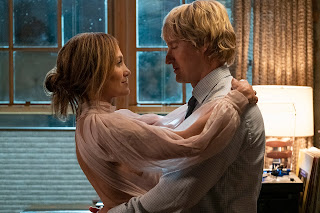
   At one point in Jennifer Lopez’s rom-com, Marry Me, Lopez’s character — a singing sensation named Kat Valdez — tells her audience that love is nothing more than a fairy tale. 
   Poor Kat. She’s flustered because Bastian (Columbian singer Maluma) her equally famous fiancee has been unfaithful to her, news Kat learns moments before the two are scheduled to be married in a grand ceremony during a concert at Madison Square Garden.
  So, yes, weep for Kat. What she thought would be the best of her several previous marriages has gone up in flames.
  There isn't much irony in saying that Marry Me — the title is taken from a hit song that Bastian and Kat have recorded together — qualifies as its own lavish fairy tale complete with musical numbers, product placements (Coach and Guess, among them), and an unashamed commitment to formula.
   Shaken emotionally, Kat decides — during the concert — to marry a stranger, a divorced Brooklyn-based math teacher (Owen Wilson) who’s attending the concert with his teenage daughter (Chloe Coleman) and his school’s gay guidance counselor (Sarah Silverman), the woman who procured the tickets and provides what there is of the movie's comic relief.
    Wilson’s baffled Charlie heads to the stage and the two marry. It’s not supposed to last. It's Kat's impulsive attempt to demonstrate how hollow marriage really is, not to mention a slam at the self-impressed Bastian.
   So that’s the formula: Two unlikely characters are united in a sham marriage. They gradually get to know each other and, here's a shock, they fall in love. 
  A last-minute change of heart by Charlie serves as the third-act obstacle that must be overcome before the couple is reunited —at a math competition in the midwest no less.
   Wilson does his best to create a human-scaled character but the movie makes no bones about being a star vehicle for Lopez — bold, glossy, and operating in a sphere beyond ridiculous, a place where a major star visits a junior high school classroom and charms the students in Charlie’s math club.
   See, Kat really is a down-to-earth human being
   If audiences weren’t willing to accept ridiculous fantasy, a whole lot of movies never would have been made.
    That means there’s an audience for Marry Me and, say this, Lopez doesn’t shortchange the audience when it comes to musical numbers. One involves female dancers dressed (sort of) as nuns and  male dancers with turned-around collars.
     Such moments may be overproduced but Lopez knows how to sell a song even as she splashes her way through what may turn out to be the silliest, most shallow rom-com of the year. 
    

Floating along with 'Death on the Nile'


   No, Kenneth Branagh, you didn't murder Death on the Nile, but you didn't bring it to scintillating life, either Yes, you have improved over your last venture into Agatha Christie territory, the lamentable 2017 adaptation of Murder on the Orient Express. But 
in neither case have you attained the sizzle to which I assume your aspired.
    Enough with the second-rate Poirot imitation.
    I had hoped that Death on the Nile would provide the tonic that the big-screen needs at this doom-struck moment. Hardly awful but lacking in distinguishing spark, Death on the Nile turns out to be a middle-grade effort.
   As was the case with Murder on the Orient Express, Branagh plays Hercule Poirot, the Belgian detective who has been solving crimes since Christie first introduced him in 1920.
   Branagh's performance — headlined by a freight train of a Belgian accent — functions somewhat in the same way as paint splattered on a carefully composed canvas. Branagh makes sure that we know Poirot is an oddball, a sharp-eyed detective with a taste for fancy pastries.
  None of this is to say that Death on the Nile lacks highlights, among them: Haris Zambarloukos's cinematography, Jim Clay's production design, and the costume design by Paco Delgado and Jobanjit Singh.
    But such accouterments have a downside, as well. I'm not sure that Emma Mackey, as the passionate, insanely jealous Jacqueline de Bellefort, isn't upstaged by her dress (think neo-Cleopatra) at a key point in the movie.
   Other highlights include Sophie Okonedo as an American jazz singer armed with a quick wit.  She's accompanied by her niece (Letitia Wright), a young woman who manages the singer’s business affairs. 
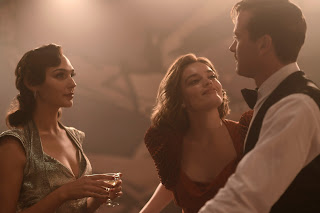
    Christie stories typically confine a large number characters in a single location, in this case, a yacht that embarks from Karnak for the honeymoon celebration of Linnet Ridgeway (Gal Gadot), a wealthy beauty who has married Simon Doyle (Armie Hammer).
    Before the story arrives in Egypt, we get London-based cabaret scenes in which Doyle seems to be totally consumed with passion for Mackey's Jacqueline de Bellefort. Passion or not, Doyle doesn't hesitate to drop de Bellefort for Ridgeway, thus setting off the jealousy that drives the plot. 
    De Bellefort hates being aced out by her best friend but she's far from the movie's only suspect.
    The passenger manifest includes the British comedy team of Dawn French and Jenifer Saunders. Annette Bening plays mother to Bouc (Tom Bateman), Poirot's pal and a generally carefree fellow. 
    I could go on, but only at risk of turning this review into a roster.
    Rather, I'll say that screenwriter Michael Green begins with a World War I flashback in which we learn Poirot's backstory, which includes lost love and an explanation of why he wears a mustache that qualifies as a special effect.
     For a finale, all the movie's suspects gather in a single location so that Poirot can pick them apart, preying on their weaknesses, until he finally reveals whodunit. 
    No harm will come to those who see Death on the Nile and some may enjoy its throwback pleasures. But I was looking to be buoyed by watching these folks, many without virtue, bob wickedly on the Nile. 
    Instead, I found myself merely floating along.


Wednesday, February 9, 2022

Another day, another Neeson movie


It's difficult not to wonder whether even Liam Neeson isn't getting bored with the characters he plays. Neeson's latest tough-guy variation arrives in Blacklight, a story about an undercover agent named Travis Block. Block gets caught up in an FBI plot run by Bureau head Gabriel Robinson (Aidan Quinn). Years in the FBI have caused Travis to neglect his now-grown daughter (Claire van Der Boom). He'd like to make amends by spending more time with his granddaughter (Gabrielle Sengos). The story begins when Block is ordered to corral an agent (Taylor John Smith) who has gone off the tracks. Block soon learns there's more to the story than he initially suspected. Eventually, he teams with a young journalist (Emmy Raver-Lampman) who's trying to expose a power-grabbing scheme within the FBI. Director Mark Williams, who directed Neeson in Honest Thief, includes the requisite elements (chases, etc.) but attempts at complication fall flat. Instead of an expose about unbridled ambition we get another movie that feels as if it has rolled off the Neeson assembly line. Neeson finds suggestions of vulnerability and idiosyncrasy in his character (Travis suffers from OCD) but Blacklight remains negligible.

She's tough and she means business


 It's appropriate to call Catch the Fair One a revenge movie.  But it's also necessary to mention that this is a revenge movie with a difference. In Catch the Fair One, real-life boxer Kali Reis plays a former champion who enters the world of sex trafficking to find a sister who has been abducted into the sex trade. Directed by Josef Kubota Wladyka, the movie focuses on a character named Kaylee, who acquired the nickname KO during her days in the ring. A woman of mixed background (Cape Verdean and Native American), Reis carries the film with a brutal determination that's impressive. When Kaylee duct tapes a sex-trafficking bigwig to a chair and tells him to talk, her ferocity is as convincing as a gut punch. The glare in her eyes says, "Don't mess with me," and it doesn't feel like a pose. Reis seems to be pulling her resolve from deep inside. Guilt-ridden about her missing sister, Kaylee sleeps with a razor blade in her mouth in what appears to be home for young women. Wladyka moves the story through scenes that aren't easy to watch, notably when Kaylee enters the sex-for-hire world to locate her sister. Kaylee eventually waterboards a sex-ring boss, slamming a knife into his thigh. Wladyka moves us through a variety of sleazy settings and serves up a chilly line when the big sex-ring boss tells Kaylee that she's naive if she thinks he remembers the names of girls for whom no one is looking.  Only Kaylee gives a damn.  Reis has been advocate for the Missing and Murdered Indigenous Women and Girls movement, which leads me to believe that Catch the Fair One springs from real  commitment. A commendable social agenda aside, brutality is still brutality and high purpose can't always redeem a movie that, like many in its genre, can  feel excessive. I won't reveal the ending, but I think it's meant to deny any easy redemption. If it's supposed to leave us distressed, it works.

Tuesday, February 8, 2022

It's Oscar time: How much do we care?

    When the Academy Awards program is broadcast on March 27th, I’ll be watching — more out of a sense of duty than one of eager anticipation. It’s not that this year’s Academy’s nominations, taken as a whole, are an embarrassment. Nor am I troubled that some of my favorites weren’t acknowledged. 
  Note the omission of Tessa Thompson from the best actress category and Ruth Negga in the supporting actress category for their work in Passing, a movie that should have gotten a best-picture nod. It didn't.
  Nope, none of that.
  Diversity, inclusion, and expansion of the Academy’s voting base aside, the Oscars still constitute an industry evaluation of its own work. 
   I say “an industry” and immediately wonder if the term still means anything. Streaming, the diminishment of adventurous art-house programming, and the increasing absorption of film festivals into various marketing niches have fragmented the movies, pushing them ever closer to cultural marginalization.
    It probably needs to be said, although it shouldn’t. I’m not insisting that there are no good movies. 
    There are plenty of them and, from the look of things, we can expect no shortage in the future — although I’m sure we’ll continue to bicker about what those “superior” efforts are.
     I recently read a provocative review in Harpers magazine of a new book about Nicolas Cage (Age of Cage: Four Decades of Hollywood Through One Singular Career by Keith Phipps) and wondered whether the prolific and sometimes risible Cage, might not be a revolutionary when it comes to acting.
     Cage can scream, brood, shriek, glower, and quake in ways that may say more about our moment than any of this year’s nominees.  And Cage isn’t afraid either of despair or violence, which he knows how to link.
    If Cage is being underestimated, future historians might find more reason to study his work than, say, the work of some of this year’s Oscar nominees.
    Cage's performance in Pig, a story about a hermitic truffle hunter devoted to his pig companion, was Oscar-worthy, but the movie may have been too weird for Hollywood consideration.
    To quote Dan Piepenbring who wrote the review in the February issue of Harpers.
    "There's something stalwart, commendable, even comforting about Cage's presence, something that reaches past entertainment toward tangled questions of talent and excess."
     Cage, as Piebenbring writes, expresses himself with "violent purity."
     Something to consider. 
     Oscar always raises questions, the low-hanging fruit of all Oscar commentary:
     Should Ben Affleck have been nominated in the best-supporting actor category for his work in The Tender Bar? Probably. His acting has gotten better and better.
    Should Peter Dinklage have received consideration for playing the lead in Cyrano? He didn't. 
    Me? I got more enjoyment out of Lady Gaga’s unabashed performance as an aspiring, conniving Gucci in House of Gucci than I did  from Nicole Kidman’s Oscar-nominated portrayal of Lucille Ball in Being the Ricardos. No nomination for Gaga. 
    I'll join you if you're cheered by a best picture nomination for CODA, a story about the pressures on the only hearing person in a fishing family in Gloucester, Mass. 
   Ditto for the supporting actor nomination of CODA's Troy Kotsur, the deaf actor who plays the family father.
    You can make your own list of likes and dislikes but aside from the usual snubs (a best picture nomination for Dune and none for its director, Denis Villeneuve), the list earns a passing grade. 
    My wariness? It’s just that its announcement will lose much of its luster before the current 24-news cycle begins to sputter.
    "Tomorrow, tomorrow, and tomorrow creeps in this petty pace from day to day," to quote from The Tragedy of Macbeth, which deserved but didn't get a best-picture nod. Talk of Oscar nominations will ebb and flow; the industry-oriented press has little choice but to analyze, re-analyze, and predict. 
      So, yes, I’ll be watching the Oscars and maybe I’ll even offer  predictions as part of the annual parade of articles that the Academy Awards encourage.
   But if Jane Campion’s Power of the Dog were to lose best picture to Kenneth Branagh’s Belfast, you won’t find me gnashing my teeth or rending my garments. I’ll say that even if something as dubious as the dud of satire, Don’t Look Up, were to win. Yes, it got a best-picture nod.
       Why do I say this? Because the only way to maintain sanity as a movie enthusiast is to remember what movies always have offered us, a sanctuary for private indulgence. Yes, under the best of conditions we watch them together, but movies remain our personal property — to be written into our book of memories or discarded along with yesterday’s newspaper. Remember those?
       If you haven’t already found one, here’s a link to this year’s full list of Oscar nominees.

Thursday, February 3, 2022

A silly mission to a falling moon


    It's not easy to know where to begin writing about a movie such as Moonfall.  Director Roland Emmerich's latest helping of sci-fi offers a ragged patchwork of elements, none  particularly interesting. 
   To put it bluntly, Moonfall - which stars Halle Berry and Patrick Wilson -- qualifies as a poorly written, badly constructed attempt by Emmerich once again to put the Earth and all its inhabitants in grave danger.
   In the age of CGI and convincing portrayals of space travel, one of the worst things you can say about a sci-fi movie is that it's too silly to be taken seriously. In Moonfall, Emmerich breaks new ground in absurdity.
   The story hinges on a mammoth conceit: One day, the moon  mysteriously alters its orbit, triggering a series of earthquakes and tidal waves. Wholesale devastation begins as the moon enters a collision course with Earth.
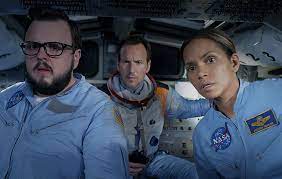
   There's little more you need to know, except that Berry and Wilson play former astronauts who wind up trying to save the world. They're helped by a brainy oddball (John Bradley) who predicted the impending catastrophe but was considered too much of a crackpot to be taken seriously.
  A couple of subplots are tossed into the mix, slowing the roll of the Earth-saving mission while introducing half-hearted themes about the nobility of sacrifice.  Carolina Bartczak, Michael Pena, and Charlie Plummer appear in supporting roles in these earthbound segments.   
   Once a hero, Wilson's Brian Harper is a ruin of a man. Harper was blamed for the death of a fellow astronaut during a space mission. No one believed his explanation, which was tied to the movie's conspiratorial revelations.
  Berry's Jo Fowler was also a part of that ill-fated mission, seen in a prologue set a decade before the main plot kicks in. 
   Once disaster strikes, the secondary characters flee the West Coast for Colorado. I guess the mountains are supposed to save them from destruction.
   Wilson should be excused if he sometimes looks confused. Who wouldn't be with a story such as this? Berry does her best to bring conviction to every line she utters. I guess someone had to act as if any of this matters.
   Why is the moon suddenly circling closer to Earth? 
    Turns out the moon is a hollow mega-structure that may have been created by aliens. Fowler, Harper, and Bradley's KC Houseman  eventually find themselves steering their spaceship through a hole leading to the moon's innards.
    Amidst an exposition-heavy ending, the screenplay spits out themes involving artificial intelligence. 
    Did I mention that a lethal dark force zips through the movie in what resembles a cloud composed of lead filings. Its purpose: the destruction of biological life.
   If you're a Berry fan, you may be disappointed that her character seems to fade from view as the movie reaches its conclusion, a loony attempt at something you might think of as techno-mysticism set deep inside the moon's gyroscopic interior.
    Emmerich's movies (Independence Day, Godzilla, and White House Down) rely heavily on mass destruction. No surprise, then, that Moonfall offers more of the same.
   Moonfall can feel like a dated helping of sci-fi, a cinematic visitor from a time when such movies didn't worry about making sense. In some hands, that might have been entertaining, but Emmerich's Moonfall proves more folly than fun.
   It's not only the moon that's hollow; it's the whole damn movie.


A wealthy man loses interest in life

     In Sundown, Mexican director Michel Franco (Chronic and New Order) casts Tim Roth as a wealthy man adrift in Acapulco. Franco doesn't so much tell a story as create a mood dominated by the withdrawal of Roth's character from nearly all forms of engagement.
    The movie opens with Roth's Neil vacationing with a woman (Charlotte Gainsbourg) we take to be his wife. They're accompanied by two grown children (Albertine Kotting McMillan and Samuel Bottomley). Their kids?
    The feeling is one of languor.  Everyone eats and drinks. Neil floats in the pool at a posh hotel. Movement seems difficult, unnecessary — even superfluous. 
    Initially, we think that Roth and Gainsbourg are playing husband and wife, an impression Franco slowly overturns. Gainsbourg's Alice, we eventually learn, is Neil's sister. McMillan and Bottomley are playing his niece and nephew.
     The ease of a Mexican respite is shattered when Gainsbourg's Alice receives a phone call. Her mother has been rushed to the hospital. Alice orders everyone into emergency mode. They must pack for a quick return to London. 
      At the airport, Neil says that he's left his passport at the hotel and must return to retrieve it. He'll catch another flight. We suspect that he's lying. We're not wrong.
      Neil ignores what turns out to be a death in the family. He remains in Acapulco, checking into a downscale hotel, drinking copious amounts of beer, and beginning a sexual relationship with Berenice (Iazua Larios), a local woman who becomes involved with him. 
     But Franco has more in mind than sexual adventure. Violence occasionally erupts, notably when a man is shot on the beach a few feet from where Neil has parked his listless body. Another violent eruption will spring up later, this one involving someone closer to Neil.
      Fearing that her brother has gone off the deep end, Alice returns to Mexico, chastising him for failing to attend his mother's funeral and begging him to return to London. Both of them are heirs to a meat-slaughtering business that demands attention.
      To underscore the seriousness of the situation, Alice's visit is preceded by entreaties from the family's attorney (Henry Goodman). Neil shrugs it off. He doesn’t want the family money. He couldn’t care less about the business.
      It's not easy to make a movie about a man who has deadened himself to life, so much so that he doesn't seem fazed when he finds himself at the center of a lurid British tabloid story or slumped in a corner in a Mexican jail.
     Obviously, Neil harbors a secret that Franco withholds until the movie's end. 
      Roth's convincingly dispassionate portrayal doesn't encourage much by way of empathy. Franco purposefully keeps us outside of Neil’s experience. We're watching a man who has given up on just about everything.
      Yet, the movie has an insinuating lilt. Mexico’s mixture of heat, surf, violence, subsistence, street encounters, and the mismatched wealth of European vacationers leaves us wondering (in a good way) what Franco is trying to say about the value of Neil's life.
      Neil ventures away from the private beaches of privilege but he’s not looking for renewal. It's an odd achievement, but Roth has created a character who's willfully useless, a decaying relic of man from a world that Franco may view as doomed.
     Or maybe Neil's just a guy who has waited all his life for a reason not to pretend that he gives a damn.


Bob's Cinema Diary: 2/4/22 -- 'Who We Are' and 'Conductor'


Who We Are
Jeffrey Robinson once served as legal director of the American Civil Liberties Union. In the documentary Who We Are: A Chronicle of Racism in America, Robinson serves as a guide through a subject made clear by the movie's subtitle. Directors Emily and Sara Kunstler build their documentary around a 2018 lecture Robinson delivered in a theater in Manhattan's Town Hall. The talk stemmed from Robinson's personal life when, unexpected circumstances, found him explaining race to his 13-year-old nephew. Robinson reveals anger, compassion, and a knowledge of the past as he talks about pivotal points in American history. Watch his face when he visits the Old Slave Mart Museum in Charleston, S.C. You'll see a  mixture of amazement, disgust, rage, and pain evoked by a pair of shackles designed for a child. He talks about the assassination of Martin Luther King Jr. and about his own upbringing in Memphis. He meets a 107-year-old survivor of the 1921 Tulsa Massacre, a sorry chapter of American history that only recently has begun to receive media attention. Robinson also makes it clear that the North wasn't immune from the enslavement process as he calls attention to what might be called our paradoxical burden: America has accomplished great things but is also steeped in racism. You might think of Robinson's talk as that of a lawyer making a case -- and he's good at it. Not just because he’s a compelling talker, which he is, but because he’s gathered abundant evidence. The point: We must look at the ugliest piece of American history and acknowledge that we're responsible for facing it -- even if we didn't create it. 

The Conductor

Marin Alsop made her mark as a woman in the male-dominated world of classical music. Not only is Alsop a musician but she also became a conductor at a time when she received little encouragement. Her ambition derived from seeing a children's concert conducted by Leonard Bernstein, a great proselytizer for classical music. Alsop later met  Bernstein who encouraged her pursuits. She once formed an all-women swing bad and spent time in Denver pursing her dream. She now works to help young aspirants find their way into a highly competitive field and remains music director laureate of the Baltimore Symphony Orchestra, where she served as principal conductor. She also conducted in São Paulo, Brazil, among other places. You'll learn about Alsop's youth and her non-conducting life but what makes The Conductor memorable is director Bernadette Wegenstein's understanding that Alsop's talent is supplemented by a ferocious determination. Alsop's magnetic personality might be the movie's best asset. You also get to hear a bit of good music in the bargain.