
Thursday, January 18, 2018
A bland helping of down-home romance


The road to catastrophe in Russia

Thursday, January 11, 2018
Critics' Choice Awards winners

The Shape of Water dominated the 23rd annual Critics' Choice Awards, taking home honors in four categories. The Critics' Choice Awards represent voting by The Broadcast Film Critics Association, of which I'm a member. Are the Critics' Choice Awards a bellwether for Oscar? They have been. This year? Who knows. The Golden Globe for best picture went to Three Billboards Outside Ebbing, Missouri. Maybe Oscar will surprise us and chart a course of its own. Lady Bird anyone?
So here's the list of those who received awards at Thursday night's ceremony.
Note: Unlike the Oscars, the Critics' Choice Awards include genre categories such as best comedy and best sci-fi/horror, a method that allows for a broader representation of the year's movies than a typical Oscar list.
BEST PICTURE – The Shape of Water
BEST ACTOR – Gary Oldman, Darkest Hour
BEST ACTRESS – Frances McDormand, Three Billboards Outside Ebbing, Missouri
BEST SUPPORTING ACTOR – Sam Rockwell, Three Billboards Outside Ebbing, Missouri
BEST SUPPORTING ACTRESS – Allison Janney, I, Tonya
BEST YOUNG ACTOR/ACTRESS – Brooklynn Prince, The Florida Project
BEST ACTING ENSEMBLE – Three Billboards Outside Ebbing, Missouri
BEST DIRECTOR – Guillermo del Toro, The Shape of Water
BEST ORIGINAL SCREENPLAY – Jordan Peele, Get Out
BEST ADAPTED SCREENPLAY – James Ivory, Call Me By Your Name
BEST CINEMATOGRAPHY – Roger Deakins, Blade Runner 2049
BEST PRODUCTION DESIGN – Paul Denham Austerberry, Shane Vieau, Jeff Melvin, The Shape of Water
BEST EDITING (TIE) – Paul Machliss, Jonathan Amos, Baby Driver and Lee Smith, Dunkirk
BEST COSTUME DESIGN – Mark Bridges, Phantom Thread
BEST HAIR AND MAKEUP – Darkest Hour
BEST VISUAL EFFECTS – War for the Planet of the Apes
BEST ANIMATED FEATURE – Coco
BEST ACTION MOVIE – Wonder Woman
BEST COMEDY – The Big Sick
BEST ACTOR IN A COMEDY – James Franco, The Disaster Artist
BEST ACTRESS IN A COMEDY – Margot Robbie, I, Tonya
BEST SCI-FI OR HORROR MOVIE – Get Out
BEST FOREIGN LANGUAGE FILM – In The Fade
BEST SONG – Remember Me from Coco
BEST SCORE – Alexandre Desplat, The Shape of Water
He wants to control ... well ... everything
Daniel Day-Lewis and Vicky Krieps play a challenging duet in director Paul Thomas Anderson's Phantom Thread, a movie about a tyrannical fashion designer. In what he says is his last screen performance, Daniel Day-Lewis reunites with director Paul Thomas Anderson (Let There Be Blood) to play a fastidious clothing designer who plies his trade in London of the 1950s. Day-Lewis’ Reynolds Woodcock (I leave it to you to deconstruct the surname) dresses women in ways that tend to stamp them with an identity: his. He designs, measures and sews until every woman who wears one of his gowns becomes a perfect representation of one of his sought-after visions.

It’s impossible (and perhaps inadvisable) to watch Day-Lewis in Phantom Thread without considering Woodcock as the embodiment of a certain kind of meticulous artist. His creations can have flourish and sweep, but they are also marked by an attention to detail that goes beyond obsessive to touch the border of tyrannical.
For Woodcock, the dress eclipses the importance of the woman who wears it. He considers himself a visionary, but he works in the world of fashion where whim and shifting tastes can undo a reputation.
A bachelor when we meet him, Woodcock allows his sister (Lesley Manville) to keep his business on track. She’s a guardian and facilitator, the woman who takes care of all the details that Woodcock prefers to ignore. She knows that Woodcock requires space to create. A finely tuned instrument, he can be thrown off by the sound of toast that’s too noisily buttered or a vegetable that's not cooked to his exacting specifications.
Looking gaunt and composed with gray hair swept back to emphasize a steep brow, Day-Lewis takes the full measure of this unusual man, an artist for whom the external world poses constant threats to his powers of concentration.
In Phantom Thread, Anderson creates an intricately designed illusion: A small movie, Phantom Thread suggests big themes, even as it offers helpings of mischievous humor.
Initially, Anderson devotes the movie to establishing Woodcock’s world, a domain over which he exerts absolute control — until the arrival of Alma (Vicky Krieps), a waitress in a country restaurant where Woodcock happens to dine. Woodcock invites Alma to become one of his models.
Alma replaces Johanna (Camilla Rutherford), a model who became a little too demanding for Woodcock’s taste.
When Woodcock brings Alma to his home, he tells her that her imperfections — she cites her small breasts — are not problems, at all. She's the landscape on which the great Woodcock will create his next masterpiece.
Not surprisingly, Alma soon begins to test Woodcock’s patience. She may not be quite as manageable as Woodcock initially hoped. Krieps gives Alma an assertive edge, and it becomes clear that this relationship will take over the movie: Woodcock and Alma are locked in a kind of dance in which he tries to exert his control and she resists.
By this time, Alma is living in Woodcock’s home, working full-time as his model and muse. But she refuses to disappear when he’d prefer not to see her.
Now, as is the case with most movies, it falls to Anderson to make something out of all that he has set in motion — with restraint, wit, and the precision of an elegant camera. Even in a character study, the characters eventually must do something. Anderson must take the finely spun cloth of the movie and weave it into something whole and finished.
How you respond to Phantom Thread may depend on what you make of the twist that Anderson brings to the movie.
I’m prepared to listen to those who disagree, but, for me, as Phantom Thread began adding a twist to the atmosphere Anderson creates, the movie's spell was broken for me. Little more can be said without introducing spoilers, so I’ll simply say that Anderson eventually defines what either can be viewed as a perfect match or a relationship of intricately blended perversities.
The performances are all first rate. By now, we all have come to appreciate Day-Lewis’ ability to inhabit characters in ways that are thorough and commanding without being showy. Watch Day-Lewis create Woodcock's smile, easy yet tentative, almost as if the designer's face is engaged in a game only he understands. Like everyone else who values his work, I hope that Day-Lewis reconsiders his proposed retirement.
Krieps gives the movie’s most surprising -- and in a way -- most dominant performance. Alma's disregard for the high pretenses of art border on a form of bullying. She brings an insistent presence to Woodcock's carefully managed home.
Phantom Thread stands as an absorbing work that proves mildly unfulfilling, a beautifully designed garment that ultimately hangs in a rather small closet. Put another way, what builds novel-like expectations at the outset winds up feeling like a short story by the end.
But that doesn't mean I wouldn't encourage you to see it -- for Day-Lewis, for Krieps and Manville, and for Anderson's insistence on making movies suited only to his own singular taste.
The woes of a beleaguered commuter

Wednesday, January 10, 2018
A great moment for journalism
The Post tells an important story and features a finely etched performance from Meryl Streep.
 I can't imagine anyone who ever has worked at a newspaper not giving a big thumbs up to The Post, director Steven Spielberg's stirring take on a story about the Washington Post's struggle to become a major player in the news game while, at the same time, performing an important national service. The Post, the movie reminds us, grabbed its share of history when it published the Pentagon Papers in 1971.

"Wait," you say. Wasn't The New York Times the first newspaper to publish the Pentagon Papers?>
Yes, The Times was first, but The Post picked up the task after the Times was blocked by a court order from publishing any more of the 7,000-page secret document that proved that the government consistently lied about its "accomplishments" in Vietnam.
It probably takes a director such as Spielberg to take a straightforward approach to a complicated story that involves maneuvering by Post reporters and executives on any number of levels -- from the corporate to the logistical.
When the Post picked up the Pentagon Papers, it wasn't clear that the paper wasn't risking its own future. The company was about to go public so that it could obtain a much-needed infusion of capital. Some of the Post's attorneys argued that defying the government might scare off potential shareholders.
Spielberg's drama begins when Daniel Ellsberg (Matthew Rhys) copies the Pentagon Papers with the idea of making them widely known. Ellsberg turned from a military analyst to a whistleblower after he heard Secretary of Defense Robert McNamara (Bruce Greenwood) lie to the press about how the US was faring in Vietnam.
Spielberg, who understands how to personalize a story, focuses on two characters: Washington Post editor Ben Bradlee (Tom Hanks) and Washington Post publisher Katharine Graham (Meryl Streep).
Graham became the Post's publisher after her husband Phil committed suicide in 1963. She had great respect for the paper but hadn't fully grown into the role of publisher when the Pentagon Papers became available.
Hanks adds some growl to a variable Boston accent as Bradlee, but can't top Jason Robards' version of the much-admired newspaperman in All the President's Men. Still, he captures Bradlee's impatience with fools and his burning desire to kick the Post's reputation up a notch.
Streep gives the movie's best and most complicated performance. Graham was a close friend of McNamara, who implored her not to publish the Pentagon Papers. She traveled in the strata of Washington society geared toward steadying the ship, not rocking the boat. She values her friendships but ultimately understands that her duty is to the truth.
The Post certainly speaks to the current moment; the movie can be read as a reply to those who would tarnish journalism with "fake news" pejoratives. Spielberg throws a counterpunch that the country needs at the moment, a reminder that the press is an indispensable part of democracy.
Now, I should hasten to say that The Post can't equal All the President's Men, which had a sense of fervor that Spielberg's picture can't quite match, perhaps because its approach is so on-the-nose that the movie sometimes feels like an illustrated history augmented by currents of feminism (there weren't many women newspaper executives at the time) and journalistic jousting.
A large and credible supporting cast helps carry the story across the finish line. The movie features a particularly nice turn from Bob Odenkirk of Better Call Saul fame. Odenkirk plays Ben Bagdikian, the Post reporter who persuaded Ellsberg to give the Post copies of the Pentagon Papers: Bagdikian carried the papers to Washington in cardboard boxes on a commercial flight. He bought a seat for the boxes so they'd never be out of his sight.
Spielberg emphasizes the role journalism plays when everything that can be deemed "fake'' is coming not from newsmen but from those whom reporters doggedly cover.
Put another way: Chalk one up for every beleaguered journalist who has been reviled as a member of the media instead of appreciated for working hard to get as close to the truth as possible.
Thursday, January 4, 2018
Tanya Harding's absurdly tilted life
Margot Robbie does stand-out work as a figure skater battling long odds, class prejudice, and her own demons.


Most movies about athletes build toward a big contest in which the main character either triumphs or, in rare cases, learns from a crushing defeat. By such measures, I, Tonya -- the story of disgraced figure skater Tonya Harding -- might be considered an anti-sports movie. It touches on subjects as diverse as class prejudice and the abuse of women, not to mention a criminal assault committed by a collection of bumbling fools.
I, Tonya also can be unexpectedly funny because director Craig Gillespie has given the movie a near-antic spirit that derives from a keen appreciation of the rank absurdity rippling through various layers of American society.
I, Tonya, of course, revolves around the 1994 episode in which Harding was blamed for a devastating attack on Nancy Kerrigan, the figure skater who became the anti-Harding. In the movie, responsibility for a ham-handed attempt at knee-capping falls to a goofball associate (Paul Walter Hauser) of Harding's abusive husband (Sebastian Stan).
According to the movie, Hauser's Shawn concocted a scheme in which a couple of hired thugs did Shawn's bidding. One of them took a retractable baton to Harding's knee in an attempt to keep her from participating in a National Competition prior to the Lillehammer Olympics of 1994.
Harding herself knew nothing about any of this, although she was vaguely aware that Stan's Gillooly was planning to send Kerrigan threatening letters to undermine her confidence, an idea he got after Harding herself received a death threat.
Working from a screenplay by Steven Rogers, Gillespie allows several of the characters to offer versions of Harding's story in faux interviews that help to give the movie some wobbly, cockeyed spin.
But I, Tonya isn't a lower-class Rashomon and it has less interest in anyone's guilt or innocence than in Harding's place as an outlier in the world of figure skating.
Harding had obvious skills, but she had to battle (often unsuccessfully) the notion that female figure skaters should be ice princesses, uncorrupted representations of purity and innocence. It's all hooey, of course: No one becomes a champion figure skater without the kind of single-minded self-absorption and drive that justifies long hours of training and sacrifice.
Harding's sometimes garish outfits and her working-class background overshadowed her skill with judges who were looking to promote not only talent but a "worthy" vision of American "girlhood."
Robbie’s performance captures both Harding’s defiance and vulnerability, as well as her belief in her own innocence. She sees herself as a woman constantly being abused by others and who has no interest in smoothing her rough edges.
It's not difficult to see some justification in Harding's viewpoint. Her husband physically abuses her. Stan's Jeff Gillooly displays a bit of rough charm, but Harding sticks with him long past the time when their love has passed any reasonable expiration date.
The biggest obstacle to Harding’s shaky confidence is her caustic, domineering mother, rendered in furious blasts of cigarette smoke by a terrific Allison Janney.
Janney’s LaVona, a waitress by trade, pushes and goads Harding, seldom missing a chance to belittle her daughter. Janney knows how to put comic spin into her work, peppering her dialogue with blistering sarcasm, some of it bitingly funny.
Robbie did some of the movie's skating, but stunt doubles presumably filled in when it became necessary to show Harding's triple axel, a difficult maneuver that she became the first American woman ever to execute.
Julianne Nicholson plays Tonya's coach, a woman who tries to help Tonya fit into an acceptable mold, and Bobby Cannavale does duty as a TV tabloid reporter, present only to suggest that Harding's story became fodder for a media that couldn't get enough of it.
The real Harding is tougher looking and physically more compact than Robbie, who made her first big splash in Wolf of Wall Street. But Robbie nails the pugnacious spirit of a young woman who has been kicked around plenty — by the authorities in her sport, by her mother, her husband and a voracious media that turned her into the butt of many cruel jokes.
I don’t know how to sort out my feelings about the real Harding, but Robbie and Janney are working at peak form, and I'll tell you this, as well: I, Tonya made me think about all the Tonyas in our culture, the ones who’ve never even gotten close to their 15 minutes of fame, who've never had their stories told and who somehow survive life’s battering, their fury undiminished.
Scars of hatred and the American West
Christian Bale portrays an embittered soldier in Hostiles.
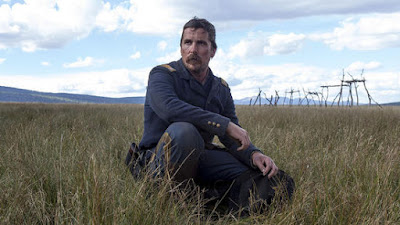 Sometimes, in straining to grapple with deep issues, a film can show more strain than grapple. That struck me as the case with Hostiles, a Western that wants to explore the impact of genocidal behavior -- not so much on its Native American victims -- but on the US soldiers who fought the many battles that led to the near-destruction of the indigenous populations of the West.

From the outset, director Scott Cooper makes his position clear. He begins with a chilling DH Lawrence quote that serves a tone-setter for what's to follow: “The essential American soul is hard, isolate, stoic, and a killer. It has never yet melted," Lawrence wrote.
In the world Hostiles imagines, whites hate Native Americans and Native Americans return the favor, each group seeing the other as murderous savages. Of course, if victory has anything to do with savagery, the whites are the greater offenders.
Christian Bale plays Captain Joseph Blocker. A grizzled veteran of the so-called Indian wars, Blocker hates the Native Americans who have taken the scalps of many of his comrades in arms. Perhaps in an attempt to balance the scales, a visiting Eastern writer accuses Blocker of having taken more scalps than Sitting Bull.
But -- or so the argument goes -- for Blocker, killing is the job that he's sworn to do.
Blocker faces a challenge when he's ordered to escort a dying Cheyenne chief (Wes Studi) and his family from New Mexico to Montana. On orders from the president Benjamin Harrison, the Army must make it possible for the imprisoned Yellow Hawk to die on land that he calls home.
A staunch believer that Native American savagery knows few bounds, Blocker makes little attempt to conceal his disdain for Studi’s Yellow Hawk, a man who has killed his share of white men. Both men fought at Wounded Knee.
Not long after the journey begins, a woman whose family is massacred by Comanche warriors (Rosamund Pike) in the movie's brutal prologue, joins the group. Pike's Rosalie is stunned and bereft and Blocker treats her with a tenderness that suggests that he may not be quite as hard-hearted as we've been led to believe.
The movie’s major question becomes obvious from the start: Will Blocker come to some sort of appreciation for the fact that Yellow Hawk and his family are human beings, no less wounded and embittered than he? Both men are deeply scarred, but Yellow Hawk seems to have done a better job of carrying his burden.
Ben Foster turns up as a soldier whose wanton disregard for life makes him one of the movie’s only true savages. Blocker shows him no mercy, although Foster's character insists that, as soldiers, they are kindred spirits.
Cooper tries to add some complexity, distinguishing between various tribes. At one point, Yellow Hawk helps the soldiers fight off a group of vicious Comanches that he likens to rattlesnakes, vipers who will destroy whites and Native Americans alike.
I’m not sure Cooper knows how to resolve the gaping contradiction that occurs when racism and humanity begin to clash in the same characters. In addition, those who argue that the movie represents another attempt to use indigenous people to redeem a white character shouldn’t entirely be dismissed.
It’s difficult to shake the feeling that Cooper isn’t so much telling a story as he’s applying contemporary sensitivities to the nagging problem of how whites can resolve the undigested shame that results from the way the US has treated Native Americans. He turns the film into a kind of social laboratory that often strands its actors in self-conscious silences.
The characters in Hostiles are laconic and, to cite Lawrence, hard and isolate, but when it comes to articulating the movie's points, they also seem to speak in ways that hit too many points squarely on the nose. Whatever the case, Hostiles doesn’t quite find its way through the rough thematic course it sets for itself.
She has powers she can't control

There are few new stories, only new ways to tell them. That may be important to remember as you watch Norwegian director Joachim Trier's Thelma, a coming-of-age tale in which Thelma, a first-year college student played by Eili Harboe, learns about the power of sexual desire. Thelma's separation from her parents (Henrik Rafaelsen and Ellen Dorrit Petersen) creates the situation in which her emerging sexuality bumps against the walls of repression established by her religious mother and father. Trier's chilly style fills the screen with images that rattle Thelma and us along with her. Some of these images occur during the seizures Thelma begins to have. Doctors can't pinpoint any cause for Thelma's distress, which seems to be exacerbated by her burgeoning friendship and sexual attraction to another coed (Kaya Wilkins). Eerie and full of disturbing sights, Trier's movie proves engaging enough to squelch criticisms that might arise from a plot that many have compared, with some justification, to that of Carrie. Whatever you make of Thelma, it's difficult to ignore Trier's ability to unsettle an audience. Besides, Harboe ably suggests a woman on the precipice of terrifying discoveries. Together, Trier and Harboe create a state of sustained unease that penetrates nearly every frame of the movie, and Thelma becomes a movie that's not so much about telling a story as about creating a world that matches Thelma's interior life. Thelma grapples with a mysterious force that she hardly comprehends but must learn to accommodate. Is this force a psychological response to religious repression? Is it something real or something imagined? Can Thelma really make things happen in the world external to herself? Trier wisely leaves us looking for answers, giving Thelma a feeling of tantalizing ambiguity.
Subscribe to:
Posts (Atom)